Easy Tricks to Master Reading Comprehension


Introduction
The Reading Comprehension section in competitive exams requires more than just reading ability. It demands quick analysis, understanding of details, and efficient question answering.
By using Mnemonic Strategies, you can enhance your memory , sharpen your comprehension skills, and approach passages with greater confidence. This method helps you to maximize your performance in the section.
RAP: Read, Ask, Put
This mnemonic helps you process and paraphrase passages effectively to grasp the main idea and supporting details.
- Read: Actively read the passage, focusing on the main idea and structure.
- Ask: Ask yourself, "What is the main idea? What are two supporting details?" This helps identify key points.
- Put: Put the main idea and details in your own words to ensure understanding and retention.
How to Use: As you read a passage, apply RAP by reading a paragraph, questioning its purpose and details, and summarising it mentally or on paper. This improves recall and helps answer questions about the passage's theme or specifics.
QAR: Question-Answer Relationship
QAR helps you categorise questions to locate answers efficiently, a critical skill for a time-bound environment.
- Right There: The answer is explicitly stated in the text, often in one sentence.
- Think & Search: The answer requires combining information from different parts of the passage.
- Author & Me: The answer isn't directly in the text but requires combining passage information with your own reasoning.
- On My Own: The answer relies on your prior knowledge, not the text.
How to Use: Before answering a question, identify its QAR type. For "Right There" questions, scan for keywords. For "Think & Search," look for connections across paragraphs. For "Author & Me," infer the author's intent. This approach saves time and improves accuracy.
SQ3R: Survey, Question, Read, Recite, Review
SQ3R is a structured approach to tackle dense passages systematically.
- Survey: Skim the passage to understand its structure, headings, or key terms.
- Question: Form questions about the passage's purpose or main ideas before reading deeply.
- Read: Actively read, underlining or noting key points and supporting details.
- Recite: Summarise key points in your own words after each paragraph.
- Review: Revisit your notes or the passage to confirm understanding before answering questions.
How to Use: Apply SQ3R during practice. Survey the passage for 30 seconds, question its purpose, read actively, recite main points, and review before tackling questions. This method boosts comprehension and retention under time pressure.
TEPIC: Title, Examine, Predict, Identify, Connect
TEPIC is a mnemonic for evaluating and understanding passages, particularly useful for complex texts.
- Title: Analyse the title or first sentence to gauge the passage's topic.
- Examine: Look at the passage's structure, tone, and key terms.
- Predict: Predict the main idea or the author's stance before reading deeply.
- Identify: Identify the main idea and supporting details as you read.
- Connect: Relate the passage to your knowledge or other parts of the text.
How to Use: Use TEPIC to approach unfamiliar passages. For example, predict the main idea based on the title and opening sentence, then confirm it while reading. This helps you stay focused and answer inference-based questions.
CHUNK: Break Down Information
Chunking organises complex passages into manageable parts, improving recall and understanding.
- Break the passage into smaller sections (e.g., paragraphs or ideas).
- Summarise each section in 1-2 sentences.
- Group related ideas to form a mental map of the passage.
How to Use: For a 500-word passage, divide it into 3-4 chunks (e.g., introduction, argument, evidence, conclusion). Summarise each chunk to grasp the flow and answer questions about the structure or specific details.
Loci Method: Visualise the Passage
The Method of Loci associates passage content with a familiar location to aid recall.
- Imagine a familiar place (e.g., your home).
- Assign key ideas from the passage to specific locations (e.g., main idea at the front door, first detail in the hallway).
- Mentally walk through the location to recall ideas during questions.
How to Use: For a passage about economic trends, visualise your house: place "inflation" at the door, "unemployment" in the kitchen, etc. This is especially helpful for recalling details in long passages under exam stress.
Tips for Effective Use
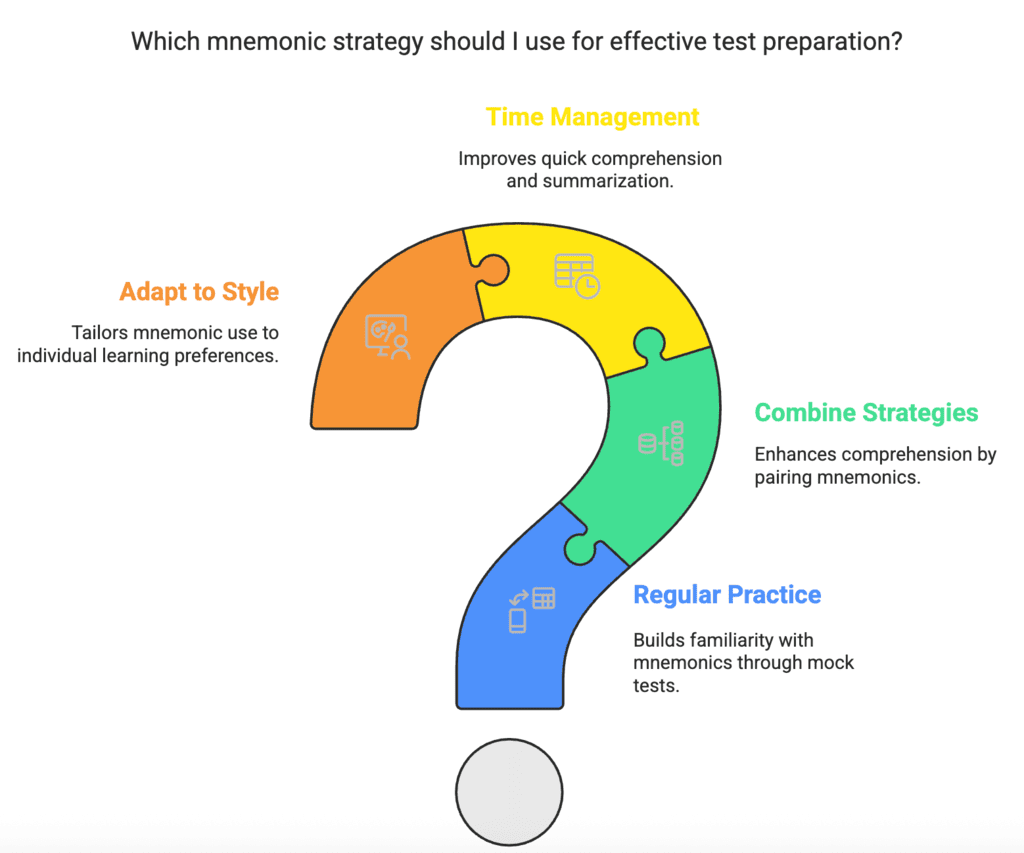
- Practice Regularly: Apply these mnemonics during mock tests to build familiarity. Start with RAP or QAR, as they're simpler, then incorporate SQ3R or TEPIC for complex passages.
- Combine Strategies: Use CHUNK with SQ3R to break down and process passages systematically. Pair Loci with TEPIC for visual learners.
- Time Management: Passages require quick comprehension. Use QAR to prioritise question types and RAP to summarise efficiently.
- Adapt to Your Style: Experiment to find which mnemonic works best for you. Visual learners may prefer Loci, while analytical learners may favour SQ3R.
Example Application
For a Passage on climate change:
- RAP: Read the first paragraph, ask, "What's the main issue? What evidence is provided?" and put it in your own words: "Climate change is accelerating due to human activity."
- QAR: For a question like "What's the author's stance?", use "Author & Me" to infer based on tone and arguments.
- SQ3R: Survey the passage, question the author's purpose, read actively, recite key points (e.g., "Rising CO2 levels"), and review before answering.
- TEPIC: Predict the passage discusses solutions to climate change, identifies key solutions, and connects to real-world knowledge.
- CHUNK: Divide into intro (problem), body (causes), and conclusion (solutions).
- Loci: Assign "CO2 emissions" to your living room, "deforestation" to your bedroom, etc.
By mastering these mnemonics, you can improve your ability to understand, retain, and analyse reading comprehension passages, boosting your VARC score. Practice consistently and adapt these tools to your learning style for the best results.
FAQs on Easy Tricks to Master Reading Comprehension
| 1. How do I identify the main idea quickly in a reading comprehension passage for SSC CGL? |  |
| 2. What's the difference between skimming and scanning when tackling reading comprehension questions? | |
| 3. How can I avoid falling into trap answer choices in reading comprehension for SSC CGL? | |
| 4. What techniques help me understand difficult vocabulary in SSC CGL reading passages without a dictionary? | |
| 5. How do I manage time effectively while solving multiple reading comprehension passages in SSC CGL exams? | |