Mnemonics for Para Jumbles


Introduction
Para Jumbles test your ability to put jumbled sentences in the right order to form a clear and logical paragraph. You can use these mnemonics to make the process easier and help you arrange the sentences more accurately.
These tips will make it simpler for you to figure out the correct order and improve your performance.
Mnemonic 1: FLOSS - Core Strategy for Solving Para Jumbles
- Find the Opening: Look for the sentence that introduces the topic or sets the context. It often contains general statements, definitions, or background information.
- Link Logically: Identify sentence pairs with logical connections (e.g., cause-effect, example, or continuation).
- Order by Words: Use transition words (e.g., therefore, however, thus) or pronouns (e.g., he, it, this) to determine sequence.
- Spot the Conclusion: Find the sentence that wraps up the idea or provides a summary.
- Scan for Structure: Ensure the paragraph flows chronologically, thematically, or logically.
Usage: Apply FLOWS systematically to each Para Jumble question. Start by identifying the opening and closing sentences, then arrange the middle ones using logical links and transition words.
Mnemonic 2: TIPS - Quick Identification of Sentence Types
- Topic Sentence: Introduces the main idea (broad, general, or contextual).
- Illustration: Provides examples, data, or evidence to support the topic.
- Pivot: Shifts the focus or introduces a contrasting idea (look for words like "but," "however").
- Summary: Concludes or restates the main point.
Usage: Label each sentence as T, I, P, or S to understand its role in the paragraph. This helps in sequencing sentences correctly.
Mnemonic 3: CLUE - Spotting Logical Connections
- Cause and Effect: Look for sentences where one explains the reason (cause) and another the outcome (effect).
- Linking Words: Identify connectors like "because," "hence," "meanwhile," or "furthermore."
- Unique References: Track pronouns (e.g., "this," "he") or repeated nouns to link sentences.
- Example-Based: Examples or elaborations often follow the idea they support.
Usage: Use CLUE to find mandatory pairs or sequences. For example, a sentence with "this" likely follows the sentence introducing the referenced noun.
Mnemonic 4: START - Common Patterns in Para Jumbles
- Sequential/Chronological: Sentences follow a timeline (look for time markers like "then," "later").
- Theme-Based: Sentences revolve around a central idea or topic.
- Argumentative: Sentences build an argument, often with a claim, evidence, and conclusion.
- Reasoning: Sentences explain why something happens, often with cause-and-effect links.
- Transition-Driven: Sentences are connected by clear transition words.
Usage: Identify the pattern (e.g., chronological or argumentative) to guide the arrangement process.
Mnemonic 5: CHECK - Final Verification
- Coherence: Ensure the paragraph makes logical sense as a whole.
- Hierarchy: Confirm the flow from general to specific or vice versa.
- Eliminate Errors: Rule out options that break logical or grammatical consistency.
- Connectors: Verify that transition words align correctly.
- Key Idea: Ensure the main idea is clear and all sentences contribute to it.
Usage: After arranging sentences, use CHECK to validate your sequence and avoid mistakes.
Practice Tips
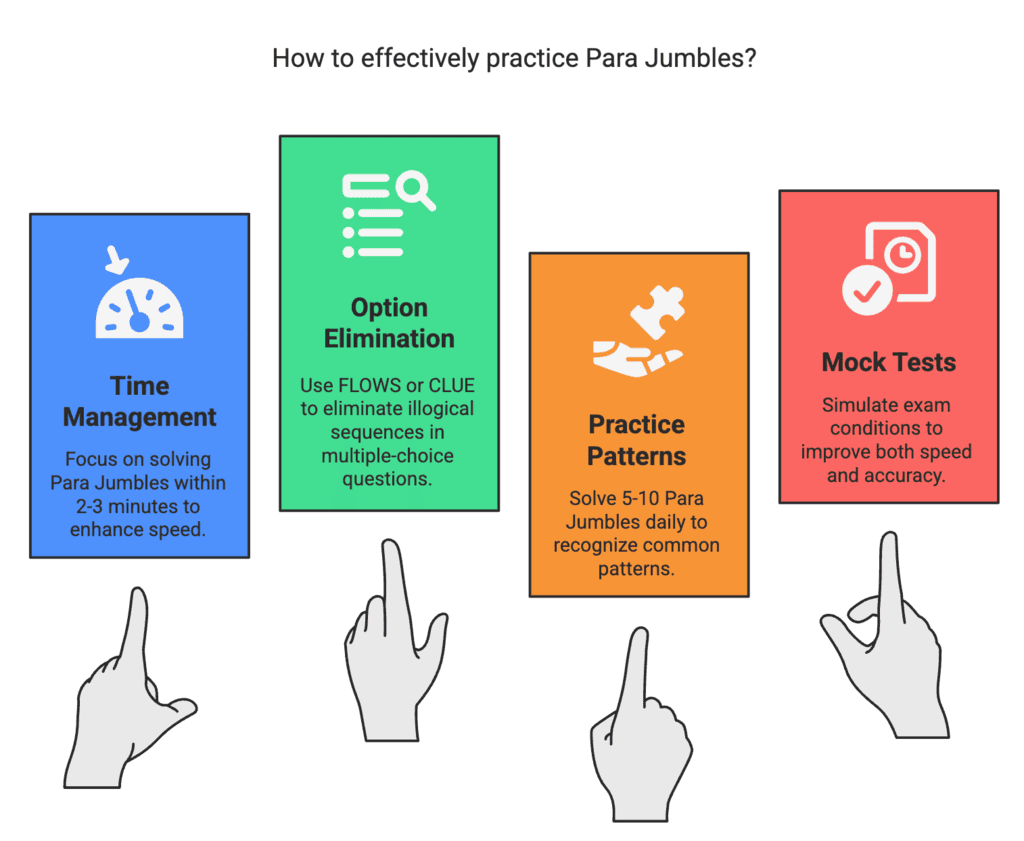
- Time Management: Aim to solve Para Jumbles in 2-3 minutes during practice.
- Option Elimination: In multiple-choice Para Jumbles, eliminate illogical sequences using FLOWS or CLUE.
- Practice Patterns: Familiarise yourself with common patterns (START) by solving 5-10 Para Jumbles daily.
- Mock Tests: Simulate exam conditions to improve speed and accuracy.
Example Application
Sample Para Jumble: A. It was a major breakthrough in technology. B. This led to widespread adoption across industries. C. The invention was initially met with scepticism. D. Over time, its benefits became undeniable.
Using FLOSS:
- Find the Opening: C introduces the invention and context (scepticism).
- Link Logically: A follows C, explaining the breakthrough. B follows A, showing the result. D concludes.
- Order by Words: "This" in B refers to A's breakthrough.
- Spot the Conclusion: D wraps up with the outcome.
- Scan for Structure: The sequence C-A-B-D is chronological and logical.
Final Order: C, A, B, D.
Using CHECK: The paragraph flows coherently (invention → breakthrough → adoption → acceptance), with clear connectors and a consistent theme.
FAQs on Mnemonics for Para Jumbles
| 1. What is the FLOSS mnemonic and how does it help with para jumbles in the CAT exam? |  |
| 2. How can TIPS be used to identify different types of sentences in para jumbles? | |
| 3. What does the CLUE mnemonic signify in the context of para jumbles? | |
| 4. How does the START mnemonic assist in recognizing common patterns in CAT para jumbles? | |
| 5. Why is the CHECK mnemonic important for final verification in para jumble questions? | |