
From 2020 to 2025, CAT LRDI consistently included multi-question logical reasoning sets, typically 4-6 questions per set. The 2025 Slot 1 paper featured three structured LR sets (13 questions total) covering conditional arrangements, weighted averages, and tabular data interpretation. These sets were moderate to difficult, requiring structured case analysis, constraint mapping, and numerical consistency checks across multiple variables.
CAT Exam > CAT Notes > Logical Reasoning (LR) & Data Interpretation (DI) > CAT Previous Year Questions: Binary Logic
CAT Previous Year Questions: Binary Logic
2025
Q1 to Q4:
Alia, Badal, Clive, Dilshan, and Ehsaan played a game in which each asks a unique question to all the others and they respond by tapping their feet, either once or twice or thrice. One tap means "Yes", two taps mean "No", and three taps mean "Maybe".
A total of 40 taps were heard across the five questions. Each question received at least one "Yes", one "No", and one "Maybe."
The following information is known.
- Alia tapped a total of 6 times and received 9 taps to her question. She responded "Yes" to the questions asked by both Clive and Dilshan.
- Dilshan and Ehsaan tapped a total of 11 and 9 times respectively. Dilshan responded "No" to Badal.
- Badal, Dilshan, and Ehsaan received equal number of taps to their respective questions.
- No one responded "Yes" more than twice.
- No one's answer to Alia's question matched the answer that Alia gave to that person's question. This was also true for Ehsaan.
- Clive tapped more times in total than Badal.
Q1: How many taps did Clive receive for his question?
Ans: 7
Sol: We are given that Alia tapped 6 times, Dilshan tapped 11 times, and Ehsan tapped 9 times. We also know that the total number of taps is 40. So, the sum of taps by Badal and Clive can be calculated as,
6 + Badal + Clive + 11 + 9 = 40
Badal + Clive = 14
We are given that taps by Clive are more than taps by Badal.
So, the possible pairs for taps by Clive and Badal such that the sum is 14 are (8, 6), (9, 5), (10, 4)...(14, 0).
We are given that no one gave more than two 'Yes' answers. We know that yes means one tap. So, the maximum number of 1 taps out of the 4 questions answered can be 2. The minimum possible number of taps for any person for the four questions would be 1 + 1 + 2 + 2 = 6. It is not possible for any person to have fewer than 6 taps as the maximum number of yes is 2.
So, out of all the possibilities, the only possible case for Badal is 6, and Clive is 8, as in all the other cases, the number by Badal was less than 6.We are given that Alia answered Yes to Clive and Dilshan's questions. We know that the total number of taps by Alia is 6, and she tapped once for both those questions. The number of taps by Alia to the questions by Badal and Ehsan must be greater than 1, as we know that a person must have a maximum of two single taps. The sum of taps by Alia to Badal and Ehsan can be calculated as,
Badal + 1 + 1 + Ehsan = 6
Badal + Ehsan = 4
We know that both the values are greater than 1 and their sum is 4, so the only possibility is for both of them to be equal to 2.
So, Alia tapped twice for both Badal and Ehsan.
We are given that Dilshan answered no to Badal's question which means he tapped twice. The total number of taps by Dilshan is 11. So, the sum of taps from Alia, Clive and Ehsan's questions can be calculated as,
Alia + 2 + Clive + Ehsan = 11
Alia + Clive + Ehsan = 9
We know that the maximum possibility for each of the values is 3, and for the sum to be 9, all the values must be equal to 3.
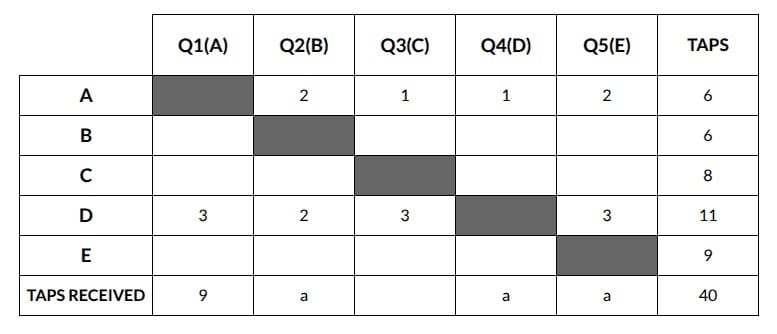
We are given that taps received for the questions by Badal, Dilshan and Ehsan are equal, so let us assume the value to be a.
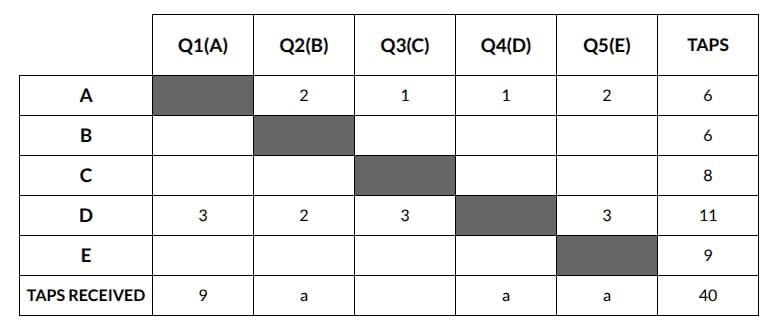
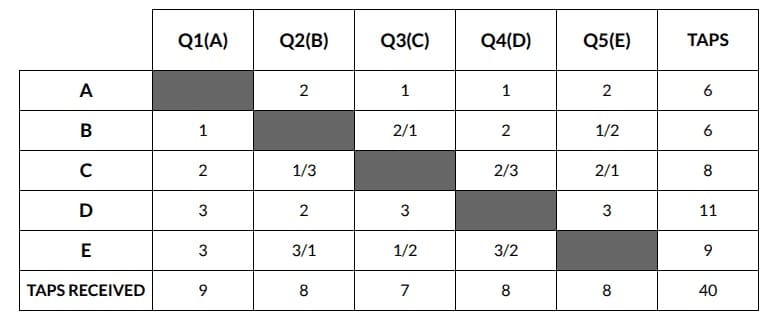
Putting all the calculated values in the table, we get,
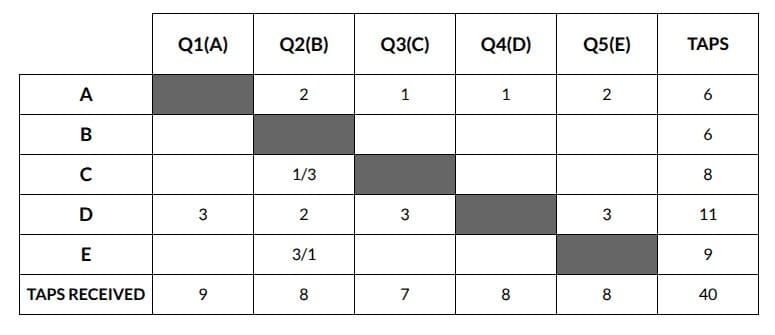
We know that each question received atleast one yes, one no and one maybe as an answer. If we examine the question asked by B, we already have two 'No's, so out of the other two, one must be 'Yes', and the other must be 'Maybe'. The taps received by B can be calculated as 2 + 2 + 1 + 3 = 8. We calculated the value of a to be 8, and the value of taps received by C can be calculated as,
9 + 8 + c + 8 + 8 = 40
c = 7
So, the number of taps received by Clive is 7.
Hence, the correct answer is 7.
Q2: Which two people tapped an equal number of times in total?
(a) Badal and Dilshan
(b) Clive and Ehsaan
(c) Dilshan and Clive
(d) Alia and Badal
Ans: d
Sol: We are given that Alia tapped 6 times, Dilshan tapped 11 times, and Ehsan tapped 9 times. We also know that the total number of taps is 40. So, the sum of taps by Badal and Clive can be calculated as,6 + Badal + Clive + 11 + 9 = 40
Badal + Clive = 14
We are given that taps by Clive are more than taps by Badal.
So, the possible pairs for taps by Clive and Badal such that the sum is 14 are (8, 6), (9, 5), (10, 4)...(14, 0).
We are given that no one gave more than two 'Yes' answers. We know that yes means one tap. So, the maximum number of 1 taps out of the 4 questions answered can be 2. The minimum possible number of taps for any person for the four questions would be 1 + 1 + 2 + 2 = 6. It is not possible for any person to have fewer than 6 taps as the maximum number of yes is 2.
So, out of all the possibilities, the only possible case for Badal is 6, and Clive is 8, as in all the other cases, the number by Badal was less than 6.
We are given that Alia answered Yes to Clive and Dilshan's questions. We know that the total number of taps by Alia is 6, and she tapped once for both those questions. The number of taps by Alia to the questions by Badal and Ehsan must be greater than 1, as we know that a person must have a maximum of two single taps. The sum of taps by Alia to Badal and Ehsan can be calculated as,
Badal + 1 + 1 + Ehsan = 6
Badal + Ehsan = 4
We know that both the values are greater than 1 and their sum is 4, so the only possibility is for both of them to be equal to 2.
So, Alia tapped twice for both Badal and Ehsan.
We are given that Dilshan answered no to Badal's question which means he tapped twice. The total number of taps by Dilshan is 11. So, the sum of taps from Alia, Clive and Ehsan's questions can be calculated as,
Alia + 2 + Clive + Ehsan = 11
Alia + Clive + Ehsan = 9
We know that the maximum possibility for each of the values is 3, and for the sum to be 9, all the values must be equal to 3.
We are given that taps received for the questions by Badal, Dilshan and Ehsan are equal, so let us assume the value to be a.
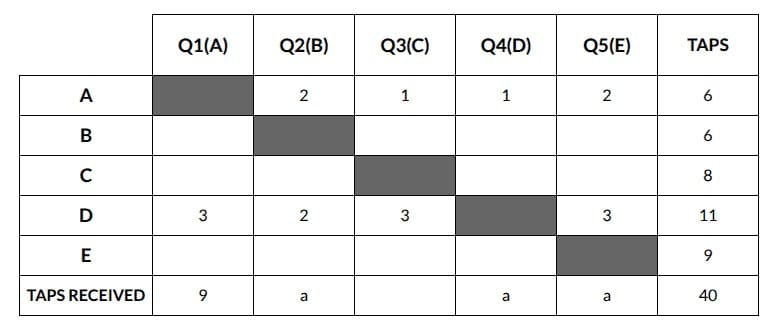
Putting all the calculated values in the table, we get,
Alia and Badal are the only people with an equal number of taps.
Hence, the correct answer is option D.
Q3: What was Clive's response to Ehsaan's question?
(a) No
(b) Maybe
(c) Cannot be determined
(d) Yes
Ans: a
Sol: We are given that Alia tapped 6 times, Dilshan tapped 11 times, and Ehsan tapped 9 times. We also know that the total number of taps is 40. So, the sum of taps by Badal and Clive can be calculated as,6 + Badal + Clive + 11 + 9 = 40
Badal + Clive = 14
We are given that taps by Clive are more than taps by Badal.
So, the possible pairs for taps by Clive and Badal such that the sum is 14 are (8, 6), (9, 5), (10, 4)...(14, 0).
We are given that no one gave more than two 'Yes' answers. We know that yes means one tap. So, the maximum number of 1 taps out of the 4 questions answered can be 2. The minimum possible number of taps for any person for the four questions would be 1 + 1 + 2 + 2 = 6. It is not possible for any person to have fewer than 6 taps as the maximum number of yes is 2.
So, out of all the possibilities, the only possible case for Badal is 6, and Clive is 8, as in all the other cases, the number by Badal was less than 6.
We are given that Alia answered Yes to Clive and Dilshan's questions. We know that the total number of taps by Alia is 6, and she tapped once for both those questions. The number of taps by Alia to the questions by Badal and Ehsan must be greater than 1, as we know that a person must have a maximum of two single taps. The sum of taps by Alia to Badal and Ehsan can be calculated as,
Badal + 1 + 1 + Ehsan = 6
Badal + Ehsan = 4
We know that both the values are greater than 1 and their sum is 4, so the only possibility is for both of them to be equal to 2.
So, Alia tapped twice for both Badal and Ehsan.
We are given that Dilshan answered no to Badal's question which means he tapped twice. The total number of taps by Dilshan is 11. So, the sum of taps from Alia, Clive and Ehsan's questions can be calculated as,
Alia + 2 + Clive + Ehsan = 11
Alia + Clive + Ehsan = 9
We know that the maximum possibility for each of the values is 3, and for the sum to be 9, all the values must be equal to 3.
We are given that taps received for the questions by Badal, Dilshan and Ehsan are equal, so let us assume the value to be a.
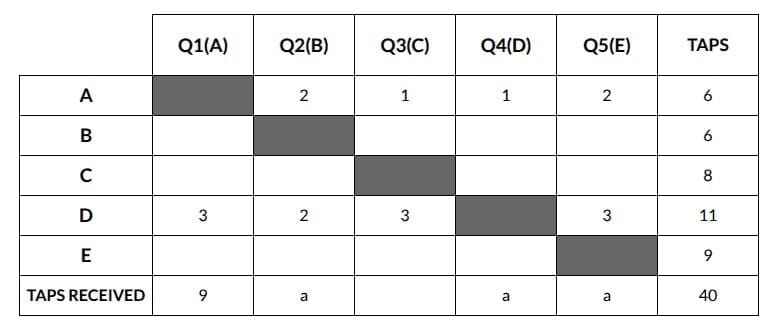
Putting all the calculated values in the table, we get,
We know that each question received atleast one yes, one no and one maybe as an answer. If we examine the question asked by B, we already have two 'No's, so out of the other two, one must be 'Yes', and the other must be 'Maybe'. The taps received by B can be calculated as 2 + 2 + 1 + 3 = 8. We calculated the value of a to be 8, and the value of taps received by C can be calculated as,
9 + 8 + c + 8 + 8 = 40
c = 7
So, the number of taps received by Clive is 7.
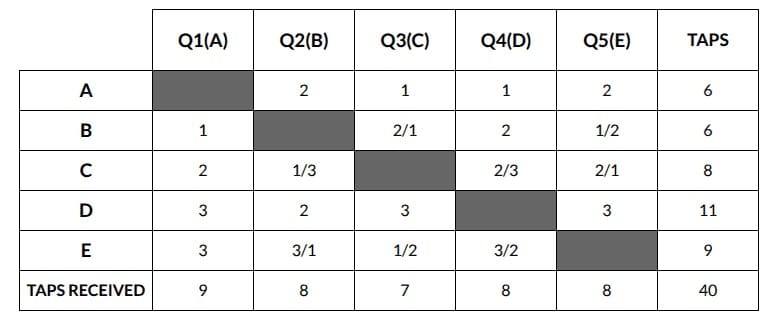
We are given that the answer by Alia does not match the answers people gave to her question. We know that the taps by Badal have to be 1, 1, 2 and 2 in some order. We know that Alia tapped twice to Badal's question, so Badal cannot tap twice to Alia's question, which means Badal tapped once for Alia's question. Now the sum of Clive and Ehsan's taps for Alia's question has to be 9 - 3 - 1 = 5. So, they have to be 2 and 3 in some order. We also know that Alia's answer to Ehsan's question is 2, so Ehsan has only one option to answer Alia, which is 3, and Clive's answer to Alia's question is 2.
Badal and Ehsan's answer to Clive's question has to be 1 and 2 in some order. Similarly, Badal and Clive's answers to Ehsan's question have to be 1 and 3 in some order.
We can also calculate the sum of taps by Badal, Clive and Ehsan to Dilshan's question is 8 - 1 = 7. So, their taps have to be 2, 2 and 3 in some order as this is the only possibility satisfying the condition of at least one Yes, one No and one Maybe for every question. We know that a tap Badal has to be either one or two, so the only possibility for Badal's answer to Dilshan's question is 2 and the other two has to be two and three in some order.
We are also given that the answer by Ehsan does not match the answers people gave to his question. Dilshan's answer to Ehsan's question is 3, so the answer by Ehsan to Dilshan's question has to be 2.
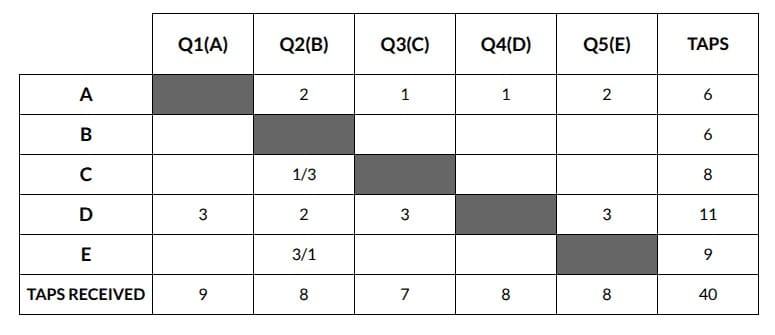
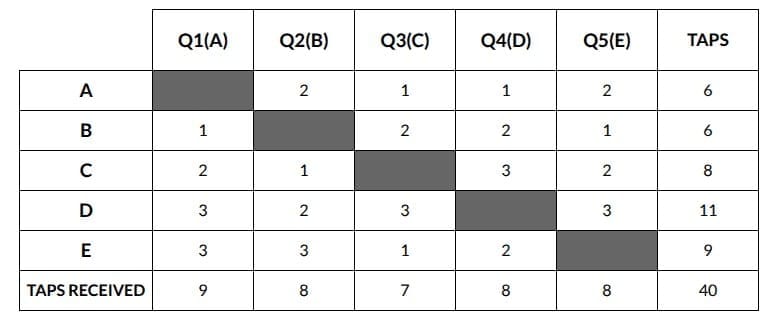
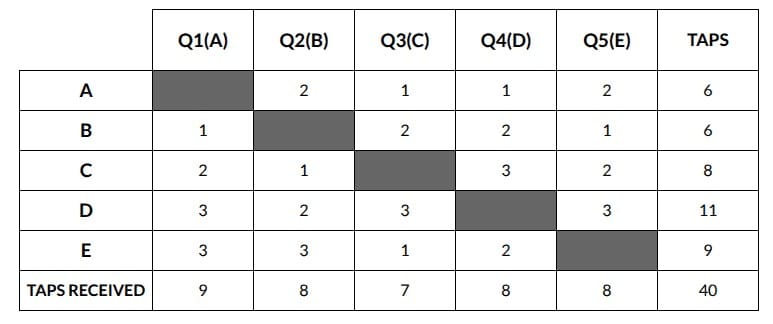
The answer by Clive to Badal's question has to be 1, as if it is 3, then the answer to Ehsan's question by Clive becomes 0, which is not possible. With that value, we can determine all the other values and putting the values in the table, we get,
Clive's answer to Ehsan's question is No, which is denoted by 2.
Hence, the correct answer is option A.
Q4: How many "Yes" responses were received across all the questions?
Ans: 6
Sol: We are given that Alia tapped 6 times, Dilshan tapped 11 times, and Ehsan tapped 9 times. We also know that the total number of taps is 40. So, the sum of taps by Badal and Clive can be calculated as,
6 + Badal + Clive + 11 + 9 = 40
Badal + Clive = 14
We are given that taps by Clive are more than taps by Badal.
So, the possible pairs for taps by Clive and Badal such that the sum is 14 are (8, 6), (9, 5), (10, 4)...(14, 0).
We are given that no one gave more than two 'Yes' answers. We know that yes means one tap. So, the maximum number of 1 taps out of the 4 questions answered can be 2. The minimum possible number of taps for any person for the four questions would be 1 + 1 + 2 + 2 = 6. It is not possible for any person to have fewer than 6 taps as the maximum number of yes is 2.
So, out of all the possibilities, the only possible case for Badal is 6, and Clive is 8, as in all the other cases, the number by Badal was less than 6.
We are given that Alia answered Yes to Clive and Dilshan's questions. We know that the total number of taps by Alia is 6, and she tapped once for both those questions. The number of taps by Alia to the questions by Badal and Ehsan must be greater than 1, as we know that a person must have a maximum of two single taps. The sum of taps by Alia to Badal and Ehsan can be calculated as,
Badal + 1 + 1 + Ehsan = 6
Badal + Ehsan = 4
We know that both the values are greater than 1 and their sum is 4, so the only possibility is for both of them to be equal to 2.
So, Alia tapped twice for both Badal and Ehsan.
We are given that Dilshan answered no to Badal's question which means he tapped twice. The total number of taps by Dilshan is 11. So, the sum of taps from Alia, Clive and Ehsan's questions can be calculated as,
Alia + 2 + Clive + Ehsan = 11
Alia + Clive + Ehsan = 9
We know that the maximum possibility for each of the values is 3, and for the sum to be 9, all the values must be equal to 3.
We are given that taps received for the questions by Badal, Dilshan and Ehsan are equal, so let us assume the value to be a.
Putting all the calculated values in the table, we get,
We know that each question received atleast one yes, one no and one maybe as an answer. If we examine the question asked by B, we already have two 'No's, so out of the other two, one must be 'Yes', and the other must be 'Maybe'. The taps received by B can be calculated as 2 + 2 + 1 + 3 = 8. We calculated the value of a to be 8, and the value of taps received by C can be calculated as,
9 + 8 + c + 8 + 8 = 40
c = 7
So, the number of taps received by Clive is 7.
We are given that the answer by Alia does not match the answers people gave to her question. We know that the taps by Badal have to be 1, 1, 2 and 2 in some order. We know that Alia tapped twice to Badal's question, so Badal cannot tap twice to Alia's question, which means Badal tapped once for Alia's question. Now the sum of Clive and Ehsan's taps for Alia's question has to be 9 - 3 - 1 = 5. So, they have to be 2 and 3 in some order. We also know that Alia's answer to Ehsan's question is 2, so Ehsan has only one option to answer Alia, which is 3, and Clive's answer to Alia's question is 2.
Badal and Ehsan's answer to Clive's question has to be 1 and 2 in some order. Similarly, Badal and Clive's answers to Ehsan's question have to be 1 and 3 in some order.
We can also calculate the sum of taps by Badal, Clive and Ehsan to Dilshan's question is 8 - 1 = 7. So, their taps have to be 2, 2 and 3 in some order as this is the only possibility satisfying the condition of at least one Yes, one No and one Maybe for every question. We know that a tap Badal has to be either one or two, so the only possibility for Badal's answer to Dilshan's question is 2 and the other two has to be two and three in some order.
We are also given that the answer by Ehsan does not match the answers people gave to his question. Dilshan's answer to Ehsan's question is 3, so the answer by Ehsan to Dilshan's question has to be 2.
The answer by Clive to Badal's question has to be 1, as if it is 3, then the answer to Ehsan's question by Clive becomes 0, which is not possible. With that value, we can determine all the other values and putting the values in the table, we get,
The total number of Yes responses is equal to the number of 1's in the table, which is 6.
Hence, the correct answer is 6.
Q5 to Q9:
The two most populous cities and the non-urban region (NUR) of each of three states, Whimshire, Fogglia, and Humbleset, are assigned Pollution Measures (PMs). These nine PMs are all distinct multiples of 10, ranging from 10 to 90. The six cities in increasing order of their PMs are: Blusterburg, Noodleton, Splutterville, Quackford, Mumpypore, Zingaloo.
The Pollution Index (PI) of a state is a weighted average of the PMs of its NUR and cities, with a weight of 50% for the NUR, and 25% each for its two cities.
There is only one pair of an NUR and a city (considering all cities and all NURs) where the PM of the NUR is greater than that of the city. That NUR and the city both belong to Humbleset.
The PIs of all three states are distinct integers, with Humbleset and Fogglia having the highest and the lowest PI respectively.
Q5: What is the PI of Whimshire?
Ans: 45
Sol: We are given that the PMs of the six cities, Blusterburg, Noodleton, Splutterville, Quackford, Mumpypore, and Zingaloo, are in increasing order.
We are also told there exists a single pair of NUR and city such that the PM of NUR is greater than the city and the NUR, city of the pair belongs to Humbleset. So, we can conclude that PMs of NURs of Whimshire and Fogglia are 10 and 20 in some order.
We also know that out of all the cities, Blusterburg has the lowest PM. So, the PM of Blusterberg has to be 30, and the PM of NUR of Humbleset has to be 40 for the above condition to be satisfied, and we can also conclude that Blusterberg is a city of Humbleset.
We can also conclude that the PMs of Noodleton, Splutterville, Quackford, Mumpypore, and Zingaloo are 50, 60, 70, 80, and 90, respectively.
We are given that in the PI calculation, cities have a contribution of 25% and NUR has a contribution of 50%. So, we can calculate the contribution of each city in the calculation of PI by dividing their PI value by 4, and the contribution of NUR can be calculated by dividing the PM value by 2.
We are given that all the PI values are unique integers, and Humbleset has the highest PI value, while Fogglia has the lowest.
For the PI value to be an integer, the cities with decimal contributions must be paired with another city with decimal contributions. Since all the decimals are 0.5, when two cities with 0.5 are added, the sum becomes 1, making the PI an integer.
The cities Splutterville and Mumpypoe must be from the same state; both have integral contributions towards the PI, and if they are added to a decimal, then the result will be a decimal, which should not be the case. These two cities have to belong to either the state of Whimshire or Fogglia, but their combined contribution towards PI is 15 + 20 = 35.
We already know that for the state of Humbleset, the PI is highest, and the two contributions towards the PI are 7.5 and 20, totalling 27.5.
There are three possibilities for the other city of Humbleset, which are Noodleton, Quackford and Zingaloo.
CASE 1: Noodleton
If the other city of Humbleset is Noodleton, then its PI would be 27.5 + 12.5 = 40.
We already obtained the sum of the PIs of one of the other 2 states to be 35 without including the PI of NUR. We know that the NUR contribution for that city would be either 5 or 10. If it is 5, then the PI of that state would be 40, and if it is 10, then the PI of that state would be 45.
However, we are told that the PI values are unique, and Humblest has the highest PI value; in either case, this condition is not satisfied.
So, we can eliminate the case of Noodleton being the second city of Humbleset.
CASE 2: Quackford
If the other city of Humbleset is Quackford, then its PI would be 27.5 + 17.5 = 45.
We already obtained the sum of the PIs of one of the other 2 states to be 35 without including the PI of NUR. We know that the NUR contribution for that city would be either 5 or 10. If it is 5, then the PI of that state would be 40, and if it is 10, then the PI of that state would be 45.
However, we are told that the PI values are unique, and Humblest has the highest PI value. So, we can eliminate the case of PI of NUR being 10 for the other state.
So, for Humbleset, the PI is 7.5 + 17.5 + 20 = 45.
For one of the other 2 states, the PI is 15 + 20 + 5 = 40
The PI of the other state can be calculated by adding all the leftover PIs, which is 12.5 + 22.5 + 10 = 45.
We can see that PI of Humbleton and one of the other two states is 45, which violates one of the conditions given.
So, we can eliminate the case of Quackford being the second city of Humbleset.
CASE 3: Zingaloo
If the other city of Humbleset is Zingaloo, then its PI would be 27.5 + 22.5 = 50.
We already obtained the sum of the PIs of one of the other 2 states to be 35 without including the PI of NUR. We know that the NUR contribution for that city would be either 5 or 10. If it is 5, then the PI of that state would be 40, and if it is 10, then the PI of that state would be 45.
If the PI of the other state is 40,
Then, for Humbleset, the PI is 7.5 + 22.5 + 20 = 50.
For one of the other 2 states, the PI is 15 + 20 + 5 = 40
The PI of the other state can be calculated by adding all the leftover PIs, which is 12.5 + 17.5 + 10 = 40.
We can see that PI of the other two states is 40, which violates one of the conditions given.
If the PI of the other state is 45,
Then, for Humbleset, the PI is 7.5 + 22.5 + 20 = 50.
For one of the other 2 states, the PI is 15 + 20 + 10 = 45
The PI of the other state can be calculated by adding all the leftover PIs, which is 12.5 + 17.5 + 5 = 35.
We can see that all the conditions are satisfied in this case, and we can conclude that Zingaloo is the second city of Humbleset, and also we know that PI is the least for Fogglia. So, the PI of Fogglia is 35, and the PI of Whimshire is 45.
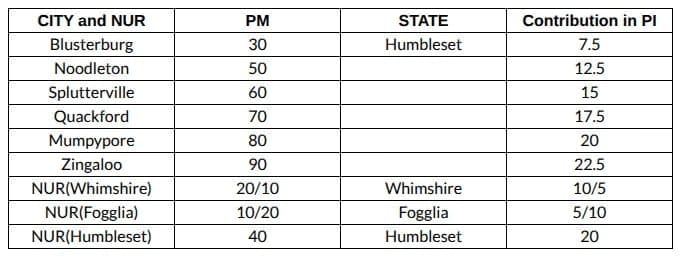
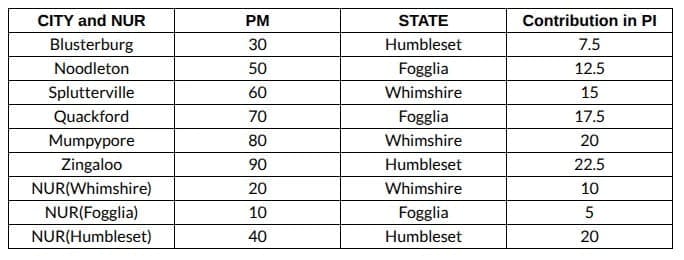
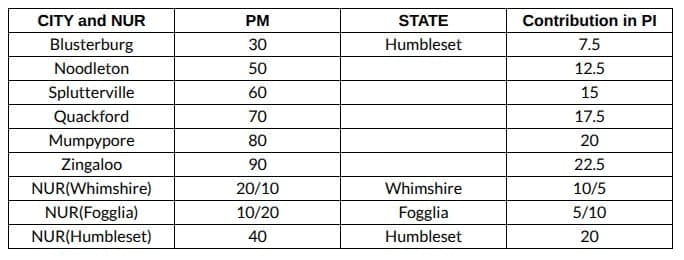
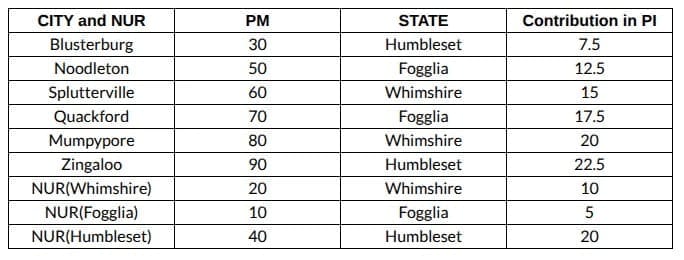
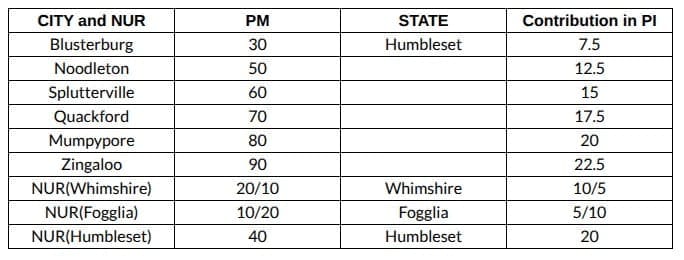
We can now assign the cities and the NURs the states and the PM values uniquely based on our calculations. After assigning the table looks like,
We calculated the PI of Whimshire to be 45.
Hence, the correct answer is 45.
Q6: What is the PI of Fogglia?
Ans: 35
Sol: We are given that the PMs of the six cities, Blusterburg, Noodleton, Splutterville, Quackford, Mumpypore, and Zingaloo, are in increasing order.
We are also told there exists a single pair of NUR and city such that the PM of NUR is greater than the city and the NUR, city of the pair belongs to Humbleset. So, we can conclude that PMs of NURs of Whimshire and Fogglia are 10 and 20 in some order.
We also know that out of all the cities, Blusterburg has the lowest PM. So, the PM of Blusterberg has to be 30, and the PM of NUR of Humbleset has to be 40 for the above condition to be satisfied, and we can also conclude that Blusterberg is a city of Humbleset.
We can also conclude that the PMs of Noodleton, Splutterville, Quackford, Mumpypore, and Zingaloo are 50, 60, 70, 80, and 90, respectively.
We are given that in the PI calculation, cities have a contribution of 25% and NUR has a contribution of 50%. So, we can calculate the contribution of each city in the calculation of PI by dividing their PI value by 4, and the contribution of NUR can be calculated by dividing the PM value by 2.
We are given that all the PI values are unique integers, and Humbleset has the highest PI value, while Fogglia has the lowest.
For the PI value to be an integer, the cities with decimal contributions must be paired with another city with decimal contributions. Since all the decimals are 0.5, when two cities with 0.5 are added, the sum becomes 1, making the PI an integer.
The cities Splutterville and Mumpypoe must be from the same state; both have integral contributions towards the PI, and if they are added to a decimal, then the result will be a decimal, which should not be the case. These two cities have to belong to either the state of Whimshire or Fogglia, but their combined contribution towards PI is 15 + 20 = 35.
We already know that for the state of Humbleset, the PI is highest, and the two contributions towards the PI are 7.5 and 20, totalling 27.5.
There are three possibilities for the other city of Humbleset, which are Noodleton, Quackford and Zingaloo.
CASE 1: Noodleton
If the other city of Humbleset is Noodleton, then its PI would be 27.5 + 12.5 = 40.
We already obtained the sum of the PIs of one of the other 2 states to be 35 without including the PI of NUR. We know that the NUR contribution for that city would be either 5 or 10. If it is 5, then the PI of that state would be 40, and if it is 10, then the PI of that state would be 45.
However, we are told that the PI values are unique, and Humblest has the highest PI value; in either case, this condition is not satisfied.
So, we can eliminate the case of Noodleton being the second city of Humbleset.
CASE 2: Quackford
If the other city of Humbleset is Quackford, then its PI would be 27.5 + 17.5 = 45.
We already obtained the sum of the PIs of one of the other 2 states to be 35 without including the PI of NUR. We know that the NUR contribution for that city would be either 5 or 10. If it is 5, then the PI of that state would be 40, and if it is 10, then the PI of that state would be 45.
However, we are told that the PI values are unique, and Humblest has the highest PI value. So, we can eliminate the case of PI of NUR being 10 for the other state.
So, for Humbleset, the PI is 7.5 + 17.5 + 20 = 45.
For one of the other 2 states, the PI is 15 + 20 + 5 = 40
The PI of the other state can be calculated by adding all the leftover PIs, which is 12.5 + 22.5 + 10 = 45.
We can see that PI of Humbleton and one of the other two states is 45, which violates one of the conditions given.
So, we can eliminate the case of Quackford being the second city of Humbleset.
CASE 3: Zingaloo
If the other city of Humbleset is Zingaloo, then its PI would be 27.5 + 22.5 = 50.
We already obtained the sum of the PIs of one of the other 2 states to be 35 without including the PI of NUR. We know that the NUR contribution for that city would be either 5 or 10. If it is 5, then the PI of that state would be 40, and if it is 10, then the PI of that state would be 45.
If the PI of the other state is 40,
Then, for Humbleset, the PI is 7.5 + 22.5 + 20 = 50.
For one of the other 2 states, the PI is 15 + 20 + 5 = 40
The PI of the other state can be calculated by adding all the leftover PIs, which is 12.5 + 17.5 + 10 = 40.
We can see that PI of the other two states is 40, which violates one of the conditions given.
If the PI of the other state is 45,
Then, for Humbleset, the PI is 7.5 + 22.5 + 20 = 50.
For one of the other 2 states, the PI is 15 + 20 + 10 = 45
The PI of the other state can be calculated by adding all the leftover PIs, which is 12.5 + 17.5 + 5 = 35.
We can see that all the conditions are satisfied in this case, and we can conclude that Zingaloo is the second city of Humbleset, and also we know that PI is the least for Fogglia. So, the PI of Fogglia is 35, and the PI of Whimshire is 45.
We can now assign the cities and the NURs the states and the PM values uniquely based on our calculations. After assigning the table looks like,
We calculated the PI of Fogglia to be 35.
Hence, the correct answer is 35.
Q7: What is the PI of Humbleset?
Ans: 50
Sol: We are given that the PMs of the six cities, Blusterburg, Noodleton, Splutterville, Quackford, Mumpypore, and Zingaloo, are in increasing order.
We are also told there exists a single pair of NUR and city such that the PM of NUR is greater than the city and the NUR, city of the pair belongs to Humbleset. So, we can conclude that PMs of NURs of Whimshire and Fogglia are 10 and 20 in some order.
We also know that out of all the cities, Blusterburg has the lowest PM. So, the PM of Blusterberg has to be 30, and the PM of NUR of Humbleset has to be 40 for the above condition to be satisfied, and we can also conclude that Blusterberg is a city of Humbleset.
We can also conclude that the PMs of Noodleton, Splutterville, Quackford, Mumpypore, and Zingaloo are 50, 60, 70, 80, and 90, respectively.
We are given that in the PI calculation, cities have a contribution of 25% and NUR has a contribution of 50%. So, we can calculate the contribution of each city in the calculation of PI by dividing their PI value by 4, and the contribution of NUR can be calculated by dividing the PM value by 2.
We are given that all the PI values are unique integers, and Humbleset has the highest PI value, while Fogglia has the lowest.
For the PI value to be an integer, the cities with decimal contributions must be paired with another city with decimal contributions. Since all the decimals are 0.5, when two cities with 0.5 are added, the sum becomes 1, making the PI an integer.
The cities Splutterville and Mumpypoe must be from the same state; both have integral contributions towards the PI, and if they are added to a decimal, then the result will be a decimal, which should not be the case. These two cities have to belong to either the state of Whimshire or Fogglia, but their combined contribution towards PI is 15 + 20 = 35.
We already know that for the state of Humbleset, the PI is highest, and the two contributions towards the PI are 7.5 and 20, totalling 27.5.
There are three possibilities for the other city of Humbleset, which are Noodleton, Quackford and Zingaloo.
CASE 1: Noodleton
If the other city of Humbleset is Noodleton, then its PI would be 27.5 + 12.5 = 40.
We already obtained the sum of the PIs of one of the other 2 states to be 35 without including the PI of NUR. We know that the NUR contribution for that city would be either 5 or 10. If it is 5, then the PI of that state would be 40, and if it is 10, then the PI of that state would be 45.
However, we are told that the PI values are unique, and Humblest has the highest PI value; in either case, this condition is not satisfied.
So, we can eliminate the case of Noodleton being the second city of Humbleset.
CASE 2: Quackford
If the other city of Humbleset is Quackford, then its PI would be 27.5 + 17.5 = 45.
We already obtained the sum of the PIs of one of the other 2 states to be 35 without including the PI of NUR. We know that the NUR contribution for that city would be either 5 or 10. If it is 5, then the PI of that state would be 40, and if it is 10, then the PI of that state would be 45.
However, we are told that the PI values are unique, and Humblest has the highest PI value. So, we can eliminate the case of PI of NUR being 10 for the other state.
So, for Humbleset, the PI is 7.5 + 17.5 + 20 = 45.
For one of the other 2 states, the PI is 15 + 20 + 5 = 40
The PI of the other state can be calculated by adding all the leftover PIs, which is 12.5 + 22.5 + 10 = 45.
We can see that PI of Humbleton and one of the other two states is 45, which violates one of the conditions given.
So, we can eliminate the case of Quackford being the second city of Humbleset.
CASE 3: Zingaloo
If the other city of Humbleset is Zingaloo, then its PI would be 27.5 + 22.5 = 50.
We already obtained the sum of the PIs of one of the other 2 states to be 35 without including the PI of NUR. We know that the NUR contribution for that city would be either 5 or 10. If it is 5, then the PI of that state would be 40, and if it is 10, then the PI of that state would be 45.
If the PI of the other state is 40,
Then, for Humbleset, the PI is 7.5 + 22.5 + 20 = 50.
For one of the other 2 states, the PI is 15 + 20 + 5 = 40
The PI of the other state can be calculated by adding all the leftover PIs, which is 12.5 + 17.5 + 10 = 40.
We can see that PI of the other two states is 40, which violates one of the conditions given.
If the PI of the other state is 45,
Then, for Humbleset, the PI is 7.5 + 22.5 + 20 = 50.
For one of the other 2 states, the PI is 15 + 20 + 10 = 45
The PI of the other state can be calculated by adding all the leftover PIs, which is 12.5 + 17.5 + 5 = 35.
We can see that all the conditions are satisfied in this case, and we can conclude that Zingaloo is the second city of Humbleset, and also we know that PI is the least for Fogglia. So, the PI of Fogglia is 35, and the PI of Whimshire is 45.
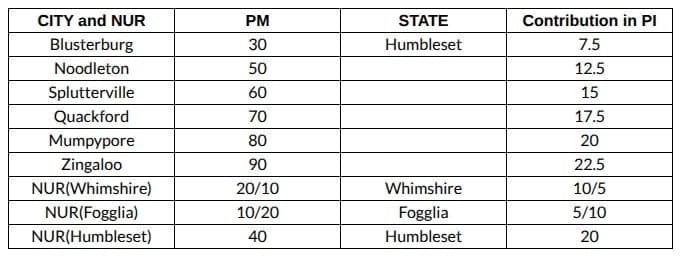
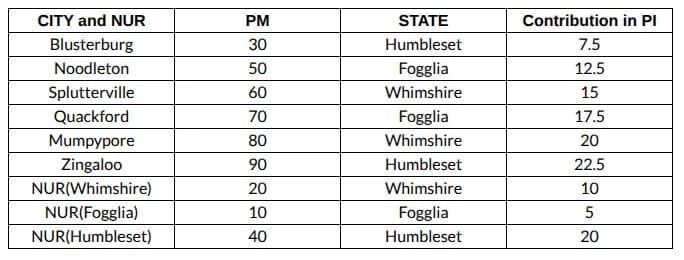
We can now assign the cities and the NURs, the states, and the PM values uniquely based on our calculations. After assigning the table looks like,
We calculated the PI of Humbleset to be 50.
Hence, the correct answer is 50.
Q8: Which pair of cities definitely belong to the same state?
(a) Mumpypore, Zingaloo
(b) Splutterville, Quackford
(c) Blusterburg, Mumpypore
(d) Noodleton, Quackford
Ans: c
Sol: We are given that the PMs of the six cities, Blusterburg, Noodleton, Splutterville, Quackford, Mumpypore, and Zingaloo, are in increasing order.
We are also told there exists a single pair of NUR and city such that the PM of NUR is greater than the city and the NUR, city of the pair belongs to Humbleset. So, we can conclude that PMs of NURs of Whimshire and Fogglia are 10 and 20 in some order.
We also know that out of all the cities, Blusterburg has the lowest PM. So, the PM of Blusterberg has to be 30, and the PM of NUR of Humbleset has to be 40 for the above condition to be satisfied, and we can also conclude that Blusterberg is a city of Humbleset.
We can also conclude that the PMs of Noodleton, Splutterville, Quackford, Mumpypore, and Zingaloo are 50, 60, 70, 80, and 90, respectively.
We are given that in the PI calculation, cities have a contribution of 25% and NUR has a contribution of 50%. So, we can calculate the contribution of each city in the calculation of PI by dividing their PI value by 4, and the contribution of NUR can be calculated by dividing the PM value by 2.
We are given that all the PI values are unique integers, and Humbleset has the highest PI value, while Fogglia has the lowest.
For the PI value to be an integer, the cities with decimal contributions must be paired with another city with decimal contributions. Since all the decimals are 0.5, when two cities with 0.5 are added, the sum becomes 1, making the PI an integer.
The cities Splutterville and Mumpypoe must be from the same state; both have integral contributions towards the PI, and if they are added to a decimal, then the result will be a decimal, which should not be the case. These two cities have to belong to either the state of Whimshire or Fogglia, but their combined contribution towards PI is 15 + 20 = 35.
We already know that for the state of Humbleset, the PI is highest, and the two contributions towards the PI are 7.5 and 20, totalling 27.5.
There are three possibilities for the other city of Humbleset, which are Noodleton, Quackford and Zingaloo.
CASE 1: Noodleton
If the other city of Humbleset is Noodleton, then its PI would be 27.5 + 12.5 = 40.
We already obtained the sum of the PIs of one of the other 2 states to be 35 without including the PI of NUR. We know that the NUR contribution for that city would be either 5 or 10. If it is 5, then the PI of that state would be 40, and if it is 10, then the PI of that state would be 45.
However, we are told that the PI values are unique, and Humblest has the highest PI value; in either case, this condition is not satisfied.
So, we can eliminate the case of Noodleton being the second city of Humbleset.
CASE 2: Quackford
If the other city of Humbleset is Quackford, then its PI would be 27.5 + 17.5 = 45.
We already obtained the sum of the PIs of one of the other 2 states to be 35 without including the PI of NUR. We know that the NUR contribution for that city would be either 5 or 10. If it is 5, then the PI of that state would be 40, and if it is 10, then the PI of that state would be 45.
However, we are told that the PI values are unique, and Humblest has the highest PI value. So, we can eliminate the case of PI of NUR being 10 for the other state.
So, for Humbleset, the PI is 7.5 + 17.5 + 20 = 45.
For one of the other 2 states, the PI is 15 + 20 + 5 = 40
The PI of the other state can be calculated by adding all the leftover PIs, which is 12.5 + 22.5 + 10 = 45.
We can see that PI of Humbleton and one of the other two states is 45, which violates one of the conditions given.
So, we can eliminate the case of Quackford being the second city of Humbleset.
CASE 3: Zingaloo
If the other city of Humbleset is Zingaloo, then its PI would be 27.5 + 22.5 = 50.
We already obtained the sum of the PIs of one of the other 2 states to be 35 without including the PI of NUR. We know that the NUR contribution for that city would be either 5 or 10. If it is 5, then the PI of that state would be 40, and if it is 10, then the PI of that state would be 45.
If the PI of the other state is 40,
Then, for Humbleset, the PI is 7.5 + 22.5 + 20 = 50.
For one of the other 2 states, the PI is 15 + 20 + 5 = 40
The PI of the other state can be calculated by adding all the leftover PIs, which is 12.5 + 17.5 + 10 = 40.
We can see that PI of the other two states is 40, which violates one of the conditions given.
If the PI of the other state is 45,
Then, for Humbleset, the PI is 7.5 + 22.5 + 20 = 50.
For one of the other 2 states, the PI is 15 + 20 + 10 = 45
The PI of the other state can be calculated by adding all the leftover PIs, which is 12.5 + 17.5 + 5 = 35.
We can see that all the conditions are satisfied in this case, and we can conclude that Zingaloo is the second city of Humbleset, and also we know that PI is the least for Fogglia. So, the PI of Fogglia is 35, and the PI of Whimshire is 45.
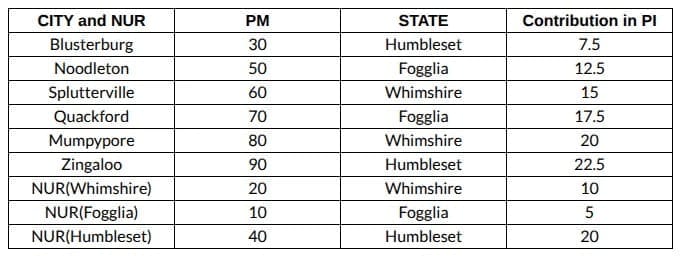
We can now assign the cities and the NURs, the states, and the PM values uniquely based on our calculations. After assigning the table looks like,
We can see that Noodleton and Quackford belong to the same state among the options.
Hence, the correct answer is option C.
Q9: For how many of the cities and NURs is it possible to identify their PM and the state they belong to?
Ans: 9
Sol: We are given that the PMs of the six cities, Blusterburg, Noodleton, Splutterville, Quackford, Mumpypore, and Zingaloo, are in increasing order.
We are also told there exists a single pair of NUR and city such that the PM of NUR is greater than the city and the NUR, city of the pair belongs to Humbleset. So, we can conclude that PMs of NURs of Whimshire and Fogglia are 10 and 20 in some order.
We also know that out of all the cities, Blusterburg has the lowest PM. So, the PM of Blusterberg has to be 30, and the PM of NUR of Humbleset has to be 40 for the above condition to be satisfied, and we can also conclude that Blusterberg is a city of Humbleset.
We can also conclude that the PMs of Noodleton, Splutterville, Quackford, Mumpypore, and Zingaloo are 50, 60, 70, 80, and 90, respectively.
We are given that in the PI calculation, cities have a contribution of 25% and NUR has a contribution of 50%. So, we can calculate the contribution of each city in the calculation of PI by dividing their PI value by 4, and the contribution of NUR can be calculated by dividing the PM value by 2.
We are given that all the PI values are unique integers, and Humbleset has the highest PI value, while Fogglia has the lowest.
For the PI value to be an integer, the cities with decimal contributions must be paired with another city with decimal contributions. Since all the decimals are 0.5, when two cities with 0.5 are added, the sum becomes 1, making the PI an integer.
The cities Splutterville and Mumpypoe must be from the same state; both have integral contributions towards the PI, and if they are added to a decimal, then the result will be a decimal, which should not be the case. These two cities have to belong to either the state of Whimshire or Fogglia, but their combined contribution towards PI is 15 + 20 = 35.
We already know that for the state of Humbleset, the PI is highest, and the two contributions towards the PI are 7.5 and 20, totalling 27.5.
There are three possibilities for the other city of Humbleset, which are Noodleton, Quackford and Zingaloo.
CASE 1: Noodleton
If the other city of Humbleset is Noodleton, then its PI would be 27.5 + 12.5 = 40.
We already obtained the sum of the PIs of one of the other 2 states to be 35 without including the PI of NUR. We know that the NUR contribution for that city would be either 5 or 10. If it is 5, then the PI of that state would be 40, and if it is 10, then the PI of that state would be 45.
However, we are told that the PI values are unique, and Humblest has the highest PI value; in either case, this condition is not satisfied.
So, we can eliminate the case of Noodleton being the second city of Humbleset.
CASE 2: Quackford
If the other city of Humbleset is Quackford, then its PI would be 27.5 + 17.5 = 45.
We already obtained the sum of the PIs of one of the other 2 states to be 35 without including the PI of NUR. We know that the NUR contribution for that city would be either 5 or 10. If it is 5, then the PI of that state would be 40, and if it is 10, then the PI of that state would be 45.
However, we are told that the PI values are unique, and Humblest has the highest PI value. So, we can eliminate the case of PI of NUR being 10 for the other state.
So, for Humbleset, the PI is 7.5 + 17.5 + 20 = 45.
For one of the other 2 states, the PI is 15 + 20 + 5 = 40
The PI of the other state can be calculated by adding all the leftover PIs, which is 12.5 + 22.5 + 10 = 45.
We can see that PI of Humbleton and one of the other two states is 45, which violates one of the conditions given.
So, we can eliminate the case of Quackford being the second city of Humbleset.
CASE 3: Zingaloo
If the other city of Humbleset is Zingaloo, then its PI would be 27.5 + 22.5 = 50.
We already obtained the sum of the PIs of one of the other 2 states to be 35 without including the PI of NUR. We know that the NUR contribution for that city would be either 5 or 10. If it is 5, then the PI of that state would be 40, and if it is 10, then the PI of that state would be 45.
If the PI of the other state is 40,
Then, for Humbleset, the PI is 7.5 + 22.5 + 20 = 50.
For one of the other 2 states, the PI is 15 + 20 + 5 = 40
The PI of the other state can be calculated by adding all the leftover PIs, which is 12.5 + 17.5 + 10 = 40.
We can see that PI of the other two states is 40, which violates one of the conditions given.
If the PI of the other state is 45,
Then, for Humbleset, the PI is 7.5 + 22.5 + 20 = 50.
For one of the other 2 states, the PI is 15 + 20 + 10 = 45
The PI of the other state can be calculated by adding all the leftover PIs, which is 12.5 + 17.5 + 5 = 35.
We can see that all the conditions are satisfied in this case, and we can conclude that Zingaloo is the second city of Humbleset, and also we know that PI is the least for Fogglia. So, the PI of Fogglia is 35, and the PI of Whimshire is 45.
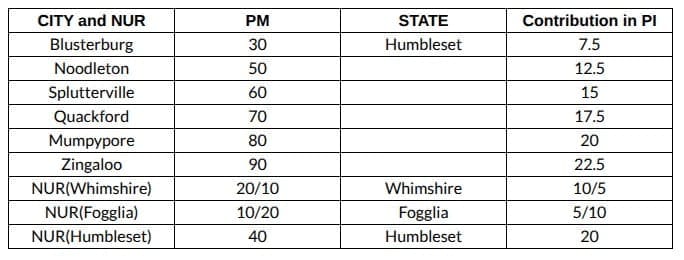
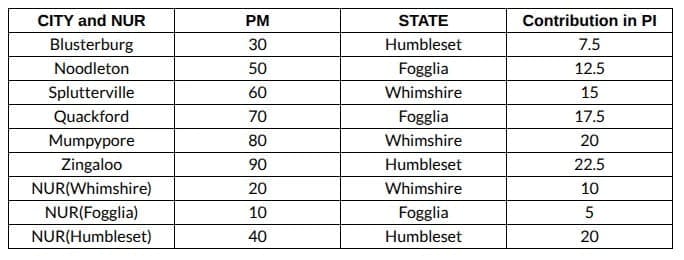
We can now assign the cities and the NURs, the states, and the PM values uniquely based on our calculations. After assigning the table looks like,
We can see that for all 6 cities and 3 NURs, the PMs and the city to which they belong can be identified uniquely. So, in total, we can identify the values uniquely for all 9 of them.
Hence, the correct answer is 9.
Q10 to Q13:
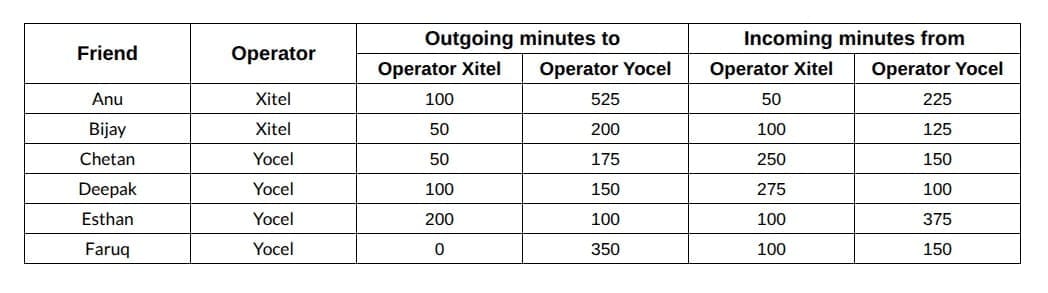
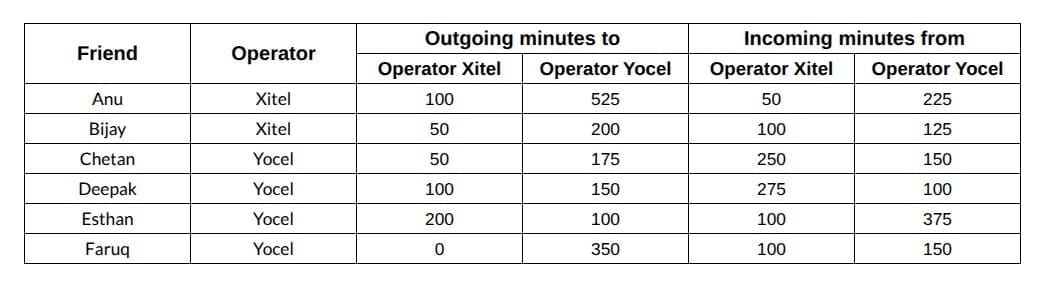
Anu, Bijay, Chetan, Deepak, Eshan, and Faruq are six friends. Each of them uses a mobile number from exactly one of the two mobile operators - Xitel and Yocel. During the last month, the six friends made several calls to each other. Each call was made by one of these six friends to another. The table below summarizes the number of minutes of calls that each of the six made to (outgoing minutes) and received from (incoming minutes) these friends, grouped by the operators. Some of the entries are missing.
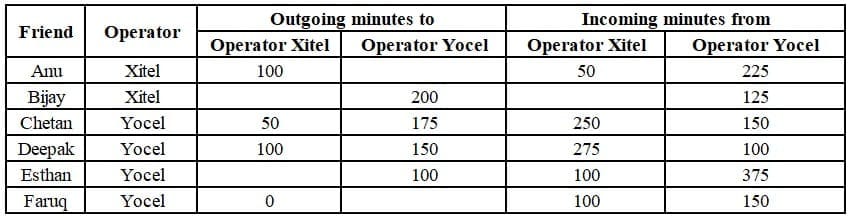
It is known that the duration of calls from Faruq to Eshan was 200 minutes. Also, there were no calls from:
i. Bijay to Eshan,
ii. Chetan to Anu and Chetan to Deepak,
iii. Deepak to Bijay and Deepak to Faruq,
iv. Eshan to Chetan and Eshan to Deepak.
Q10: What was the duration of calls (in minutes) from Bijay to Anu?
Ans: 50
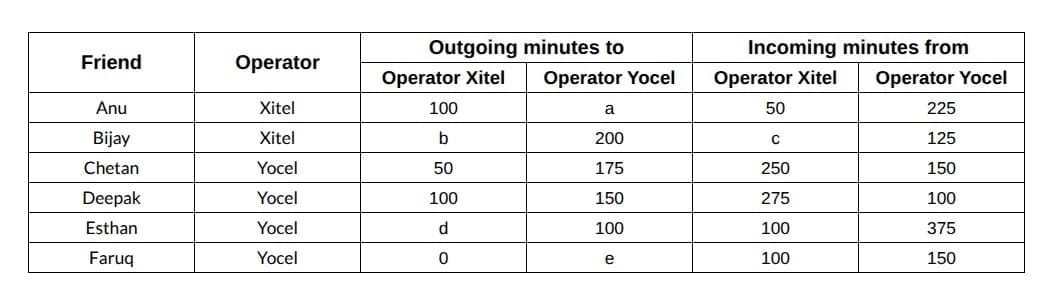
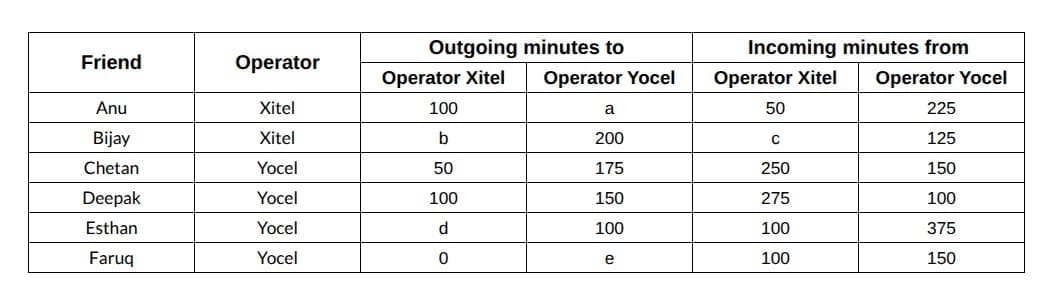
Sol: This is the table given in the question with unknown values of a, b, c, d and e.
We are told that Anu and Bijay use the Xitel operator, and Chetan, Deepak, Esthan and Faruq use the Yocel operator.
The outgoing call from Anu to the Xitel operator has to be the incoming call from Xitel to Bijay because there are only two friends using Xitel, and if one of the Xitel users is calling another Xitel user, then those two have to be Anu and Bijay.
The outgoing to Xitel by Anu = 100
The incoming from Xitel for Bijay = c = The outgoing to Xitel by Anu = 100
So, the value of c in the above table is 100.
The outgoing to Xitel by Bijay = b
The incoming from Xitel for Anu = 50 = The outgoing to Xitel by Bijay = b
So, the value of b in the above table is 50.
The sum of Outgoing from Anu and Bijay to operator Yocel must be equal to the sum of Incoming minutes from Xitel for Chetan, Deepak, Esthan and Faruq.
The sum of Outgoing from Anu and Bijay to operator Yocel = a + 200
The sum of Incoming minutes from Xitel for Chetan, Deepak, Esthan and Faruq = 250 + 275 + 100 + 100 = 725
Equating them, we get,
a + 200 = 725
a = 525
So, the value of a in the above table is 525.
The sum of outgoing minutes from Chetan, Deepak, Esthan, and Faruq to operator Xitel must be equal to the sum of Incoming minutes from Yocel for Anu and Bijay.
The sum of outgoing minutes from Chetan, Deepak, Esthan, and Faruq to operator Xitel = 50 + 100 + d + 0 = 150 + d
The sum of Incoming minutes from Yocel for Anu and Bijay = 225 + 125 = 350
Equating them, we get,
150 + d = 350
d = 200
So, the value of d in the above table is 200.
The sum of outgoing minutes from Chetan, Deepak, Esthan, and Faruq to operator Yocel must be equal to the sum of Incoming minutes from Yocel for Chetan, Deepak, Esthan, and Faruq.
The sum of outgoing minutes from Chetan, Deepak, Esthan, and Faruq to operator Yocel = 175 + 150 + 100 + e = 425 + e
The sum of Incoming minutes from Yocel for Chetan, Deepak, Esthan, and Faruq = 150 + 100 + 375 + 150 = 775
Equating them, we get,
425 + e = 775
e = 350
So, the value of e in the above table is 350.
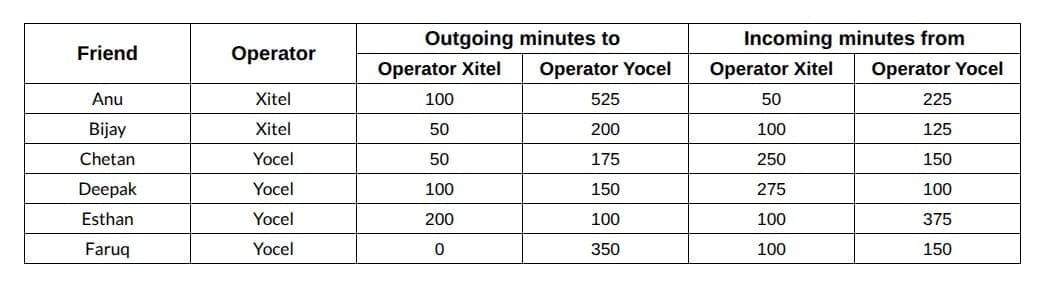
The final table is,
The duration of calls from Bijay to Ajay is 50 minutes, which is the outgoing minutes to operator Xitel of Bijay.
Hence, the correct answer is 50.
Q11: What was the total duration of calls (in minutes) made by Anu to friends having mobile numbers from Operator Yocel?
Ans: 525
Sol: This is the table given in the question with unknown values of a, b, c, d and e.
We are told that Anu and Bijay use the Xitel operator, and Chetan, Deepak, Esthan and Faruq use the Yocel operator.
The outgoing call from Anu to the Xitel operator has to be the incoming call from Xitel to Bijay because there are only two friends using Xitel, and if one of the Xitel users is calling another Xitel user, then those two have to be Anu and Bijay.
The outgoing to Xitel by Anu = 100
The incoming from Xitel for Bijay = c = The outgoing to Xitel by Anu = 100
So, the value of c in the above table is 100.
The outgoing to Xitel by Bijay = b
The incoming from Xitel for Anu = 50 = The outgoing to Xitel by Bijay = b
So, the value of b in the above table is 50.
The sum of Outgoing from Anu and Bijay to operator Yocel must be equal to the sum of Incoming minutes from Xitel for Chetan, Deepak, Esthan and Faruq.
The sum of Outgoing from Anu and Bijay to operator Yocel = a + 200
The sum of Incoming minutes from Xitel for Chetan, Deepak, Esthan and Faruq = 250 + 275 + 100 + 100 = 725
Equating them, we get,
a + 200 = 725
a = 525
So, the value of a in the above table is 525.
The sum of outgoing minutes from Chetan, Deepak, Esthan, and Faruq to operator Xitel must be equal to the sum of Incoming minutes from Yocel for Anu and Bijay.
The sum of outgoing minutes from Chetan, Deepak, Esthan, and Faruq to operator Xitel = 50 + 100 + d + 0 = 150 + d
The sum of Incoming minutes from Yocel for Anu and Bijay = 225 + 125 = 350
Equating them, we get,
150 + d = 350
d = 200
So, the value of d in the above table is 200.
The sum of outgoing minutes from Chetan, Deepak, Esthan, and Faruq to operator Yocel must be equal to the sum of Incoming minutes from Yocel for Chetan, Deepak, Esthan, and Faruq.
The sum of outgoing minutes from Chetan, Deepak, Esthan, and Faruq to operator Yocel = 175 + 150 + 100 + e = 425 + e
The sum of Incoming minutes from Yocel for Chetan, Deepak, Esthan, and Faruq = 150 + 100 + 375 + 150 = 775
Equating them, we get,
425 + e = 775
e = 350
So, the value of e in the above table is 350.
The final table is,
The total duration of calls made by Anu to friends having mobile numbers from Operator Yocel is Anu's outgoing minutes to Operator Yocel, which is 525 minutes.
Hence, the correct answer is 525.
Q12: What was the total duration of calls (in minutes) made by Faruq to friends having mobile numbers from Operator Yocel?
Ans: 350
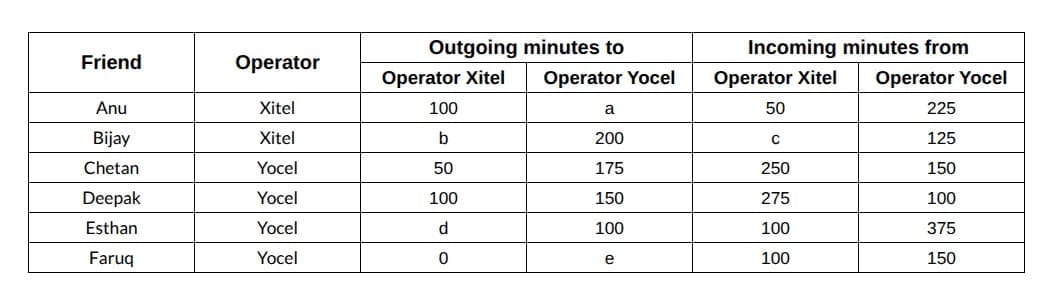
Sol: This is the table given in the question with unknown values of a, b, c, d and e.
We are told that Anu and Bijay use the Xitel operator, and Chetan, Deepak, Esthan and Faruq use the Yocel operator.
The outgoing call from Anu to the Xitel operator has to be the incoming call from Xitel to Bijay because there are only two friends using Xitel, and if one of the Xitel users is calling another Xitel user, then those two have to be Anu and Bijay.
The outgoing to Xitel by Anu = 100
The incoming from Xitel for Bijay = c = The outgoing to Xitel by Anu = 100
So, the value of c in the above table is 100.
The outgoing to Xitel by Bijay = b
The incoming from Xitel for Anu = 50 = The outgoing to Xitel by Bijay = b
So, the value of b in the above table is 50.
The sum of Outgoing from Anu and Bijay to operator Yocel must be equal to the sum of Incoming minutes from Xitel for Chetan, Deepak, Esthan and Faruq.
The sum of Outgoing from Anu and Bijay to operator Yocel = a + 200
The sum of Incoming minutes from Xitel for Chetan, Deepak, Esthan and Faruq = 250 + 275 + 100 + 100 = 725
Equating them, we get,
a + 200 = 725
a = 525
So, the value of a in the above table is 525.
The sum of outgoing minutes from Chetan, Deepak, Esthan, and Faruq to operator Xitel must be equal to the sum of Incoming minutes from Yocel for Anu and Bijay.
The sum of outgoing minutes from Chetan, Deepak, Esthan, and Faruq to operator Xitel = 50 + 100 + d + 0 = 150 + d
The sum of Incoming minutes from Yocel for Anu and Bijay = 225 + 125 = 350
Equating them, we get,
150 + d = 350
d = 200
So, the value of d in the above table is 200.
The sum of outgoing minutes from Chetan, Deepak, Esthan, and Faruq to operator Yocel must be equal to the sum of Incoming minutes from Yocel for Chetan, Deepak, Esthan, and Faruq.
The sum of outgoing minutes from Chetan, Deepak, Esthan, and Faruq to operator Yocel = 175 + 150 + 100 + e = 425 + e
The sum of Incoming minutes from Yocel for Chetan, Deepak, Esthan, and Faruq = 150 + 100 + 375 + 150 = 775
Equating them, we get,
425 + e = 775
e = 350
So, the value of e in the above table is 350.
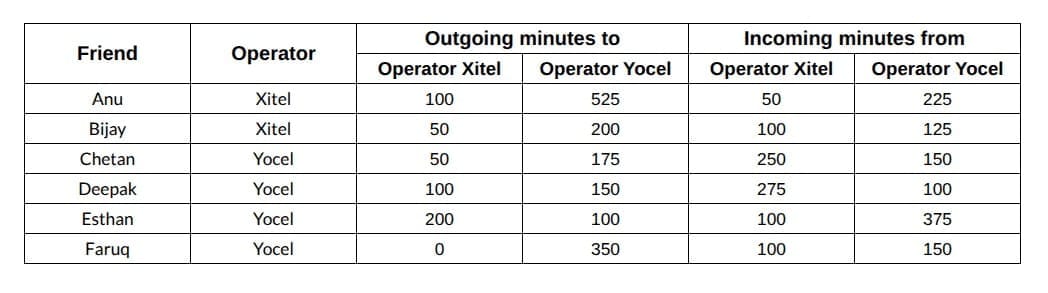
The final table is,
The total duration of calls made by Faruq to friends having mobile numbers from Operator Yocel is the outgoing minutes from Faruq to Operator Yocel, which is 350 minutes.
Hence, the correct answer is 350.
Q13: What was the duration of calls (in minutes) from Deepak to Chetan?
(a) 100
(b) 125
(c) 50
(d) 0
Ans: a
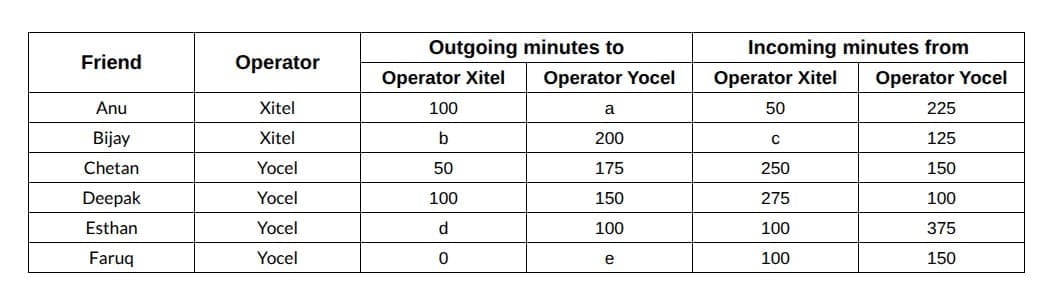
Sol: This is the table given in the question with unknown values of a, b, c, d and e.
We are told that Anu and Bijay use the Xitel operator, and Chetan, Deepak, Esthan and Faruq use the Yocel operator.
The outgoing call from Anu to the Xitel operator has to be the incoming call from Xitel to Bijay because there are only two friends using Xitel, and if one of the Xitel users is calling another Xitel user, then those two have to be Anu and Bijay.
The outgoing to Xitel by Anu = 100
The incoming from Xitel for Bijay = c = The outgoing to Xitel by Anu = 100
So, the value of c in the above table is 100.
The outgoing to Xitel by Bijay = b
The incoming from Xitel for Anu = 50 = The outgoing to Xitel by Bijay = b
So, the value of b in the above table is 50.
The sum of Outgoing from Anu and Bijay to operator Yocel must be equal to the sum of Incoming minutes from Xitel for Chetan, Deepak, Esthan and Faruq.
The sum of Outgoing from Anu and Bijay to operator Yocel = a + 200
The sum of Incoming minutes from Xitel for Chetan, Deepak, Esthan and Faruq = 250 + 275 + 100 + 100 = 725
Equating them, we get,
a + 200 = 725
a = 525
So, the value of a in the above table is 525.
The sum of outgoing minutes from Chetan, Deepak, Esthan, and Faruq to operator Xitel must be equal to the sum of Incoming minutes from Yocel for Anu and Bijay.
The sum of outgoing minutes from Chetan, Deepak, Esthan, and Faruq to operator Xitel = 50 + 100 + d + 0 = 150 + d
The sum of Incoming minutes from Yocel for Anu and Bijay = 225 + 125 = 350
Equating them, we get,
150 + d = 350
d = 200
So, the value of d in the above table is 200.
The sum of outgoing minutes from Chetan, Deepak, Esthan, and Faruq to operator Yocel must be equal to the sum of Incoming minutes from Yocel for Chetan, Deepak, Esthan, and Faruq.
The sum of outgoing minutes from Chetan, Deepak, Esthan, and Faruq to operator Yocel = 175 + 150 + 100 + e = 425 + e
The sum of Incoming minutes from Yocel for Chetan, Deepak, Esthan, and Faruq = 150 + 100 + 375 + 150 = 775
Equating them, we get,
425 + e = 775
e = 350
So, the value of e in the above table is 350.
The final table is,
Label the unknown value we need as
x = minutes from Deepak to ChetanUse the operator groups from the table:
Xitel users: Anu, Bijay.
Yocel users: Chetan, Deepak, Eshan, Faruq.
Chetan's incoming from Yocel = 150 minutes.
Yocel→Chetan can come only from Deepak, Eshan, or Faruq. But the problem states Eshan → Chetan = 0, so
(Deepak → Chetan) + (Faruq → Chetan)=150
Hence
x + (Faruq → Chetan) = 150 (1)
Faruq's outgoing to Yocel = 350 minutes (table). Those 350 minutes are split among Yocel recipients Chetan, Deepak and Eshan. We are told Faruq → Eshan = 200 (given). So
(Faruq → Chetan) +(Faruq → Deepak) + 200 = 350,
hence
(Faruq → Chetan) + (Faruq → Deepak) = 150 (2)
Consider Deepak's incoming from Yocel (table) = 100 minutes. The ones in Yocel that can call Deepak are Chetan, Eshan, and Faruq. But we are told Chetan → Deepak = 0 and Eshan → Deepak = 0, so the only Yocel caller to Deepak is Faruq. Therefore
(Faruq → Deepak) = 100 (3)
Substitute (3) into (2):
(Faruq → Chetan) + 100 = 150 ⇒ (Faruq → Chetan) = 50
Now use (1):
x + (Faruq → Chetan) = 150x
With Faruq → Chetan = 50, we get,
x + 50 = 150
x = 100
Thus Deepak → Chetan = 100 minutes.
Hence, the correct answer is option A.
2021
Passage
Each of the bottles mentioned in this question contains 50 ml of liquid. The liquid in any bottle can be 100% pure content (P) or can have certain amount of impurity (I). Visually it is not possible to distinguish between P and I. There is a testing device which detects impurity, as long as the percentage of impurity in the content tested is 10% or more.
For example, suppose bottle 1 contains only P, and bottle 2 contains 80% P and 20% I. If content from bottle 1 is tested, it will be found out that it contains only P. If content of bottle 2 is tested, the test will reveal that it contains some amount of I. If 10 ml of content from bottle 1 is mixed with 20 ml content from bottle 2, the test will show that the mixture has impurity, and hence we can conclude that at least one of the two bottles has I. However, if 10 ml of content from bottle 1 is mixed with 5 ml of content from bottle 2. the test will not detect any impurity in the resultant mixture.
Q1: 5 ml of content from bottle A is mixed with 5 ml of content from bottle B. The resultant mixture, when tested, detects the presence of I. If it is known that bottle A contains only P, what BEST can be concluded about the volume of I in bottle B?
(a) 1 ml
(b) Less than 1 ml
(c) 10 ml
(d) 10 ml or more
Ans: d
Sol: Given that each of the bottles contains a volume of 50 ml each.
If 5 ml from bottle A which contains only P is mixed with 5 ml of bottle B and in the resultant mixture the presence of I was detected.
In order to detect the presence of I in this, there must be at least 10% impurity in the 10 ml which is equivalent to 1 ml. This must be from bottle B.
Hence 5 ml of solution from B must contain at least 1ml of impurity and since bottle B is of a total volume of 50 ml. This must contain at least 10 ml of impurity.
Q2: There are four bottles. Each bottle is known to contain only P or only I. They will be considered to be "collectively ready for despatch" if all of them contain only P. In minimum how many tests, is it possible to ascertain whether these four bottles are "collectively ready for despatch"?
Ans: 1
Sol: The bottles contain either P(pure) or I(impure). The possible cases here are :
1- (P, P, P, P), 2-(P,P,P,I), 3-(P,P,I,I), 4-(P,I,I,I), 5-(I,I,I,I).
In the first case if all the four solutions are pure then taking equal volumes of all the four bottles will get the result to dispatch or not to dispatch.
In the second case if 3 bottles are pure and one impure taking equal volumes of all four bottles and testings will confirm the impurity and hence cannot be dispatched.
In the third case if 2 bottles are pure and two are impure taking equal volumes of all four bottles and testing will confirm the impurity and hence cannot be dispatched.
In the fourth case when only one bottle is pure taking equal volumes of all four bottles will confirm the impurity and hence cannot be dispatched.
In the fifth case if all four bottles are impure taking equal volumes of the four bottles will confirm the impurity and hence cannot be dispatched.
In all the cases a single test is enough to determine if the lot is to be dispatched or not.
Q3: There are four bottles. It is known that three of these bottles contain only P, while the remaining one contains 80% P and 20% I.
What is the minimum number of tests required to definitely identify the bottle containing some amount of I?
Ans: 2
Sol: The percentage concentration of the impure solution is 80 percent.
When equal volumes of all four solutions are mixed.
Considering 10 ml of each we have impurity to be 2ml/40ml. The impurity concentration is less than 10 percent and hence cannot be recognized.
Similarly when equal volumes of one impure and 2 pure solutions are mixed. The impurity in the solution is 2ml/30ml which is less than 10 percent and hence cannot be recognized.
Hence for detecting the impure solution we must use equal volumes of 2 solutions at a time.
Considering the three pure solutions to be P and the impure solution to be I.
P, P, P, I.
Considering equal volumes of solution from the bottle one bottle of P, and I. Testing this would recognize the impurity.
After this consider one bottle among the other 2 P bottles which are left and test this with one among the previously tested P, I.
If the one considered is I it will detect the impurity and confirms the bottle to be I.
If the one considered is P it will fail to detect the impurity and hence the other bottle will be I.
Hence a minimum of two tests are required to identify the bottle with the impurity.
Q4: There are four bottles. It is known that either one or two of these bottles contain(s) only P, while the remaining ones contain 85% P and 15% I. What is the minimum number of tests required to ascertain the exact number of bottles containing only P?
(a) 4
(b) 2
(c) 3
(d) 1
Ans: d
Sol: The bottles could possibly be : Case - 1 Pure, Impure, Impure, Impure.
Case-2, Pure , Pure, Impure, Impure.
Since the concentration in the impure bottle is 85 percent.
In case 1 when equal volumes from all the bottles are considered and mixed. The test result detects the impurity..
Since the overall concentration of impurity is greater than 10 percent.
Considering 10 ml from all four bottles.
The impure concentration is 4.5ml/40ml which is greater than 10.(15ml*3 = 4.5ml) (Impurity is detected) For case 2 when all four bottles are considered. The case here has 2 pure and 2 impure bottles.
When equal volumes from all four bottles are mixed. The resultant concentration of impurity when 10 ml from each of the four solutions is considered : The impure concentration is 3ml/40ml which is less than 10 percent.. (1.5ml*2 = 3ml). (Impurity is not detected.) Hence in one possibility the impurity is detected and not detected in the other case. A single test is enough based on the results of which the number of pure and the number of impure bottles can be identified.
The document CAT Previous Year Questions: Binary Logic is a part of the CAT Course Logical Reasoning (LR) & Data Interpretation (DI).
All you need of CAT at this link: CAT
FAQs on CAT Previous Year Questions: Binary Logic
| 1. What is Binary Logic and why is it important for the CAT exam? |  |
Ans. Binary Logic is a fundamental concept in computer science and mathematics that deals with true or false values, represented as 1s and 0s. It is important for the CAT exam because it tests critical thinking and problem-solving skills, which are essential for management studies and professional careers.
| 2. How can I prepare for Binary Logic questions in the CAT exam? | |
Ans. To prepare for Binary Logic questions in the CAT exam, practice solving different types of logical reasoning puzzles, familiarize yourself with truth tables, and work on sample questions from previous years. Additionally, taking mock tests can help improve your speed and accuracy.
| 3. What types of questions can I expect related to Binary Logic in the CAT exam? | |
Ans. In the CAT exam, you can expect questions that involve logical deductions, truth tables, logical operators (AND, OR, NOT), and syllogisms. These questions often require you to evaluate statements and draw conclusions based on given premises.
| 4. Are there any common mistakes to avoid when answering Binary Logic questions? | |
Ans. Yes, common mistakes include misunderstanding the logical operators, misreading the question, and overlooking negations. It's important to read each statement carefully and double-check your reasoning to avoid these pitfalls.
| 5. How much time should I allocate to Binary Logic questions during the CAT exam? | |
Ans. It is advisable to allocate around 15-20 minutes for Binary Logic questions in the CAT exam. This allows you to carefully analyze each question and apply your logical reasoning skills without rushing, ensuring better accuracy in your answers.
About this Document

4.61/5 Rating

Apr 26, 2026 Last updated
Document Description: CAT Previous Year Questions: Binary Logic for CAT 2026 is part of Logical Reasoning (LR) & Data Interpretation (DI) preparation. The notes and questions for CAT Previous Year Questions: Binary Logic have been prepared according to the CAT exam syllabus. Information about CAT Previous Year Questions: Binary Logic covers topics like and CAT Previous Year Questions: Binary Logic Example, for CAT 2026 Exam. Find important definitions, questions, notes, meanings, examples, exercises and tests below for CAT Previous Year Questions: Binary Logic.
Introduction of CAT Previous Year Questions: Binary Logic in English is available as part of our Logical Reasoning (LR) & Data Interpretation (DI) for CAT & CAT Previous Year Questions: Binary Logic in Hindi for Logical Reasoning (LR) & Data Interpretation (DI) course. Download more important topics related with notes, lectures and mock test series for CAT Exam by signing up for free. CAT: CAT Previous Year Questions: Binary Logic
Description
CAT Previous Year Questions: Binary Logic of Logical Reasoning is important for the exam. Get access to all the questions with solutions asked in past years of CAT exam. Download it from EduRev.
Information about CAT Previous Year Questions: Binary Logic
In this doc you can find the meaning of CAT Previous Year Questions: Binary Logic defined & explained in the simplest way possible. Besides explaining types of CAT Previous Year Questions: Binary Logic theory, EduRev gives you an ample number of questions to practice CAT Previous Year Questions: Binary Logic tests, examples and also practice CAT tests



Related Searches
past year papers, Sample Paper, shortcuts and tricks, Semester Notes, study material, Important questions, pdf , CAT Previous Year Questions: Binary Logic, ppt, practice quizzes, Free, video lectures, Objective type Questions, Summary, MCQs, Exam, CAT Previous Year Questions: Binary Logic, CAT Previous Year Questions: Binary Logic, mock tests for examination, Extra Questions, Viva Questions, Previous Year Questions with Solutions;