CLAT Exam > CLAT Notes > Legal Reasoning > Mind Map: Law of Torts
Mind Map: Law of Torts

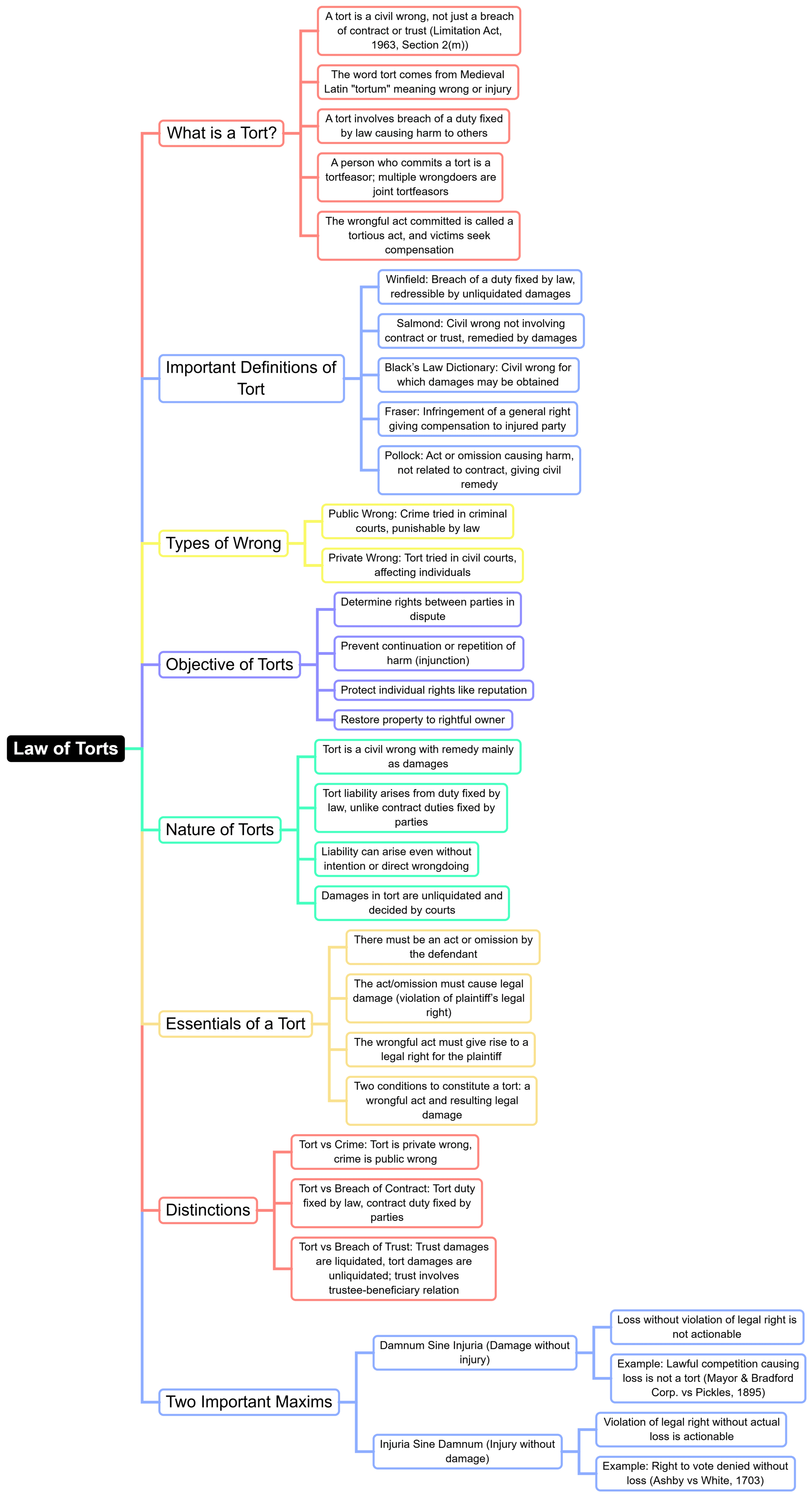
The document Mind Map: Law of Torts is a part of the CLAT Course Legal Reasoning for CLAT.
All you need of CLAT at this link: CLAT
FAQs on Mind Map: Law of Torts
| 1. What are the main elements you need to prove for a tort case to succeed? |  |
Ans. To establish tort liability, a student must demonstrate duty of care, breach of that duty, causation, and measurable damages. Duty of care means the defendant owed a legal obligation to the plaintiff. Breach occurs when the defendant fails to meet that standard. Causation links the breach directly to injury, while damages quantify the harm suffered. These four pillars form the foundation of tort law and appear frequently in CLAT reasoning questions.
| 2. How is negligence different from intentional torts in the Law of Torts? | |
Ans. Negligence involves unintentional harm caused by failure to exercise reasonable care, whereas intentional torts result from deliberate, wrongful acts. In negligence cases, the defendant's state of mind is irrelevant-only their conduct matters. Intentional torts like assault, battery, or false imprisonment require proof of intentional wrongdoing. Understanding this distinction is crucial for analysing CLAT legal reasoning scenarios and identifying which tort principles apply.
| 3. What counts as compensation or damages in a tort claim? | |
Ans. Damages in tort law include compensatory damages (covering actual losses like medical bills and lost wages), special damages (quantifiable financial losses), and general damages (non-monetary harm like pain and suffering). Punitive damages may apply in egregious cases to deter misconduct. Students studying the law of torts must distinguish between these categories, as CLAT examiners test whether candidates understand what remedies courts award for different types of wrongs.
| 4. Can someone be held liable for torts they didn't directly cause themselves? | |
Ans. Yes, through vicarious liability, employers and principals can be held responsible for torts committed by their employees or agents during the course of employment. Occupiers of premises may also face liability for injuries on their property under occupiers' liability doctrine. This concept challenges students because it extends tort responsibility beyond the person who committed the wrongful act, making it essential for comprehensive CLAT legal reasoning preparation.
| 5. What's the difference between absolute liability and strict liability in tort cases? | |
Ans. Strict liability requires proof of breach and causation but not negligence or intent; the defendant is liable regardless of care exercised. Absolute liability is harsher-the defendant is liable even without breach, applying mainly to hazardous activities like Rylands v. Fletcher cases. Absolute liability offers injured parties stronger protection but limits defendant defences significantly. Distinguishing these concepts strengthens answers in CLAT tort-based reasoning questions and helps students identify applicable legal principles accurately.
About this Document

4.87/5 Rating

Apr 18, 2026 Last updated
Related Exams
Document Description: Mind Map: Law of Torts for CLAT 2026 is part of Legal Reasoning for CLAT preparation. The notes and questions for Mind Map: Law of Torts have been prepared according to the CLAT exam syllabus. Information about Mind Map: Law of Torts covers topics like and Mind Map: Law of Torts Example, for CLAT 2026 Exam. Find important definitions, questions, notes, meanings, examples, exercises and tests below for Mind Map: Law of Torts.
Introduction of Mind Map: Law of Torts in English is available as part of our Legal Reasoning for CLAT for CLAT & Mind Map: Law of Torts in Hindi for Legal Reasoning for CLAT course. Download more important topics related with notes, lectures and mock test series for CLAT Exam by signing up for free. CLAT: Mind Map: Law of Torts
Description
Mind Map: Law of Torts of Legal Reasoning provides you one-page visual summary of the chapter covering all the important topics. Download the PDF from EduRev.
Information about Mind Map: Law of Torts
In this doc you can find the meaning of Mind Map: Law of Torts defined & explained in the simplest way possible. Besides explaining types of Mind Map: Law of Torts theory, EduRev gives you an ample number of questions to practice Mind Map: Law of Torts tests, examples and also practice CLAT tests


Related Searches
Extra Questions, Mind Map: Law of Torts, video lectures, Viva Questions, Sample Paper, practice quizzes, Exam, shortcuts and tricks, MCQs, ppt, Previous Year Questions with Solutions, study material, Objective type Questions, pdf , Mind Map: Law of Torts, Important questions, Mind Map: Law of Torts, past year papers, Semester Notes, Summary, mock tests for examination, Free;