CLAT Exam > CLAT Notes > Legal Reasoning > Mind Map: Criminal Law (BNS, 2023)
Mind Map: Criminal Law (BNS, 2023)

Criminal Law (BNS, 2023)-1
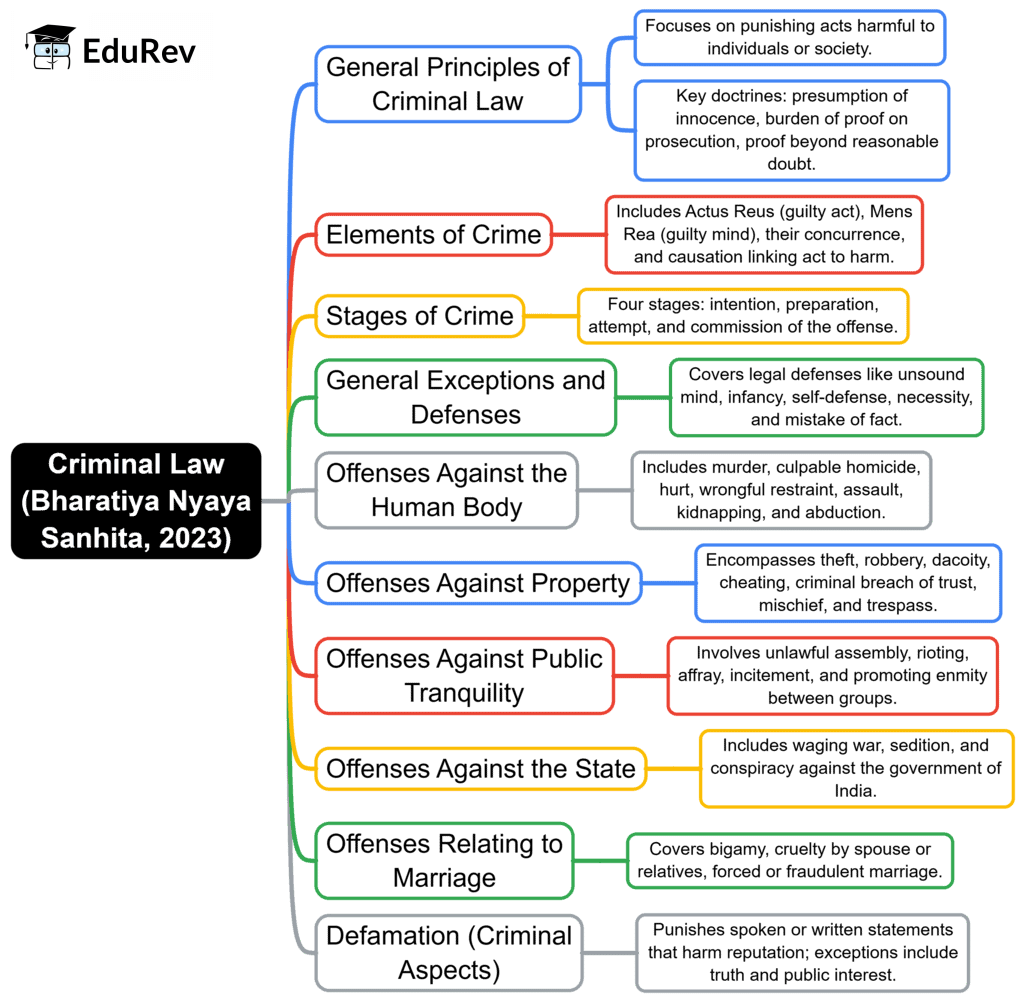
Criminal Law (BNS, 2023)-2
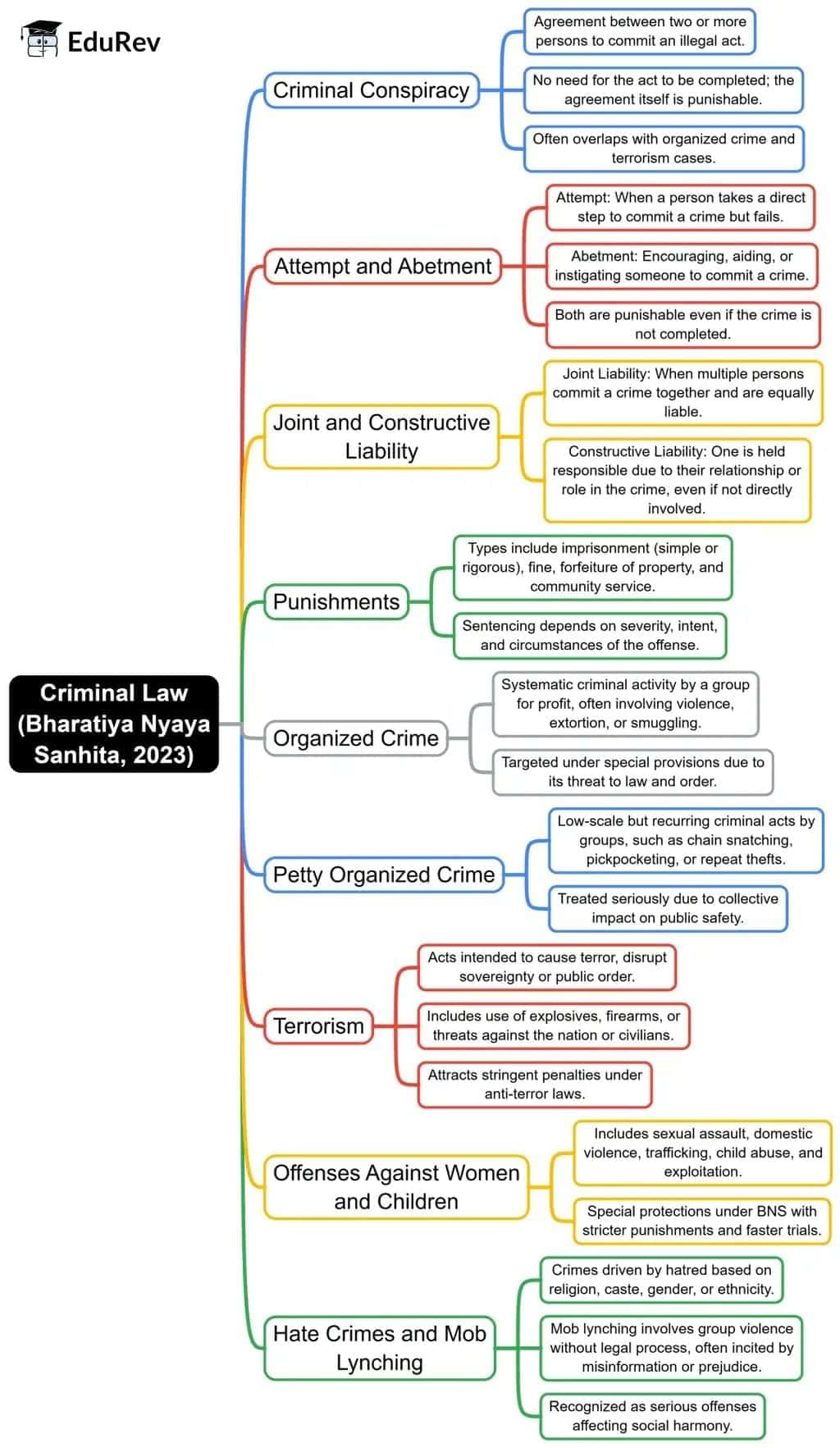
The document Mind Map: Criminal Law (BNS, 2023) is a part of the CLAT Course Legal Reasoning for CLAT.
All you need of CLAT at this link: CLAT
FAQs on Mind Map: Criminal Law (BNS, 2023)
| 1. What are the main sections of the Bharatiya Nyaya Sanhita 2023 that I need to focus on for CLAT? |  |
Ans. The BNS 2023 replaces the Indian Penal Code and divides criminal law into three primary parts: general principles of criminal liability, specific offences, and procedural matters. For CLAT preparation, focus on general principles (mens rea, actus reus, complicity), offences against persons and property, and defences. Understanding how these sections interconnect through a criminal law mind map helps clarify the hierarchical structure and application of provisions in legal reasoning questions.
| 2. How do mens rea and actus reus differ in criminal law under BNS 2023, and why does this matter for CLAT? | |
Ans. Mens rea (guilty mind/criminal intention) and actus reus (guilty act/criminal conduct) are two foundational elements required to establish criminal liability under BNS 2023. Mens rea involves intent, knowledge, or recklessness, while actus reus refers to the physical wrongful act itself. CLAT legal reasoning questions frequently test whether both elements coexist in a scenario-a crime typically requires both, though some statutory offences demand only actus reus, making this distinction critical for accurate case analysis.
| 3. What counts as criminal negligence versus recklessness in BNS 2023, and how do examiners test this? | |
Ans. Criminal negligence involves gross deviation from a reasonable person's standard of care, while recklessness means conscious disregard for consequences despite knowing the risk. Under BNS 2023, negligence requires the defendant to breach duty of care; recklessness demands awareness of danger. CLAT examiners test this distinction through scenario-based legal reasoning questions where students must classify conduct as negligent or reckless to determine applicable criminal provisions and liability.
| 4. Which defences under BNS 2023 can completely eliminate criminal liability, and which only reduce it? | |
Ans. Complete defences eliminating liability include insanity, automatism, and consent (where applicable), while partial defences like provocation and diminished responsibility reduce liability from murder to culpable homicide. BNS 2023 restructures these defences with updated language and scope. For CLAT preparation, use mind maps to visualise the hierarchy of defences-when each applies, their conditions, and outcomes-enabling quick categorisation during exam reasoning tasks involving criminal culpability assessments.
| 5. How should I structure my BNS 2023 criminal law revision to ace CLAT legal reasoning questions? | |
Ans. Organise revision around three layers: foundational principles (elements of crime, liability), specific offence categories (violence, property, sexual crimes), and defences with real-world applications. Create interconnected mind maps linking provisions to landmark cases. Study how CLAT questions integrate multiple BNS 2023 sections within single scenarios. Use flashcards for definitions and offence elements on EduRev to reinforce recall speed-essential for managing time during legal reasoning sections where criminal law increasingly features across questions.
About this Document

4.66/5 Rating

Apr 18, 2026 Last updated
Related Exams
Document Description: Mind Map: Criminal Law (BNS, 2023) for CLAT 2026 is part of Legal Reasoning for CLAT preparation. The notes and questions for Mind Map: Criminal Law (BNS, 2023) have been prepared according to the CLAT exam syllabus. Information about Mind Map: Criminal Law (BNS, 2023) covers topics like and Mind Map: Criminal Law (BNS, 2023) Example, for CLAT 2026 Exam. Find important definitions, questions, notes, meanings, examples, exercises and tests below for Mind Map: Criminal Law (BNS, 2023).
Introduction of Mind Map: Criminal Law (BNS, 2023) in English is available as part of our Legal Reasoning for CLAT for CLAT & Mind Map: Criminal Law (BNS, 2023) in Hindi for Legal Reasoning for CLAT course. Download more important topics related with notes, lectures and mock test series for CLAT Exam by signing up for free. CLAT: Mind Map: Criminal Law (BNS, 2023)
Description
Mind Map: Criminal Law (BNS, 2023) of Legal Reasoning provides you one-page visual summary of the chapter covering all the important topics. Download the PDF from EduRev.
Information about Mind Map: Criminal Law (BNS, 2023)
In this doc you can find the meaning of Mind Map: Criminal Law (BNS, 2023) defined & explained in the simplest way possible. Besides explaining types of Mind Map: Criminal Law (BNS, 2023) theory, EduRev gives you an ample number of questions to practice Mind Map: Criminal Law (BNS, 2023) tests, examples and also practice CLAT tests


Related Searches
Viva Questions, Objective type Questions, 2023), mock tests for examination, past year papers, Extra Questions, Important questions, Exam, shortcuts and tricks, ppt, Sample Paper, Free, video lectures, Previous Year Questions with Solutions, 2023), study material, Mind Map: Criminal Law (BNS, Mind Map: Criminal Law (BNS, Semester Notes, Mind Map: Criminal Law (BNS, pdf , Summary, MCQs, practice quizzes, 2023);