UPSC Exam > UPSC Notes > CSAT Preparation > Mind Map: Seating Arrangement
Mind Map: Seating Arrangement

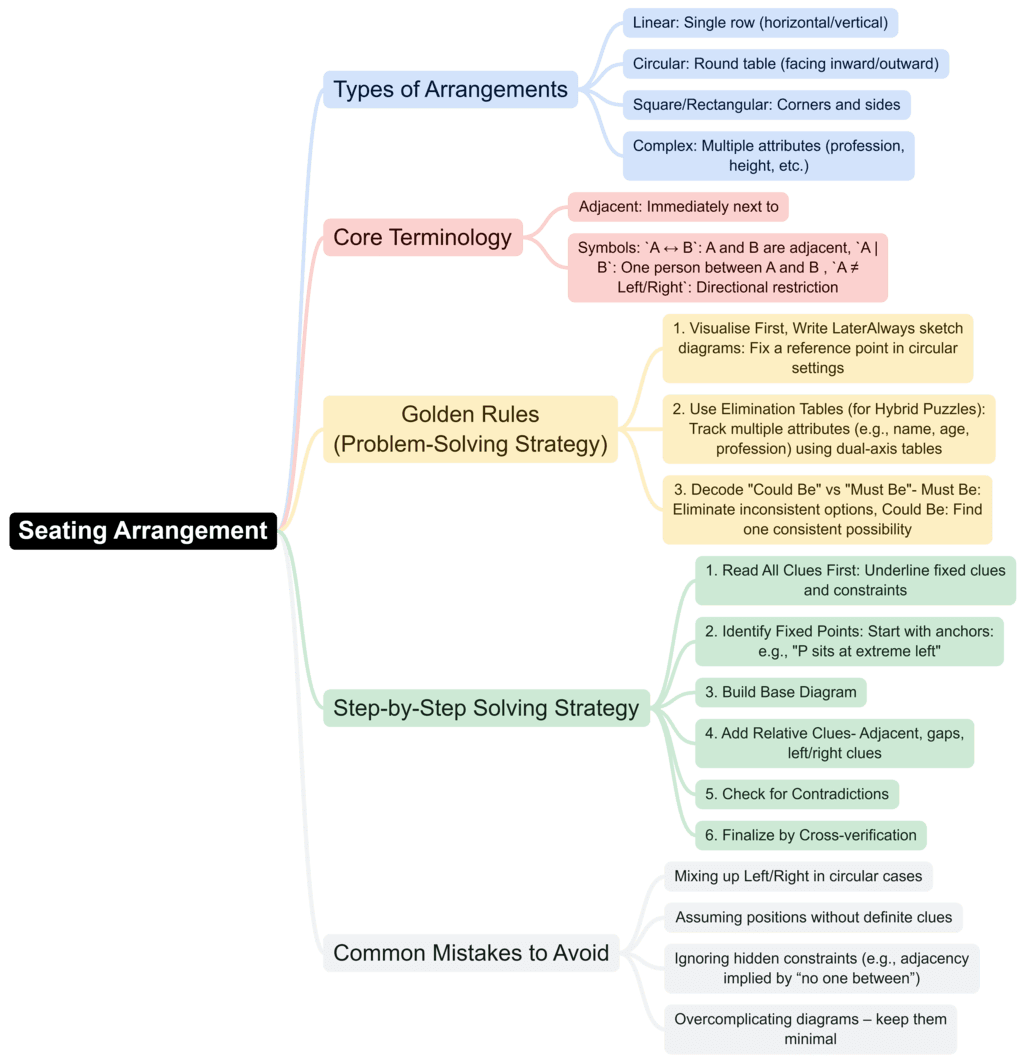
The document Mind Map: Seating Arrangement is a part of the UPSC Course CSAT Preparation.
All you need of UPSC at this link: UPSC
FAQs on Mind Map: Seating Arrangement
| 1. What is a seating arrangement and why is it important in exams? |  |
Ans. A seating arrangement refers to the way in which students are positioned in an exam hall or classroom. It is crucial for maintaining order and discipline during exams, minimizing distractions, and preventing cheating. A well-planned seating arrangement can also help in managing the flow of students entering and exiting the exam room.
| 2. How can I prepare for a seating arrangement-based exam? | |
Ans. To prepare for a seating arrangement-based exam, practice understanding different types of seating puzzles that may be presented. Familiarize yourself with common terms and relationships used in these questions, such as "to the left of," "next to," or "opposite." Additionally, practice past papers to improve your speed and accuracy in answering such questions.
| 3. What types of questions related to seating arrangements can I expect in an exam? | |
Ans. In an exam, you may encounter various types of seating arrangement questions, including linear arrangements, circular arrangements, or rectangular arrangements. Questions may ask you to determine specific positions of individuals, relationships between individuals, or how many ways a group can be arranged based on given conditions.
| 4. Are there any tips for solving seating arrangement problems quickly? | |
Ans. Yes, some tips for solving seating arrangement problems quickly include drawing diagrams to visualize arrangements, using symbols to represent individuals, and marking relationships clearly. Practice regularly to improve your speed, and read questions thoroughly to ensure you understand the requirements before attempting to answer.
| 5. How does the seating arrangement differ for different types of exams (e.g., online vs. offline)? | |
Ans. For offline exams, seating arrangements are often fixed to maintain an organized environment and to minimize cheating. In contrast, online exams may not require a physical seating arrangement, but they may have guidelines on how students should set up their workspace to ensure integrity during the exam. Each type has its own set of rules and requirements based on the testing format.
About this Document

1.2K Views

4.61/5 Rating

Apr 19, 2026 Last updated
Related Exams
Document Description: Mind Map: Seating Arrangement for UPSC 2026 is part of CSAT Preparation preparation. The notes and questions for Mind Map: Seating Arrangement have been prepared according to the UPSC exam syllabus. Information about Mind Map: Seating Arrangement covers topics like and Mind Map: Seating Arrangement Example, for UPSC 2026 Exam. Find important definitions, questions, notes, meanings, examples, exercises and tests below for Mind Map: Seating Arrangement.
Introduction of Mind Map: Seating Arrangement in English is available as part of our CSAT Preparation for UPSC & Mind Map: Seating Arrangement in Hindi for CSAT Preparation course. Download more important topics related with notes, lectures and mock test series for UPSC Exam by signing up for free. UPSC: Mind Map: Seating Arrangement
Description
Mind Map: Seating Arrangement of CSAT Preparation provides you one-page visual summary of the chapter covering all the important topics. Download the PDF from EduRev.
Information about Mind Map: Seating Arrangement
In this doc you can find the meaning of Mind Map: Seating Arrangement defined & explained in the simplest way possible. Besides explaining types of Mind Map: Seating Arrangement theory, EduRev gives you an ample number of questions to practice Mind Map: Seating Arrangement tests, examples and also practice UPSC tests



Related Searches
MCQs, Semester Notes, mock tests for examination, practice quizzes, Mind Map: Seating Arrangement, Mind Map: Seating Arrangement, shortcuts and tricks, video lectures, Important questions, Objective type Questions, pdf , past year papers, Sample Paper, Extra Questions, study material, Summary, Previous Year Questions with Solutions, Exam, ppt, Viva Questions, Mind Map: Seating Arrangement, Free;