Half Yearly Class 7 Social Studies Set 3 (Solutions)

Maximum Marks: 80
Time: 3 Hours
General Instructions:
(i) The question paper consists of 34 questions divided into four sections: A, B, C, and D.
(ii) All questions are compulsory.
(iii) Section A: Questions 1 to 15 are multiple-choice questions, carrying 1 mark each. Select the most appropriate response.
(iv) Section B: Questions 16 to 22 are short-answer questions, carrying 2 marks each.
(v) Section C: Questions 23 to 31 are short-answer questions, carrying 4 marks each.
(vi) Section D: Questions 31 to 32 are short-answer questions, carrying 5 marks each.
(vii) Section E: Question 33 : Case Based Question, carrying 5 marks and Question 34 : Map Based Question, carrying 4 marks.
(viii) Write answers neatly and legibly.
Syllabus: Geographical Diversity of India, Understanding the Weather, Climates of India, New Beginnings: Cities and States, The Rise of Empires, The Age of Reorganisation, The Gupta Era: An Age of Tireless Creativity, How the Land Becomes Sacred, From the Rulers to the Ruled: Types of Governments, The Constitution of India: An Introduction, From Barter to Money, Understanding Markets.
Section A
(a) Kanchipuram
(a) Measure temperature
(b) Measure wind speed and direction
(c) Measure humidity
(d) Measure pressure
Ans: (b) Measure wind speed and direction
Solution: The anemometer is the simplest instrument used to measure wind speed, calculating the rate of rotation on a vertical shaft to determine the speed in kilometers per hour (km/h).
(a) Kanchipuram
(b) Vaishali
(c) Ujjain
(d) Pataliputra
Ans: (b) Vaishali
Solution: Vaishali was a historically significant ancient city that served as a center for both Jainism and Buddhism during the mahājanapada period,.
(a) Kanchipuram
a) Gupta ruler
b) Chedi king
c) Satavahana queen
d) Pallava poet
Ans: b) Chedi king
Solution: Khāravela was the most notable ruler of the Chedi dynasty and was known as a devoted follower of Jain teachings.
(a) Paper notes
(b) Grains
(c) Credit cards
(d) Digital tokens
Ans: (b) Grains
Solution: Grains were commonly exchanged in the barter system alongside other commodities like salt, cloth, and cattle.
(a) Kanchipuram
a) Kalidasa
b) Aryabhata
c) Harisena
d) Prabhavati Gupta
Ans: b) Aryabhata
Solution: Āryabhaṭa authored a treatise on astronomy and mathematics and provided a correct explanation for solar and lunar eclipses.
(a) Sundarbans
(b) Thar Desert
(c) Deccan Plateau
(d) Himalayas
Ans: (a)
Solution: The Sundarbans, located in the delta formed by the Ganga and Brahmaputra, support mangrove forests due to the unique combination of river, sea, and land.
(a) Kanchipuram
a) B.R. Ambedkar
b) Rajendra Prasad
c) Sachidananda Sinha
d) Begum Aizaz Rasul
Ans: b) Rajendra Prasad
Solution: The Constituent Assembly, formed in 1946 to write the Indian Constitution, was chaired by Dr. Rajendra Prasad.
(a) The king
(b) Elected representatives
(c) The military
(d) Religious leaders
Ans: (b)
Solution: In a democracy, the creation of rules is referred to as the legislative function, which is carried out by elected representatives chosen by the people.
(a) Kanchipuram
a) Guptas
b) Cholas, Cheras, Pandya
c) Vakatakas
d) Kamarupa
Ans: b) Cholas, Cheras, Pandya
Solution: The period defined by the Sangam literature, known as the Sangam Age, is referenced through the works describing the three crowned kings: the Cholas, the Cheras, and the Pānḍyas.
(a) Thar Desert
(b) Western Ghats
(c) Aravali Range
(d) Indo-Gangetic Plains
Ans: (b) Western Ghats
Solution: The Western Ghats act as a natural barrier, intercepting the moisture-laden southwest monsoon winds and causing heavy rainfall on their western slopes.
(a) Kanchipuram
a) Heavy rain overflow
b) Glacier melt breaching lake barriers
c) Forest fire spread
d) Cyclone eye
Ans: b) Glacier melt breaching lake barriers
Solution: A glacial burst occurs when water from a glacial lake breaks through the natural barrier of rocks and ice, often triggered by rapid melting or excessive rainfall.
(a) It used heavy coins
(b) It lacked divisibility
(c) It was too fast
(d) It used digital payments
Ans: (b) It lacked divisibility
Solution: Barter suffered from physical constraints of commodities, specifically the lack of divisibility, making it difficult to exchange only a portion of a large item.
(a) Kanchipuram
a) Equality before law
b) Brotherhood among citizens
c) Freedom of speech
d) Sovereign decisions
Ans: b) Brotherhood among citizens
Solution: Fraternity is a core value in the Preamble meaning that all citizens should behave as members of the same family and treat each other equally.
(a) Gupta Empire
(b) Maurya Empire
(c) Chola Empire
(d) Vijayanagara Empire
Ans: (b) Maurya Empire
Solution: The Mauryan state utilized centralized minting and standardized currency, allowing them to implement an efficient tax collection system and strengthen the treasury,.
(a) Kanchipuram
a) ISI
b) FSSAI
c) Agmark
d) BIS
Ans: b) FSSAI
Solution: The FSSAI (Food Safety & Standards Authority of India) logo ensures consumers that the food has been tested by the government and is safe to consume.
Section B
Ans: A barometer is the instrument used to measure atmospheric pressure, which is the pressure exerted by the weight of the air above and around us. The unit it displays is generally the millibar (mb). Measuring atmospheric pressure is important because a dramatic drop in pressure can result in a "depression" or "low-pressure system," which may develop into a storm or cyclone.
Ans: Two ancient Indian ports were Lothal and Bharuch. Ports were centers of economic activity for millennia, facilitating crucial maritime trade with external regions like Mesopotamia. These coastal centers were vital for the export and import of valuable commodities, connecting India's internal trade routes to global networks.
Ans: The Kuṣhāṇas held control over significant sections of the Silk Route, which connected India with the Mediterranean world through Central Asia and Persia. By controlling these major trade routes during their peak, the Kuṣhāṇa reign facilitated extensive trade between India, Asia, and the West. This commercial activity promoted economic growth and cultural intermixing in the subcontinent.
Ans: A republic is a form of government where the head of state is elected (not a hereditary monarch) and relies on elected representatives. A monarchy is ruled by a single monarch (king or queen) whose position is typically hereditary, passing from one generation to the next within the royal family.
Ans: Directive Principles of State Policy (DPSP) represent the essence of the social and economic vision for India, acting as guidelines that the government should try to achieve. Two examples of these principles include the goal to protect and improve the natural environment, covering forests, lakes, rivers, and wildlife, and enhancing the standard of living, nutrition, and public health.
Ans: Two sacred mountains are Mount Kailash and Nanda Devi. Mountains are revered because they are often viewed as a symbolic gateway from earth to heaven due to their height, and are associated with deities.
Ans: Wholesalers are participants in the market who buy goods in bulk quantities directly from the manufacturer or producer. They manage the storage of this produce in large warehouses called godowns, which may include cold storage facilities for perishable items. Wholesalers act as a crucial supply channel by distributing products to retailers, helping to maintain stock and ensure an uninterrupted flow of goods to the end consumers across the country and internationally.
Section C
Ans: Humidity is the amount of water vapour present in the air, recognized as an important element of weather.
1. The presence of humidity affects how individuals perceive temperature: high humidity makes hot weather feel hotter because it slows down the rate at which sweat evaporates from the body, while low humidity can make the air feel drier and cooler,. Humidity is measured precisely using an instrument called a hygrometer,.
2. The hygrometer measures relative humidity, which is defined as the ratio of the current amount of water vapour in the air to the maximum amount the air can hold at that specific temperature,.
3. This measurement is expressed as a percentage, ranging from 0% (completely dry air) to 100% (air fully saturated, which leads to condensation like dew or fog).
Ans: Vaishali was a highly significant ancient city, playing crucial roles both politically and religiously during the mahājanapada period,.1. Political Significance (Early Republic): Vaishali served as the capital of the Vajji (or Vṛijji) mahājanapada,. This state was distinctive because it was organized as a gaṇa or sangha, classifying it as an early republic, which was a form of government where the head of state was elected,. Instead of a hereditary monarchy, leaders were chosen based on merit, and key decisions were collectively made through discussion and sometimes a vote in an assembly,.2. Religious Significance: Vaishali was an important site for both Jainism and Buddhism,. These spiritual traditions flourished during the Second Urbanisation, and centers like Vaishali attracted scholars and pilgrims. These individuals then played a key role in disseminating teachings and literature to other regions,.
Ans: The Chedis were a kingdom that emerged in eastern India during the Age of Reorganisation (2nd century BCE to 3rd century CE), with their capital located at Suktimati,. Their most notable ruler was Khāravela, a devoted follower of Jain teachings who was sometimes called bhikṣhu-rāja (monk-king),.1. Military and Welfare Contributions: Khāravela's accomplishments, including his victorious military campaigns (such as defeating the Sātavāhanas and expanding his territory) and benevolent works, are recorded in the Hāthīgumphā inscription located in the Udayagiri hills, Odisha,. The inscription details his efforts toward public welfare, such as building canals for irrigation, planting gardens, and providing relief during famines,. He also showed respect for all sects, promoting cultural tolerance,.2. Architectural Contributions: In terms of architecture, the Chedis contributed to the development of rock-cut caves at Udayagiri and Khandagiri in Odisha. These caves, which feature intricate carvings, pillars, and living quarters, served as monasteries for Jaina monks and represent notable examples of early rock-cut architecture in India.
Ans: An oligarchy is a type of government where a small, powerful group, usually consisting of influential or wealthy families, makes all the key decisions,. This system presents several limitations when compared to a democracy:1. Limited Participation: In an oligarchy, power is strictly limited to a few, often suppressing broader citizen participation,. In sharp contrast, a democracy mandates representative participation through universal adult franchise, where every person has the right to choose their representatives.2. Lack of Accountability and Equality: Oligarchies often lead to inequality because the small ruling group tends to govern primarily for its own benefit and is generally not accountable to the citizens,. Conversely, a democracy ensures equality before the law for every person and requires the government to be accountable to the people through regular elections.3. Suppression of Rights: Non-democratic systems like oligarchy often result in the curtailment of fundamental freedoms, such as speech and expression. In a democracy, these fundamental rights are protected and guaranteed by an independent judiciary.
Ans: The Constitution of India is uniquely described as a living document because it is designed to be flexible and capable of being amended to adapt to changing societal needs, ensuring its continued relevance over time. This inherent flexibility allows it to evolve through a continuous process of debate and consensus, reflecting the dynamic nature of Indian society,.1. Evolution through Amendments: Changes, or 'amendments', are introduced only after rigorous discussions in Parliament, sometimes requiring input from state assemblies or the general public. Key historical examples include the 42nd Amendment in 1976, which added Fundamental Duties (Part IV-A), and the 73rd Amendment in 1992, which formally incorporated the Panchayati Raj System into the legal framework.2. Judicial Interpretation: The adaptability of the Constitution is also maintained through the Supreme Court's power of interpretation, which allows it to apply constitutional principles to new contexts,. For instance, the Supreme Court determined that flying the national flag at home falls under the Fundamental Right to Freedom of Expression, expanding its scope.
Ans: Major trade and communication routes, particularly the Silk Route, functioned as vital arteries for ancient India, facilitating significant commercial and cultural exchange.1. Geographical Connection: The Silk Route connected India's interior commercial centers, such as Taxila and Pāṭaliputra, as well as important port cities, to distant regions across the globe, including Central Asia and China,. These routes were essential for both trade and military campaigns.2. Economic Exchange: The routes facilitated the brisk flow of a variety of valuable goods,. India exported items like spices, gems, silk, and other luxury items,. The Kushanas, who controlled parts of the Silk Route, enriched the economy by enabling trade between India, Asia, and the West,.3. Cultural Flow and Urban Prosperity: Beyond economic goods, the Silk Route critically promoted the exchange of ideas and culture, helping to integrate the Indian Subcontinent and regions beyond,. Moreover, cities that were strategically located along or near these successful trade routes flourished due to the continuous stream of goods and the resulting wealth, supporting both urban expansion and specialized craft production.
Ans: A microclimate is a climate condition that is localized in a small geographical area and differs significantly from the surrounding larger climate zone. These unique variations are caused by specific local factors, such as topography, vegetation, or human structures, and can change dramatically over very short distances.1. Urban Heat Islands: A prominent example is the phenomenon of urban heat islands found in cities. In these densely built areas, materials like asphalt roads and concrete buildings trap heat, causing the urban environment to be noticeably warmer than the surrounding rural regions, particularly at night,.2. Natural Examples: Microclimates also occur in natural settings, such as within enclosed valleys or dense forests, where thick tree cover retains moisture and provides shade, resulting in cooler, more humid conditions compared to open plains nearby. Similarly, in hilly terrain like the Western Ghats, south-facing slopes are often warmer and drier than the northern slopes due to exposure to the sun.3. Impact: Microclimates are important because they impact local agriculture, influence urban planning decisions, and affect the daily lives of people living within those regions.
Ans: Emperor Ashoka made profound and lasting contributions to Indian society primarily through administrative welfare measures and the active promotion of Dhamma,.1. Propagation of Dhamma: Following the devastating Kalinga war, Ashoka promoted Dhamma (moral law or ethical conduct) by engraving edicts on rocks and pillars across his extensive empire. The core essence of Dhamma encouraged ethical conduct, non-violence, and importantly, respect for all religious sects (tolerance),. Ashoka used this policy to project himself as a benevolent and compassionate ruler,.2. Social Welfare and Infrastructure: Ashoka claimed to have implemented significant welfare projects for his subjects,. These included the construction of hospitals for both people and animals, the establishment of rest houses and wells along main roads, and the planting of fruit and shade trees for public benefit.3. Cultural Unity and Communication: To ensure his moral and political messages reached diverse populations across his empire, Ashoka issued his edicts in Prakrit (the popular language) using the Brahmi script. He further contributed to cultural exchange by sending emissaries to regions like Sri Lanka and Central Asia to spread the message of Buddhism.
Section D
Ans: The administrative structure under the Mauryan Empire, which preceded the rise of the Guptas, was strong and centralized, guided by the principles laid down by Kauṭilya (also known as Chāṇakya). Kauṭilya's political thought centered on the concept of the saptānga (seven parts that constitute a kingdom), which defined the necessary components for a stable and prosperous state.The seven constituents of the state according to the saptānga are:1. The King ( swāmi ): The central authority.2. Ministers ( amātya ): Councillors and high officials.3. Territory ( janapada ): The state territory and its population.4. Fortified Cities ( durga ): Essential for protection and defense.5. Treasury ( koṣha ): The financial wealth of the kingdom, vital for funding the empire.6. Law and Order ( daṇḍa ): The forces of defense and justice.7. Allies ( mitra ): External relationships necessary for peace and trade.Kauṭilya emphasized that the king's supreme duty lay in the welfare of his subjects. This duty involved three internal responsibilities: rakṣha (protection from external aggression), pālana (maintenance of law and order), and yogakṣhema (safeguarding the welfare of the people). Kauṭilya famously stated that "In the happiness of his subjects lies the king's happiness; in their welfare his welfare". He instructed the king to prioritize welfare by favoring those who benefited the people, such as by building embankments or road bridges, emphasizing that power and resources originate from the countryside, the source of all economic activity.
Ans: Monsoons are defined as seasonal winds that bring crucial rainfall to India, which is vital for the country's agriculture and economy. The entire mechanism of monsoons is based on the simple physical principle that the land heats up or cools down faster than the ocean. There are two primary monsoon types in India: the southwest monsoon and the northeast monsoon.1. The Southwest Monsoon (Summer Monsoon):Timing and Mechanism: This monsoon occurs during the summer months, from June to September. As the vast Indian landmass heats up, a powerful low-pressure system forms over it, drawing moist winds from the cooler, high-pressure Indian Ocean.Rainfall Distribution: These winds cross the equator, absorb moisture, and eventually encounter the Western Ghats, causing heavy orographic rain on the windward side, with some places like Kerala receiving up to 250 cm of rainfall. Areas on the leeward side, such as the Deccan plateau, consequently receive less rainfall.Impact: The Southwest Monsoon advances in two main branches-the Arabian Sea (along the west coast) and the Bay of Bengal (east and north)-covering most of India, except for the Thar Desert. This rainfall supports the cultivation of kharif crops but can also result in floods.2. The Northeast Monsoon (Winter Monsoon):
Timing and Mechanism: This phase happens in winter, typically from October to December. As the land cools rapidly, a high-pressure system forms over it, causing winds to blow from the land toward the warmer sea.Rainfall Distribution: Although these winds are initially dry, the Bay of Bengal branch picks up moisture, bringing rainfall to eastern and southern India, particularly Tamil Nadu, Andhra Pradesh, and Kerala. Tamil Nadu, for example, averages between 100-150 cm of rainfall during this period.Impact: The Northeast Monsoon aids in the growth of rabi crops and helps replenish water resources, but it carries a risk of leading to cyclones.Monsoons generally influence various aspects of society, including culture, festivals, and the occurrence of natural disasters like floods.
Section E
Q33. Case-Based Question (5 Marks)
Ans: The duty of safeguarding the welfare of the people is referred to as yogakṣhema.
Ans:1. A dictatorship possesses absolute power, meaning the ruler has complete control.2. Dictatorships do not have any limits imposed on them by a constitution or law, unlike democracy which operates within a framework of fundamental rules.
Ans:1. In a Parliamentary democracy, the members of the executive (Prime Minister and Council of Ministers) are also part of the legislature and are accountable to the legislature.2. In a Presidential democracy, the executive (President) works independently of the legislature and is elected directly by the people, not requiring the confidence of the legislature for his position.
Q34. Map Based Question ( 4 Marks)
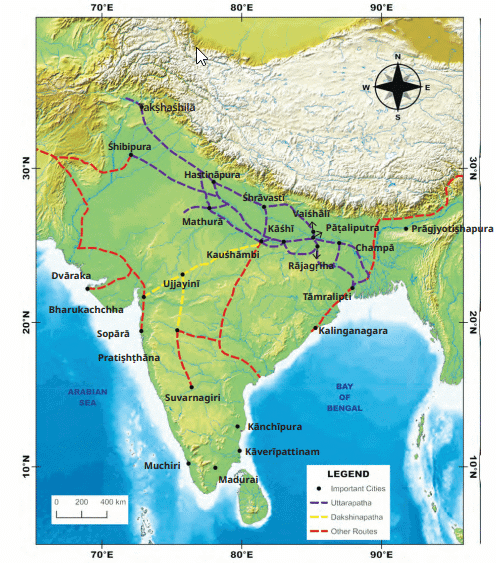
On the map, trace the Uttarapatha and Dakshinapatha trade routes. Identify two major cities along each route mentioned in the chapter or implied by its context. Explain how controlling these trade routes contributed to the economic strength of the Mauryan Empire.
Ans: Trace Uttarapatha (northwest to east across northern India) and Dakshinapatha (north to south, connecting central to southern India).
- Uttarapatha Cities: Pataliputra (Bihar) and Takṣhaśhila (modern-day Taxila, northwest).
- Dakshinapatha Cities: Kaushambi (Uttar Pradesh) and Kaveripattanam (southern India, implied as a southern trade hub).
- Economic Strength: Controlling trade routes allowed the Mauryas to access diverse goods (textiles, spices, gems) and collect taxes, boosting the treasury and supporting military campaigns.
FAQs on Half Yearly Class 7 Social Studies Set 3 (Solutions)
| 1. What topics are covered in the Class 7 Social Studies Half Yearly Exam? |  |
| 2. How can I prepare effectively for the Half Yearly Social Studies exam? | |
| 3. What are some important historical events that might be included in the exam? | |
| 4. Are there specific skills or concepts I should focus on for the geography section? | |
| 5. What format can I expect for the exam questions? | |