Time: 3 Hours
Maximum Marks: 80
General Instructions:
(i) The question paper consists of 34 questions divided into four sections: A, B, C, and D.
(ii) All questions are compulsory.
(iii) Section A: Questions 1 to 15 are multiple-choice questions, carrying 1 mark each. Select the most appropriate response.
(iv) Section B: Questions 16 to 22 are short-answer questions, carrying 2 marks each.
(v) Section C: Questions 23 to 31 are short-answer questions, carrying 4 marks each.
(vi) Section D: Questions 32 to 34 are short-answer questions, carrying 5 marks each.
(vii) Answer the questions in the space provided or on a separate answer sheet as instructed.
(viii) Use of calculators is not permitted.
Section A
Q1. The process of heat transfer in liquids is called: (1 mark)
(a) Conduction
(b) Convection
(c) Radiation
(d) Evaporation
Q2. The gas released during photosynthesis is: (1 mark)
(a) Carbon dioxide
(b) Oxygen
(c) Nitrogen
(d) Hydrogen
Q3. Which substance turns red litmus paper blue? (1 mark)
(a) Vinegar
(b) Soap solution
(c) Distilled water
(d) Lemon juice
Q4. The SI unit of speed is: (1 mark)
(a) m/s
(b) km/h
(c) cm/s
(d) m/min
Q5. A shadow is formed when: (1 mark)
(a) Light is absorbed
(b) Light is blocked
(c) Light is reflected
(d) Light is refracted
Q6. Which of the following is a non-metal? (1 mark)
(a) Iron
(b) Sulphur
(c) Aluminium
(d) Copper
Q7. The Earth's revolution around the Sun causes: (1 mark)
(a) Day and night
(b) Seasons
(c) Shadows
(d) Moon phases
Q8. The process of removing waste from the body is called: (1 mark)
(a) Respiration
(b) Digestion
(c) Excretion
(d) Circulation
Q9. Burning of paper is an example of: (1 mark)
(a) Physical change
(b) Chemical change
(c) Reversible change
(d) Temporary change
Q10. Which characteristic of the image formed by a plane mirror is demonstrated when viewing the word 'AMBULANCE' written laterally inverted on the vehicle? (1 mark)
(a) Image is erect
(b) Image is of the same size as the object
(c) Image is laterally inverted
(d) Image cannot be obtained on a screen
Q11. The time period of a pendulum depends on: (1 mark)
(a) Mass of the bob
(b) Length of the string
(c) Amplitude
(d) Weight
Q12. What primary mechanism controls the significant physical and emotional changes that take place in the body during adolescence? (1 mark)
(a) Respiration
(b) Digestion
(c) Hormones
(d) Circulation
Q13. The tiny pores on leaves are called: (1 mark)
(a) Chlorophyll
(b) Stomata
(c) Veins
(d) Roots
Q14. Heat transfer without a medium is called: (1 mark)
(a) Conduction
(b) Convection
(c) Radiation
(d) Evaporation
Q15. A solar eclipse occurs when: (1 mark)
(a) Earth is between Sun and Moon
(b) Moon is between Sun and Earth
(c) Sun is between Earth and Moon
(d) Moon is behind Earth
Section B
Q16. Define conduction and give one example. (2 marks)
Q17. Name two physical changes during adolescence in girls. (2 marks)
Q18. Draw a circuit diagram with a battery, bulb, and switch. (2 marks)
Q19. Define photosynthesis and name one product. (2 marks)
Q20. Explain how shadows are formed. (2 marks)
Q21. What is the SI unit of time? Give one device to measure time. (2 marks)
Q22. Name two types of eclipses. (2 marks)
Section C
Q23. Explain the role of chlorophyll in the process of food production in plants. (4 marks)
Q24. Describe how a sundial measures time. (4 marks)
Q25. Read the source and answer the question that follows. (4 marks)
On National Science Day, Ashwin and Keerthi were amazed to see the magic of indicators at their school's science fair. When a liquid was sprayed on their blank sheet, the words "Welcome to the Wonderful World of Science" appeared! They were curious about how the words appeared, and soon learned it was because the paper contained a special indicator. At the Colourful World of Substances stall, they saw various experiments where substances changed colour based on whether they were acidic, basic, or neutral. Using litmus paper and red rose extract, they tested several substances and were able to determine if they were acids or bases by the colour change of the indicators. Ashwin was particularly fascinated by how litmus paper and red rose extract could reveal the nature of substances.
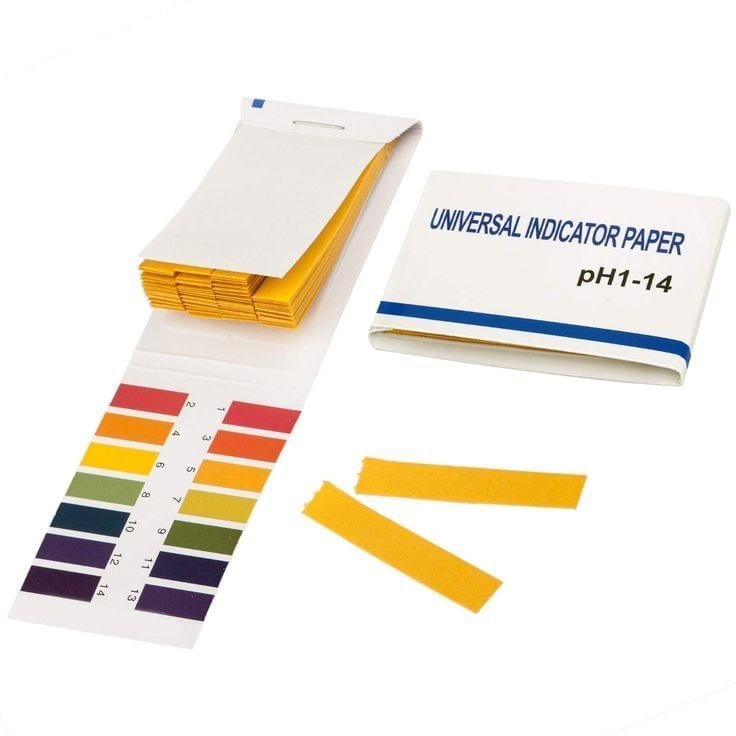
(i) What is the difference between acidic, basic, and neutral substances as observed using indicators?
(ii) How do litmus and red rose extract act as indicators differently?
(iii) How can Ashwin and Keerthi use litmus paper to test the nature of a substance at home?
(iv) Why is the use of natural indicators like litmus and red rose extract beneficial for testing substances at home?
Q26. What happens to the food in small intestine of the digestive tract? (4 marks)
Q27. Suppose the '+' and '-' symbols cannot be read on a battery. Suggest a method to identify the two terminals of this battery. (4 marks)
Q28.How does water seep through the surface of the Earth and get stored as groundwater? (4 Marks)
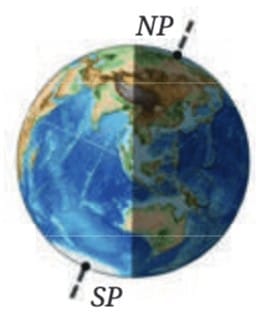
Q29. In Fig. , how many hours of sunlight do the North Pole and the South Pole receive during one rotation of the Earth? (4 Marks)
Q30. Complete the following flow chart: (4 Marks)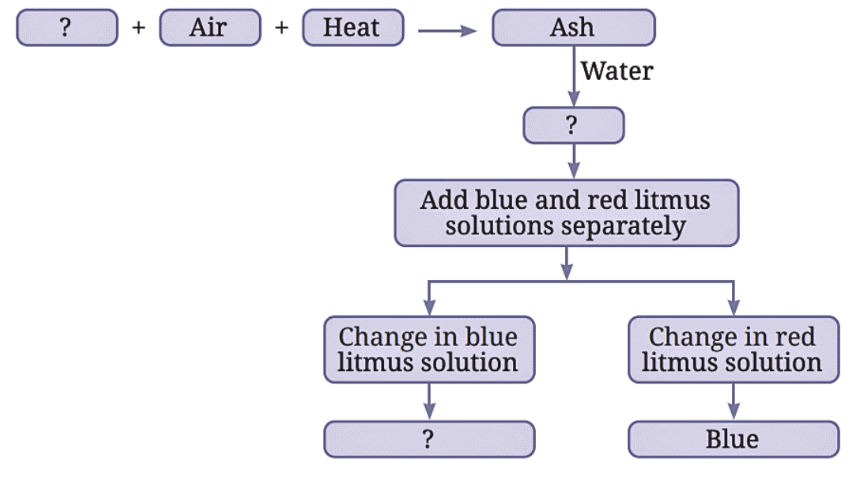
Q31. How can we create a periscope and how does it work? (4 Marks)
Section D
Q32. Describe how plants transport water and food, including the roles of xylem and phloem. Explain how respiration in plants differs from photosynthesis. (5 Marks)
Q33. Explain how light travels and what happens when it hits different objects. (5 Marks)
Q34. While using a toilet, Mohini noticed that used sanitary pads were scattered near the bin. She got upset and shared her feelings with her friends. They discussed the importance of menstrual hygiene and healthy sanitary habits. What menstrual hygiene and sanitary habits would you suggest to your friends? (5 Marks)
You can access the solutions to this Final Exam here.