Sample Question Paper Class 7 Social Studies Set 1 (Solutions)

Maximum Marks: 80
Time: 3 Hours
General Instructions:
(i) The question paper consists of 34 questions divided into five sections: A, B, C, D and E.
(ii) All questions are compulsory.
(iii) Section A: Questions 1 to 15 are multiple-choice questions, carrying 1 mark each.
(iv) Section B: Questions 16 to 22 are very short-answer questions, carrying 2 marks each.
(v) Section C: Questions 23 to 30 are short-answer questions, carrying 4 marks each.
(vi) Section D: Questions 31 to 32 are long-answer questions, carrying 5 marks each.
(vii) Section E: Question 33 is Case Based (5 marks) and Question 34 is Map Based (4 marks).
(viii) Write answers neatly and legibly.
Syllabus: Geographical Diversity of India, Understanding the Weather, Climates of India, New Beginnings: Cities and States, The Rise of Empires, The Age of Reorganisation, The Gupta Era: An Age of Tireless Creativity, How the Land Becomes Sacred, From the Rulers to the Ruled: Types of Governments, The Constitution of India: An Introduction, From Barter to Money, Understanding Markets. The Story of Indian Farming; India and Her Neighbours; Empires and Kingdoms: 6th to 10th Centuries; Turning Tides: 11th and 12th Centuries; India, a Home to Many; The State, the Government, and You; Infrastructure: Engine of India's Development; and Banks and the Magic of Finance.
Section A (1 Mark Each)
a) Field
b) To cultivate
c) Forest
d) Soil
Ans: b) To cultivate
The word agriculture comes from the Latin word 'agri' meaning field and 'culture' meaning to cultivate.
a) Rabi
b) Zaid
c) Kharif
d) Haimana
Ans: c) Kharif
The kharif season is associated with monsoon crops such as rice, maize, jowar, and bajra.
a) Stratosphere
b) Troposphere
c) Ozone Layer
d) Mesosphere
Ans: b) Troposphere
The troposphere is the lowest layer of the atmosphere where weather events like rain, storms, and clouds take place.
a) Thermometer
b) Rain gauge
c) Barometer
d) Anemometer
Ans: c) Barometer
A barometer measures atmospheric pressure, which helps predict weather changes.
a) Raja Ravi Varma
b) M.S. Swaminathan
c) Brahmagupta
d) Kautilya
Ans: b) M.S. Swaminathan
M.S. Swaminathan was the architect of the Green Revolution in India.
a) Pakistan
b) Bangladesh
c) China
d) Nepal
Ans: c) China
China is India's largest neighbor, with an area approximately three times larger than India.
a) Chola
b) Pāla
c) Pallava
d) Rashtrakuta
Ans: c) Pallava
The Shore Temple at Māmallapuram was built during the reign of the Pallava dynasty.
a) Chandragupta I
b) Samudragupta
c) Chandragupta II
d) Aryabhata
Ans: b) Samudragupta
Samudragupta is praised in the Prayaga Prashasti (Allahabad Pillar Inscription) composed by his court poet Harisena for his extensive military conquests.
a) Delhi
b) Kannauj
c) Tanjavur
d) Badami
Ans: b) Kannauj
Kannauj became the centre of a long, indecisive 'Tripartite Struggle' between the Pālas, Gurjara-Pratīhāras, and Rāṣhṭrakūṭas.
a) Democracy
b) Monarchy
c) Oligarchy
d) Republic
Ans: c) Oligarchy
Oligarchy is a form of government where power is held by a small group of people, often from elite or wealthy families.
a) United Payment Institution
b) Universal Price Index
c) Unified Payments Interface
d) Union Public Infrastructure
Ans: c) Unified Payments Interface
UPI stands for Unified Payments Interface, a digital payment system launched by NPCI.
a) Varanasi
b) Bodh Gaya
c) Amritsar
d) Tirupati
Ans: b) Bodh Gaya
Bodh Gaya is sacred for Buddhists as it is the place where Gautama Buddha attained enlightenment under the Bodhi tree.
a) 1947
b) 1853
c) 1901
d) 1875
Ans: b) 1853
The British introduced railways in India in 1853.
a) Chandragupta Maurya
b) Bindusara
c) Ashoka
d) Samudragupta
Ans: c) Ashoka
Ashoka is known for his policy of Dhamma, which promoted non-violence, tolerance, and moral conduct after the Kalinga War.
a) State Bank of India
b) NABARD
c) Reserve Bank of India
d) ICICI Bank
Ans: c) Reserve Bank of India
The Reserve Bank of India (RBI) is the central bank and functions as the banker of banks.
Section B (2 Marks Each)
Ans: Intercropping is the agricultural practice of growing two or more different crops simultaneously in the same field.Example: Growing sugarcane along with pumpkin.
Ans: Weather is the state of the Earth's atmosphere at a particular time and place.Elements include temperature and rainfall.
Ans: Sāmantas were subordinate rulers or vassals who governed regions under powerful kings and sometimes challenged them.They managed local administration and led armies, but could become independent if the central authority weakened.
Ans: Weather refers to day-to-day atmospheric conditions, while climate is the long-term pattern of weather over many years.Weather changes frequently, but climate describes average conditions over decades.
Ans: Sovereignty is the full authority of a state to make its own laws without external control. It ensures independence and prevents interference in internal affairs.
Ans: The barter system is the direct exchange of goods and services without money. Example: A farmer exchanging wheat for pots.
Ans: The Ganga and the Yamuna.These rivers bring fertile alluvial soil through annual flooding, supporting agriculture.
Section C (4 Marks Each)
Ans: India follows three main cropping seasons based on climate and rainfall patterns.
The Kharif season depends on the southwest monsoon and includes crops like rice and maize grown from June to September. The Rabi season consists of winter crops such as wheat and mustard, sown in October and harvested in spring. The Zaid season is a short summer season between Rabi and Kharif, producing crops like watermelon and cucumber. These seasons help ensure continuous food production throughout the year.
Ans: India's climate is influenced by several geographical factors.
Latitude determines the amount of sunlight received, making southern India warmer than northern regions. Altitude affects temperature, with hill stations being cooler than plains. Distance from the sea moderates coastal climates, while inland areas face extreme temperatures. Relief features like the Himalayas block cold winds and influence monsoon rainfall.
Ans: King Bhoja of the Paramāra dynasty was a famous scholar and able ruler.
He was known for efficient administration and the construction of large public works like the Bhojpur lake. Bhoja was a great patron of learning and authored important works on architecture, medicine, and governance. His court attracted scholars from different regions, making his kingdom a centre of education and culture.
Ans: The Western Ghats play a major role in shaping India's monsoon climate.
They act as a natural barrier to the moisture-laden southwest monsoon winds. As a result, the western slopes receive heavy rainfall, supporting dense forests and biodiversity. The eastern side receives less rain due to the rain-shadow effect, influencing agriculture and settlement patterns.
Ans: The government works through three main organs known as the pillars of democracy.
The Legislature makes laws for the country and represents the people. The Executive implements these laws and manages day-to-day administration. The Judiciary interprets laws, settles disputes, and protects citizens' rights, ensuring justice and balance.
Ans: Rivers are considered sacred in India because they are closely linked with religion and daily life.
They are worshipped as goddesses and believed to purify sins. Rivers provide water for drinking, farming, and industries, sustaining civilizations. Many important religious ceremonies and pilgrimages take place on river banks, strengthening their sacred status.
Ans: The introduction of coins brought major improvements to trade in ancient India.
Coins removed the problems of the barter system, such as the need for double coincidence of wants. They provided a standard measure of value, making transactions easier and faster. Coins also encouraged long-distance trade and economic growth by improving trust and efficiency.
Ans: The Unified Payments Interface (UPI) has transformed India's payment system.
It allows instant money transfers using mobile phones at any time. UPI promotes cashless transactions, reducing dependence on physical currency. It has increased financial inclusion by making digital payments accessible to people across urban and rural areas.
Section D (5 marks each)
Ans: Mahmud of Ghazni and Muhammad Ghuri were two important invaders whose attacks greatly affected Indian history, though their objectives were different.
1. Mahmud of Ghazni carried out repeated invasions mainly to plunder wealth and treasures from temples like Somnath.
2. He did not aim to establish permanent rule in India and returned to Ghazni after each raid.
3. Muhammad Ghuri, on the other hand, wanted territorial expansion and long-term political control.
4. After defeating Prithviraj Chauhan in the Second Battle of Tarain, he captured Delhi and Ajmer.
5. Ghuri appointed trusted generals like Qutb-ud-din Aibak to govern conquered regions.
In conclusion, Mahmud's invasions weakened India economically, while Muhammad Ghuri's conquests laid the foundation of the Delhi Sultanate.
Ans: India's geographical diversity has played a crucial role in shaping its culture and way of life.
1. The Himalayas act as a natural barrier, protecting India and influencing climate and river systems.
2. The Indo-Gangetic Plains are fertile and supported early civilizations, dense population, and agriculture.
3. The Peninsular Plateau is rich in minerals and forests, encouraging mining and distinct regional cultures.
4. The Thar Desert led to unique lifestyles, clothing, and water conservation practices.
5. Coastal plains supported fishing, trade, and cultural exchange through sea routes.
Thus, India's varied geographical features have deeply influenced settlement patterns, occupations, traditions, and cultural diversity.
Section E (Case Based and Map Based Questions)
"Soil is a complex ecosystem with organisms like bacteria, fungi, earthworms, and insects. It has minerals, organic matter (humus), water, and air. To maintain its health and fertility, farmers use various soil conservation techniques. Crop rotation is one such method, where different types of crops are grown in the same field in different seasons to prevent the soil from losing specific nutrients. Terracing is used in hilly areas to slow down water runoff."
Ans: Bacteria, fungi, earthworms, insects, minerals, organic matter, water, and air.
ii) What is 'Humus'? (1)
Ans: Humus is the dark organic matter in soil formed by the decomposition of plant and animal matter; it is rich in nutrients.
iii) How does crop rotation help the soil? (1)
Ans: It prevents the soil from losing specific nutrients by growing different crops in different seasons.
iv) What is the purpose of terrace farming? (2)
Ans: It is used in hilly areas to create flat steps, which slows down water runoff and reduces soil erosion.
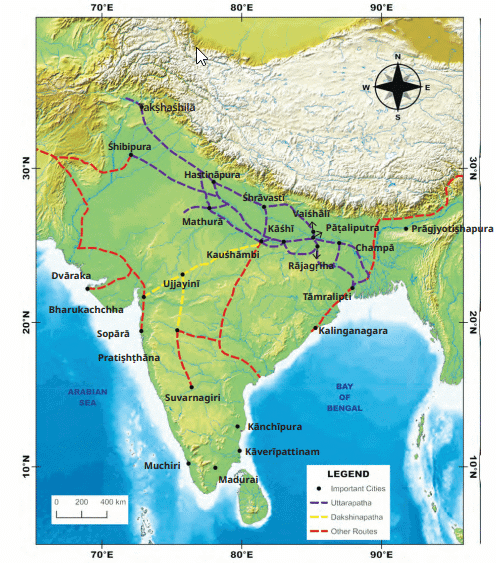
On the map, trace the Uttarapatha and Dakshinapatha trade routes. Identify two major cities along each route mentioned in the chapter or implied by its context. Explain how controlling these trade routes contributed to the economic strength of the Mauryan Empire.
Ans: Trace Uttarapatha (northwest to east across northern India) and Dakshinapatha (north to south, connecting central to southern India).
- Uttarapatha Cities: Pataliputra (Bihar) and Takṣhaśhila (modern-day Taxila, northwest).
- Dakshinapatha Cities: Kaushambi (Uttar Pradesh) and Kaveripattanam (southern India, implied as a southern trade hub).
- Economic Strength: Controlling trade routes allowed the Mauryas to access diverse goods (textiles, spices, gems) and collect taxes, boosting the treasury and supporting military campaigns.
FAQs on Sample Question Paper Class 7 Social Studies Set 1 (Solutions)
| 1. What topics are covered in the Class 7 Social Studies exam? |  |
| 2. How can I effectively prepare for the Class 7 Social Studies final exam? | |
| 3. Are there any recommended study materials or resources for Class 7 Social Studies? | |
| 4. What is the exam format for the Class 7 Social Studies final exam? | |
| 5. How important is it to understand the historical context in Social Studies? | |