Sample Question Paper Class 7 Social Studies Set 3 (Solutions)

Maximum Marks: 80
Time: 3 Hours
General Instructions:
(i) The question paper consists of 34 questions divided into five sections: A, B, C, D and E.
(ii) All questions are compulsory.
(iii) Section A: Questions 1 to 15 are multiple-choice questions, carrying 1 mark each.
(iv) Section B: Questions 16 to 22 are very short-answer questions, carrying 2 marks each.
(v) Section C: Questions 23 to 30 are short-answer questions, carrying 4 marks each.
(vi) Section D: Questions 31 to 32 are long-answer questions, carrying 5 marks each.
(vii) Section E: Question 33 is Case Based (5 marks) and Question 34 is Map Based (4 marks).
(viii) Write answers neatly and legibly.
Syllabus: Geographical Diversity of India, Understanding the Weather, Climates of India, New Beginnings: Cities and States, The Rise of Empires, The Age of Reorganisation, The Gupta Era: An Age of Tireless Creativity, How the Land Becomes Sacred, From the Rulers to the Ruled: Types of Governments, The Constitution of India: An Introduction, From Barter to Money, Understanding Markets. The Story of Indian Farming; India and Her Neighbours; Empires and Kingdoms: 6th to 10th Centuries; Turning Tides: 11th and 12th Centuries; India, a Home to Many; The State, the Government, and You; Infrastructure: Engine of India's Development; and Banks and the Magic of Finance.
Section A (1 Mark Each)
a) Sanskrit
b) Latin
c) Arabic
d) Persian
Ans: c) Arabic
The terms kharif, rabi, and zaid are of Arabic origin and have been used since Mughal times.
a) Minerals
b) Bacteria
c) Plastic fragments
d) Humus
Ans: c) Plastic fragments
Soil is a complex ecosystem consisting of minerals, organic matter (humus), water, air, and organisms like bacteria and fungi.
a) Nepal
b) Bangladesh
c) Bhutan
d) Maldives
Ans: c) Bhutan
Bhutan is a small, landlocked Himalayan kingdom nestled between India and China.
a) Thimphu
b) Colombo
c) Kathmandu
d) Dhaka
Ans: c) Kathmandu
The Paśhupatinātha temple is a major Hindu pilgrimage site in Nepal.
a) Atlantic
b) Pacific
c) Indian Ocean
d) Arctic
Ans: c) Indian Ocean
The peninsula projects deep into the Indian Ocean, aiding maritime trade.
a) Krishna I
b) Amoghavarsha
c) Dantidurga
d) Bhoja
Ans: c) Dantidurga
Dantidurga overthrew the Chalukyas to establish Rashtrakuta rule.
a) Ramanuja
b) Basaveshvara
c) Shankara
d) Gopala
Ans: b) Basaveshvara
Basaveshvara promoted equality and rejected caste distinctions.
a) Kalhana
b) Jayadeva
c) Banabhatta
d) Ravikirti
Ans: b) Jayadeva
Jayadeva's work celebrates devotion to Krishna.
a) Himalayas
b) Vindhyas
c) Hindu Kush
d) Western Ghats
Ans: c) Hindu Kush
The pass historically connected India with Central Asia.
a) Parsis
b) Siddis
c) Armenians
d) Syriac Christians
Ans: b) Siddis
The Siddis were brought to India as enslaved people.
a) Monarchy, Republic
b) Democratic, Republic
c) Secular, Theocratic
d) Oligarchy, State
Ans: b) Democratic, Republic
The Preamble defines India as a Democratic Republic.
a) State
b) Union
c) Local Government
d) Judiciary
Ans: c) Local Government
Panchayats and Municipalities form the third tier.
a) Bell
b) Morse
c) J.C. Bose
d) Marconi
Ans: c) J.C. Bose
Jagadish Chandra Bose pioneered wireless technology.
a) Mumbai-Pune-Nashik-Thane
b) Delhi-Mumbai-Chennai-Kolkata
c) Srinagar-Kanyakumari-Silchar-Porbandar
d) Bengaluru-Hyderabad-Kochi-Chennai
Ans: b) Delhi-Mumbai-Chennai-Kolkata
It is India's largest highway project.
a) Any Time Money
b) Automated Teller Machine
c) Automatic Transaction Medium
d) Account Transfer Method
Ans: b) Automated Teller Machine
ATMs enable 24×7 cash withdrawal.
Section B (2 Marks Each)
Ans:
Humus is dark organic matter formed from decayed plants and animals. It improves soil fertility, retains moisture, and provides nutrients essential for plant growth.
Ans:
A maritime neighbour is a country connected by sea but not land. Sri Lanka is India's maritime neighbour.
Ans:
The Hindu Shahis ruled parts of Afghanistan and Pakistan and resisted Ghaznavid invasions.
Ans:
He introduced rules for zero and advanced algebraic equations.
Ans:
Sovereignty is the supreme authority of a state to govern itself without external interference.
Ans:
He believed in village self-rule where people govern their own local affairs.
Ans:
National Savings Certificates and Kisan Vikas Patra.
Section C (4 Marks Each)
Ans:
Banks in India offer different types of bank accounts to meet the financial needs of various individuals and institutions. A Savings Account is mainly opened by individuals to keep their money safe while earning interest on the deposited amount. A Current Account is generally used by businesspersons and traders because it allows frequent and large transactions without limits, though it usually does not provide interest. A Fixed Deposit Account involves depositing a lump sum of money for a fixed period, during which it earns a higher rate of interest, encouraging long-term savings. Additionally, Jan Dhan Accounts were introduced to promote financial inclusion by allowing people from economically weaker sections to open zero-balance accounts and access banking facilities.
Ans:
Buddhism originated in India and gradually spread to many neighbouring regions through peaceful means such as teaching, travel, and trade. Indian monks and scholars travelled to countries like Sri Lanka, China, Tibet, and Southeast Asia, carrying Buddhist teachings, texts, and practices with them. Pilgrims from these regions also visited Indian centres of learning such as Nalanda and Bodh Gaya, strengthening cultural exchanges. These interactions helped build strong spiritual, cultural, and educational connections between India and its neighbours. As a result, Buddhism became a powerful bridge that linked India with other Asian civilizations.
Ans:
Living Root Bridges are unique structures found in Meghalaya that are created by guiding the roots of rubber fig trees across rivers and streams. These bridges are eco-friendly, as they are grown naturally without harming the environment, and they become stronger as the roots mature over time. They are highly durable and can last for several hundred years, making them suitable for areas with heavy rainfall and frequent floods. Living Root Bridges also reflect the traditional knowledge and skills of local tribal communities. Thus, they represent an excellent example of sustainable development and harmony between humans and nature.
Ans:
The Tripartite Struggle was a long-lasting power struggle among the Palas, Gurjara-Pratiharas, and Rashtrakutas for control over the city of Kannauj. Kannauj was considered a symbol of political authority and economic prosperity because of its strategic location in the fertile Gangetic plains. Each dynasty tried repeatedly to capture and retain the city, leading to continuous conflicts over several decades. This prolonged struggle weakened all three powers both militarily and economically. As a result, North India became politically unstable and more vulnerable to future invasions.
Ans:
Communication infrastructure includes facilities such as mobile networks, internet services, satellites, and communication towers that help people share information quickly and efficiently. It plays an important role in education by enabling online classes, digital libraries, and distance learning, especially in remote areas. Communication systems support business growth through e-commerce, digital payments, and global trade connections. They also improve governance by enabling e-governance services, online grievance systems, and public awareness campaigns. In addition, effective communication infrastructure helps in disaster management by providing early warnings and emergency alerts.
Ans:
India is called a Democratic Republic because it combines the principles of democracy and republicanism. It is democratic because the people of India elect their representatives through free and fair elections, ensuring that power lies with the citizens. It is a republic because the head of the state, the President, is elected and not a hereditary ruler. The Constitution of India places limits on the powers of the government to protect citizens' rights. This system ensures equality before the law, accountability of leaders, and rule of law in the country.
Ans:
A stock market is a place where shares of companies are bought and sold by investors. When people purchase shares, they become part-owners of the company and may earn profits in the form of dividends or price increases. Companies use the stock market to raise funds for expansion, development, and operations. The prices of shares change depending on the company's performance, market demand, and overall economic conditions. Thus, the stock market plays a vital role in economic growth.
Ans:
India follows a three-tier system of government to ensure effective administration across the country. The Union Government is responsible for national matters such as defence, foreign policy, currency, and railways. The State Governments handle issues related to their states, including education, health services, agriculture, and law and order. The Local Government, which includes Panchayats in rural areas and Municipalities in urban areas, deals with local issues like water supply, sanitation, roads, and street lighting. This system promotes decentralisation and ensures that governance reaches people at the grassroots level.
Section D (5 Marks Each)
Ans:
The Gupta Empire marked a very important phase in Indian history and is often described as the "Golden Age" because of its achievements in administration, culture, science, and art. The rise of the Guptas brought political stability and encouraged overall development in society.
1. Strong Leadership and Administration: The Gupta rulers such as Chandragupta I and Samudragupta established a strong and efficient system of administration. They maintained law and order, collected taxes fairly, and ensured peace, which helped the empire grow and remain stable for a long period.
2. Growth of Art and Architecture: The Gupta period saw remarkable progress in art and architecture. Beautiful temples, sculptures, and cave paintings such as those at Ajanta were created. These works reflected religious devotion as well as high artistic skill.
3. Advancement in Science and Mathematics: Scholars like Aryabhata made major contributions during this period. He explained the concept of zero, calculated the value of pi, and explained eclipses scientifically. These discoveries influenced later scientific developments.
4. Flourishing of Literature and Education: Sanskrit literature reached great heights during the Gupta age. Famous works like Kalidasa's plays and poems were written, and centres of learning attracted scholars from different regions.
5. Economic Prosperity and Trade: Peaceful conditions encouraged agriculture, trade, and crafts. Trade with other regions brought wealth to the empire and supported urban growth.
In conclusion, the Gupta Empire created a strong foundation for Indian culture and learning. Its achievements in administration, science, art, and literature left a lasting impact on Indian civilization and continue to be admired even today.
Ans:
Monsoons are seasonal winds that play a very important role in India's climate and economy, especially because agriculture depends heavily on rainfall. India mainly experiences two types of monsoons, which together determine the pattern of rainfall across the country.
1. Southwest Monsoon: The Southwest Monsoon is the most important monsoon in India and occurs from June to September. During this time, moist winds blow from the Indian Ocean towards the land, bringing heavy rainfall to most parts of the country.
2. Distribution of Rainfall: When these winds strike the Western Ghats, they cause heavy rainfall on the western coastal regions. However, areas lying on the leeward side, such as parts of the Deccan Plateau, receive less rainfall.
3. Importance for Agriculture: The Southwest Monsoon is crucial for growing kharif crops like rice, maize, and cotton. A good monsoon leads to a good harvest, while poor rainfall can result in droughts.
4. Northeast Monsoon: The Northeast Monsoon occurs from October to December. During this season, winds blow from land to sea but pick up moisture from the Bay of Bengal and bring rainfall mainly to the eastern coast of India.
5. Regional Significance: This monsoon is especially important for states like Tamil Nadu, which receive most of their rainfall during this period. It also helps replenish water resources after summer.
Thus, both the Southwest and Northeast Monsoons are essential for India's agriculture, water supply, and economy. They strongly influence people's lives, festivals, and overall livelihood across the country.
Section E
Read the passage and answer the questions:
"The Unified Payments Interface (UPI) is a fast and secure digital payment system launched in 2016 by the NPCI. It allows users to transfer funds instantly using a QR code or phone number. During the COVID-19 pandemic, it supported cashless, socially distanced transactions. Today, countries like Nepal, UAE, and France have adopted it, making it India's gift to the world."
Ans: UPI was launched in 2016 by the National Payments Corporation of India (NPCI).
ii) List two ways to initiate a UPI transaction. (1)
Ans: Using a QR code or the phone number of the recipient.
iii) Why did UPI become popular during the pandemic? (1)
Ans: It supported cashless transactions, which was essential for maintaining social distancing.
iv) Name any two foreign countries that have adopted UPI. (2)
Nepal, United Arab Emirates, France, or Mauritius.
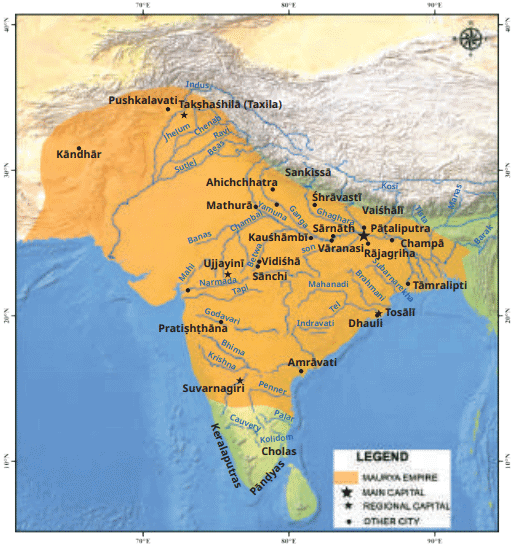
On the map, mark Takshashila (modern-day Taxila) and Sanchi. What was its significance during this period?
Ans:
Mark Takshashila in northwest India (modern-day Taxila, Pakistan).
Significance: A renowned university where Kautilya taught, contributing to intellectual and strategic advancements that aided Chandragupta Maurya.
FAQs on Sample Question Paper Class 7 Social Studies Set 3 (Solutions)
| 1. What topics are covered in Class 7 Social Studies Final Exam Set 3? |  |
| 2. How can I prepare effectively for the Class 7 Social Studies exam? | |
| 3. Are there any specific study materials recommended for Class 7 Social Studies? | |
| 4. What is the exam format for Class 7 Social Studies? | |
| 5. How important is it to review past exam papers for the Class 7 Social Studies exam? | |