Welcome to this carefully curated document designed to prepare you for your board exams. The questions included here are highly significant, frequently asked in previous exams, and crafted to boost your confidence and performance.
Covalent Bonding and Properties of Carbon Compounds
Q1: List two properties by virtue of which carbon can form a large number of compounds.
Solution:
Ans: Two key properties that allow carbon to form a vast number of compounds are:
Tetravalency: Carbon can form four covalent bonds.
Catenation: Carbon atoms can bond with each other to form long chains.
Q2: Explain why carbon forms compounds mainly by covalent bonds. Explain in brief two main reasons for carbon forming a large number of compounds. Why does carbon form strong bonds with most other elements?
Solution:
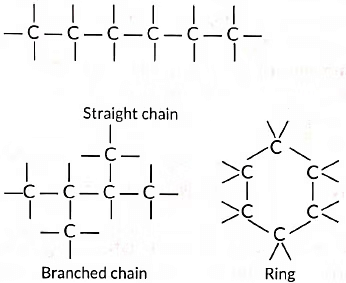
Ans: As carbon has four valence electrons and it can neither loose nor gain four electrons thus, it attains noble gas configuration only by sharing of electrons. Thus, it forms covalent compounds. The existence of large number of compounds is due to some unique properties of carbon which are: (i) Catenation: Carbon atoms possess an unique property to link together to form very long chains. This property is referred to as catenation. A large number of carbon atoms can join together to form straight chains, branched chains and rings as shown below:
(ii) Tetravalency: Due to small size and presence of four valence electrons, a carbon atom can form multiple bonds with some other carbon atoms as well as with other atoms like oxygen, nitrogen etc., This increases the variety of compounds formed by it and hence the number of compounds is tremendously increased. Due to small size, the nucleus of carbon atom can hold its shared pairs of electrons strongly. As a result, the bonds that carbon forms with most of the other elements such as hydrogen, oxygen, nitrogen, etc. are very strong there by making these compounds exceptionally stable.
Q3: Carbon forms compounds mainly by covalent bonding. Why ?
Solution:
Ans: Carbon forms compounds mainly by covalent bonding.Carbon primarily forms covalent compounds due to its unique electronic structure:
Carbon has four electrons in its outer shell, making it challenging to gain or lose electrons to achieve a stable octet.
To attain a stable configuration, carbon shares its valence electrons with other atoms, either with other carbon atoms or different elements.
This ability to share electrons leads to the formation of a vast number of compounds, including:
Catenation: Carbon can bond with itself, creating long chains, branched structures, or rings.
Strong bonds: The small size of carbon allows for strong interactions with shared electrons, resulting in stable compounds.
Overall, carbon's unique properties enable it to form a diverse range of stable covalent compounds.
Q4: Carbon, a member of group 14, forms a large number of carbon compounds estimated to be about three million. Why is this property not exhibited by other elements of this group? Explain.
Solution:
Ans: Carbon is unique among group 14 elements due to its ability to form a vast number of compounds, estimated at around three million. This is primarily because of two key properties:
Catenation: Carbon can bond with itself, creating long chains, branched structures, or rings. This allows for the formation of large molecules.
Bond Strength: Carbon forms strong bonds with other elements, including single, double, and triple bonds. This stability is due to its small size, which allows the nucleus to hold onto shared electrons effectively.
In contrast, other elements in this group, like silicon, can form fewer and less stable compounds. Their bond energies decrease as you move down the group, leading to limited catenation.
Q5: Which element exhibits the property of catenation to maximum extent and why?
Solution:
Ans: Carbon exhibits the property of catenation to the maximum extent due to several key factors:
Carbon can form strong bonds with other carbon atoms, creating large and complex molecules.
This ability allows for various structures, including long chains, branched chains, and rings.
Carbon's small size contributes to the strength of the carbon-carbon bonds, making them stable.
With a valency of four, carbon can bond with up to four other atoms, enhancing its versatility.
Other elements, like silicon, show limited catenation, forming fewer and more reactive compounds.
Q6: Catenation is the ability of an atom to form bonds with other atoms of the same element. It is exhibited by both carbon and silicon. Compare the ability of the catenation of the two elements. Give reasons.
Solution:
Ans: Catenation is the ability of an atom to bond with other atoms of the same element. This property is notably exhibited by both carbon and silicon, but carbon demonstrates it to a far greater extent.
Carbon can form long chains, branched structures, or rings due to its strong carbon-carbon bonds.
Carbon has a valency of four, allowing it to bond with up to four other atoms, including other carbon atoms.
This results in a vast number of stable compounds, as the bonds formed are strong and do not easily break.
In contrast, silicon can form chains of only seven or eight atoms with hydrogen, but these compounds are highly reactive.
Overall, the unique ability of carbon to catenate leads to an extensive variety of compounds, making it essential for life and numerous applications.
Q7: Give reason why carbon can neither form C4+ cations nor C4- anions but form covalent compounds.
Solution:
Ans: Carbon cannot form C4+ cations because removal of 4 electrons from a carbon atom would require a large amount of energy and it cannot form C4- anion because it would be difficult for the nucleus with 6 protons to hold 10 electrons. Thus it shares electrons to form covalent compounds.
Homologous Series
Q1: Define a homologous series of carbon compounds.
Ans: A homologous series is a group of carbon compounds where each member differs from the next by a CH2 unit. They share the same functional group and exhibit similar chemical properties.
Q2: Consider the following statements about homologous series of carbon compounds : (A)All succeeding members differ by - CH2 unit. (B)Melting point and boiling point increases with increasing molecular mass. (C)The difference in molecular masses between two successive members is 16 u. (D)C2H2 and C3H4 are NOT the successive members of alkyne series. The correct statements are - (a) (A) and (B) (b) (B) and (C) (c) (A) and (C) (d) (C) and (D)
Solution:
Ans: (a) In a homologous series of carbon compounds, like alkanes or alkynes, each member differs from the next by a specific group of atoms (-CH2), which is explained in statement (A). As the size of the molecules increases (more carbon and hydrogen atoms), their melting and boiling points also generally increase, as stated in (B). Thus, both (A) and (B) are correct, making option (a) the right answer.
Q3:What is homologous series of carbon compound? Write the molecular formula of any two consecutive members of homologous series of aldehydes.
Solution:
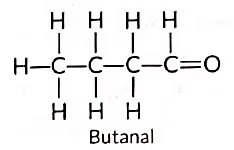
Ans: A homologous series is a group of compounds that share the same functional group, with each member differing by a specific number of CH2 units. For example, the molecular formulas of two consecutive members of the aldehyde series are:
CH3CHO (Ethanal)
C2H5CHO (Butanal)
Q4:Write the molecular formula of first two members of homologous series having functional group -Br.
Solution:
Ans: The first two members of homologous series having functional group -Br are :
CH3Br
C2H5Br
Q5:Name the third homologue of: (a) alcohols (b) aldehydes
Solution:
Ans:(a) Three homologue of alcohol are the following:CH3OH, CH3CH2OH, CH3CH2CH2OH Third homologue of alcohol is CH3CH2CH2OH (b) Three homologue of aldehyde are the following: HCHO, CH3CHO, CH3CH,CHO Third homologue of aldehyde is CH3CH2CHO.
Q6:Write the formula of first member of the homologous series to which the carbon compound C4H6 belongs.
Solution:
Ans: C4H6 (or CnH2n-2, n = 4) i.e., alkyne series. The first member of alkyne series is ethyne (C2H2) HC ≡ CH.
Q7: Write the molecular formula of first two members of homologous series having functional group -CI.
Solution:
Ans: The molecular formula of first two members of homologous series having - Cl functional group are CH3CI and CH3CH2CI.
Q8: Write the molecular formula of first two members of homologous series having functional group -OH.
Solution:
Ans: The molecular formula of first two members of homologous series having - OH functional group are CH3OH and CH3CH2OH.
Q9: Write the molecular formula of the 2nd and 3rd member of the homologous series whose first member is ethene.
Solution:
Ans: Homologous series of alkenes have general formula, CnH2n whose first member is ethene. 2nd member of homologous series of alkenes is C3H6 i.e., propene. 3rd member of homologous series of alkenes is C4H8 i.e., butene.
Q10: Write the molecular formula of the 2nd and 3rd member of the homologous series whose first member is methane.
Solution:
Ans: Methane, CH4 is an alkane. Alkanes have general formula, CnH2n+2. 2nd member of homologous series of alkanes is C2H6 i.e., ethane. 3rd member of homologous series of alkanes is C3H8 i.e., propane.
Hydrocarbons
Q1: Draw two different possible structures of a saturated hydrocarbon having four carbon atoms in its molecule. What are these two structures of the hydrocarbon having same molecular formula called? Write the molecular formula and the common name of this compound. Also write the molecular formula of its alkyne.
Solution:
Ans: These are called structural isomers as they have the same molecular formula i.e., C4H10 but different structures. As the molecular formula is C4H10, common name of this compound is butane. The alkyne of four carbon atoms is butyne. Its structure i is as follows: The molecular formula of butyne is C4H6.
Q2: Name a cyclic unsaturated carbon compound.
Solution:
Ans: A cyclic unsaturated carbon compound is a compound that contains a carbon ring with one or more double or triple bonds between the carbon atoms. An example of a cyclic unsaturated carbon compound is benzene, which has a ring of six carbon atoms with alternating double bonds.
Q3: "A compound 'X' on combustion gives a yellow flame with lots of smoke." What inference would you draw from this statement ?
Solution:
Ans: The compound 'X' is likely an unsaturated compound (such as an alkene or alkyne) that burns in air, producing a yellow, sooty flame with significant smoke.
Q4: The formulae of four organic compounds are given as following:
(A) Which one of these compounds P, Q, R or S is a saturated hydrocarbon? (B) Identify the organic acid and give its structural formula.
Solution:
Ans: (A) S is a saturated hydrocarbon. (B) Q is an organic acid. Structural formula:
Q5: Write the name and structure of a saturated compound in which the carbon atoms are arranged in a ring. Give the number of single bonds present in this compound.
Solution:
Ans: Structure
Name: Cyclopentane Number of single bonds: 15 Structure: C5H10
Q6: The number of single and double bonds present in a molecule of benzene (C6H6) respectively, are: (a) 6 and 6 (b) 9 and 3 (c) 3 and 9 (d) 3 and 3
Solution:
Ans: (b)
Six single bonds between Carbons and Hydrogens, three single bonds between six Carbons and Hydrogens ( alternatively) . Three double bonds present between carbons ( alternatively in hexagonal ring). So a total of nine single bonds, three double bonds are present in benzene ring.
Q7: Consider the structures of the three cyclic carbon compounds (I), (II) and (III) given below and select the correct option from the following: (a) (I) and (III) are isomers of hexane and (II) is benzene.
(b) (I) is an isomer of hexane, (II) is benzene and (III) is an isomer of hexene. (c) (I) is a saturated cyclic hydrocarbon and (II) and (III) are unsaturated cyclic hydrocarbons. (d) (I) is cyclohexane and (II) and (III) are the isomers of benzene.
Solution:
Ans: (c) Structure (I) is cyclohexane, a saturated cyclic hydrocarbon with single bonds between all the carbon atoms. Structure (II) is benzene, an unsaturated cyclic hydrocarbon with alternating double bonds, giving it aromatic stability. Structure (III) is cyclohexene, an unsaturated cyclic hydrocarbon with one double bond. Thus, (I) is a saturated cyclic hydrocarbon, and (II) and (III) are unsaturated cyclic hydrocarbons, making (c) the correct answer.
Q8: (i) Write the molecular formula of benzene and draw its structure. (ii) Write the number of single and double covalent bonds present in a molecule of benzene. (iii) Which compounds are called alkynes?
Solution:
Ans: (i) Molecular formula of benzene is C6H6.
(ii) Number of single bonds = 9 Number of double bonds = 3 (iii) Alkynes are the unsaturated hydrocarbons that contain at least one triple bond between two carbon atoms (-C ≡ C-)
Functional Groups
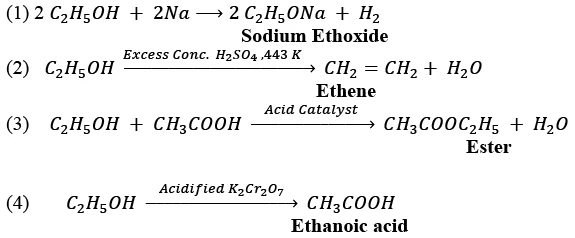
Q1: (i) Name a commercially important carbon compound having functional group -OH and write its molecular formula. (ii) Write chemical equation to show its reaction with (1)Sodium metal (2) Excess cone, sulphuric acid (3)Ethanoic acid in the presence of an acid catalyst (4) Acidified potassium dichromate Also write the name of the product formed in each case.
Solution:
Ans: (i) A commercially important carbon compound with the functional group -OH is Ethanol with the molecular formula C2H5OH. (ii)
NOTE: Name of the product for each reaction is given in bold letters under the reaction.
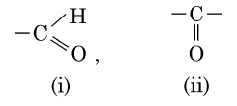
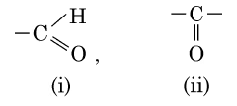
Q2: More than three million carbon compounds have been discovered in the field of chemistry. The diversity of these compounds is due to the capacity of carbon atoms for bonding with one another as well as with other atoms. Most of the carbon compounds are poor conductors of electricity and have low melting and boiling points. (a) Write the molecular formula of first two members of homologous series having functional group -Br. (b) Given below are the formulae of some functional groups :
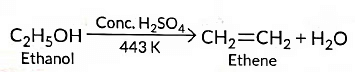
Write the name of these functional groups. (c)What would be observed on adding a 5% alkaline potassium permanganate drop by drop to some warm ethanol taken in a test tube? State the role of KMn04 in the reaction and write the chemical equation for the reaction involved. OR (c) Write the name of the compound formed when ethanol is heated at 443 K temperature with excess of cone. H2S04. What is the role of cone. H2S04 in the reaction? Write the chemical equation for the reaction involved.
Solution:
Ans: (a) The first two members of homologous series having functional group -Br. are CH3Br, C2H5Br (b) (i) Aldehyde (ii) Ketone (c) When a 5% alkaline potassium permanganate solution is added drop by drop to warm ethanol in a test tube, the following is observed:
The purple colour of potassium permanganate fades, indicating a reaction.
The role of KMnO4 in this reaction is as an oxidising agent.
OR (c) When ethanol is heated at 443 K with excess concentrated H2SO4, the compound formed is Ethene.
The role of concentrated H2SO4 is as a dehydrating agent. The chemical equation for this reaction is:
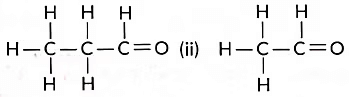
Q3: Consider the following organic compounds: (i) (a) Name the functional group present in these compounds. (b) Write the general formula for the compounds of this functional group. (c) State the relationship between these compounds and draw the structure of any other compound having similar functional group
Solution:
Ans: (a) Aldehyde (-CHO) group. (b) CnH2nO (c) Compound (i) is propanal, and compound (ii) is ethanal. They belong to the same homologous series where each successive compound differs from each other by a-CH2 unit. Other member of same homologous series:
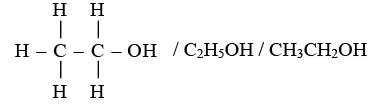
Q4: (i) Write the name and structure of an organic compound 'X' having two carbon atoms in its molecule and its name is suffixed with '-ol'. (ii) What happens when 'X' is heated with excess concentrated sulphuric acid at 443 K? Write the chemical equation for the reaction stating the conditions for the reaction. Also, state the role played by concentrated sulphuric acid in the reaction.
Solution:
Ans: (i) The organic compound X with two carbon atoms and the suffix -ol is Ethanol.
(ii) When X is heated with excess concentrated sulphuric acid at 443 K, it undergoes dehydration to form ethene. The reaction can be represented as:
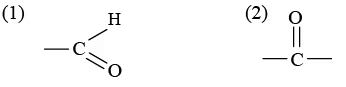
Q5: Write the formula of the functional group present in (1) aldehydes, and (2) ketones.
Solution:
Ans:
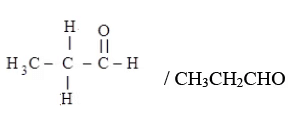
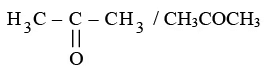
Q6: Write the name and structures of (i) aldehyde and (ii) ketone with molecular form C3H6O.
Solution:
Ans: (i) Aldehyde: Propanal (ii) Ketone: Propanone
Chemical Reactions Involving Carbon Compounds
Q1: Write the chemical equation for the following: (i) Combustion of methane (ii) Oxidation of ethan (iii) Hydrogenation of ethene (iv) Esterification reaction (v) Saponification reaction
Solution:
Ans: (i) The process in which compounds of carbon react with oxygen to give carbon dioxide, water, heat and light, is known as combustion. Alkanes burn in air and release large amount of heat, therefore can be used as excellent fuels. (ii) Oxidation is a process in which oxygen is added to a substance. (iii) Hydrogenation means addition of hydrogen to an unsaturated compound. (iv) When alcohol is added to carboxylic acid in the presence of acid catalyst then, a fruity smelling ester is formed. This process is called esterification. (v) Esters react in the presence of an acid or a base to give the alcohol and carboxylic acid. This reaction is known as saponification because it is used in the preparation of soap.
Q2: Distinguish between a saturated and an unsaturated hydrocarbon by flame test. List the products of combustion reaction of a saturated hydrocarbon.
Solution:
Ans:
The products of the combustion reaction of a saturated hydrocarbon are:
Carbon dioxide (CO2)
Water (H2O)
Q3: Why is the conversion of ethanol to ethanoic acid an oxidation reaction? Name the oxidising agent used in this conversion. Write chemical equation for this oxidation reaction. How is this reaction different from the reaction in which ethanol burns in the presence of oxygen?
Solution:
Ans:
(i) Oxygen is added to ethanol to produce ethanoic acid.
(ii) Alkaline potassium permanganate or Acidified potassium dichromate
(iii)
(iv) It is oxidation reaction while other is combustion reaction/ burning of ethanol is exothermic while other is endothermic.
Q4: More than three million carbon compounds have been discovered in the field of chemistry. The diversity of these compounds is due to the capacity of carbon atoms for bonding with one another as well as with other atoms. Most of the carbon compounds are poor conductors of electricity and have low melting and boiling points. (a) Write the molecular formula of first two members of homologous series having functional group -Br. (b) Given below are the formulae of some functional groups :
Write the name of these functional groups. (c)What would be observed on adding a 5% alkaline potassium permanganate drop by drop to some warm ethanol taken in a test tube? State the role of KMn04 in the reaction and write the chemical equation for the reaction involved. OR (c) Write the name of the compound formed when ethanol is heated at 443 K temperature with excess of cone. H2S04. What is the role of cone. H2S04 in the reaction? Write the chemical equation for the reaction involved.
Solution:
Ans: (a) The first two members of homologous series having functional group -Br. are CH3Br, C2H5Br (b) (i) Aldehyde (ii) Ketone (c) When a 5% alkaline potassium permanganate solution is added drop by drop to warm ethanol in a test tube, the following is observed:
The purple colour of potassium permanganate fades, indicating a reaction.
The role of KMnO4 in this reaction is as an oxidising agent.
OR (c) When ethanol is heated at 443 K with excess concentrated H2SO4, the compound formed is Ethene.
The role of concentrated H2SO4 is as a dehydrating agent. The chemical equation for this reaction is:
Q5: 3 mL of ethanol is taken in a test tube and warmed gently in a water bath. A 5% solution of alkaline potassium permanganate is added first drop by drop to this solution, then in excess. (i) How is 5% solution of KMnO4 prepared? (ii) State the role of alkaline potassium permanganate in this reaction. What happens on adding it in excess? (iii) Write chemical equation of this reaction.
Solution:
Ans:(i) 5% solution of KMnO4 is prepared by adding 5 g of KMnO4 in 95 g of water. (ii) Here alkaline KMnO4 acts as an oxidising agent. It oxidises ethanol to ethanoic acid by donating nascent oxygen. If excess of KMnO4 is added the purple colour will persist indicating no more alcohol is left and reaction stops. (iii)
Q6: (a) Carry out following conversions: (i) Ethanol to ethene (ii)Ethanol to ethanoic acid (b) Differentiate between addition reaction and substitution reaction. Give one example of each.
Solution:
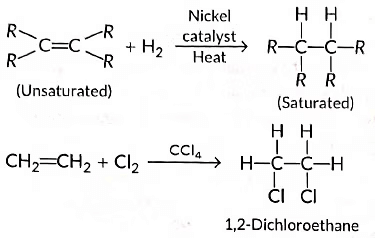
Ans: (a) (i) When ethanol is heated with cone. H2SO4 at 443 K, ethene is obtained due to dehydration of ethanol. (ii) When 5 % alkaline KMn04 solution is added drop by drop to warm ethanol then it gets oxidised to ethanoic acid. (b) Addition reactions: Those reactions in which atoms or group of atoms are simply added to a double or triple bond without the elimination of any atom or molecule, are known as addition reactions. Substitution reactions: The reactions which involve the displacement or substitution of an atom or a group of atoms in an organic compound by another atom or group of atoms, are known as substitution reactions. Saturated hydrocarbons are fairly unreactive and inert in the presence of most of the reagents. However, in presence of sunlight, hydrocarbons undergo rapid substitution reactions. e.g.,
Q7: What happens when 5% alkaline potassium permanganate solution is added drop by drop to warm propyl alcohol (propanol) taken in a test tube? Explain with the help of a chemical equation.
Solution:
Ans: When a 5% alkaline potassium permanganate solution is added drop by drop to warm propanol, a chemical reaction occurs:
The propanol is oxidised to propanoic acid.
In this process, the alkaline potassium permanganate acts as the oxidising agent.
The chemical equation for this reaction is:
Q8: A saturated organic compound 'A' belongs to the homologous series of alcohols. On heating 'A' with concentrated sulphuric acid at 443 K, it forms an unsaturated compound 'B' with molecular mass 28 u. The compound 'B' on addition of one mole of hydrogen in the presence of Nickel, changes to a saturated hydrocarbon 'C'. (A) Identify A, B and C. (B) Write the chemical equations showing the conversion of A into B. (C) What happens when compound C undergoes combustion? (D) State one industrial application of hydrogenation reaction. (E) Name the products formed when compound A reacts with sodium.
Solution:
Ans: (A) Ethanol (C2H5OH) belongs to alcohol's homologous series. A- Ethanol (C2H5OH) B- Ethene (C2H4) C- Ethane (C2H6) (B) Dehydration occurs when ethanol is heated with concentrated sulphuric acid at 443 K, resulting in the formation of ethene Concentrated sulphuric acid serves as a dehydrating agent in this reaction. (C) Compound C is ethane. When it undergoes combustion, it forms CO2 and water. (D) Hydrogenation reactions are used in the production of saturated vegetable ghee from unsaturated vegetable oils. (E) Sodium ethoxide is formed when ethanol (C2H5OH) reacts with sodium (Na). The reaction is as follows:
Q9:Define the following terms giving one example of each. (i) Esterification (ii) Addition reaction
Solution:
Ans: (i) Carboxylic acids react with alcohols in the presence of a little concentrated sulphuric acid to form pleasant smelling esters. This reaction is called esterification reaction. (ii) Those reactions in which atoms or group of atoms are simply added to a double or triple bond without the elimination of any atom or molecule, are known as addition reactions.
Q10: Assertion(A): Esterification is a process in which a sweet smelling substance is produced. Reason (R): When esters react with sodium hydroxide an alcohol and sodium salt of carboxylic acid are obtained. (a) Both (A) and (R) are true, and (R) is the correct explanation of (A). (b) Both (A) and (R) are true, and (R) is not the correct explanation of (A). (c) (A) is true but (R) is false. (d) (A) is false but (R) is true.
Solution:
Ans: (b) Assertion (A): Esterification is a process in which a sweet-smelling substance is produced. This is true. Esterification is a chemical reaction between an acid (usually a carboxylic acid) and an alcohol, resulting in the formation of an ester, which typically has a fruity or sweet smell. Reason (R): When esters react with sodium hydroxide, an alcohol and sodium salt of carboxylic acid are obtained. This is also true. This reaction is known as saponification, where an ester reacts with a strong base to produce an alcohol and the salt of a carboxylic acid. Since both statements are true, but the reason does not explain the assertion (as esterification and saponification are different processes), the correct answer is (b) Both (A) and (R) are true, and (R) is not the correct explanation of (A).
Structural Isomers
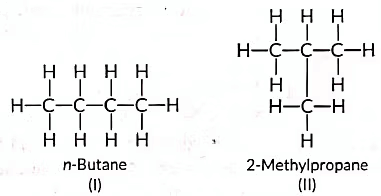
Q1: What are structural isomers ? Write the structures of two isomers of butane (C4H10).
Or
Draw two structural isomers of butane.
Or
Define isomerism. Draw all possible isomers of butane.
Solution:
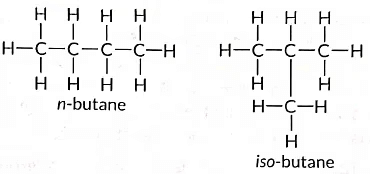
Structural isomers are compounds that have the same molecular formula but different structures. Two isomers of butane (C₄H₁₀) are:
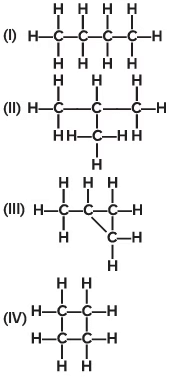
Q2: Which of the following are correct structural isomers of C4H10?
(a) (I) and (III) (b) (II) and (IV ) (c) (I) and (II) (d) (III) and (IV ) (CBSE 2016, 15, 14, 11)
Solution:
Ans: (c) The molecular formula C₄H₁₀ represents butane and its isomer isobutane (also called 2-methylpropane). Structures (I) and (II)in the image represent these two structural isomers of C₄H₁₀: (I) shows a straight chain structure (n-butane). (II) shows a branched structure (isobutane or 2-methylpropane). Thus, the correct answer is (c) (I) and (II).
Electron Dot Structures
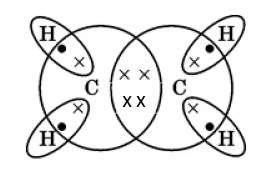
Q1: Name and draw the electron dot structure of ethene.
Solution:
Ans: The electron dot structure of ethe is as follows:
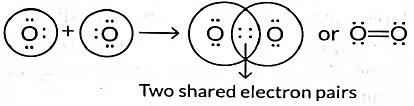
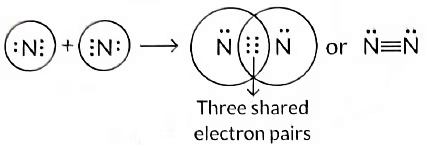
Q2: Draw the electron dot structure of the molecules of (a) Oxygen, and (b) Nitrogen. The atomic numbers of oxygen and nitrogen are 8 and 7 respectively.
Solution:
Ans: (a) Formation of oxygen molecule:
(b) Formation of nitrogen molecule:
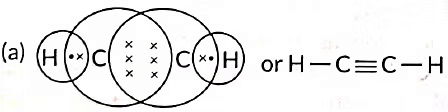
Q3: Draw the electron dot structure for ethyne.
Solution:
Ans:
Soaps and Detergents
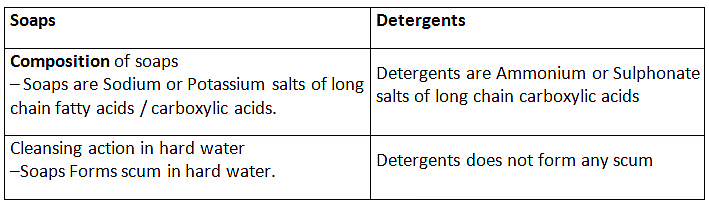
Q1: Compare soaps and detergents on the basis of their composition and cleansing action in hard water.
Ans: (a)
Q2: Soaps and detergents are both types of salts. State the difference between the two. Write the mechanism of the cleansing action of soaps. Why do soaps not form lather (foam) with hard water? Mention any two problems that arise due to the use of detergents instead of soaps.
Solution:
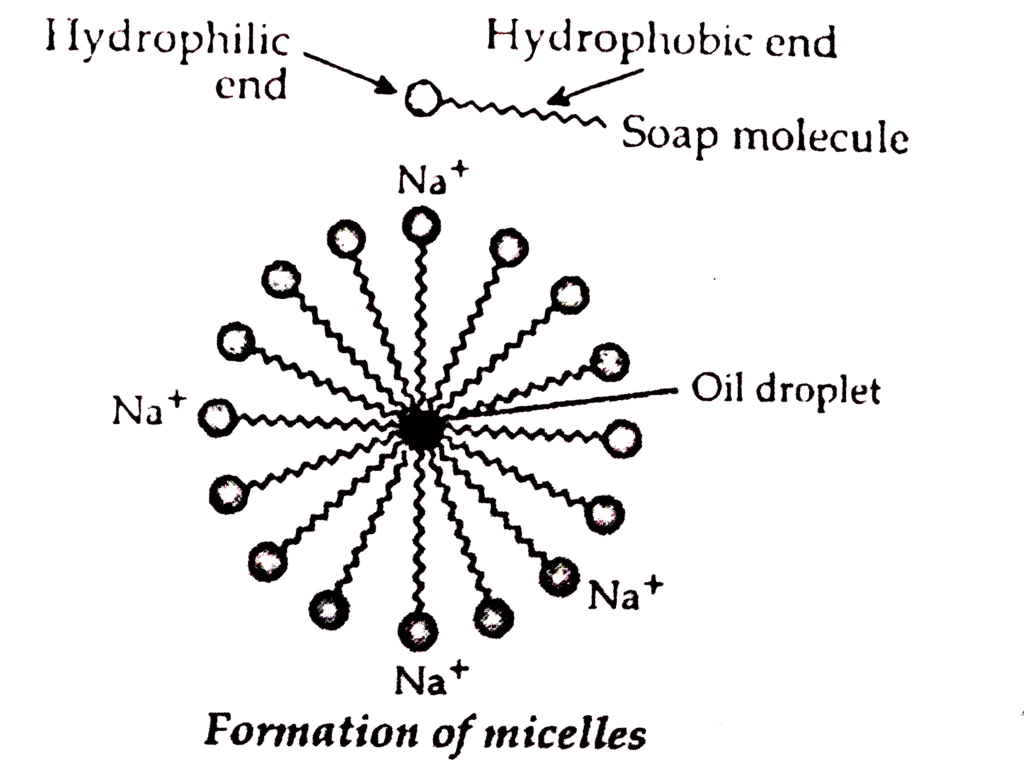
Ans: The molecules of soap are sodium or potassium salts of long-chain carboxylic acids. Detergents are generally ammonium or sulphonate salts of long chain carboxylic acids. Difference between Soap and Detergent Soaps: (i) Soaps are sodium salts of long chain carboxylic acids. (ii) The ionic group in soap is -COO-Na+. (iii) Soaps are not useful when water is hard. Detergents (i) Detergents are the odium salt of long chain benzene sulphonic acids. (ii) The ionic groups in detergents is SO3-Na+ or SO4-Na+. (iii) Detergent can be used for washing purpose even when water is hard Cleansing action of soap can be described as follows: The soap molecule is generally represented as RCOONa. In solution, it ionises to form RCOO- and Na+. Each soap molecule has a polar head group (carboxylate ion, COO- group) and a long nonpolar hydrocarbon tail (R group from long chain fatty acid). The polar head attracts the polar water molecule and is called hydrophilic end and the nonpolar tail attracts the water-insoluble oily or greasy dirt particles.
Q3: A student took four test tubes P, Q, R and S and filled about 8 mL of distilled water in each. After that he dissolved an equal amount of Na2SO4 in P, K2SO4 in Q, CaSO4 in R and MgSO4 in S. On adding an equal amount of soap solution and shaking each test tube well, a good amount of lather will be obtained in the test tubes: (a) P and Q (b) P and R (c) P, Q and S (d) Q, R and S
Solution:
Ans: (a) Soap forms lather easily in soft water, while hard water (which contains calcium and magnesium ions) reacts with soap to form scum, preventing the formation of lather. In this case: (i) Test tube P contains Na₂SO₄ (sodium sulfate), and Test tube Q contains K₂SO₄ (potassium sulfate). Both sodium and potassium salts do not contribute to water hardness, so they will allow soap to form lather. (ii) Test tube R contains CaSO₄ (calcium sulfate), and Test tube S contains MgSO₄ (magnesium sulfate). Both calcium and magnesium contribute to water hardness, which prevents lather formation. Therefore, a good amount of lather will be obtained in test tubes P and Q.
Q4: A student is given equal amount of three samples of water with temporary hardness labelled as 'A', 'B' and 'C'. He keeps the three samples at different temperatures - A at room temperature, B at 50 ºC and C at 95 ºC. Which sample will give maximum amount of lather when 10 mL of soap solution is added to each sample and shaken for equal time? (a) A only (b) Both A and B (c) Both B and C (d) C only
Solution:
Ans: (d) In this scenario:
Sample C is kept at 95 ºC, which is close to boiling temperature. At this high temperature, the temporary hardness will be significantly reduced due to the decomposition of bicarbonates, allowing more lather to form when soap is added.
Samples A (at room temperature) and B (at 50 ºC) will still retain more temporary hardness than sample C, and therefore will produce less lather.
Thus, sample C will give the maximum amount of lather, making the correct answer (d) C only.
Q5: Why is reaction between when soap is added to water? Will a micelle be formed in other solvents such as ethanol also? State briefly how the formation of micelles help to clean the clothes having oily spots.
Solution:
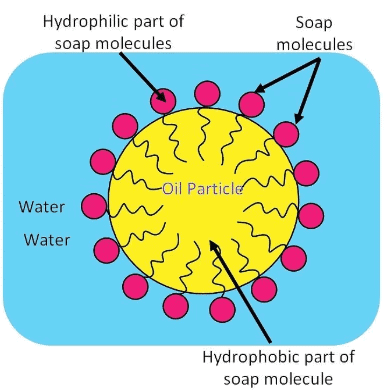
Ans:A micelle is a tiny cluster of molecules with non-polar groups inside and hydrophilic groups outside. When soap is added to water:
The hydrophobic tails of soap molecules avoid water, forming a cluster.
The hydrophilic heads remain in contact with water, stabilising the structure.
If ethanol is used instead of water, micelles will not form because ethanol lacks the necessary polar characteristics.The formation of micelles helps clean oily spots on clothes by:
Trapping oily dirt in the centre of the micelle.
Allowing the dirt to be easily rinsed away due to the colloidal nature of micelles.
Thus, soap effectively removes grease and dirt from fabrics.
The document Important Questions: Carbon and its compounds is a part of the Class 10 Course Science Class 10.
FAQs on Important Questions: Carbon and its compounds
1. What is a covalent bond and how does it relate to carbon compounds?
Ans. A covalent bond is a chemical bond that involves the sharing of electron pairs between atoms. In carbon compounds, covalent bonding is crucial because carbon has four valence electrons, allowing it to form four covalent bonds with other atoms. This ability leads to the vast diversity of organic compounds, as carbon can bond with itself and other elements, forming chains, rings, and complex structures.
2. What are homologous series and how are they significant in organic chemistry?
Ans. A homologous series is a group of organic compounds that share the same functional group and have a similar general formula, differing by a constant unit (usually -CH2-). They show a gradual change in physical properties such as boiling and melting points. This concept is significant in organic chemistry as it helps in understanding the behavior of similar compounds and predicting their properties based on their structure.
3. What are functional groups and why are they important in carbon compounds?
Ans. Functional groups are specific groups of atoms within molecules that are responsible for the characteristic chemical reactions of those molecules. In carbon compounds, functional groups such as hydroxyl (-OH), carboxyl (-COOH), and amino (-NH2) determine the properties and reactivity of the compounds. Understanding functional groups is essential for predicting how different compounds will react in chemical reactions.
4. What are structural isomers and how do they differ from each other?
Ans. Structural isomers are compounds that have the same molecular formula but differ in the arrangement of their atoms. They can vary in the connectivity of atoms (chain isomers) or the position of functional groups (positional isomers). This difference in structure leads to distinct physical and chemical properties, making the study of structural isomers important in organic chemistry.
5. How do soaps and detergents work in terms of their chemical structure?
Ans. Soaps and detergents are surfactants that contain both hydrophilic (water-attracting) and hydrophobic (water-repelling) parts in their molecular structure. Soaps are made from fatty acids and work by forming micelles that trap grease and oil, allowing them to be washed away with water. Detergents, which may be synthetic, work similarly but are often more effective in hard water. Their unique structure enables them to interact with both water and oils, making them effective cleaning agents.
practice quizzes, Semester Notes, Important Questions: Carbon and its compounds, Free, Objective type Questions, Viva Questions, MCQs, Important questions, Sample Paper, Important Questions: Carbon and its compounds, shortcuts and tricks, Extra Questions, Summary, pdf , video lectures, Important Questions: Carbon and its compounds, ppt, Exam, Previous Year Questions with Solutions, past year papers, mock tests for examination, study material;



 Due to small size, the nucleus of carbon atom can hold its shared pairs of electrons strongly. As a result, the bonds that carbon forms with most of the other elements such as hydrogen, oxygen, nitrogen, etc. are very strong there by making these compounds exceptionally stable.
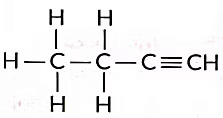 The molecular formula of butyne is C4H6.
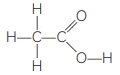

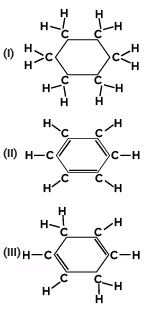 (a) (I) and (III) are isomers of hexane and (II) is benzene.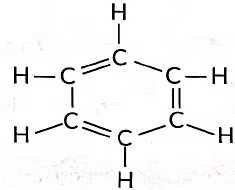
 OR
OR

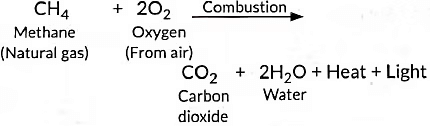 (ii) Oxidation is a process in which oxygen is added to a substance.
 (iii) Hydrogenation means addition of hydrogen to an unsaturated compound.
 (iv) When alcohol is added to carboxylic acid in the presence of acid catalyst then, a fruity smelling ester is formed. This process is called esterification.
 (v) Esters react in the presence of an acid or a base to give the alcohol and carboxylic acid. This reaction is known as saponification because it is used in the preparation of soap.


 OR
OR

 (ii) When 5 % alkaline KMn04 solution is added drop by drop to warm ethanol then it gets oxidised to ethanoic acid.
 (b) Addition reactions: Those reactions in which atoms or group of atoms are simply added to a double or triple bond without the elimination of any atom or molecule, are known as addition reactions.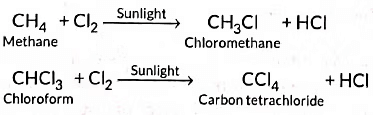

 (C) Compound C is ethane. When it undergoes combustion, it forms CO2 and water.
 (D) Hydrogenation reactions are used in the production of saturated vegetable ghee from unsaturated vegetable oils.
 (ii) Those reactions in which atoms or group of atoms are simply added to a double or triple bond without the elimination of any atom or molecule, are known as addition reactions.