Chapter Notes: Sleep Disorders

Electroencephalogram (EEG)
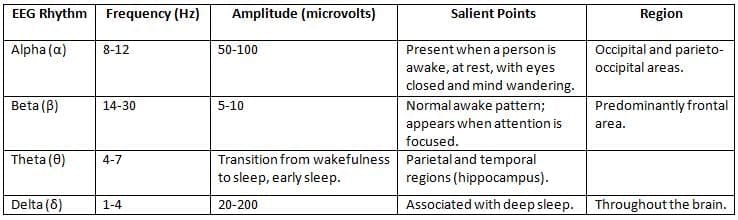
An electroencephalogram (EEG) is a test that measures the brain's electrical activity by placing electrodes on the scalp to detect potential differences between them. A typical EEG shows various types of brain rhythms.
Stages of Sleep
Sleep can be divided into two stages:1. Nonrapid Eye Movement Sleep (NREM): It is further divided into following four stages:
- Stage 1, NREM: This is the lightest stage of sleep, where a person can be easily awakened. During this stage, the EEG shows a loss of alpha waves (which are present when a person is awake with closed eyes) and an increase in theta waves.
- Stage 2, NREM:This is the longest stage of sleep, characterized by two main features on the EEG:
- Sleep spindles: Bursts of regular waves with a frequency of 13-15 Hz and an amplitude of 50 microvolts.
- K-complexes: High-voltage spikes that occur intermittently.
- Stage 3, NREM: Sleep deepens during this stage, and delta waves begin to appear on the EEG.
- Stage 4, NREM: This stage is characterized by deep sleep, with a predominance of delta waves on the EEG.
During NREM sleep, several hormones, including gonadotropins and growth hormones, are released in pulses. Additionally, there is a decrease in blood pressure, heart rate, and respiratory rate.
2. Rapid Eye Movement Sleep (REM):
- REM sleep follows NREM sleep and is characterized by several features:
- The EEG shows more activity, similar to when a person is awake, with increased beta activity and a return of alpha activity.
- The presence of rapid eye movements.
- A general loss of muscle tone.
- An increased rate of metabolism in the brain.
- Penile erection and heightened activity in the body's systems, such as a rise in pulse rate, respiratory rate, and blood pressure.
- Dreams that can be remembered occur during REM sleep.
- Ponto geniculo occipital spikes, which are large, brief electrical signals from cholinergic neurons in the pons, moving quickly to the lateral geniculate body and then to the occipital cortex, are a defining feature.
- REM sleep is often called paradoxical sleep because, although the EEG looks similar to the awake state, it is very hard to wake the person.
- During an 8-hour sleep, most time (around 6-6.5 hours) is spent in NREM sleep, while the remaining (around 1.5 hours) is in REM sleep.
- Most of the stage 4 NREM sleep happens in the first one-third of the night, while most of the REM sleep occurs in the last one-third.
- REM sleep occurs regularly every 90-100 minutes, with about 4-5 episodes throughout the night.
Sleep Disorders
Sleep disorders can be broadly classified into two categories:- Dyssomnias: These disorders involve problems with the duration or quality of sleep. They can manifest as difficulty falling asleep, staying asleep, or experiencing restful sleep.
- Parasomnias: These disorders are characterized by unusual behaviors or experiences during sleep, such as sleepwalking, night terrors, or sleep talking.
Dyssomnias
These disorders are characterized by abnormality in the duration or quality of sleep. They include:1. Insomnia:
- Primary Insomnia occurs when no specific cause is found for poor sleep. Symptoms may include:
- Difficulty falling asleep
- Difficulty staying asleep (waking up often during the night or too early in the morning)
- Nonrestorative sleep (feeling tired in the morning due to poor sleep quality)
- Treatment: Commonly involves medications like benzodiazepines, Zolpidem, and other sleep aids.
Other Disorders Related to Insomnia:
- i) Periodic Limb Movement Disorder: Characterized by sudden muscle contractions, usually in the legs, during sleep. This leads to:
- Frequent awakenings at night, although the person may not be aware of it.
- Bed partners may notice disturbances.
- Nonrestorative sleep and daytime sleepiness.
- Treatment: Typically involves benzodiazepines.
- ii) Restless Leg Syndrome (Ekbom syndrome): Involves uncomfortable sensations in the legs, often described as feeling like insects crawling on the skin. Relief comes from:
- Moving or walking around, which can make it hard to fall asleep.
- Treatment: The only approved medication is ropinirole, a dopamine agonist.
2. Hypersomnia:
This is diagnosed when excessive sleepiness occurs without a known cause. Symptoms may include:
- Long sleep episodes
- Excessive daytime sleepiness
Other Disorders Related to Hypersomnia:
- Narcolepsy: This disorder has several key features:
- Sleep Attacks: An overwhelming urge to sleep can happen at any time during the day.
- Cataplexy: A sudden loss of muscle control that can lead to falling.
- Hypnagogic Hallucinations: Hallucinations that occur when falling asleep, and possibly also during waking up (hypnopompic hallucinations).
- Sleep Paralysis: Occurs in the morning when the person wakes up but cannot move.
- Characteristic: In narcolepsy, there is a shorter time to reach REM sleep, which usually takes about 90 minutes in healthy individuals.
- Treatment: Involves scheduled naps and medications such as modafinil and other stimulants like amphetamines.
- Kleine-Levin Syndrome: A rare condition marked by episodes of excessive sleep, increased appetite, and heightened sexual behavior. The person is generally normal between episodes.
Parasomnias
These disorders are characterized by dysfunctional events associated with the sleep. These include:
Stage 4, NREM Sleep Disorders: These disorders happen during stage 4 of NREM sleep (also during stage 3). Most of the stage 4 NREM sleep occurs in the first third of the night, so these disorders are typically seen during that time. Patients usually cannot remember these events the next morning. They are most commonly found in children and include:
- Night Terror (Pavor Nocturnus): The person suddenly wakes up screaming and shows signs of extreme fear, like a fast heartbeat and sweating. They do not remember any dreams or reasons for their fear.
- Sleepwalking (Somnambulism): Individuals may perform various activities while asleep, such as getting out of bed, walking around, or even dressing and driving, and they will not remember these actions later.
- Sleep-Related Enuresis: This is the involuntary passing of urine in inappropriate places during sleep, mostly occurring at night in about 80% of cases. Common causes include psychosocial factors like sibling rivalry. The preferred treatment is using bed alarms that sound when the child urinates. Medications, such as tricyclic antidepressants like imipramine, can be used, but they have significant side effects. A better alternative is intranasal desmopressin.
- Bruxism (Teeth Grinding): The person grinds their teeth, creating loud noises, which can lead to damage to the tooth enamel.
- Sleep Talking (Somniloquy): People talk during stages 3 and 4 of NREM sleep, and they cannot remember doing so when they wake up.
Most of the time, these disorders do not need treatment, and parents should be reassured. In some cases, benzodiazepines may be prescribed, as they reduce the time spent in stage 4 NREM sleep, which can help lessen these episodes.
Other Sleep Disorders:
- Nightmare: This occurs during REM sleep, where the person experiences a frightening dream, wakes up scared, and shows signs of anxiety such as a fast heartbeat and high blood pressure. Unlike night terrors, people usually remember the dream after waking. Medications that shorten sleep, like tricyclic antidepressants, can be used for treatment.
FAQs on Chapter Notes: Sleep Disorders
| 1. What are the stages of sleep and why are they important? |  |
| 2. What are dyssomnias and how do they affect sleep? | |
| 3. What are parasomnias and what are some common examples? | |
| 4. How can sleep disorders be diagnosed? | |
| 5. What lifestyle changes can help improve sleep quality? | |