How to attempt JEE Exam on D-Day?

The Joint Entrance Examination (JEE) Main and JEE Advanced are critical gateways to India's premier engineering institutes, including NITs, IIITs, and IITs. JEE Main , conducted by the National Testing Agency (NTA), is the qualifying exam for JEE Advanced , managed by IIT Kanpur under the Joint Admission Board (JAB). This guide provides a comprehensive overview of exam day guidelines, patterns, and time management strategies for both exams, based on the latest information from jeemain.nta.nic.in and jeeadv.ac.in.
Exam Day Guidelines (Common to JEE Main and Advanced)
Both exams enforce strict protocols to ensure fairness. Below are key guidelines applicable to both, with specific differences noted where relevant.
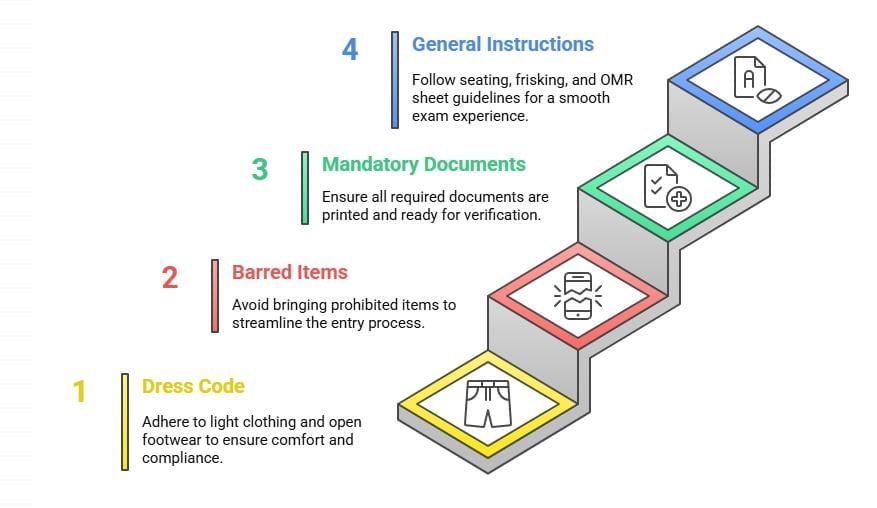
Dress Code
- Wear: Light clothing with half sleeves and sandals or open-toe footwear with low heels.
- Avoid: Long sleeves, closed shoes, or heavy accessories.
- Special Note: Candidates wearing customary attire (due to religious/cultural practices) must arrive early (by 7:00 AM for JEE Advanced, 7:30 AM for JEE Main) for thorough frisking.
Barred Items
- Prohibited: Stationery (pens, pencils, calculators), electronic devices (mobile phones, smartwatches, Bluetooth devices), accessories (wallets, belts, caps, ornaments), or any items that could facilitate unfair means.
- Note: No safekeeping facilities are provided, so avoid bringing these items.
Mandatory Documents
- JEE Main: Printed JEE Main admit card, passport-size photograph (same as uploaded), valid photo ID (Aadhaar, PAN card, passport, voter ID, or driving license), PwD certificate (if applicable).
- JEE Advanced: Printed JEE Advanced admit card, original valid photo ID, PwD certificate (if applicable).
- Note: No other documents or items are allowed in the exam hall.
General Instructions
- Seating: Occupy the assigned seat with your roll number.
- Frisking: Expect thorough frisking with metal detectors and biometric verification (fingerprint and photograph for JEE Advanced).
- OMR Sheet: Fill details accurately and submit to the invigilator before leaving.
- Conduct: A ballpoint pen is provided for OMR marking. Follow invigilator announcements (start, halfway, end). Candidates are video-recorded, so maintain an upright posture.
- Prohibited Actions: Do not leave the exam hall before the paper concludes. Beverages and eatables are not allowed, except for candidates with medical conditions (e.g., diabetes) who may carry transparent water bottles with prior approval.
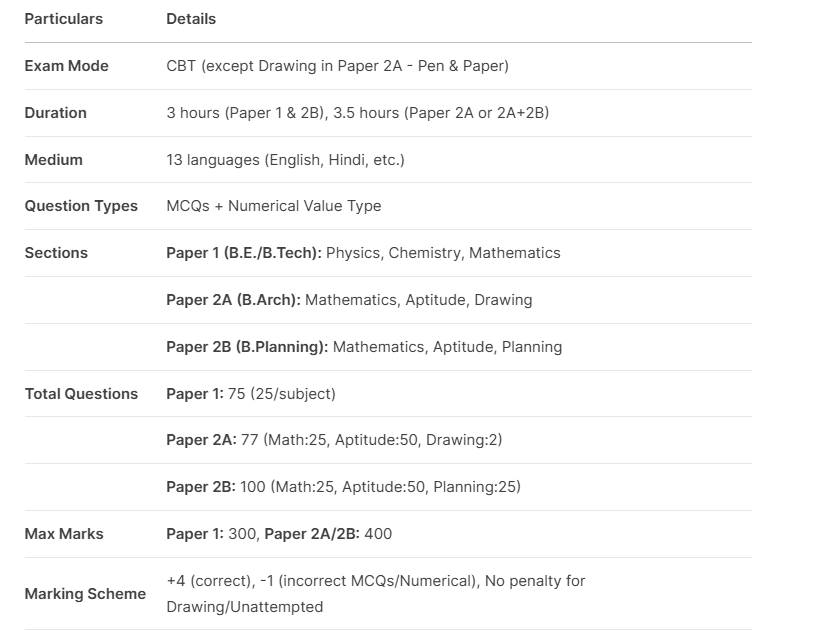
JEE Main Exam Pattern
JEE Advanced Exam Pattern
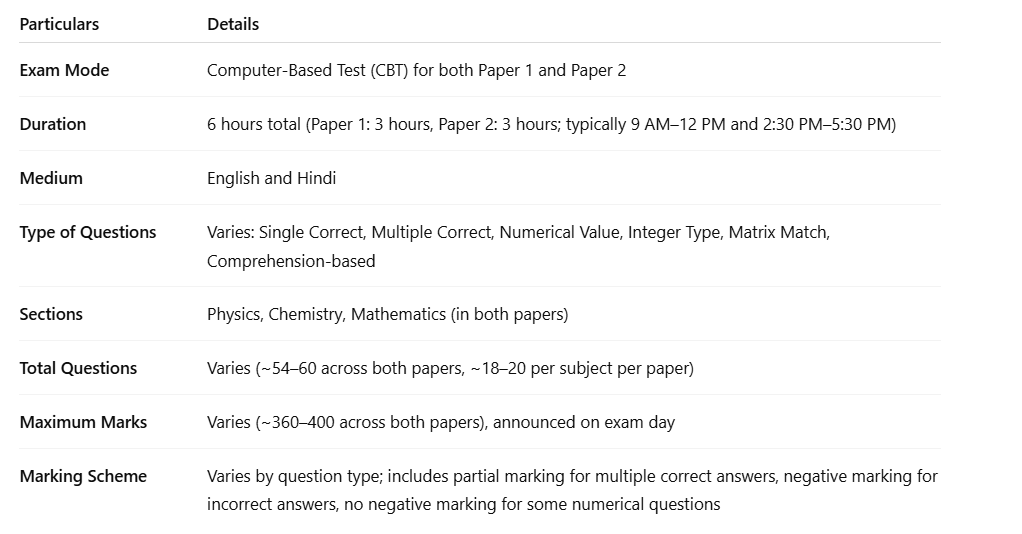
Note: JEE Advanced's exact question count and marking scheme are revealed only on exam day. Read instructions carefully before attempting each paper.
Time Management on Exam Day
Effective time management is crucial for both exams due to their competitive nature and time constraints. Below are tailored strategies, with common principles and exam-specific nuances.
Common Strategies
- Arrive Early: Reach the exam center 45-60 minutes before the reporting time (7:30 AM for JEE Main, 7:00 AM for JEE Advanced) to complete frisking and settle in.
- Glance Technique: Quickly scan the question paper to prioritize easy questions, practiced through mock tests.
- Previous Trends: Analyze past papers to identify high-weightage topics (e.g., Mechanics, Organic Chemistry, Calculus for both exams).
- Adaptability: Skip tough questions initially, mark for review, and return later to maximize scores.
- OMR Management: Fill the OMR sheet simultaneously and verify markings in the last 10-15 minutes.
JEE Main Time Management
- Duration: 3 hours (Paper 1) or 3.5 hours (Paper 2A/2B).
- Strategy:
- Start with your strongest subject (e.g., Chemistry for quick wins).
- Allocate ~50-60 minutes for Mathematics, 40-50 minutes for Chemistry, 60-70 minutes for Physics (Paper 1).
- For Paper 2A (B.Arch), spend ~60 minutes each on Mathematics, Aptitude, and Drawing. For Paper 2B, distribute time evenly.
- Reserve 15-20 minutes to revisit difficult questions and check OMR markings.
- Tip: Solve easy MCQs and numerical questions first to secure marks quickly.
JEE Advanced Time Management
- Duration: 6 hours (3 hours per paper, same day).
- Strategy:
- Begin with your strongest subject in each paper to build confidence.
- Spend ~50-60 minutes per subject per paper (Physics, Chemistry, Mathematics).
- Prioritize single-correct MCQs and numerical questions, saving matrix match or comprehension questions for later if time-consuming.
- If stuck on a question for >2-3 minutes, skip and mark for review.
- Use the ~2.5-hour gap between papers to relax, hydrate, and eat a light snack (if permitted). Avoid discussing Paper 1.
- Reserve 10-15 minutes per paper to verify OMR markings.
- Tip: Practice full-length mock tests (both papers) to build stamina for the 6-hour exam day.
Additional Tips for Both Exams
- Mock Tests:
- JEE Main: Use NTA's free mock tests on jeemain.nta.nic.in or the "NTA STUDENT" app.
- JEE Advanced: Practice official mock tests on jeeadv.ac.in or past papers from coaching platforms (FIITJEE, Allen).
- Preparation:
- Revise key formulas, concepts, and shortcuts. Focus on high-weightage topics identified from past papers.
- For JEE Advanced, prepare for innovative question types like matrix match and comprehension.
- Health and Rest:
- Get 7-8 hours of sleep the night before.
- Eat a light, healthy meal before the exam and during breaks (JEE Advanced).
- Admit Card Verification:
- Check details (name, roll number, center) on the admit card.
- Stay Calm:
- Avoid last-minute cramming or discussions with peers to maintain focus.
- Practice stress management techniques during mock tests to handle exam pressure.
For the latest updates, check jeemain.nta.nic.in (JEE Main) and jeeadv.ac.in (JEE Advanced) regularly, as minor changes may occur closer to the exam dates.
FAQs on How to attempt JEE Exam on D-Day?
| 1. What are the key guidelines to follow on the exam day for JEE? |  |
| 2. What is the exam pattern for JEE Main? | |
| 3. How does the JEE Advanced exam pattern differ from JEE Main? | |
| 4. What time management strategies should candidates employ during the JEE exam? | |
| 5. What additional tips can help candidates perform better on exam day? | |




