CTET & State TET Exam > CTET & State TET Notes > Child Development and Pedagogy for CTET Preparation > Mind Map: 4 Parenting Styles
Mind Map: 4 Parenting Styles

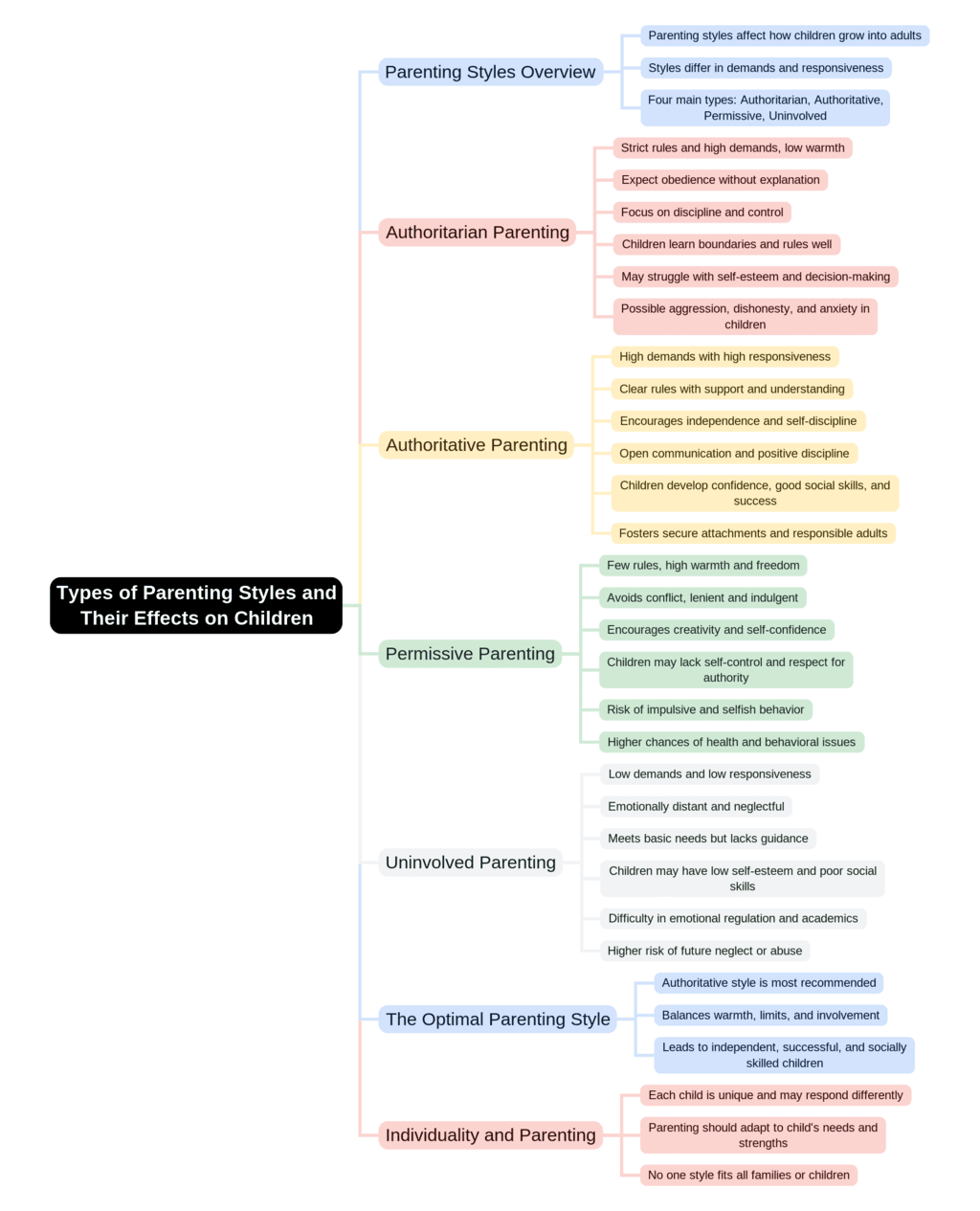
The document Mind Map: 4 Parenting Styles is a part of the CTET & State TET Course Child Development and Pedagogy for CTET Preparation.
All you need of CTET & State TET at this link: CTET & State TET
FAQs on Mind Map: 4 Parenting Styles
| 1. What are the four main parenting styles? |  |
Ans. The four main parenting styles are authoritative, authoritarian, permissive, and neglectful. Authoritative parents are responsive and set clear boundaries, authoritarian parents are strict and demand obedience, permissive parents are lenient and indulgent, and neglectful parents are disengaged and uninvolved in their children's lives.
| 2. How does each parenting style affect a child's development? | |
Ans. Authoritative parenting generally leads to positive outcomes, such as higher self-esteem and better social skills. Authoritarian parenting can result in children who are obedient but may struggle with self-esteem and social interactions. Permissive parenting can lead to children who are self-confident but may have difficulties with authority and discipline. Neglectful parenting often leads to issues with attachment and self-regulation in children.
| 3. Can parenting styles change over time? | |
Ans. Yes, parenting styles can change over time due to various factors such as life experiences, cultural shifts, or personal growth. Parents may adapt their approaches based on their children's needs, their own development, or changes in their family dynamics.
| 4. What are some characteristics of authoritative parenting? | |
Ans. Authoritative parenting is characterized by warmth, responsiveness, and open communication. Parents set clear expectations and rules but also encourage independence and self-expression. They are supportive and provide reasoning for their rules, fostering a cooperative and respectful relationship with their children.
| 5. How can parents identify their own parenting style? | |
Ans. Parents can identify their parenting style by reflecting on their behaviors, attitudes, and interactions with their children. They may consider how they respond to their children's needs, the level of control they exert, and how much warmth and support they provide. Seeking feedback from partners or parenting groups can also help in this self-assessment.
About this Document

4.70/5 Rating

Apr 18, 2026 Last updated
Related Exams
Document Description: Mind Map: 4 Parenting Styles for CTET & State TET 2026 is part of Child Development and Pedagogy for CTET Preparation preparation. The notes and questions for Mind Map: 4 Parenting Styles have been prepared according to the CTET & State TET exam syllabus. Information about Mind Map: 4 Parenting Styles covers topics like and Mind Map: 4 Parenting Styles Example, for CTET & State TET 2026 Exam. Find important definitions, questions, notes, meanings, examples, exercises and tests below for Mind Map: 4 Parenting Styles.
Introduction of Mind Map: 4 Parenting Styles in English is available as part of our Child Development and Pedagogy for CTET Preparation for CTET & State TET & Mind Map: 4 Parenting Styles in Hindi for Child Development and Pedagogy for CTET Preparation course. Download more important topics related with notes, lectures and mock test series for CTET & State TET Exam by signing up for free. CTET & State TET: Mind Map: 4 Parenting Styles
Description
Mind Map: 4 Parenting Styles of Child Development & Pedagogy provides you one-page visual summary of the chapter covering all the important topics. Download the PDF from EduRev.
Information about Mind Map: 4 Parenting Styles
In this doc you can find the meaning of Mind Map: 4 Parenting Styles defined & explained in the simplest way possible. Besides explaining types of Mind Map: 4 Parenting Styles theory, EduRev gives you an ample number of questions to practice Mind Map: 4 Parenting Styles tests, examples and also practice CTET & State TET tests



Related Searches
video lectures, pdf , Exam, Mind Map: 4 Parenting Styles, shortcuts and tricks, MCQs, Sample Paper, past year papers, Mind Map: 4 Parenting Styles, Viva Questions, study material, ppt, practice quizzes, Important questions, Free, Previous Year Questions with Solutions, Summary, mock tests for examination, Extra Questions, Objective type Questions, Semester Notes, Mind Map: 4 Parenting Styles;