Chapter Notes: Constructions

Introduction
Imagine being able to create perfect shapes like triangles, circles, and parallel lines using just a ruler and a compass, without measuring lengths or angles! This is the magic of geometric constructions, a skill perfected by the ancient Greek mathematician Euclid in his famous book, Elements. In this exciting chapter, we dive into the art of constructing parallel lines, triangles, circumcircles, and incircles with simple tools. These techniques are not only fun but also help us understand the beauty and logic of geometry, making it a fundamental part of our mathematical journey!
To Construct Parallel Lines
Understand that a parallel line can be drawn through a point not on the given line by creating equal alternate angles.
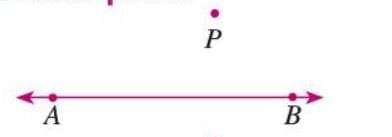
Steps to construct a line parallel to a given line AB through a point P:
- Choose a point Q on line AB and connect P to Q.
- With Q as the center, draw an arc with a suitable radius that intersects QB at L and QP at M.
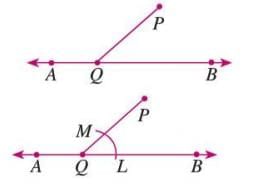
- Using P as the center and the same radius, draw an arc on the opposite side of PQ to intersect QP at N.
- With N as the center, draw an arc with radius equal to LM to intersect the arc from step 3 at O.
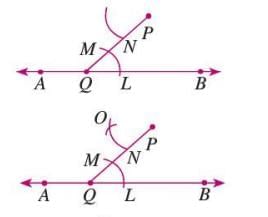
- Join P and O, then extend the line. This line, OP, is parallel to AB.
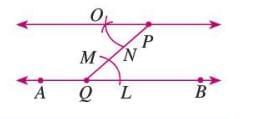
Reasoning: The construction ensures ∠MQL = ∠NPO, making the lines parallel as alternate angles are equal when a transversal cuts parallel lines.
Construction of Triangles
- Triangles can be constructed based on given sides, angles, or a combination, following specific criteria.
Key properties of triangles:
- The sum of the three angles in a triangle is 180°.
- An exterior angle equals the sum of the opposite interior angles.
- The sum of any two sides is greater than the third side.
- In a right-angled triangle, the hypotenuse2 equals the sum of the squares of the other two sides.
To construct a triangle when two sides and the included angle are given
Steps to construct triangle ABC with AB = 4 cm, BC = 7.5 cm, and ∠ABC = 45°:
 At point B, construct an angle ∠CBD = 45°.Draw line segment BC of length 7.5 cm.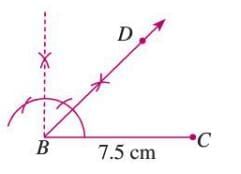
- With B as the center, draw an arc of radius 4 cm to intersect ray BD at point A.
- Connect A to C to form triangle ABC.
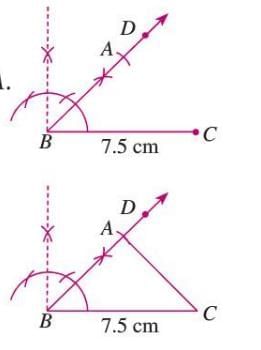
To construct a triangle when two angles and one side are given
Steps to construct triangle ABC with ∠A = 30°, ∠B = 60°, and AB = 8.8 cm:
- Draw line segment AB of length 8.8 cm.
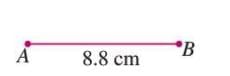
- At point A, construct angle ∠BAD = 30°.
- At point B, construct angle ∠ABE = 60° to intersect ray AD at point C.
- Triangle ABC is formed.
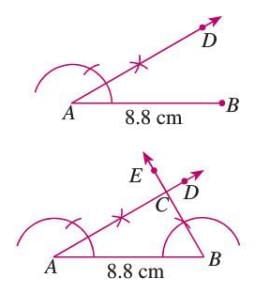
Note: If side AC and angles ∠A and ∠B are given, calculate ∠C (180° - ∠A - ∠B) and then construct the triangle.
To construct a triangle when its three sides are given
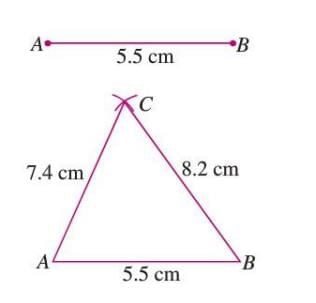
Steps to construct triangle ABC with AB = 5.5 cm, BC = 8.2 cm, and CA = 7.4 cm:
- Draw line segment AB of length 5.5 cm.
- With A as center, draw an arc of radius 7.4 cm.
- With B as center, draw an arc of radius 8.2 cm to intersect the arc from step 2 at point C.
- Connect A to C and B to C to form triangle ABC.
To construct an equilateral triangle when its side is given
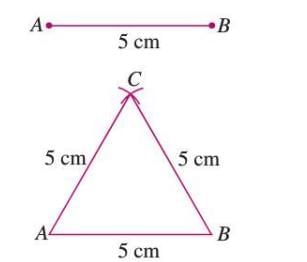
Steps to construct equilateral triangle ABC with side 5 cm:
- Draw line segment AB of length 5 cm.
- With A as center, draw an arc of radius 5 cm.
- With B as center, draw an arc of radius 5 cm to intersect the arc from step 2 at point C.
- Connect A to C and B to C to form equilateral triangle ABC.
To construct an isosceles triangle when its base and base angles are given
Steps to construct isosceles triangle ABC with AB = 7.4 cm, ∠CAB = ∠CBA = 60°:
- Draw line segment AB of length 7.4 cm.
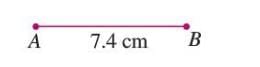
- At point A, construct angle ∠DAB = 60°.
- At point B, construct angle ∠EBA = 60° to intersect ray DA at point C.
- Triangle ABC is the required isosceles triangle.
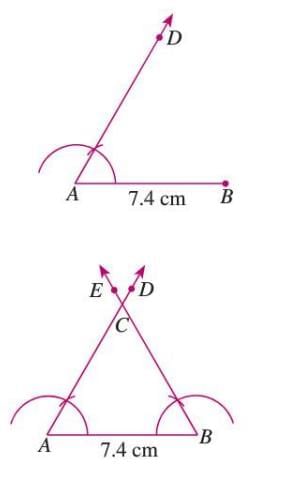
To construct an isosceles triangle when one of the equal sides and the vertical angle are given
Steps to construct isosceles triangle ABC with AB = 6.4 cm and ∠A = 30°:
- Draw line segment AB of length 6.4 cm.
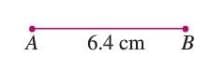
- At point A, construct angle ∠DAB = 30°.
- With A as center, draw an arc of radius 6.4 cm to intersect ray AD at point C.
- Connect B to C to form isosceles triangle ABC.
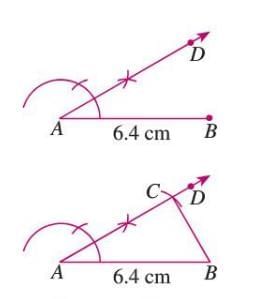
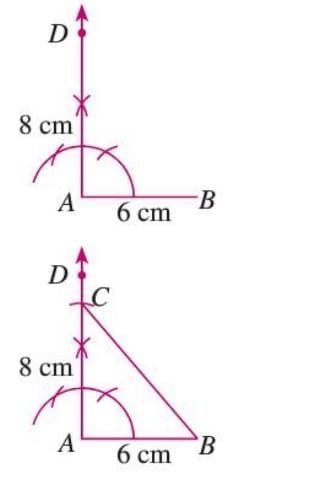
To construct a right-angled triangle when its two sides forming the right angle are given
Steps to construct right-angled triangle ABC with AB = 6 cm and AC = 8 cm:
- Draw line segment AB of length 6 cm.
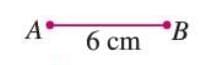
- At point A, construct angle ∠DAB = 90°.
- With A as center, draw an arc of radius 8 cm to intersect ray AD at point C.
- Connect B to C to form the right-angled triangle ABC.
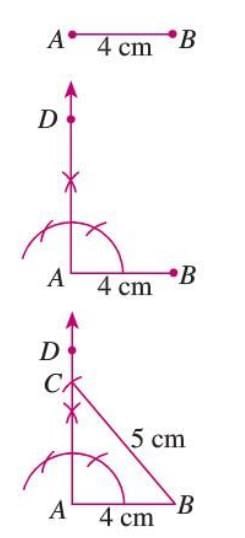
To construct a right-angled triangle when one of its sides and hypotenuse are given
Steps to construct right-angled triangle ABC with AB = 4 cm and hypotenuse BC = 5 cm:
- Draw line segment AB of length 4 cm.
- At point A, construct angle ∠DAB = 90°.
- With B as center, draw an arc of radius 5 cm to intersect ray AD at point C.
- Connect B to C to form the right-angled triangle ABC.
Circumcircle
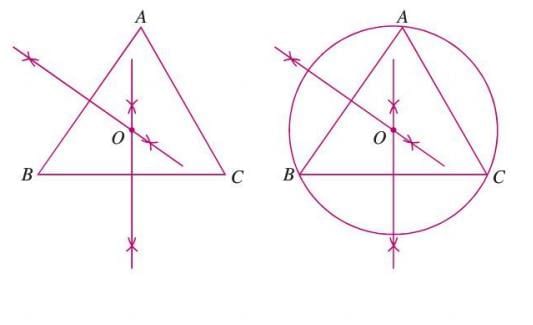
- A circumcircle is a circle passing through all three vertices of a triangle.
- The center is called the circumcentre, and its radius is the circumradius.
Steps to construct the circumcircle of a triangle:
- Construct the triangle with the given measurements.
- Draw perpendicular bisectors of any two sides (e.g., AB and BC) to intersect at point O.
- With O as center, draw a circle using OA, OB, or OC as the radius, passing through all three vertices.
Incircle
- An incircle is a circle inside a triangle that touches all three sides.
- The center is called the incentre.
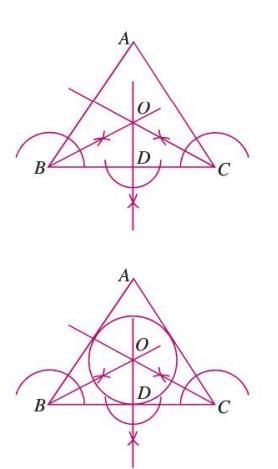
Steps to construct the incircle of a triangle:
- Construct the triangle with the given measurements.
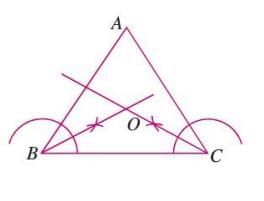
- Draw angle bisectors of any two angles (e.g., ∠ABC and ∠ACB) to intersect at point O.
- From O, draw a perpendicular to side BC, intersecting at point D.
- With O as center and OD as radius, draw a circle that touches all three sides.
FAQs on Chapter Notes: Constructions
| 1. What are the steps to construct parallel lines using a compass and straightedge? |  |
| 2. How can we construct different types of triangles using a compass and straightedge? | |
| 3. What is the method for constructing a circumcircle of a triangle? | |
| 4. How do you construct the incircle of a triangle? | |
| 5. Why are constructions important in geometry, particularly for students learning in Class 7? | |