Chapter Notes: Area and Perimeter of Plane Figures


Introduction
Imagine designing a beautiful garden or planning the layout of a sports field-knowing how to calculate the area and perimeter of shapes is key! Chapter 20, "Area and Perimeter of Plane Figures," takes you on a journey through the fascinating world of geometry, where you'll learn to measure the boundaries and surfaces of various shapes like triangles, quadrilaterals, and circles. From finding the space inside a triangle to determining the fencing needed for a circular park, this chapter equips you with essential formulas and techniques to solve real-world problems with confidence. Get ready to explore the measurements that bring shapes to life!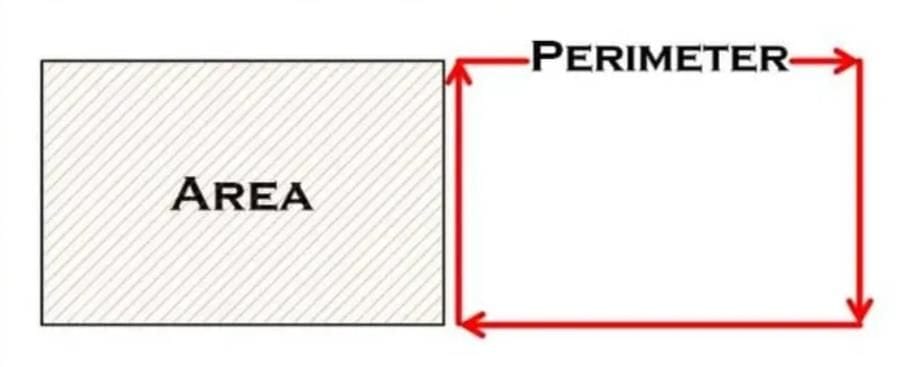
Perimeter: The perimeter is the total distance around the boundary of a shape.
- Units for perimeter are the same as for length, such as centimeters (cm) or meters (m).
Area: The area measures the surface enclosed within the boundary of a shape.
- Area is measured in square units, like square centimeters (cm2) or square meters (m2).
Square Meter vs. Meter Square:
- Square meter refers to an area (e.g., 5 square meters is an area measurement).
- Meter square refers to a square with each side measuring a certain number of meters, and its area is calculated as side × side (e.g., a 5-meter square has an area of 5 × 5 = 25 square meters).
Example: A square has a side of 4 meters. Its perimeter is 4 × 4 = 16 meters, and its area is 4 × 4 = 16 square meters. Here, "square meters" indicates the area, while a "4-meter square" refers to the shape itself.
Area and Perimeter of Triangles
- Area Formula: Area = ½ × base × height
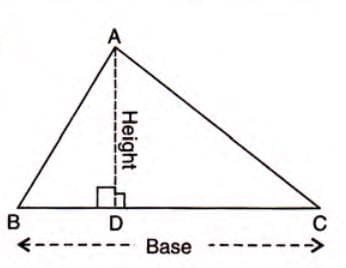
- The height (altitude) is the perpendicular distance from the opposite vertex to the base.
- Any side of a triangle can be chosen as the base, with the corresponding height being the perpendicular from the opposite vertex to that base.
- Heron's Formula:For a triangle with sides a, b, and c:
- Perimeter = a + b + c
- Semi-perimeter (s) = (a + b + c) / 2
- Area = √[s(s - a)(s - b)(s - c)]
- Units:
- In C.G.S. system: Length in cm, Area in cm2.
- In M.K.S. (S.I.) system: Length in m, Area in m2.
- Conversion: 1 cm = 1/100 m, 1 cm2 = 1/(100 × 100) m2, 1 m2 = 100 × 100 cm2.
Example: Find the area of a triangle with height 6 cm and base 10 cm.
Solution:
- Area = ½ × base × height
- = ½ × 10 × 6 = 30 cm2
Example (Heron's Formula): Find the area of a triangle with sides 17 cm, 8 cm, and 15 cm, and the altitude corresponding to the largest side.
Solution:
- Let a = 17 cm, b = 8 cm, c = 15 cm.
- Semi-perimeter s = (17 + 8 + 15) / 2 = 20 cm.
- Area = √[20(20 - 17)(20 - 8)(20 - 15)] = √[20 × 3 × 12 × 5] = 60 cm2.
- For altitude corresponding to the largest side (17 cm):
- Area = ½ × base × altitude
- 60 = ½ × 17 × altitude
- Altitude = (60 × 2) / 17 = 7.06 cm.
Some Special Types of Triangles
1. Equilateral Triangle
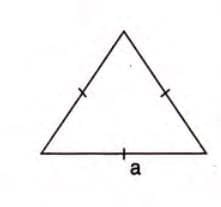
- All sides are equal, and all angles are 60°.
- Perimeter:3 × side = 3a
- Area:(√3 / 4) × (side)2 = (√3 / 4) × a2
- The altitude bisects the base, forming two right-angled triangles.
Example: Calculate the area of an equilateral triangle with height 20 cm. (Take √3 = 1.73)
Solution:
- Let side = a cm, height = 20 cm.
- In an equilateral triangle, the altitude bisects the base.
- In right-angled triangle ABD: BD = a/2, AD = 20 cm, AB = a.
- By Pythagoras theorem: 202 + (a/2)2 = a2.
- 400 + a2/4 = a2.
- a2 - a2/4 = 400.
- (3a2)/4 = 400.
- a2 = (400 × 4) / 3 = 1600/3.
- Area = (√3 / 4) × a2 = (1.73 / 4) × (1600 / 3) ≈ 230.9 cm2.
2. Isosceles Triangle
- Two sides are equal, and the angles opposite them are equal.
- The altitude from the vertex to the base bisects the base.
- Area Formula:½ × base × height
- Alternative Formula:(1/4) × b × √(4a2 - b2), where a = equal sides, b = base.
- Heron's Formula: Area = √[s(s - a)(s - a)(s - b)], where s = (a + a + b) / 2.
Example: Find the area of an isosceles triangle with equal sides 5 cm each and base 6 cm.
Solution: 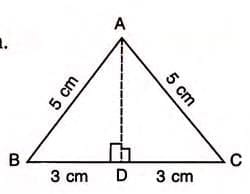
(Method 1 - Using Height):
- Let AB = AC = 5 cm, BC = 6 cm.
- Altitude AD bisects base BC, so BD = CD = 3 cm.
- In right-angled triangle ABD: AD2 = AB2 - BD2 = 52 - 32 = 16.
- AD = 4 cm.
- Area = ½ × BC × AD = ½ × 6 × 4 = 12 cm2.
Alternative Method (Heron's Formula):
- s = (5 + 5 + 6) / 2 = 8 cm.
- Area = √[8(8 - 5)(8 - 5)(8 - 6)] = √[8 × 3 × 3 × 2] = 12 cm2.
Third Method (Alternative Formula):
- Area = (1/4) × 6 × √(4 × 52 - 62) = (1/4) × 6 × √(100 - 36) = (1/4) × 6 × 8 = 12 cm2.
3. Right-Angled Triangle
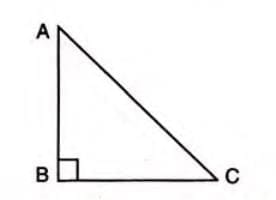
- One angle is 90°.
- Area Formula:½ × (product of sides containing the right angle)
Example: The sides of a right-angled triangle containing the right angle are 5x cm and (3x - 1) cm. If the area is 60 cm2, find the sides.
Solution:
- Area = ½ × (5x) × (3x - 1) = 60.
- 5x × (3x - 1) = 120.
- 15x2 - 5x = 120.
- 3x2 - x - 24 = 0.
- Solving the quadratic equation: x = 3 or x = -8/3.
- Since x = -8/3 gives negative sides (invalid), x = 3.
- Sides = 5x = 5 × 3 = 15 cm, (3x - 1) = (3 × 3 - 1) = 8 cm.
Area and Perimeter of Quadrilaterals
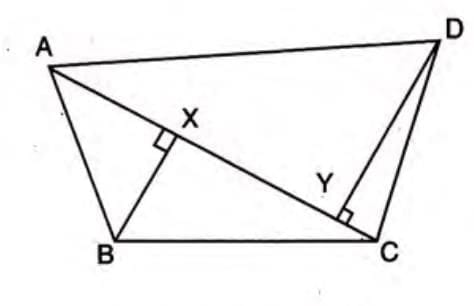
General Method 1 (One Diagonal and Perpendiculars):
- Area = ½ × diagonal × (sum of perpendiculars from opposite vertices to the diagonal)
- For quadrilateral ABCD with diagonal AC and perpendiculars BX and DY from B and D to AC: Area = ½ × AC × (BX + DY).
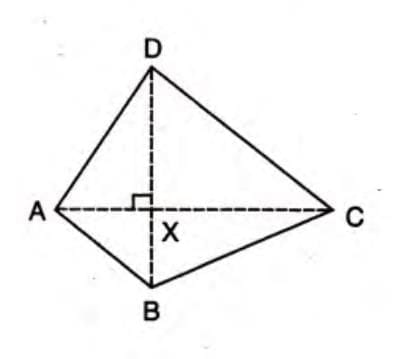
General Method 2 (Diagonals at Right Angles):
- Area = ½ × (product of diagonals)
- For quadrilateral ABCD with diagonals AC and BD intersecting at right angles: Area = ½ × AC × BD.
Example: Find the area of quadrilateral ABCD with diagonal AC = 30 cm and perpendiculars from B and D to AC as 19 cm and 11 cm.
Solution:
- Area = ½ × AC × (BX + DY).
- = ½ × 30 × (19 + 11) = ½ × 30 × 30 = 450 cm2.
Some Special Types of Quadrilaterals
1. Rectangle
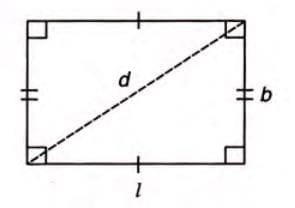
- Area:length × breadth = l × b
- Perimeter:2(length + breadth) = 2(l + b)
- Diagonal:√(l2 + b2)
Example: The perimeter of a rectangle is 25.5 m, and its length is 9.5 m. Calculate its area.
Solution:
- Perimeter = 2(l + b) = 25.5.
- 2(9.5 + b) = 25.5.
- 9.5 + b = 12.75.
- b = 3.25 m.
- Area = l × b = 9.5 × 3.25 = 30.875 m2.
2. Square
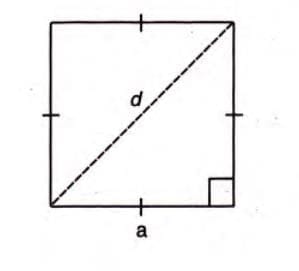
- Area:(side)2 = a2
- Perimeter:4 × side = 4a
- Diagonal:a√2
- Also, diagonal = √(2 × Area)
Example: The area of a square field is 484 m2. Find the length of its side and diagonal (correct to two decimal places).
Solution:
- Area = a2 = 484.
- Side = a = √484 = 22 m.
- Diagonal = a√2 = 22 × 1.414 ≈ 31.11 m.
3. Parallelogram
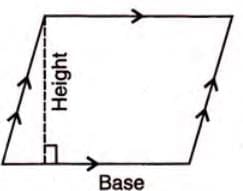
- Area:base × height
- Height is the perpendicular distance between the base and the opposite side.
Example: Two adjacent sides of a parallelogram are 15 cm and 10 cm. If the distance between the 15 cm sides is 8 cm, find the distance between the 10 cm sides.
Solution: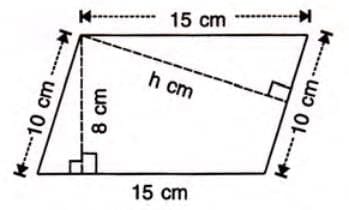
- Area = base × height.
- With base 15 cm and height 8 cm: Area = 15 × 8 = 120 cm2.
- With base 10 cm and height h: 10 × h = 120.
- h = 12 cm.
4. Rhombus
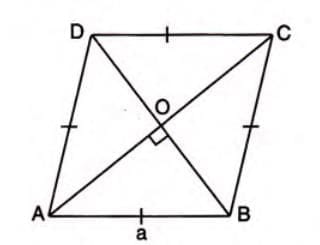
- Perimeter:4 × side = 4a
- Area:½ × (product of diagonals) = ½ × d1 × d2
- Diagonals bisect each other at right angles.
- Side length: √[(d1/2)2 + (d2/2)2]
- Area (as parallelogram): base × height
Example: In rhombus PQRS, PQ = 3 cm, and height is 2.5 cm. Calculate the perimeter and area.
Solution:
- Perimeter = 4 × 3 = 12 cm.
- Area = base × height = 3 × 2.5 = 7.5 cm2.
5. Trapezium
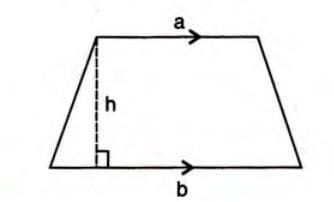
- Area:½ × (sum of parallel sides) × (distance between them) = ½ × (a + b) × h
Example: A trapezium ABCD has parallel sides DC = 15 cm, AB = 23 cm, and non-parallel sides DA = 10 cm, BC = 8 cm. Find its area.
Solution: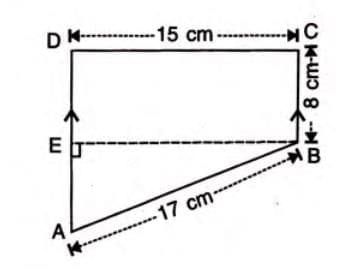
- Draw CE parallel to DA, forming parallelogram AECD.
- AE = DC = 15 cm, so EB = AB - AE = 23 - 15 = 8 cm.
- In triangle EBC: sides EB = 8 cm, CE = DA = 10 cm, BC = 8 cm.
- Semi-perimeter s = (8 + 10 + 8) / 2 = 13 cm.
- Area of triangle EBC = √[13(13 - 8)(13 - 10)(13 - 8)] = 5√39 cm2.
- Area = ½ × EB × CF = 5√39.
- CF = (5√39) / 4 cm (height of trapezium).
- Area of trapezium = ½ × (15 + 23) × (5√39 / 4) ≈ 148.32 cm2.
Circumference of a Circle
- Circumference is the length of the boundary of a circle.
- The ratio of circumference to diameter is constant, denoted by π (pi).
- Circumference Formula:C = π × d = 2πr, where d = diameter, r = radius.
- π ≈ 22/7 or 3.14.
Example: The circumference of a circle exceeds its diameter by 270 cm. Find its diameter.
Solution:
- Let radius = r cm.
- Circumference = 2πr, diameter = 2r.
- Given: 2πr - 2r = 270.
- 2r(π - 1) = 270.
- 2r(22/7 - 1) = 270.
- 2r × 15/7 = 270.
- r = (270 × 7) / (2 × 15) = 63 cm.
- Diameter = 2 × 63 = 126 cm.
Area of a Circle
- Area is the surface enclosed by the circle's boundary.
- Area Formula:πr2, where r = radius.
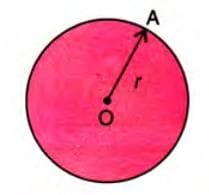
Example: The area of a circle is numerically equal to its circumference. Find its area (Take π = 3.14).
Solution:
- Let radius = r.
- Area = πr2, Circumference = 2πr.
- Given: πr2 = 2πr.
- r = 2.
- Area = π × 22 = 3.14 × 4 = 12.56 square units.
FAQs on Chapter Notes: Area and Perimeter of Plane Figures
| 1. What is the formula to calculate the area of a triangle? |  |
| 2. How do you find the perimeter of different types of triangles? | |
| 3. What are the key properties of special quadrilaterals like squares and rectangles? | |
| 4. How is the circumference of a circle calculated, and what is its significance? | |
| 5. Can you explain how to calculate the area of a circle? | |




