Chapter Notes: Height and Distance

Introduction
Imagine standing on a vast plain, gazing up at a towering monument or a distant mountain peak, wondering just how tall it is or how far away it lies. The chapter "Heights and Distances" unlocks the magic of trigonometry to answer these questions with precision! By using angles and a few simple measurements, we can calculate the heights of towering structures or the distances to far-off objects without ever leaving the ground. This chapter introduces the fascinating concepts of angles of elevation and depression, guiding us through a world where math meets real-life adventure, from measuring the height of a tree to finding the distance between ships at sea. Let's dive into this exciting journey of discovery!
Angles of Elevation and Depression
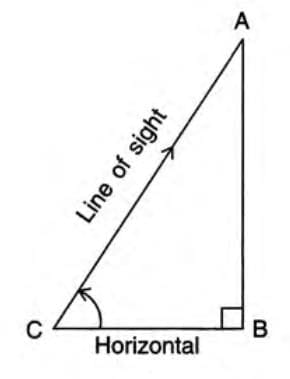
- Line of Sight: The imaginary line connecting the observer's eye to the object being viewed.
- Angle of Elevation: The angle formed between the line of sight and the horizontal when the observer looks upward at an object.
- Angle of Depression: The angle formed between the line of sight and the horizontal when the observer looks downward at an object.
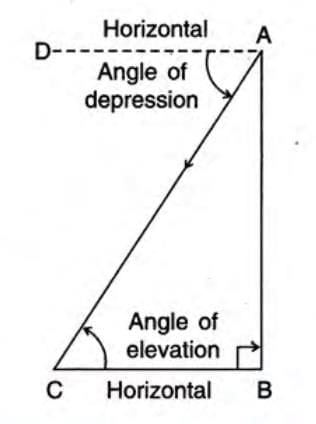
- Key Property: The angle of elevation of a point A as seen from point C equals the angle of depression of point C as seen from point A.
- Formula Used: In right-angled triangles, trigonometric ratios like tan θ = opposite/adjacent are used to relate heights and distances.
- Stepwise Explanation:
- Identify the right-angled triangle formed by the observer, object, and horizontal ground.
- Determine whether the angle is elevation (looking up) or depression (looking down).
- Use trigonometric ratios (e.g., tan θ = height/distance) to set up equations.
- Solve for the unknown height or distance using known values.
Example: The length of the shadow of a vertical tower is √3 times its height. Find the angle of elevation of the sun.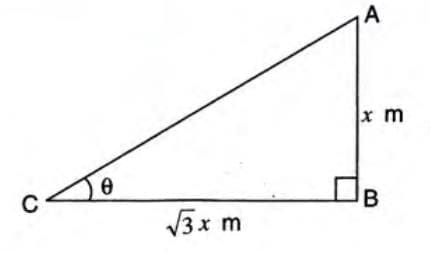
- Let the height of the tower be x meters.
- Shadow length = √3x meters.
- Angle of elevation of the sun = θ.
- In the right triangle formed, tan θ = height/shadow = x/(√3x) = 1/√3.
- Since tan 30° = 1/√3, θ = 30°.
- Answer: The angle of elevation of the sun is 30°.
Solved Examples
Example 1: The angle of elevation of the top of a tower at a distance of 120 m from its foot on a horizontal plane is 30°. Find the height of the tower.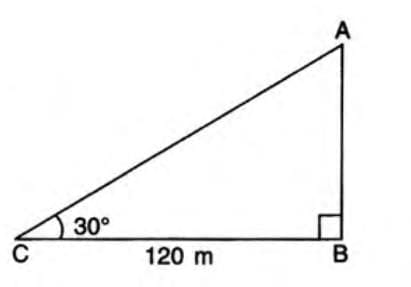
- Let AB be the tower, C the point of observation, BC = 120 m, ∠ACB = 30°.
- In triangle ABC, tan 30° = AB/BC = height/120.
- Since tan 30° = 1/√3, we have height/120 = 1/√3.
- Height = 120 × (1/√3) = 120/√3 ≈ 69.28 m.
- Answer: The height of the tower is approximately 69.28 m.
Example 2: A guard observes an enemy boat from an observation tower 180 m above sea level at an angle of depression of 29°. (i) Calculate the distance of the boat from the foot of the tower. (ii) If the boat is later 200 m from the foot, find the new angle of depression.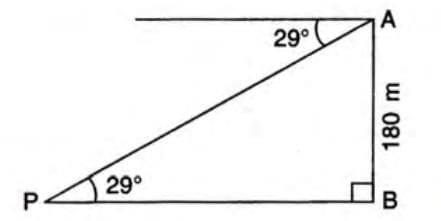
- (i) Let AB be the tower (180 m), P the boat, ∠APB = 29° (angle of depression).
- In triangle ABP, tan 29° = AB/PB = 180/PB.
- PB = 180/tan 29° ≈ 180/0.5543 ≈ 325 m.
- Alternative Method: ∠PAB = 90° - 29° = 61°. Then, BP/AB = tan 61°, so BP = 180 × tan 61° ≈ 180 × 1.804 ≈ 325 m.
- (ii) New position Q, QB = 200 m. tan θ = AB/QB = 180/200 = 0.9 ≈ tan 41°59'.
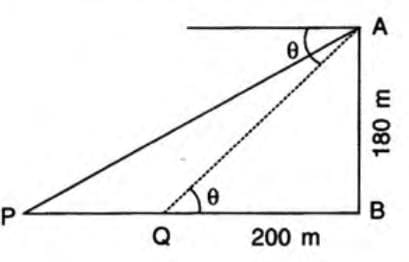
- Answer: (i) 325 m, (ii) 41°59'.
Example 3: From a 200 m cliff, the angles of depression of two ships are 45° and 30°. Find the distance between the ships if (i) on the same side, (ii) on opposite sides.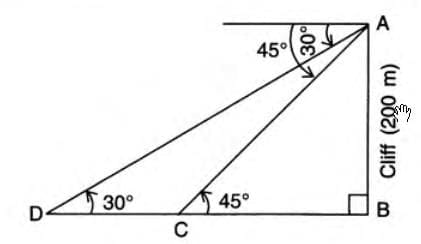
- (i) Same side: Let AB be the cliff (200 m), C and D the ships, ∠ACB = 45°, ∠ADB = 30°.
- In triangle ABC, tan 45° = 200/BC = 1, so BC = 200 m.
- In triangle ABD, tan 30° = 200/BD = 1/√3, so BD = 200 × √3 ≈ 346.4 m.
- Distance CD = BD - BC = 346.4 - 200 = 146.4 m.
- (ii) Opposite sides: Distance CD = BD + BC = 346.4 + 200 = 546.4 m.
- Answer: (i) 146.4 m, (ii) 546.4 m.
Example 4: From a tower, a car takes 12 minutes to change the angle of depression from 30° to 45°. How soon will it reach the tower?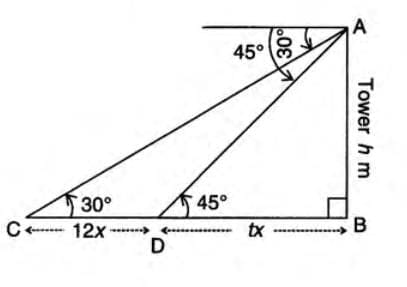
- Let AB be the tower, C the initial position, D the position after 12 minutes, ∠ACB = 30°, ∠ADB = 45°.
- Car speed = x m/min, time to reach tower = t min, CD = 12x m, DB = tx m.
- In triangle ABD, tan 45° = h/(tx) = 1, so h = tx.
- In triangle ACB, tan 30° = h/(12x + tx) = 1/√3.
- Substitute h = tx: tx/(12x + tx) = 1/√3, so t/(12 + t) = 1/√3.
- Solve: √3t = 12 + t, t(√3 - 1) = 12, t ≈ 12/(√3 - 1) ≈ 16.39 min.
- Answer: The car will reach the tower in approximately 16.39 minutes.
Example 5: From 25 m above a lake, the angle of elevation of a cloud is 30°, and the angle of depression of its reflection is 60°. Find the cloud's height above the lake.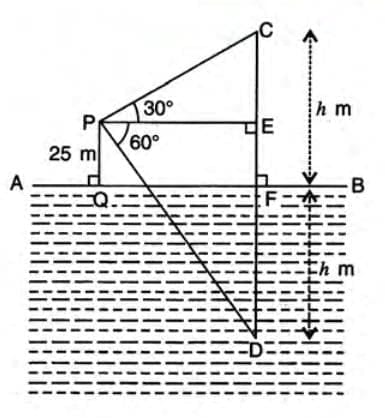
- Let PQ = 25 m (observation point above lake), C the cloud, D its reflection, CF = DF = h m, ∠CPE = 30°, ∠DPE = 60°.
- CE = h - 25 m, DE = h + 25 m.
- In triangle CPE, tan 30° = (h - 25)/PE = 1/√3, so PE = √3(h - 25).
- In triangle DPE, tan 60° = (h + 25)/PE = √3, so PE = (h + 25)/√3.
- Equate: √3(h - 25) = (h + 25)/√3, so 3(h - 25) = h + 25, h = 50 m.
- Answer: The height of the cloud is 50 m.
Example 6: From a point, the tangent of the angle of elevation of a tower is 3/5. After walking 50 m towards the tower, the tangent is 4/5. Find the tower's height.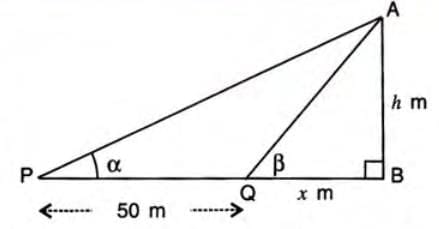
- Let AB = h m (tower height), P the first point, Q the second point, PQ = 50 m, tan α = 3/5, tan β = 4/5, BQ = x m.
- In triangle APB, tan α = h/(x + 50) = 3/5, so 5h = 3(x + 50).
- In triangle AQB, tan β = h/x = 4/5, so 5h = 4x.
- Solve: 3(x + 50) = 4x, so x = 150, h = 4x/5 = 120 m.
- Answer: The height of the tower is 120 m.
Example 7: From the top of a 20 m pole, the angle of elevation of a tower's top is 60°, and the angle of depression of its foot is 30°. Find the tower's height.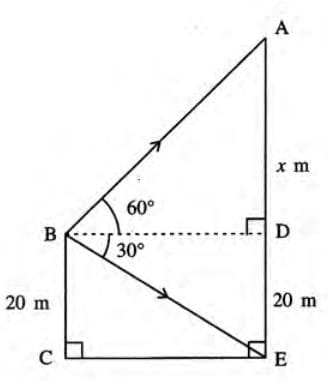
- Let BC = 20 m (pole), AE = x + 20 m (tower), BD = y m, ∠ABD = 60°, ∠EBD = 30°.
- In triangle ABD, tan 60° = x/y = √3, so y = x/√3.
- In triangle EBD, tan 30° = 20/y = 1/√3, so y = 20√3.
- Equate: x/√3 = 20√3, so x = 60.
- Height of tower = x + 20 = 60 + 20 = 80 m.
- Answer: The height of the tower is 80 m.
FAQs on Chapter Notes: Height and Distance
| 1. What is the difference between angles of elevation and angles of depression? |  |
| 2. How can angles of elevation and depression be applied in real-life scenarios? | |
| 3. What trigonometric ratios are commonly used to solve problems involving height and distance? | |
| 4. Can you provide a step-by-step method to solve a problem involving angles of elevation or depression? | |
| 5. Why is it important to understand angles of elevation and depression in geometry? | |




