ICSE Class 8 > Class 8 Notes > History > Mind Map: Rural Life and Society
Mind Map: Rural Life and Society

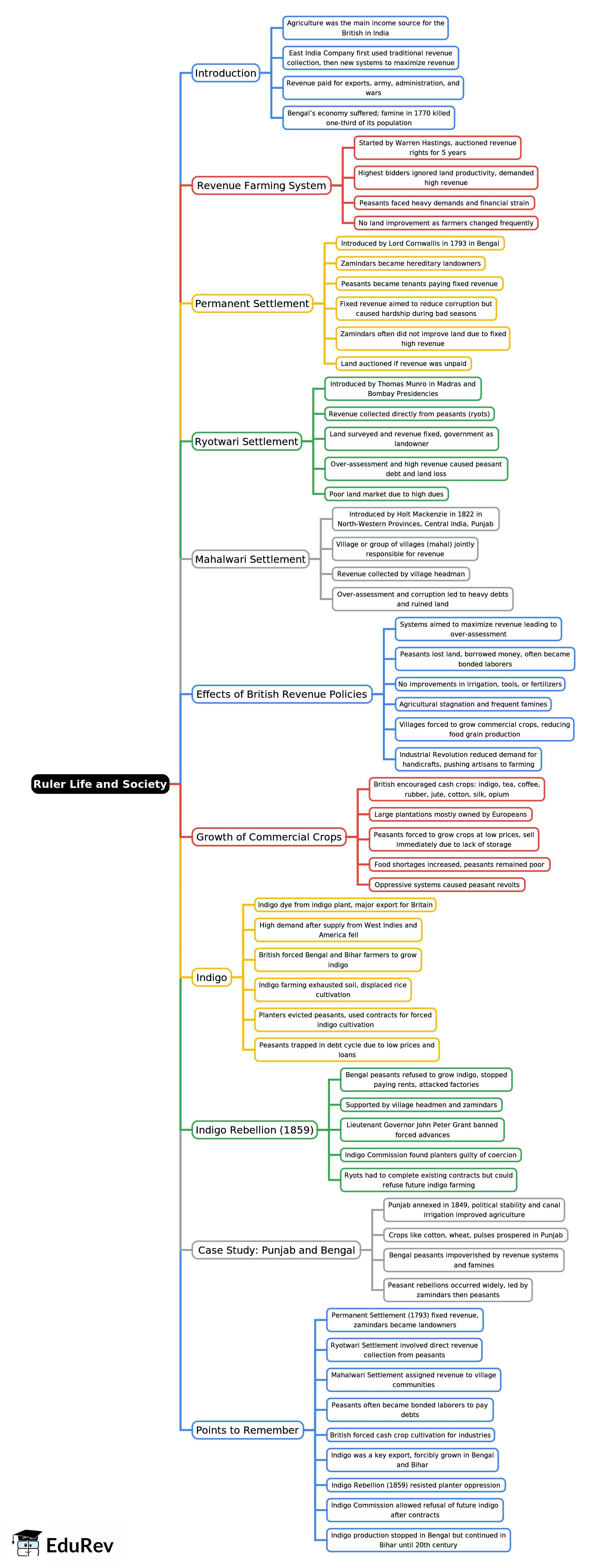
The document Mind Map: Rural Life and Society is a part of the Class 8 Course History Class 8 ICSE.
All you need of Class 8 at this link: Class 8
FAQs on Mind Map: Rural Life and Society
| 1. What is the significance of rulers in shaping societies throughout history? |  |
Ans.Rulers have played a crucial role in shaping societies by establishing laws, governance structures, and cultural norms. They often influence social hierarchies and economic systems, impacting how resources are distributed and how citizens interact with one another. Through their decisions, rulers can promote stability or contribute to conflict, thereby determining the overall quality of life within their societies.
| 2. How did different types of rulers interact with their subjects in various historical contexts? | |
Ans.Different types of rulers, such as monarchs, dictators, and elected leaders, have varied in their approaches to governance. Monarchs often ruled by divine right, maintaining power through lineage and tradition, while dictators might use force and propaganda to control their subjects. Elected leaders, on the other hand, are typically accountable to the electorate, leading to different forms of interaction, such as campaigns and public forums. The nature of these interactions greatly affects societal cohesion and public trust.
| 3. What were some common methods used by rulers to maintain control over their territories? | |
Ans.Rulers have historically employed various methods to maintain control, including military force, strategic alliances, and propaganda. They might establish a strong military presence to deter rebellion or use diplomacy to secure loyalty from other leaders. Additionally, rulers often use propaganda to shape public perception and promote their legitimacy, ensuring that their authority is accepted by the populace.
| 4. How have the roles and perceptions of rulers changed over time? | |
Ans.The roles and perceptions of rulers have evolved significantly due to social, political, and technological changes. In ancient times, rulers were often seen as divine figures with absolute power. However, the rise of democracy and human rights movements has shifted this perception, leading to increased demands for accountability and transparency. Today, many societies view rulers as public servants whose primary responsibility is to serve the interests of their constituents.
| 5. In what ways did rulers influence cultural practices and societal norms? | |
Ans.Rulers have significantly influenced cultural practices and societal norms through their policies and personal choices. They often promote certain religious beliefs, art forms, and educational systems that reflect their values. For instance, patronage of the arts can lead to cultural flourishing, while imposing specific laws can reshape social behavior. The ruler's influence can thus create a legacy that shapes the identity of a society for generations.
About this Document

4.72/5 Rating

Apr 29, 2026 Last updated
Related Exams
Document Description: Mind Map: Rural Life and Society for Class 8 2026 is part of History Class 8 ICSE preparation. The notes and questions for Mind Map: Rural Life and Society have been prepared according to the Class 8 exam syllabus. Information about Mind Map: Rural Life and Society covers topics like and Mind Map: Rural Life and Society Example, for Class 8 2026 Exam. Find important definitions, questions, notes, meanings, examples, exercises and tests below for Mind Map: Rural Life and Society.
Introduction of Mind Map: Rural Life and Society in English is available as part of our History Class 8 ICSE for Class 8 & Mind Map: Rural Life and Society in Hindi for History Class 8 ICSE course. Download more important topics related with notes, lectures and mock test series for Class 8 Exam by signing up for free. Class 8: Mind Map: Rural Life and Society
Description
Mind Map: Rural Life & Society of History Class 8 ICSE provides you one-page visual summary of the chapter covering all the important topics. Download the PDF from EduRev.
Information about Mind Map: Rural Life and Society
In this doc you can find the meaning of Mind Map: Rural Life and Society defined & explained in the simplest way possible. Besides explaining types of Mind Map: Rural Life and Society theory, EduRev gives you an ample number of questions to practice Mind Map: Rural Life and Society tests, examples and also practice Class 8 tests



Related Searches
mock tests for examination, study material, Mind Map: Rural Life and Society, Semester Notes, Sample Paper, video lectures, past year papers, Free, shortcuts and tricks, Mind Map: Rural Life and Society, ppt, Extra Questions, Important questions, Previous Year Questions with Solutions, Viva Questions, pdf , Summary, MCQs, Mind Map: Rural Life and Society, Exam, Objective type Questions, practice quizzes;