Chapter Notes: Continuity and Change in the 18th-Century States

Introduction
From 1648 to 1815, European states experienced profound changes driven by Enlightenment ideas, revolutions, and wars. This chapter notes explores shifts in political sovereignty, social structures, and cultural movements, focusing on the French Revolution, Napoleon's reforms, and the conservative reaction at the Congress of Vienna. It also examines the rise of Romanticism and nationalism, which reshaped European identity.
How Did 18th-Century States Experience Change?
- Between 1648 and 1815, European nations underwent significant transformations in their political systems, social frameworks, and cultural landscapes. While monarchies and empires strove to uphold tradition and hierarchical order, they faced increasing challenges from Enlightenment principles, revolutionary upheavals, and warfare.
- Despite efforts to maintain stability, political legitimacy, and control, the French Revolution and Napoleon's rule fundamentally altered the European balance of power, disseminating revolutionary ideas across the continent and prompting both progressive reforms and conservative backlash.
Political Sovereignty: From Divine Right to Popular Rule?
The French Revolution and Its Challenge to Authority
The French Revolution (1789-1799) dramatically disrupted Europe's established political and social order. Grounded in the ideals of liberty, equality, and fraternity, it directly contested the divine right of monarchs, inherited privileges, and absolute rule.
- The revolution sparked calls for constitutional governance, the elimination of feudal rights, and greater civic involvement.
- Its influence extended beyond France, inspiring colonial regions like Saint-Domingue, where enslaved individuals led the Haitian Revolution (1791-1804), founding the first Black-led republic.
Not everyone embraced these changes:
Edmund Burke, a British conservative philosopher, vehemently opposed the revolution, cautioning that the swift dismantling of traditional authority would result in tyranny and disorder. His 1790 work, Reflections on the Revolution in France, became a cornerstone of modern conservative thought.
Monarchs throughout Europe echoed Burke's concerns. The French Revolution triggered counter-revolutionary alliances and widened the rift between revolutionary liberalism and traditional monarchy.
Napoleon's Reign: Reform and Authoritarianism
Napoleon Bonaparte emerged from the revolution's turmoil to become First Consul and later Emperor of France. While professing to uphold revolutionary principles, his governance combined modernization with authoritarian control.
What Changed:
- The Napoleonic Code(1804) established a standardized legal framework:
- Eliminated feudalism and hereditary privileges.
- Secured property rights and civil liberties (primarily for men).
- Promoted equality before the law.
- Continues to influence many legal systems today.
- The Concordat of 1801 reconciled France with the Catholic Church, reintegrating it into society under state oversight.
- New educational reforms and military academies bolstered the French state's strength.
What Stayed the Same (or Got Worse):
- Napoleon enforced stringent censorship and employed a secret police to suppress dissent.
- He declared himself emperor, concentrating power in his own hands.
- Women experienced a reduction in rights under the Napoleonic Code.
Through the Napoleonic Wars (1803-1815), France exported legal, administrative, and nationalist reforms across Europe, often against local populations' wishes. These conflicts challenged dynastic empires and planted seeds for future revolutionary movements.
The Congress of Vienna (1814-1815): A Conservative Restoration
- After Napoleon's defeat, European leaders gathered at the Congress of Vienna to restore the pre-revolutionary order.
- Led by Austrian diplomat Prince Klemens von Metternich, the Congress aimed to:
- Reinstate monarchical authority (e.g., the Bourbon Restoration in France).
- Redraw European borders to ensure a balance of power.
- Curb liberal and nationalist movements.
Key Outcomes
- Formation of the German Confederation, dominated by Austria.
- Creation of the Holy Alliance (Russia, Austria, Prussia) to uphold conservative principles.
- Establishment of the Concert of Europe, a diplomatic system to prevent future upheavals.
While the Congress of Vienna maintained relative peace in Europe until 1848, its suppression of nationalism and liberalism only postponed the inevitable. These repressed forces later erupted during the Revolutions of 1848 and the unifications of Germany and Italy.
Culture and Philosophy: Romanticism as Reaction
While the Enlightenment emphasized reason, logic, and scientific progress, the late 18th and early 19th centuries saw the emergence of Romanticism, a cultural response to Enlightenment rationalism and industrialization.
Rousseau and the Rise of Emotion
- Jean-Jacques Rousseau, a pivotal intellectual forerunner of Romanticism, contended that:
- Humans were inherently good but corrupted by societal structures.
- Emotional experiences were as vital as rational thought.
- Education and governance should foster natural virtue, not stifle it.
- Romanticism built on Rousseau's ideas, developing into a broader critique of modern society.
Romanticism vs. Enlightenment: A Shift in Values
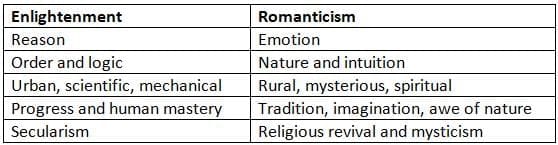
- Romanticism prioritized individual emotion, national identity, historical memory, and the sublime beauty of nature.
- It thrived in:
- Literature (Goethe, Shelley, Wordsworth).
- Art (Delacroix, Turner, Goya).
- Religion (Methodism and personal faith movements).
Nationalism and Identity
- Romanticism also fueled nationalism by emphasizing:
- Folk traditions, songs, and myths.
- Shared languages and collective histories.
- A unique "people's spirit" (Volksgeist) for each nation.
- This cultural nationalism laid the ideological foundation for movements like Italian and German unification and uprisings in Eastern Europe.
Conclusion
- The era from 1648 to 1815 was marked by both continuity and profound transformation.
- Continuities: Monarchies, religious institutions, and class hierarchies persisted, particularly in Eastern Europe and under Metternich's system.
- Changes: Revolutions, legal reforms, philosophical shifts, and cultural movements reshaped European societies.
- By the early 19th century, the Enlightenment's rationalism had been institutionalized in legal codes and bureaucracies but was also challenged by Romanticism, nationalism, and conservatism.
- Despite attempts to restore the old order, the revolutionary ideas sparked by the French Revolution could not be suppressed, setting the stage for the defining conflicts and transformations of the next century.
Key Terms
- Bourbons: A prominent European royal dynasty originating in France, influential during absolutism and challenged by revolutionary movements, with their restoration a focus of the Congress of Vienna.
- Catholic Church Restoration: Efforts to revive the Catholic Church's influence in Europe after the French Revolution, countering secularism and reasserting its role in society.
- Civic Literacy: Knowledge and skills enabling effective civic participation, emphasized by Enlightenment thinkers as essential for democratic governance.
- Congress of Vienna: A 1814-1815 diplomatic conference to restore European stability post-Napoleonic Wars, redrawing borders and establishing diplomatic frameworks.
- Edmund Burke: An Irish philosopher whose critique of the French Revolution in Reflections on the Revolution in France shaped modern conservative thought, emphasizing tradition and gradual change.
- Enlightenment: A late 17th-18th century movement promoting reason, individualism, and skepticism, influencing political and social transformations that Romanticism countered.
- French Revolution: A 1789-1799 upheaval that ended absolute monarchy, promoted popular sovereignty, and inspired global democratic movements.
- French Civil Code: The 1804 Napoleonic Code, unifying French civil law with principles of equality and property rights, influencing global legal systems.
- Haitian Revolution: A 1791-1804 anti-slavery and anti-colonial uprising in Saint-Domingue, establishing Haiti as the first Black republic, inspired by French revolutionary ideals.
- Hundred Days' War: The period from March to June 1815 when Napoleon briefly returned to power, ending with his defeat at Waterloo.
- Napoleonic Wars: Conflicts from 1803-1815 between Napoleon's empire and European coalitions, reshaping Europe's political and national boundaries.
- Napoleon's Reign: The period from 1799-1815 when Napoleon ruled France, blending revolutionary ideals with authoritarian reforms, spreading nationalism and prompting coalitions against him.
- Napoleonic Code: The 1804 Civil Code, unifying French law with Enlightenment principles of equality and property rights, while reinforcing centralized power.
- Neoclassical Art: A mid-18th century art movement reviving classical Greek and Roman styles, emphasizing order and civic virtue, reflecting Enlightenment ideals.
- Prince Klemens von Metternich: Austrian diplomat who led the Congress of Vienna, advocating conservative policies to restore monarchies and suppress liberalism and nationalism.
- Romanticism: A late 18th-early 19th century movement emphasizing emotion, individualism, and nature, reacting against Enlightenment rationalism and industrialization.
- Rousseau: Jean-Jacques Rousseau, an Enlightenment philosopher whose ideas on human nature, emotion, and the social contract influenced Romanticism and political thought.
- Scientific Revolution: A 16th-18th century shift to empirical science, shaping Enlightenment rationalism and influencing societal changes that Romanticism critiqued.
FAQs on Chapter Notes: Continuity and Change in the 18th-Century States
| 1. How did the concept of political sovereignty evolve in the 18th century? |  |
| 2. What was the significance of the Congress of Vienna in terms of political change? | |
| 3. How did Romanticism serve as a reaction to the changes of the 18th century? | |
| 4. What role did Enlightenment thinkers play in shaping political thought during the 18th century? | |
| 5. In what ways did the 18th century set the stage for future revolutions? | |




