Humanities/Arts Exam  >  Humanities/Arts Notes  >  Political Science Class 11  >  Cheat Sheet: Constitution: Why and How?

Cheat Sheet: Constitution: Why and How?

The Indian Constitution, born from the independence struggle, provides a framework for governance, balances power, protects rights, and reflects societal aspirations. It ensures:

  • Coordination.
  • Prevents misuse of authority.
  • Embodies the collective identity of the people.

Why Do We Need a Constitution?

  • A Constitution is a set of written rules that determine how a country is governed, how power is shared, and what rights and responsibilities citizens and the government have.
  • It provides a framework to ensure order, justice, and equality in society.

The Constitution Allows Coordination and Assurance

The Constitution provides a common set of rules that help people from different regions, religions, or backgrounds to cooperate and live peacefully.
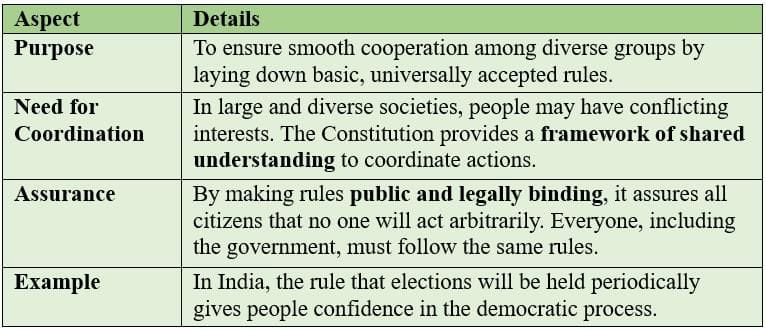
The Constitution Allows Coordination and Assurance

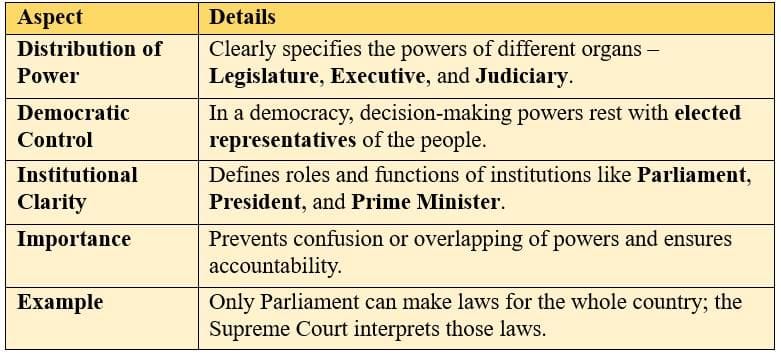
Specification of Decision-Making Powers

The Constitution defines who has the authority to make decisions and how these decisions will be implemented.Specification of Decision-Making Powers
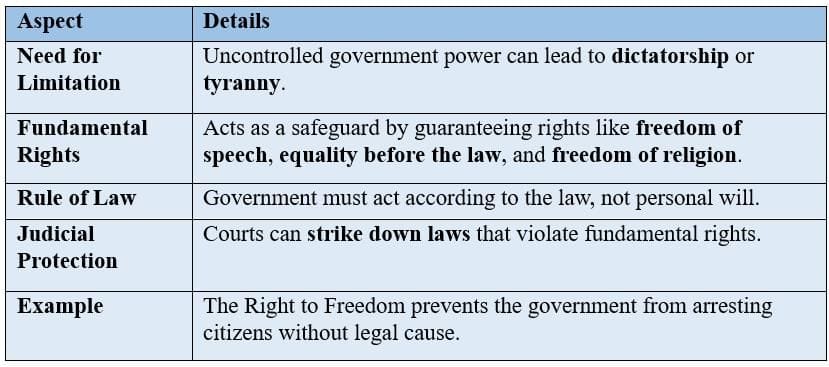
Limitations on the Powers of Government

The Constitution restricts the powers of the government to prevent misuse and protect citizens' rights.Limitations on the Powers of Government
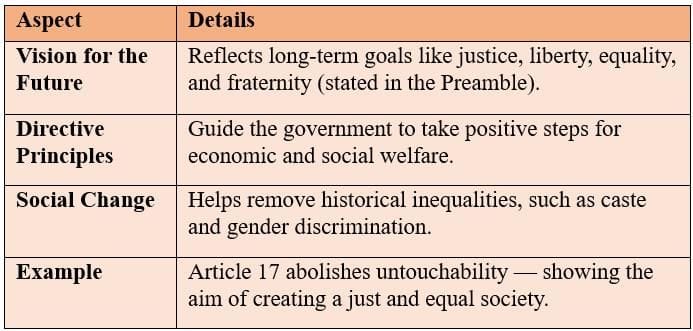
Aspirations and Goals of a Society

A Constitution expresses the dreams, values, and future goals that a society wishes to achieve collectively.Aspirations and Goals of a Society
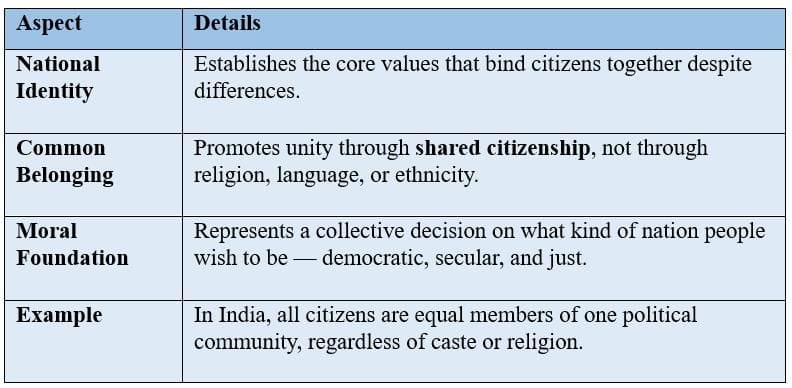
Fundamental Identity of a People

A Constitution defines who "the people" are and what their shared political and moral identity is.Fundamental Identity of a People
Authority of a Constitution

The Constitution derives its authority from the people and serves as the supreme law of the land, guiding the functioning of government and protecting citizens' rights.

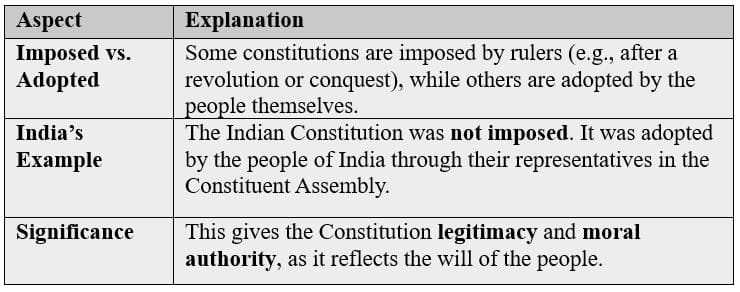
Mode of Promulgation

How the Constitution came into existence and was adopted.Mode of Promulgation
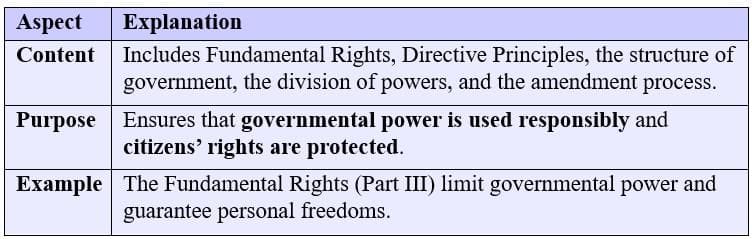
The Substantive Provisions of a Constitution

These are the actual rules and principles that define how the government functions.The Substantive Provisions of a Constitution
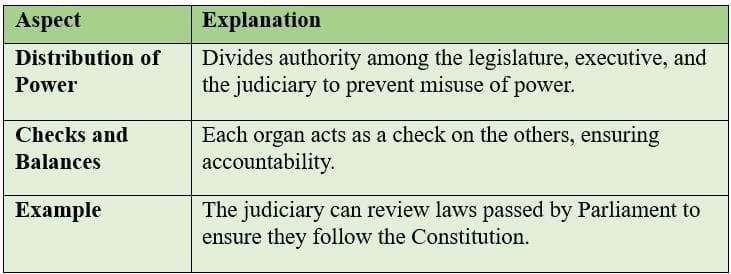
Balanced Institutional Design

The Constitution creates institutions that share and check each other's powers.Balanced Institutional Design
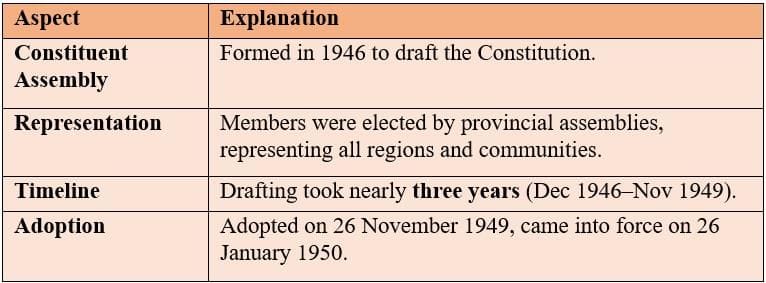
How Was the Indian Constitution Made?

The process through which the Indian Constitution was framed and adopted.How Was the Indian Constitution Made?
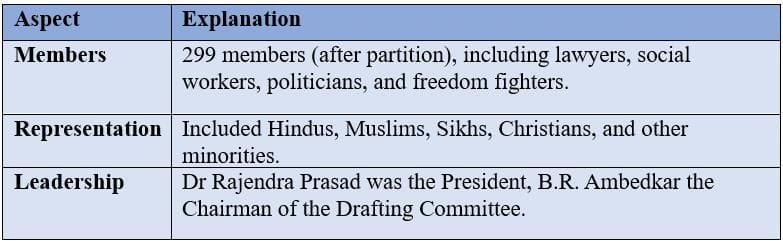
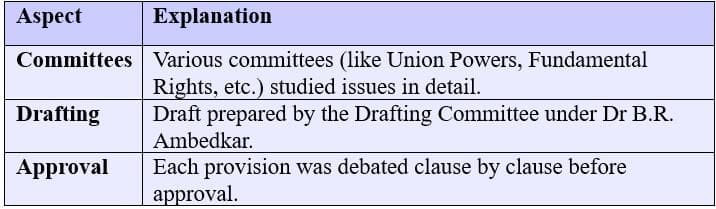
Composition of the Constituent Assembly

Who framed the Constitution and how they were selected.Composition of the Constituent Assembly
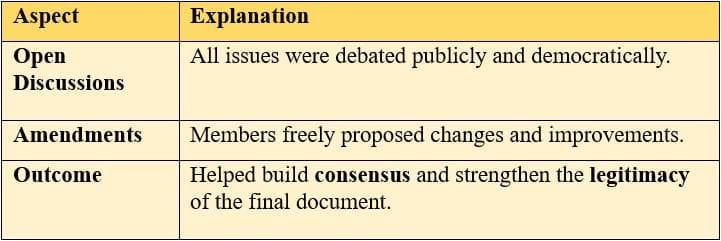
The Principle of Deliberation

The method of discussion and debate used while drafting the Constitution.The Principle of Deliberation
Procedures

The formal steps and rules followed during the Constitution-Making Process.Procedures
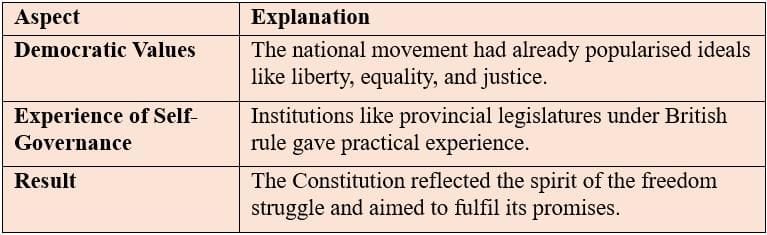
Inheritance of the Nationalist Movement

How the Freedom Struggle Influenced the Making of the Constitution.Inheritance of the Nationalist Movement
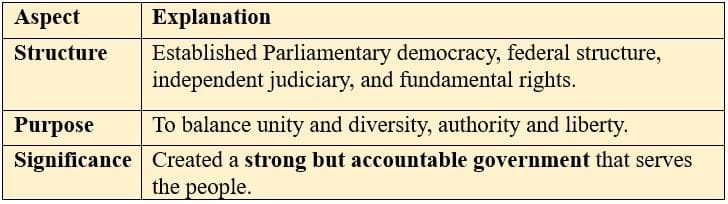
Institutional Arrangements

The framework of government created by the Constitution.Institutional Arrangements
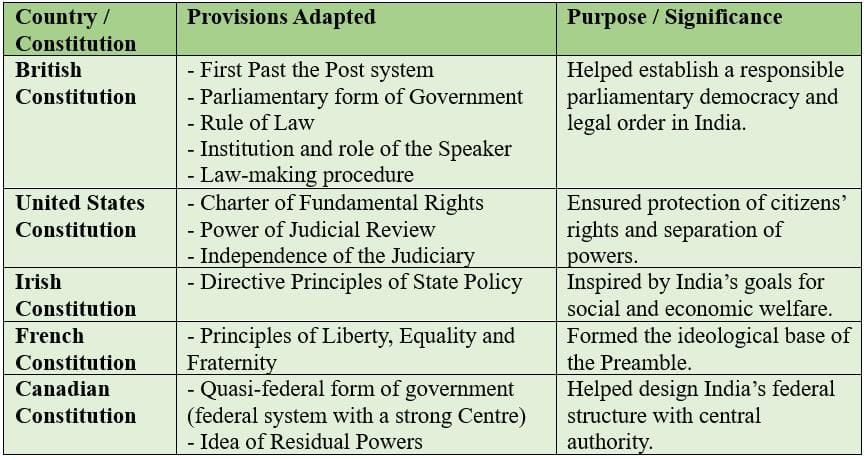
Provisions adapted from the Constitutions of Different Countries 

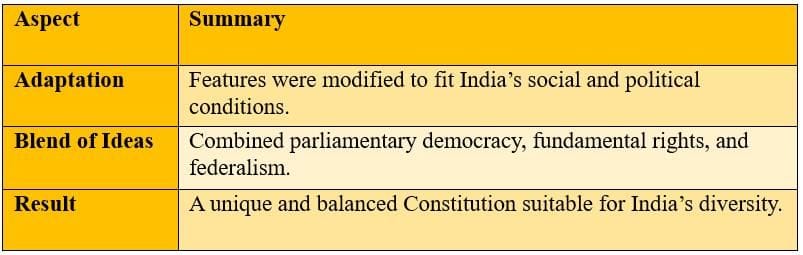
The makers of the Indian Constitution borrowed several features from different countries' constitutions. These features were carefully adapted to suit India's needs, not copied directly.Provisions adapted from the Constitutions of Different Countries 
Quick Recall

Quick Recall

The document Cheat Sheet: Constitution: Why and How? is a part of the Humanities/Arts Course Political Science Class 11.
All you need of Humanities/Arts at this link: Humanities/Arts

FAQs on Cheat Sheet: Constitution: Why and How?

1. Why is a constitution necessary for a country?
Ans. A constitution is essential for a country as it serves as the supreme legal document that outlines the fundamental principles, structures, and processes of governance. It establishes the authority of the state, delineates the rights and responsibilities of citizens, and provides a framework for the protection of individual liberties. By doing so, a constitution helps maintain order, promote justice, and ensure accountability among government institutions.
2. What are the substantive provisions typically found in a constitution?
Ans. Substantive provisions in a constitution generally include the declaration of fundamental rights and duties, the structure of government (executive, legislative, and judiciary), the distribution of powers between different levels of government (federal or unitary), and procedures for amending the constitution. These provisions collectively define how the state operates and how citizens interact with it.
3. How does the authority of a constitution derive legitimacy?
Ans. The authority of a constitution derives its legitimacy from the consent of the governed. This means that a constitution is often adopted through democratic processes, such as referendums or the deliberations of elected representatives. The legitimacy is further reinforced when citizens recognize the constitution as a binding framework that represents their collective will, values, and aspirations.
4. What were the key principles and procedures involved in the making of the Indian Constitution?
Ans. The Indian Constitution was crafted through a process that emphasized deliberation and inclusivity. Key principles included the acknowledgment of India's diversity and the need for a democratic framework. The Constituent Assembly, formed in 1946, engaged in extensive debates and discussions, incorporating feedback from various stakeholders. This participatory approach ensured that the Constitution reflected the aspirations of the Indian populace.
5. What is meant by balanced institutional design in a constitution?
Ans. Balanced institutional design refers to the arrangement of various branches of government in a way that prevents the concentration of power and promotes checks and balances. A well-designed constitution ensures that the executive, legislative, and judicial branches function independently while also being interdependent. This balance helps to safeguard against the abuse of power and upholds the rule of law.
Explore Courses for Humanities/Arts exam
Get EduRev Notes directly in your Google search
Related Searches
Exam, ppt, Sample Paper, past year papers, study material, Semester Notes, mock tests for examination, Extra Questions, MCQs, shortcuts and tricks, Important questions, Viva Questions, Objective type Questions, Cheat Sheet: Constitution: Why and How?, practice quizzes, Previous Year Questions with Solutions, Cheat Sheet: Constitution: Why and How?, Summary, pdf , Cheat Sheet: Constitution: Why and How?, Free, video lectures;