How to Study Mechanics (Kinematics and Dynamics) for NEET


Introduction
Step into one of the most concept-rich and scoring sections of Mechanics: Kinematics and Dynamics. For students preparing for competitive school-level examinations, this unit combines clear physical ideas with routine numerical work. A steady, structured approach helps convert understanding into speed and accuracy in the examination hall. This guide distils the core syllabus, high-yield topics, study strategy, resources and exam-day tactics so you can study Mechanics with clarity and purpose.
Understanding the Mechanics (Kinematics and Dynamics) Syllabus
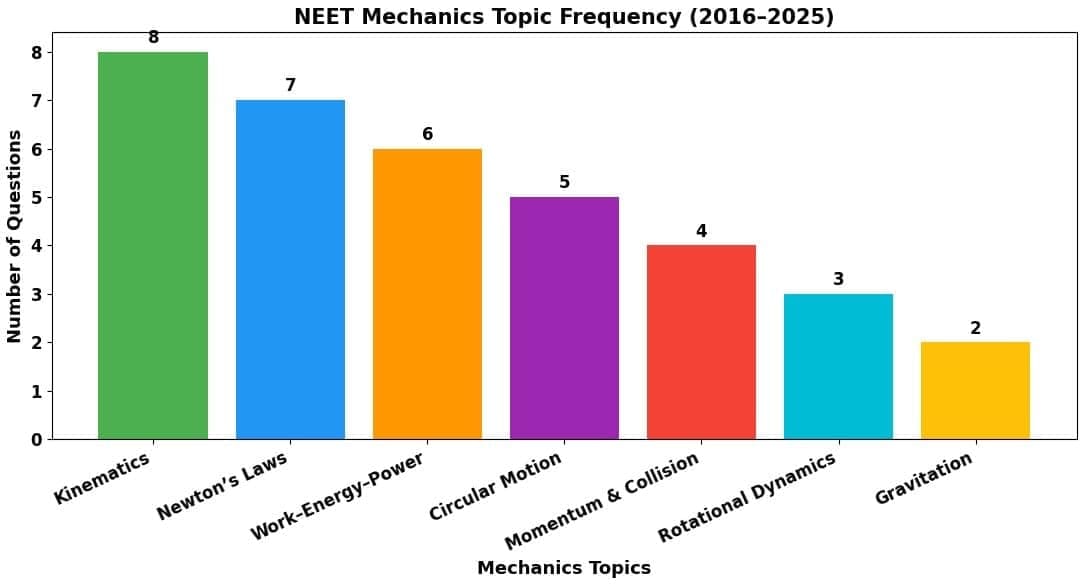
Begin by mapping the syllabus: know which topics frequently appear in question papers and what each topic demands in terms of concepts and numerical skills.
- Kinematics (one-dimensional and two-dimensional motion)
- Vectors and relative motion
- Newton's Laws of Motion
- Work, Energy and Power
- Circular motion and centripetal force
- Momentum and collisions (linear momentum, impulse, elastic and inelastic collisions)
- Rotational dynamics (torque, moment of inertia)
- Gravitation (Newton's law of gravitation, potential and orbital motion)
- Friction (static and kinetic)
- Simple Harmonic Motion (SHM)
- Centre of mass and motion of a system of particles
Focus on Core Concepts
After confirming the syllabus, emphasise the topics that carry the most weight and appear most frequently in past papers. Mastering these will yield the best return for study time.
- Kinematics (high priority): Displacement, velocity and acceleration in 1D and 2D; projectile motion and motion graphs are frequently tested.
- Newton's Laws: F = ma and applications to pulleys, inclined planes and force balances.
- Work, Energy and Power: Work done by a force, kinetic energy, potential energy and conservation of mechanical energy.
- Circular Motion: Centripetal acceleration and force; banking of roads and rotating frames basics.
- Momentum and Collision: Conservation of linear momentum, impulse, elastic and inelastic collisions in one and two dimensions.
- Rotational Dynamics: Torque, rotational analogues of Newton's laws, and moment of inertia for common bodies.
- Gravitation: Universal law, gravitational potential, and simple orbital motion problems.
How to Study Important Topics
Use a practical, topic-wise routine: read the theory, understand derivations, visualise the motion, practise representative numerical problems, and maintain a short error log.
Kinematics
- Focus: Understand displacement, average and instantaneous velocity, and acceleration. Learn standard kinematic relations for constant acceleration such as s = ut + (1/2)at2 and v = u + at. Be fluent with vector representation of motion in two dimensions and with projectile motion (horizontal and vertical components, range, maximum height, time of flight).
- Method: Draw diagrams and resolve motion into components for 2D problems. Practice motion-graph interpretation (position-time, velocity-time, acceleration-time). Solve 10-15 mixed kinematics problems per week including projectile, relative motion and graph questions.
Vectors and Relative Motion
- Focus: Vector addition/subtraction, components, magnitude and direction; relative velocity concept in 1D and 2D.
- Method: Practice vector resolution in inclined plane and projectile contexts; solve problems involving boats/streams and motion seen from moving frames.
Newton's Laws of Motion
- Focus: Grasp the statement and consequences of Newton's three laws. Use F = ma for dynamics problems. Be comfortable drawing and using free-body diagrams, distinguishing between applied forces, normal reaction, frictional forces, tension and weight.
- Method: Solve 5-10 problems weekly on inclined planes, pulleys, connected bodies and non-inertial observations. Check units and sign conventions carefully.
Work, Energy and Power
- Focus: Define work done by a constant and variable force, kinetic energy KE = ½mv2, potential energy and the work-energy theorem. Use conservation of mechanical energy where non-conservative work (like friction) is absent.
- Method: Practice problems that compare work and energy methods with Newtonian force methods; use energy techniques to simplify otherwise lengthy dynamics problems.
Circular Motion
- Focus: Centripetal acceleration ac = v2/r and centripetal force Fc = mv2/r. Problems include banking of roads, motion in vertical loops and rotating frames.
- Method: Resolve forces in radial and tangential directions; practise uniform and non-uniform circular motion questions and those involving normal reaction and weight.
Momentum and Collisions
- Focus: Linear momentum p = mv, impulse, and conservation of momentum. Distinguish elastic and inelastic collisions; use centre of mass concept for systems of particles.
- Method: Solve 5-10 collision problems covering head-on collisions and oblique two-body collisions; check energy change in collisions to identify elastic vs inelastic cases.
Rotational Dynamics
- Focus: Torque τ = r × F, rotational analogues of Newton's laws, angular acceleration, and moment of inertia for point masses and common rigid bodies (rod, ring, disc).
- Method: Relate translational and rotational quantities when bodies roll without slipping. Practice torque and rotational energy problems.
Gravitation
- Focus: Newton's law of universal gravitation, gravitational field and potential, and simple orbital motion (Kepler basics are occasionally referenced at school level).
- Method: Practice problems involving gravitational force between masses, escape velocity and orbital speed for circular orbits around a mass M.
Friction and Simple Harmonic Motion
- Focus: Differentiate static and kinetic friction; apply friction in equilibrium and motion problems. For SHM, understand restoring force proportional to displacement and key relations for period and frequency.
- Method: Solve equilibrium problems with friction and small oscillation problems (mass-spring and simple pendulum approximations).
Resources for Important Topics
Choose core textbooks for sound theory and reliable problem sets, and use supplementary resources for guided practice and mocks.
- Core materials: NCERT Physics Class 11 - Chapter 3: Motion in a Straight Line, Chapter 4: Motion in a Plane, Chapter 5: Laws of Motion, Chapter 6: Work, Energy and Power.
- Reference books: HC Verma, Concepts of Physics (Volume 1 mechanics chapters) for clear theory and graded problems; DC Pandey, Objective Physics for objective practice and conceptual questions.
- Supplementary resource: EduRev app for structured video lectures, topic-wise practice questions and mock tests tailored to competitive preparation.
Memorise and Understand Formulas
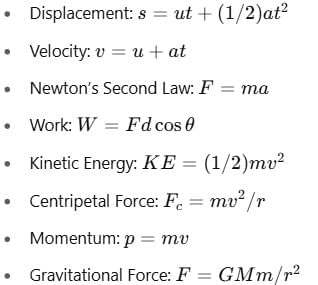
Memorising key formulas is helpful, but derivation and understanding allow you to reconstruct formulas under pressure. Maintain a concise formula sheet that also shows the conditions under which each formula holds (for example, constant acceleration for the standard kinematic equations).
Essential formulas and relations (select list)
- Kinematic (constant acceleration): s = ut + (1/2)at2, v = u + at, v2 = u2 + 2as
- Projectile motion: horizontal range R = (u2 sin 2θ)/g, time of flight T = (2u sin θ)/g, maximum height H = (u2 sin2θ)/(2g)
- Newton's second law: F = ma
- Work and energy: W = Fd cosθ, KE = ½mv2, potential energy in uniform gravity PE = mgh
- Circular motion: ac = v2/r, Fc = mv2/r
- Linear momentum: p = mv, impulse J = Δp
- Gravitation: gravitational force F = G m1 m2 / r2
Learning approach for formulas
- Develop a single-page formula sheet and practise deriving each formula quickly so you understand assumptions behind it (for example, constant acceleration, no air resistance).
- Use flashcards for quick recall of formulas and standard results (range, period of pendulum approximations, moments of inertia).
- Always apply formulas in numerical problems rather than rote memorisation alone; understanding helps avoid misapplication under exam stress.
Consistent Numerical Practice
- Daily objective: Aim for 20-30 numerical problems per week focused on high-frequency topics: kinematics, Newton's laws, work-energy and circular motion.
- Problem sources: DC Pandey's Objective Physics, HC Verma problems, NCERT exemplar problems, and past year papers available on EduRev and other reliable repositories.
- Focus areas: Motion graphs, projectile computations, force balances, energy methods and centripetal dynamics.
- Strategy: Time each practice question (target 1-2 minutes for objective questions), maintain an error log to identify recurring mistakes and revisit those concepts.
Analysis of Previous Years' Papers
- Purpose: Identify question patterns, commonly tested subtopics and typical difficulty levels.
- Scope: Review papers across several years to see repeated themes: projectile motion, pulleys and inclined planes, work-energy problems, and centripetal force questions appear regularly.
- Expectation: Anticipate a mix of conceptual and numerical questions with strong emphasis on kinematics and Newton's laws.
- Resource: Use collections of past papers and topic-wise compilations on EduRev or institutional archives for targeted practice.
Mock Test Practice
- Objective: Simulate exam conditions to develop time management, question selection strategy and exam temperament.
- Goal: In full-length timed mocks, target an average of 1-2 minutes per objective question and learn when to skip and return to lengthy numerical problems.
- Resource: Regularly take topic-wise and full tests from EduRev or other trusted mock providers and analyse weak areas after each test.
Exam Day Tips
- Quick formula review: Glance through your formula sheet to reinforce key relations (kinematic, Newton's laws, work-energy, centripetal formulas).
- Prioritise questions: Begin with high-confidence areas such as standard kinematics and straightforward Newton's-law problems to secure quick marks.
- Time allocation: Keep to a rough target of 1-2 minutes per objective question; skip prolonged calculations initially and return if time allows.
- Units and dimensions: Check units consistently (for example, m, s, m/s, m/s2). Dimensional sense-checks catch many mistakes.
- Break down hard problems: For a difficult collision or gravitation problem, split it into smaller parts (identify conserved quantities, write equations for each part).
- Stay calm: Steady breathing and short pauses help recover from a stuck point and avoid careless errors.
Additional Preparation Strategies
- Consistency: Allocate daily focused time to Mechanics - 1-2 hours daily yields steady improvement.
- Precision: In multi-step numericals, check every algebraic step and unit; small algebraic slips cost marks.
- Time management practice: Train on timed sets so selection and skipping strategy become automatic.
- Well-being: Maintain regular sleep (6-8 hours), short breaks during long study sessions and a balanced diet to keep concentration high.
- Motivation: Set short achievable targets (for example, master projectile problems in one week) and celebrate small milestones to sustain momentum.
FAQs on How to Study Mechanics (Kinematics and Dynamics) for NEET
| 1. What are the core concepts in Mechanics (Kinematics and Dynamics) that NEET aspirants should focus on? |  |
| 2. How can students effectively memorize and understand formulas in Mechanics for NEET preparation? | |
| 3. What strategies can be employed for consistent numerical practice in Mechanics? | |
| 4. How important is the analysis of previous years' papers for NEET preparation in Mechanics? | |
| 5. What tips can be followed on exam day to ensure optimal performance in the Mechanics section of NEET? | |




