CBSE Class 3 > Class 3 Notes > Science > Mind Map: Parts of a Plant
Mind Map: Parts of a Plant

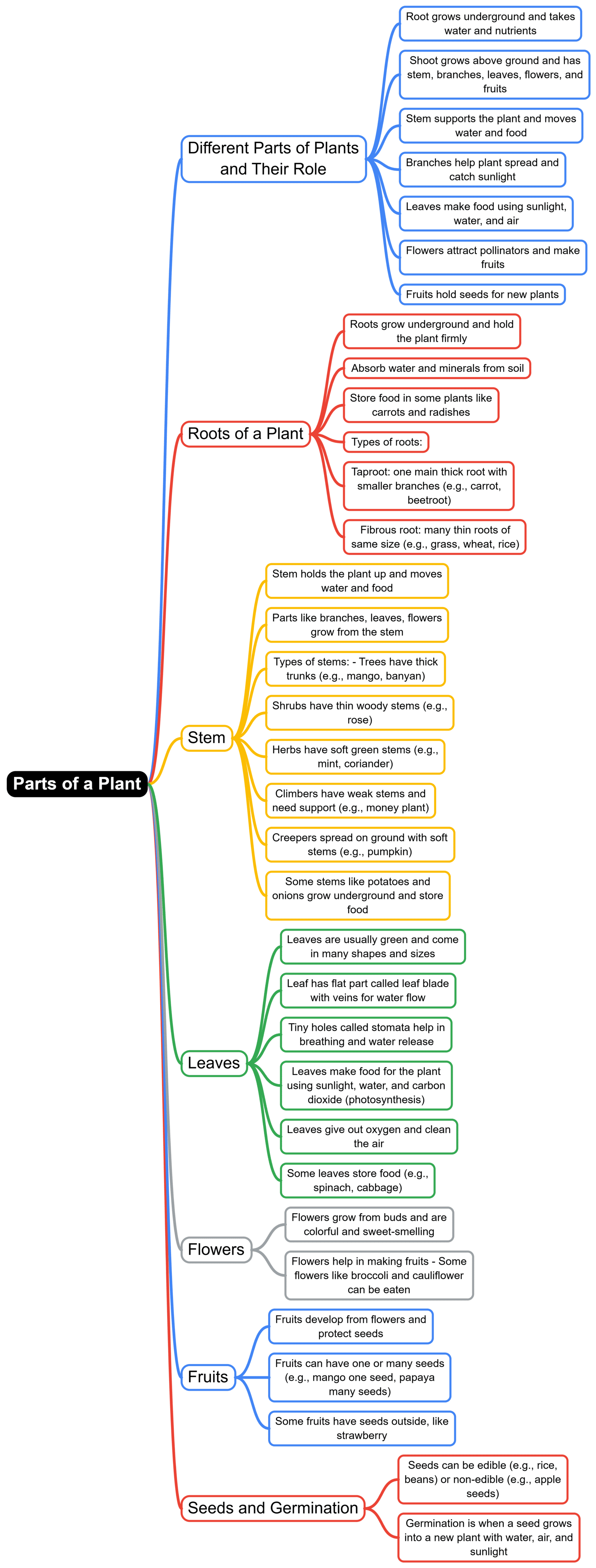
The document Mind Map: Parts of a Plant is a part of the Class 3 Course Science for Class 3.
All you need of Class 3 at this link: Class 3
FAQs on Mind Map: Parts of a Plant
| 1. What are the main parts of a plant and their functions? |  |
Ans. The main parts of a plant include the roots, stem, leaves, flowers, and fruits. The roots anchor the plant in the soil and absorb water and nutrients. The stem supports the plant and transports water and nutrients between the roots and leaves. Leaves are crucial for photosynthesis, where the plant converts sunlight into energy. Flowers are involved in reproduction, and fruits contain seeds that can grow into new plants.
| 2. How do roots help a plant survive? | |
Ans. Roots play a vital role in a plant's survival by anchoring it in place, which prevents it from being uprooted by wind or rain. They also absorb water and essential nutrients from the soil, which are necessary for growth and development. Additionally, roots can store energy in the form of carbohydrates, helping the plant sustain itself during unfavorable conditions.
| 3. Why are leaves important for photosynthesis? | |
Ans. Leaves are essential for photosynthesis because they contain chlorophyll, the green pigment that captures sunlight. During photosynthesis, leaves take in carbon dioxide from the air and water from the soil, using sunlight to convert these into glucose (a form of sugar) and oxygen. This process not only provides energy for the plant but also releases oxygen into the atmosphere, which is vital for life on Earth.
| 4. What is the role of flowers in a plant's lifecycle? | |
Ans. Flowers are crucial for a plant's lifecycle as they are the reproductive structures. They facilitate the process of pollination, where pollen from the male part of the flower fertilizes the female ovule, leading to the formation of seeds. Flowers can attract pollinators like bees and butterflies with their colors and scents, enhancing the chances of successful reproduction.
| 5. How do fruits contribute to plant reproduction? | |
Ans. Fruits contribute to plant reproduction by enclosing and protecting seeds. Once the seeds are fully developed, fruits help in seed dispersal, which can occur through various methods such as wind, water, or animals. This dispersal is important as it allows the seeds to grow in new locations, increasing the chances of survival and the spread of the plant species.
About this Document

4.96/5 Rating

Apr 18, 2026 Last updated
Related Exams
Document Description: Mind Map: Parts of a Plant for Class 3 2026 is part of Science for Class 3 preparation. The notes and questions for Mind Map: Parts of a Plant have been prepared according to the Class 3 exam syllabus. Information about Mind Map: Parts of a Plant covers topics like and Mind Map: Parts of a Plant Example, for Class 3 2026 Exam. Find important definitions, questions, notes, meanings, examples, exercises and tests below for Mind Map: Parts of a Plant.
Introduction of Mind Map: Parts of a Plant in English is available as part of our Science for Class 3 for Class 3 & Mind Map: Parts of a Plant in Hindi for Science for Class 3 course. Download more important topics related with notes, lectures and mock test series for Class 3 Exam by signing up for free. Class 3: Mind Map: Parts of a Plant
Description
Mind Map: Parts of a Plant of Science provides you one-page visual summary of the chapter covering all the important topics. Download the PDF from EduRev.
Information about Mind Map: Parts of a Plant
In this doc you can find the meaning of Mind Map: Parts of a Plant defined & explained in the simplest way possible. Besides explaining types of Mind Map: Parts of a Plant theory, EduRev gives you an ample number of questions to practice Mind Map: Parts of a Plant tests, examples and also practice Class 3 tests



Related Searches
Summary, Viva Questions, Sample Paper, mock tests for examination, Exam, study material, Extra Questions, video lectures, Free, past year papers, Objective type Questions, Important questions, Mind Map: Parts of a Plant, Mind Map: Parts of a Plant, pdf , practice quizzes, shortcuts and tricks, MCQs, ppt, Semester Notes, Previous Year Questions with Solutions, Mind Map: Parts of a Plant;