CBSE Class 3 > Class 3 Notes > EVS : The World around us (Our Wondrous World) > Mind Map: Getting to know plants
Mind Map: Getting to know plants

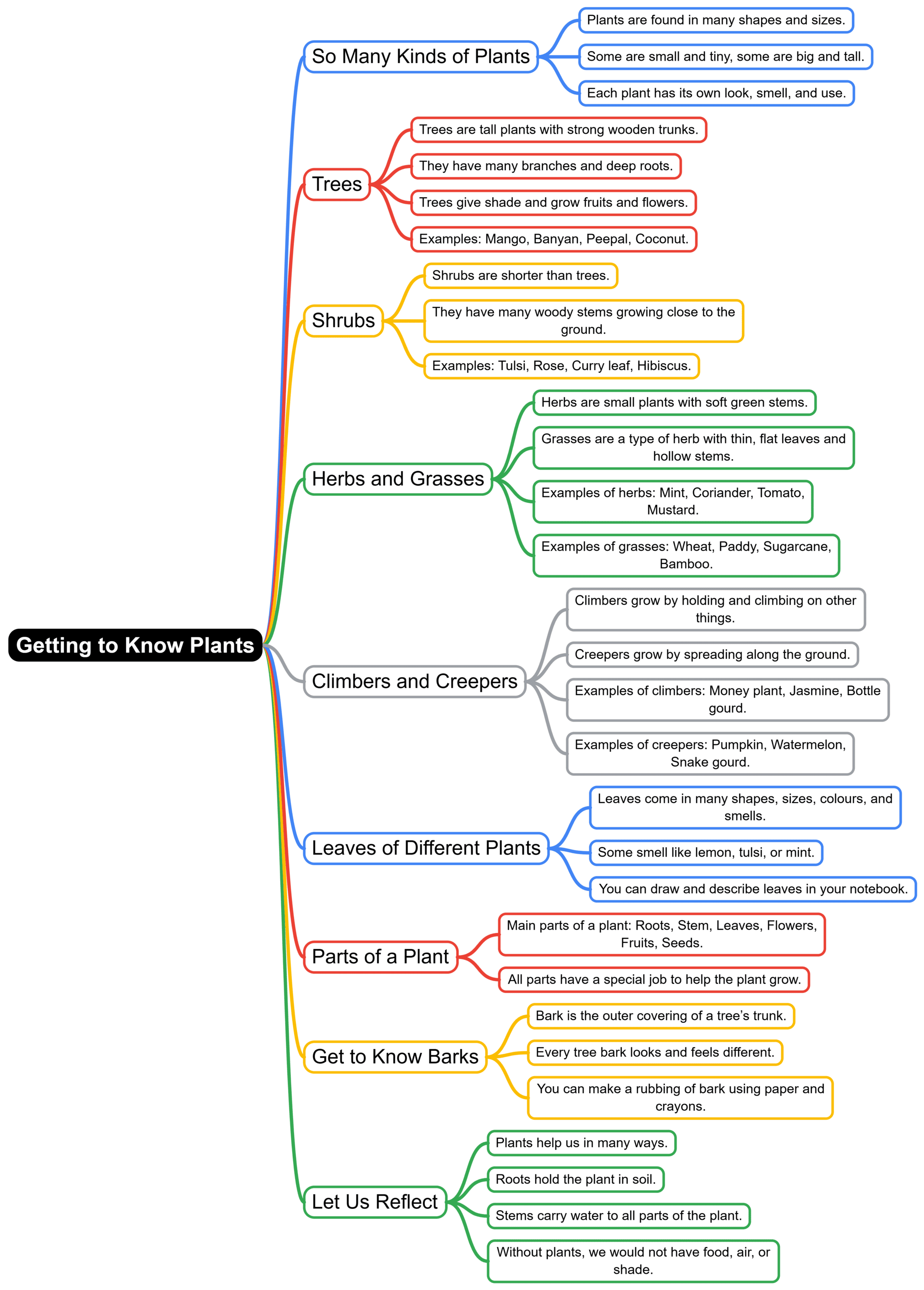
The document Mind Map: Getting to know plants is a part of the Class 3 Course EVS Class 3: The World around us (Our Wondrous World).
All you need of Class 3 at this link: Class 3
FAQs on Mind Map: Getting to know plants
| 1. What are the main parts of a plant and their functions? |  |
Ans. The main parts of a plant include the roots, stems, leaves, flowers, and fruits. Roots anchor the plant in the soil and absorb water and nutrients. Stems support the plant and transport water and nutrients between the roots and leaves. Leaves are crucial for photosynthesis, as they capture sunlight and convert it into energy. Flowers are involved in reproduction, attracting pollinators, while fruits contain seeds that help in the propagation of the plant.
| 2. How do plants adapt to their environments? | |
Ans. Plants adapt to their environments in various ways. For instance, cacti have thick, fleshy stems to store water and spines to reduce water loss. Some plants develop deep roots to access groundwater, while others have broad leaves to capture more sunlight in shady areas. Additionally, certain plants can change their growth patterns in response to seasons, ensuring they can survive different climatic conditions.
| 3. What is photosynthesis and why is it important for plants? | |
Ans. Photosynthesis is the process by which green plants use sunlight to convert carbon dioxide and water into glucose and oxygen. This process occurs mainly in the leaves, where chlorophyll captures sunlight. Photosynthesis is essential for plants as it provides them with the energy needed for growth and development, and it also produces oxygen, which is vital for most living organisms on Earth.
| 4. What roles do flowers play in the life cycle of a plant? | |
Ans. Flowers play a critical role in the reproductive cycle of a plant. They contain the reproductive organs, with stamens producing pollen and pistils housing the ovules. Flowers attract pollinators such as bees, butterflies, and birds, which help in transferring pollen from one flower to another. This process leads to fertilization, resulting in the formation of seeds and fruits, ensuring the continuation of the plant species.
| 5. How can we classify different types of plants? | |
Ans. Plants can be classified into various groups based on their characteristics. The primary classifications are into flowering plants (angiosperms) and non-flowering plants (gymnosperms). Flowering plants produce flowers and seeds, while non-flowering plants reproduce through cones or spores. Additionally, plants can be categorized as herbs, shrubs, or trees based on their size and structure. Other classifications include aquatic plants, succulents, and climbers, depending on their habitat and growth habits.
About this Document

4.74/5 Rating

Apr 30, 2026 Last updated
Document Description: Mind Map: Getting to know plants for Class 3 2026 is part of EVS Class 3: The World around us (Our Wondrous World) preparation. The notes and questions for Mind Map: Getting to know plants have been prepared according to the Class 3 exam syllabus. Information about Mind Map: Getting to know plants covers topics like and Mind Map: Getting to know plants Example, for Class 3 2026 Exam. Find important definitions, questions, notes, meanings, examples, exercises and tests below for Mind Map: Getting to know plants.
Introduction of Mind Map: Getting to know plants in English is available as part of our EVS Class 3: The World around us (Our Wondrous World) for Class 3 & Mind Map: Getting to know plants in Hindi for EVS Class 3: The World around us (Our Wondrous World) course. Download more important topics related with notes, lectures and mock test series for Class 3 Exam by signing up for free. Class 3: Mind Map: Getting to know plants
Description
Mind Map: Getting to know plants of EVS Class 3 provides you one-page visual summary of the chapter covering all the important topics. Download the PDF from EduRev.
Information about Mind Map: Getting to know plants
In this doc you can find the meaning of Mind Map: Getting to know plants defined & explained in the simplest way possible. Besides explaining types of Mind Map: Getting to know plants theory, EduRev gives you an ample number of questions to practice Mind Map: Getting to know plants tests, examples and also practice Class 3 tests



Related Searches
practice quizzes, Free, shortcuts and tricks, Mind Map: Getting to know plants, mock tests for examination, Mind Map: Getting to know plants, MCQs, Exam, study material, pdf , ppt, Sample Paper, Semester Notes, Extra Questions, Previous Year Questions with Solutions, Mind Map: Getting to know plants, Objective type Questions, Summary, Important questions, past year papers, Viva Questions, video lectures;