CBSE Class 3 > Class 3 Notes > EVS : The World around us (Our Wondrous World) > Mind Map : The World of Things
Mind Map : The World of Things

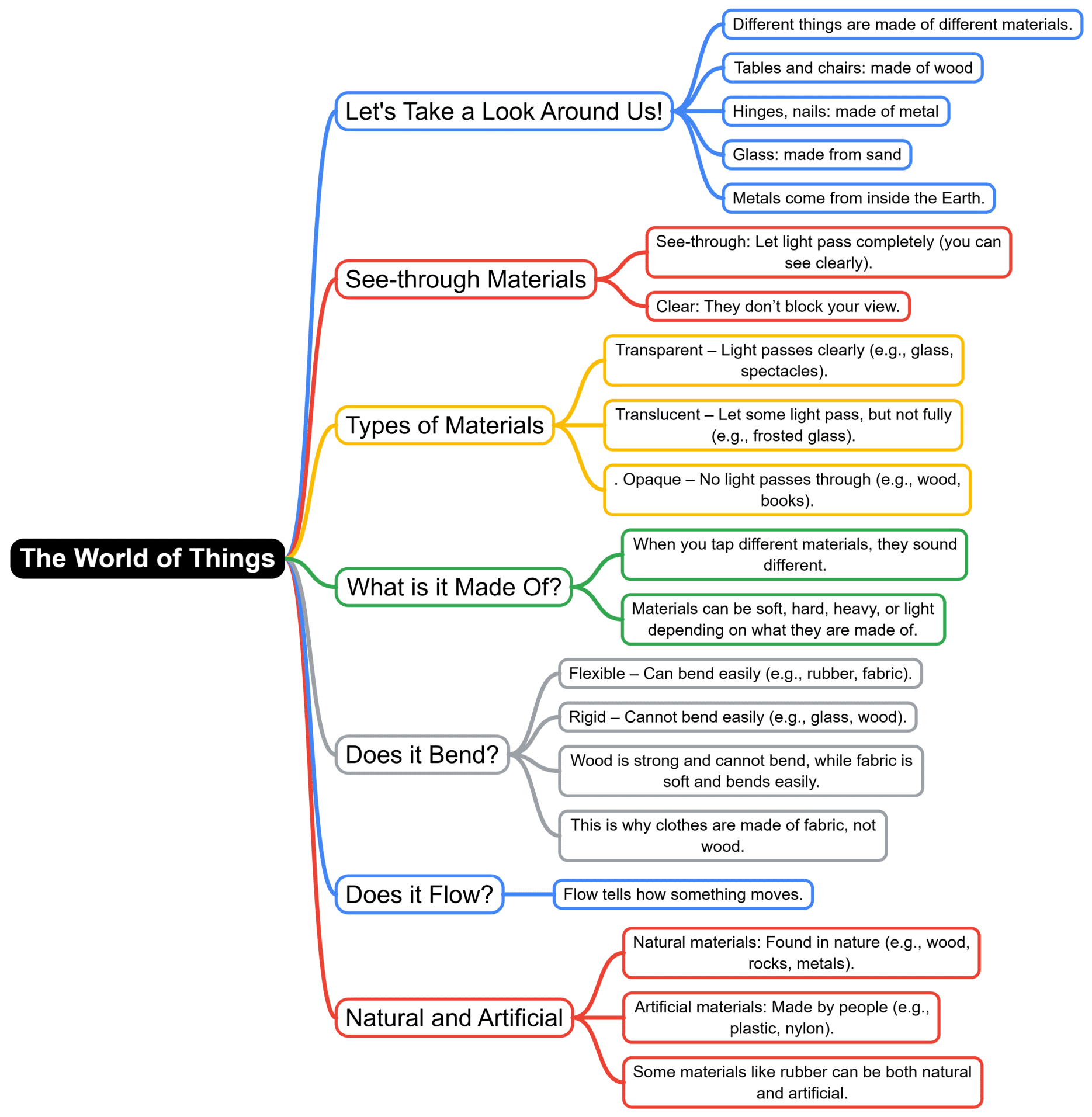
The document Mind Map : The World of Things is a part of the Class 3 Course EVS Class 3: The World around us (Our Wondrous World).
All you need of Class 3 at this link: Class 3
FAQs on Mind Map : The World of Things
| 1. What are the different categories of things we encounter in everyday life? |  |
Ans. In our everyday life, things can be categorized into various groups such as natural things, which include plants and animals, and man-made things, which are products created by humans like toys and furniture. Additionally, we can classify things based on their uses, such as tools, clothing, or vehicles, and their properties, such as solid, liquid, or gas.
| 2. How do objects around us impact our daily activities? | |
Ans. Objects around us play a significant role in our daily activities by providing us with the necessary tools and resources for various tasks. For instance, kitchen items like pots and pans help us prepare meals, while educational tools like books and computers facilitate learning. The presence of comfortable furniture enhances our relaxation and productivity at home and school.
| 3. What is the importance of understanding the materials that make up different objects? | |
Ans. Understanding the materials that make up different objects is important because it helps us appreciate their properties and uses. For example, knowing that glass is fragile can remind us to handle it carefully, while understanding that metals are strong can inform us why they are used for construction. This knowledge also guides us in making informed choices about recycling and sustainability.
| 4. How can we differentiate between living and non-living things? | |
Ans. Living things are characterized by their ability to grow, reproduce, respond to the environment, and carry out life processes such as respiration and nutrition. In contrast, non-living things do not exhibit these characteristics. For example, a tree is a living thing because it grows and produces seeds, while a rock is a non-living thing as it does not show any signs of life.
| 5. Why is it essential to learn about the world of things at an early age? | |
Ans. Learning about the world of things at an early age is essential because it helps children develop observational skills, critical thinking, and an understanding of their environment. This knowledge fosters curiosity and encourages exploration, which is vital for their overall cognitive development. Additionally, it lays the foundation for responsible citizenship by promoting awareness of environmental and sustainability issues.
About this Document

4.66/5 Rating

Apr 30, 2026 Last updated
Related Exams
Document Description: Mind Map : The World of Things for Class 3 2026 is part of EVS Class 3: The World around us (Our Wondrous World) preparation. The notes and questions for Mind Map : The World of Things have been prepared according to the Class 3 exam syllabus. Information about Mind Map : The World of Things covers topics like and Mind Map : The World of Things Example, for Class 3 2026 Exam. Find important definitions, questions, notes, meanings, examples, exercises and tests below for Mind Map : The World of Things.
Introduction of Mind Map : The World of Things in English is available as part of our EVS Class 3: The World around us (Our Wondrous World) for Class 3 & Mind Map : The World of Things in Hindi for EVS Class 3: The World around us (Our Wondrous World) course. Download more important topics related with notes, lectures and mock test series for Class 3 Exam by signing up for free. Class 3: Mind Map : The World of Things
Description
Mind Map : The World of Things of EVS Class 3 provides you one-page visual summary of the chapter covering all the important topics. Download the PDF from EduRev.
Information about Mind Map : The World of Things
In this doc you can find the meaning of Mind Map : The World of Things defined & explained in the simplest way possible. Besides explaining types of Mind Map : The World of Things theory, EduRev gives you an ample number of questions to practice Mind Map : The World of Things tests, examples and also practice Class 3 tests



Related Searches
Important questions, Mind Map : The World of Things, Sample Paper, Summary, shortcuts and tricks, MCQs, Mind Map : The World of Things, video lectures, past year papers, Semester Notes, Objective type Questions, ppt, study material, pdf , Viva Questions, Extra Questions, Previous Year Questions with Solutions, Free, mock tests for examination, Mind Map : The World of Things, practice quizzes, Exam;