UGC NET Paper 2: Psychology 14 Dec 2023

Q1: A decrease in sensitivity to leptin is found to be a factor contributing to:
(a) weight gain
(b) weight loss
(c) maintaining homeostasis
(d) loss of appetite
Ans: a
Sol: The correct answer is 'weight gain'
Weight gain:
- Leptin is a hormone that helps regulate energy balance by inhibiting hunger, which in turn helps to regulate body weight.
- A decrease in sensitivity to leptin, known as leptin resistance, means the body does not respond to leptin signals effectively.
- This can lead to increased food intake and decreased energy expenditure, resulting in weight gain.
Other Related Points
Weight loss:
- Weight loss would typically be associated with increased sensitivity to leptin, not a decrease. Increased leptin sensitivity would result in reduced food intake and increased energy expenditure.
Maintaining homeostasis:
- Maintaining homeostasis involves a balance of various physiological processes. While leptin plays a role in energy homeostasis, a decrease in sensitivity to leptin disrupts this balance rather than maintaining it.
Loss of appetite:
- Loss of appetite would occur with increased leptin sensitivity, as leptin signals the brain to reduce hunger. A decrease in leptin sensitivity would have the opposite effect, potentially increasing appetite.
Q2: On the basis of which criterion the tests are classified into 'Verbal Tests' and 'Non - verbal Test'.
(a) Criterion of purpose
(b) Criterion of contents of items
(c) Criterion of scoring
(d) Criterion of time limits
Ans: b
Sol: The correct answer is 'Criterion of contents of items'
Criterion of contents of items:
- The classification of tests into 'Verbal Tests' and 'Non-verbal Tests' is based on the nature of the content of the test items.
- Verbal tests involve language-based items such as reading comprehension, vocabulary, and grammatical questions.
- Non-verbal tests include items that do not rely on language, such as patterns, shapes, and visual puzzles.
Other Related Points
Criterion of purpose:
- This criterion refers to the goal or objective of the test, such as assessing intelligence, aptitude, or achievement.
- It does not determine whether a test is verbal or non-verbal.
Criterion of scoring:
- This criterion deals with how the test is scored, whether through objective or subjective methods.
- Scoring methods do not influence whether a test is classified as verbal or non-verbal.
Criterion of time limits:
- This criterion involves the time constraints placed on completing the test.
- Time limits are related to the administration of the test, not the content of the items.
Q3: Which of the following is not a technological system designed to aid, enhance or inspire learning:
(a) Python
(b) Logo
(c) Squcak
(d) Boxer
Ans: a
Sol: The correct answer is 'Python'
Python:
- Python is a high-level programming language widely used for general-purpose programming.
- While it can be used to develop educational tools and resources, it itself is not specifically designed as an educational system.
- Python's versatility and ease of learning make it popular for teaching programming, but it does not inherently include educational frameworks or systems.
Logo:
- Logo is an educational programming language known for its use in teaching children about programming concepts.
- It is specifically designed to aid learning through interactive graphics and is often used in educational environments to introduce students to programming.
Squeak:
- Squeak is an open-source programming language and multimedia authoring environment.
- It is designed to support educational and learning activities, particularly in the context of teaching children about computing.
Boxer:
- Boxer is a programming environment designed to be a learning tool for students.
- It provides a visual and interactive way to learn programming concepts and problem-solving skills.
Other Related Points
Educational programming languages:
- Languages like Logo, Squeak, and Boxer are specifically designed to facilitate learning and teaching programming concepts.
- They often include features that make them more accessible and engaging for students, such as visual feedback and interactive environments.
Q4: According to Watson, Conscious mentalism refer to:
(a) Wakeful sate of mind
(b) Knowledge about mental activities
(c) Reasoning ability
(d) Attention to thinking activities
Ans: d
Sol: The correct answer is 'Attention to thinking activities'
Attention to thinking activities:
- Conscious mentalism, according to Watson, refers to the awareness and attention given to one's own thought processes and mental activities.
- This involves being mindful and reflective about what one is thinking and how those thoughts are processed.
- It emphasizes the active engagement in and monitoring of mental activities.
Other Related Points
Wakeful state of mind:
- This refers to being awake and alert, but does not specifically involve attention to one's mental activities.
- Wakefulness is a basic state of consciousness, not necessarily linked to conscious mentalism.
Knowledge about mental activities:
- While knowledge about mental activities is important, it does not capture the active attention and engagement aspect of conscious mentalism.
- It is more about having information rather than actively monitoring and reflecting on one's thoughts.
Reasoning ability:
- Reasoning ability is the capacity to think logically and make rational decisions.
- Although it involves mental processes, it does not specifically refer to the conscious attention to those processes.
Q5: Which scale of measurement has absolute zero ?
(a) Nominal
(b) Ordinal
(c) Interval
(d) Ratio
Ans: d
Sol: The correct answer is 'Ratio'
Ratio Scale:
- The ratio scale of measurement possesses an absolute zero point, meaning that zero indicates the absence of the quantity being measured.
- This scale allows for the comparison of absolute magnitudes and supports a full range of statistical operations, including multiplication and division.
- Examples include weight, height, and age, where zero truly signifies the lack of the attribute.
Other Related Points
Nominal Scale:
- This scale is used for labeling variables without any quantitative value.
- It categorizes data but does not rank or order them.
- Examples include gender, nationality, and blood type.
Ordinal Scale:
- This scale provides a rank order among items but does not quantify the difference between them.
- It indicates relative positioning but not the magnitude of difference.
- Examples include class rankings, satisfaction ratings, and levels of education.
Interval Scale:
- This scale measures the difference between items but lacks a true zero point.
- It allows for meaningful comparison of differences but not ratios.
- Examples include temperature scales like Celsius and Fahrenheit, where zero is arbitrary and does not indicate a lack of temperature.
Q6: Brainstorming is technique in Gerard Egan's problem management approach to helping. Which of the statements given below is NOT a characteristics feature of brainstorming.
(a) Develop 'wild' possibilities
(b) Suspend judgement
(c) Use one idea as a takeoff point for another
(d) Set of time frame
Ans: d
Sol: The correct answer is 'Set of time frame'
Brainstorming Characteristics:
- Develop 'wild' possibilities: Encourages free thinking and the generation of unconventional ideas without limitations.
- Suspend judgement: Participants are encouraged to withhold criticism or evaluation of ideas during the brainstorming session to promote creativity.
- Use one idea as a takeoff point for another: Building on others' ideas to create more refined or innovative solutions.
Set of time frame:
- While setting a time frame can be practical for managing a session, it is not a characteristic feature of the brainstorming process itself, which focuses on idea generation without constraints.
Other Related Points
Purpose of Brainstorming:
- The goal is to generate a wide range of ideas and solutions without immediate evaluation or criticism.
- It is particularly useful in problem-solving, creative thinking, and team collaboration settings.
Q7: The number of cases of a disease, injury or disability at a given point of time which can be expressed as the number of new cases or the number of existing cases is called:
(a) Mortality
(b) Prevalence
(c) Morbidity
(d) Incidence
Ans: c
Sol: The number of cases of a disease, injury or disability at a given point of time which can be expressed as the number of new cases or the number of existing cases is 'Morbidity'
Morbidity:
- Morbidity refers to the state of being diseased or unhealthy within a population.
- It can indicate the prevalence (existing cases) or incidence (new cases) of a disease.
- This term is used to describe how often a disease or condition occurs in a specific area or is a measure of the number of people affected by a disease.
Other Related Points
Mortality:
- Mortality refers to the number of deaths in a population over a period of time.
- It is used to measure the frequency of occurrence of death in a defined population during a specified interval.
Prevalence:
- Prevalence is the proportion of a population found to have a condition (typically a disease or risk factor) at a specific time.
- It includes both new and pre-existing cases in the population at a given time.
Incidence:
- Incidence refers to the number of new cases that develop in a given period of time.
- It provides information about the risk of contracting the disease.
Q8: 'Miracle Question' is a technique used in:
(a) Narrative therapy
(b) Solution focused brief therapy
(c) Feminist therapy
(d) Reality therapy
Ans: b
Sol: The correct answer is Solution focused brief therapy
Solution focused brief therapy:
- The "Miracle Question" is a technique used in Solution Focused Brief Therapy (SFBT).
- It involves asking clients to envision how their life would be different if a miracle occurred and their problem was solved overnight.
- This helps clients identify goals and potential solutions by focusing on a desired future rather than past problems.
Other Related Points
Narrative therapy:
- This therapy focuses on the stories people tell about their lives and how these narratives shape their identity and experiences.
- It helps clients re-author their stories in a more empowering way but does not specifically use the "Miracle Question" technique.
Feminist therapy:
- Feminist therapy addresses the psychological impact of gender and power imbalances in society.
- It aims to empower clients by recognizing and addressing these imbalances but does not typically use the "Miracle Question."
Reality therapy:
- Reality therapy focuses on helping clients make better choices to meet their needs and achieve their goals.
- It emphasizes personal responsibility and present behavior rather than using techniques like the "Miracle Question."
Q9: Which of the following comes under divergent thinking?
(A) Fluency
(B) Flexibility
(C) Elaboration
(D) Preparation
(E) Verification
Choose the correct answer from the options given below:
(a) (B), (C), (D) Only
(b) (A), (C), (E) Only
(c) (A), (B), (C) Only
(d) (B), (C), (E) Only
Ans: c
Sol: The correct answer is 'Fluency, Flexibility, and Elaboration'
Divergent Thinking:
- Fluency: The ability to generate a large number of ideas or solutions to a problem.
- Flexibility: The capacity to consider different perspectives and approaches to a problem.
- Elaboration: The skill of adding details to an idea to improve it or make it more comprehensive.
Other Related Points
Preparation:
- This involves gathering information and resources needed to address a problem but does not directly relate to generating multiple ideas.
Verification:
- This step involves evaluating and refining the ideas generated, which is more aligned with convergent thinking.
Q10: Scientifically sound test must possess which of the following:
(A) Objectively
(B) Norms
(C) Time Limit
(D) Reliability
(E) Validity
Choose the correct answer from the options given below:
(a) (A), (B), (C), (D) Only
(b) (A), (B), (D), (E) Only
(c) (A), (B), (C), (E) Only
(d) (E), (D), (C), (B) Only
Ans: b
Sol: The correct answer is '(A), (B), (D), (E) Only'
Objectivity:
- Ensures that the test results are unbiased and based on factual data rather than personal feelings or opinions.
Norms:
- Provide a basis for comparing individual test scores with a pre-established standard or with the scores of a representative group.
Reliability:
- Indicates the consistency of the test results over time or across different raters.
Validity:
- Measures whether the test actually assesses what it claims to assess.
Other Related Points
Incorrect Options:
- Option 1: Excludes Validity, which is essential for a scientifically sound test.
- Option 3: Excludes Reliability, which is crucial for ensuring consistent results.
- Option 4: Excludes Objectivity, which is important for unbiased results.
- Time Limit: While important in certain contexts, it is not a fundamental requirement for a scientifically sound test.
Q11: Factors covered by the General Aptitude Test Battery (GATB) are:
(A) Verbal Aptitude
(B) Form Perception
(C) Mechanical Reasoning
(D) Motor Coordination
(E) Clerical Perception
Choose the correct answer from the options given below:
(a) (A), (B), (C), (D) Only
(b) (B), (C), (D), (E) Only
(c) (C), (D), (E), (A) Only
(d) (A), (B), (D), (E) Only
Ans: d
Sol: The correct answer is '(A), (B), (D), (E) Only'
The General Aptitude Test Battery (GATB) is a standardized test designed to assess various aptitudes and abilities essential for success in different occupational fields. Developed by the United States Employment Service, the GATB evaluates candidates across multiple domains to provide insights into their vocational aptitudes. Let's explore the factors covered by the GATB:
Key Points:
Verbal Aptitude (A):
- This factor assesses an individual's proficiency in understanding and using language.
- It includes skills such as vocabulary, comprehension, and verbal reasoning.
- Verbal aptitude is crucial for occupations that require effective communication, writing, and comprehension skills.
Form Perception (B):
- Form perception evaluates an individual's ability to perceive and manipulate visual forms and patterns.
- It involves tasks such as identifying shapes, recognizing spatial relationships, and visual problem-solving.
- Form perception is essential for occupations that involve tasks such as drafting, engineering, and graphic design.
Motor Coordination (D):
- Motor coordination evaluates an individual's ability to coordinate muscle movements and perform manual tasks accurately.
- It includes skills such as hand-eye coordination, manual dexterity, and precision in motor tasks.
- Motor coordination is essential for occupations that involve manual labor, fine motor skills, and operating machinery.
Clerical Perception (E):
- Clerical perception assesses an individual's ability to process and organize written and numerical information accurately.
- It involves tasks such as data entry, proofreading, and organizing information.
- Clerical perception is important for occupations in administrative roles, data entry, and clerical work.
Other Related Points
Mechanical Reasoning (C):
- Mechanical reasoning is important for occupations in fields like engineering, automotive repair, and manufacturing.
- It involves tasks related to mechanical systems, tools, and devices, testing the ability to analyze and solve mechanical problems.
- While important it is note measured by The General Aptitude Test Battery (GATB)
Q12: Which best explains about 'Paradigm'?
(A) It is the study of intact, meaningful mental events
(B) A viewpoint regarding physical reality as we perceive
(C) A point of view shared by a substantial number of scientists that provides a general framework for empirical research
(D) It is usually more than just one theory and corresponds more closely to what is called a school of thought
Choose the correct answer from the options given below:
(a) (B), (D) Only
(b) (C), (D) Only
(c) (A), (D) Only
(d) (A), (C) Only
Ans: b
Sol: The correct answer is 'A point of view shared by a substantial number of scientists that provides a general framework for empirical research'
In psychology, paradigms play a crucial role in shaping the theories, methods, and approaches used to understand human behavior and mental processes. Different paradigms provide distinct lenses through which psychologists interpret and investigate psychological phenomena. Let's delve into how paradigms manifest in psychology:
1. Psychodynamic Paradigm:
- Developed by Sigmund Freud, the psychodynamic paradigm emphasizes the role of unconscious conflicts and early childhood experiences in shaping behavior and personality.
- Key concepts include the id, ego, superego, defense mechanisms, and psychosexual stages of development.
- This paradigm has influenced various therapeutic approaches, such as psychoanalysis and psychodynamic therapy.
2. Behaviorist Paradigm:
- The behaviorist paradigm focuses on observable behaviors and the environmental factors that influence them.
- Key figures include Ivan Pavlov, John B. Watson, and B.F. Skinner, who emphasized the importance of conditioning and reinforcement in learning.
- Behaviorist principles underpin techniques like classical conditioning, operant conditioning, and behavior modification.
3. Cognitive Paradigm:
- The cognitive paradigm explores mental processes such as perception, memory, language, problem-solving, and decision-making.
- It emphasizes the role of internal cognitive structures and processes in shaping behavior.
- Key figures include Jean Piaget, Albert Bandura, and Ulric Neisser, who contributed to cognitive psychology, social cognitive theory, and cognitive neuroscience.
4. Humanistic-Existential Paradigm:
- The humanistic-existential paradigm focuses on subjective experiences, personal growth, self-actualization, and the search for meaning.
- Humanistic psychology, spearheaded by Carl Rogers and Abraham Maslow, emphasizes the importance of self-awareness, authenticity, and positive regard in psychological well-being.
- Existential psychology, influenced by thinkers like Viktor Frankl and Rollo May, explores themes of freedom, responsibility, and existential angst.
5. Biological Paradigm:
- The biological paradigm examines the physiological and neurological factors underlying behavior and mental processes.
- It includes areas such as neuroscience, genetics, psychopharmacology, and physiological psychology.
- Researchers investigate topics like brain structure and function, neurotransmitter systems, and the genetic basis of psychological traits and disorders.
6. Socio-Cultural Paradigm:
- The socio-cultural paradigm focuses on how social, cultural, and environmental factors influence behavior, cognition, and emotion.
- It encompasses areas such as social psychology, cultural psychology, and cross-cultural psychology.
- Researchers explore topics like social influence, group dynamics, cultural norms, acculturation, and cultural variations in psychological phenomena.
- A point of view shared by a substantial number of scientists that provides a general framework for empirical research:
Other Related Points
- It is the study of intact, meaningful mental events: This option refers to Gestalt psychology, which is not the same as a paradigm.
- A viewpoint regarding physical reality as we perceive: This option is too vague and does not capture the essence of a paradigm in the scientific context.
- It is usually more than just one theory and corresponds more closely to what is called a school of thought: While this option touches on the idea of a paradigm, it is not as precise as the correct option. A paradigm encompasses a broader framework rather than just a collection of theories.
Q13: Which of the following are true of method of Appreciative Inquiry?
(A) Inquiry begins with appreciation
(B) It is not collaborative
(C) It is not proactive
(D) Inquiry is applicable
Choose the correct answer from the options given below:
(a) (A), (D) Only
(b) (B), (C) Only
(c) (C), (D) Only
(d) (A), (B) Only
Ans: a
Sol: The correct answer is 'Inquiry begins with appreciation and Inquiry is applicable'
Inquiry begins with appreciation:
- Appreciative Inquiry (AI) is a method that focuses on identifying and leveraging the strengths of individuals, teams, and organizations.
- The process begins with the appreciation of what is already working well, which sets a positive tone for the inquiry.
Inquiry is applicable:
- AI is not limited to a specific type of organization or situation; it can be applied in various contexts to bring about positive change.
- This adaptability makes AI a versatile tool for organizational development and problem-solving.
Other Related Points
It is not collaborative:
- This statement is incorrect as AI is inherently a collaborative process. It involves the participation of multiple stakeholders to co-create a vision for the future.
It is not proactive:
- This statement is also incorrect. AI is a proactive approach that seeks to build on existing strengths to create a desired future, rather than just solving problems reactively.
Q14: Resistance to persuasion may be increased :
(A) Reactance
(B) Emotional appeal
(C) Fore warning
(D) Selective avoidance
Choose the correct answer from the options given below:
(a) (A), (B) Only
(b) (B), (C) Only
(c) (A), (B), (D) Only
(d) (A), (C), (D) Only
Ans: d
Sol: The correct answer is '(A) Reactance, (C) Fore warning, (D) Selective avoidance'
Reactance:
- Reactance is a psychological response where individuals resist persuasion efforts, especially when they perceive their freedom to choose is being threatened.
- It often leads to a strengthening of their original attitudes and behaviors.
Fore warning:
- Fore warning involves informing individuals in advance that they will be exposed to a persuasive message.
- This allows them to prepare counter-arguments and increases their resistance to being persuaded.
Selective avoidance:
- Selective avoidance is the tendency to avoid messages that are inconsistent with one's existing beliefs and attitudes.
- By avoiding counter-attitudinal information, individuals can maintain their current attitudes and resist persuasion.
Other Related Points
Emotional appeal:
- Emotional appeals are persuasive messages that aim to evoke an emotional response in the audience.
- While emotional appeals can be effective in influencing attitudes and behaviors, they do not necessarily increase resistance to persuasion.
- In fact, emotional appeals can sometimes make individuals more susceptible to persuasion if they resonate with the audience's feelings and values.
Q15: Which one of the following is not intrinsic factor affecting reliability?
(a) Group variability
(b) Length of the test
(c) Range of total scores
(d) Homogeneity of items
Ans: a
Sol: The correct answer is Group variability
Group variability:
- Refers to the differences or variations within a group of test-takers.
- It is an extrinsic factor as it pertains to the external characteristics of the test-takers rather than the test itself.
Other Related Points
Length of the test:
- Longer tests tend to be more reliable as they provide a more comprehensive assessment of the test-taker's abilities.
- This is an intrinsic factor as it directly pertains to the construction of the test.
Range of total scores:
- A wider range of scores can indicate greater variability in test-taker performance, which can affect reliability.
- This is also intrinsic as it relates to the scoring system of the test.
Homogeneity of items:
- Refers to the similarity or consistency of the test items in measuring the same construct.
- More homogeneous items usually lead to higher reliability, making it an intrinsic factor.
Q16: Wechsler Adult Intelligence Scale (WAIS) published in 1955 has:
(a) 5 Verbal and 5 Performance
(b) 5 Verbal and 6 Performance
(c) 6 Verbal and 5 Performance
(d) 6 Verbal and 6 Performance
Ans: c
Sol: The correct answer is '6 Verbal and 5 Performance'
Wechsler Adult Intelligence Scale (WAIS) Overview:
- The WAIS is a widely used test designed to measure the intelligence of adults.
- It was first published in 1955 by David Wechsler.
Correct Subtests Distribution:
- The WAIS consists of 6 Verbal subtests and 5 Performance subtests.
- This distribution allows for a comprehensive assessment of both verbal and non-verbal intelligence.
Other Related Points
Incorrect Options:
5 Verbal and 5 Performance:
- This option suggests an equal number of verbal and performance subtests, which is not accurate for the WAIS.
5 Verbal and 6 Performance:
- This option suggests there are more performance subtests than verbal, which is incorrect.
6 Verbal and 6 Performance:
- This option suggests an equal number of verbal and performance subtests, but with one extra subtest in each category, which is not true for the WAIS.
Q17: Which of the following can faster prejudice ?
(A) Threats to self-esteem
(B) Competition for resources
(C) Social categorization
(D) Social recategorization
Choose the correct answer from the options given below:
(a) (A), (C), (D) Only
(b) (A), (B), (C) Only
(c) (A), (B), (D) Only
(d) (B), (C), (D) Only
Ans: b
Sol: The correct answer is '(A), (B), (C) Only'
Threats to self-esteem:
- When individuals or groups perceive a threat to their self-esteem, they may develop prejudices as a defense mechanism.
- This can lead to negative attitudes and discriminatory behavior towards others to boost their own self-worth.
Competition for resources:
- Competition for limited resources can foster prejudice as groups vie for dominance and access to these resources.
- This often results in negative stereotypes and discriminatory practices towards the competing group.
Social categorization:
- Social categorization involves dividing people into groups based on characteristics such as race, gender, or age.
- This can lead to in-group favoritism and out-group discrimination, fostering prejudice.
Other Related Points
Social recategorization:
- Social recategorization aims to reduce prejudice by changing the way people categorize others, promoting more inclusive group identities.
- While this can reduce prejudice, it is not a factor that fosters it; rather, it is a strategy to combat it.
Q18: Sigmund Freud was born on ______.
(a) 23 - 09 - 1939
(b) 06 - 05 - 1939
(c) 23 - 09 - 1856
(d) 06 - 05 - 1856
Ans: d
Sol: The correct answer is '06 - 05 - 1856'
06 - 05 - 1856:
- Sigmund Freud, the father of psychoanalysis, was born on this date.
- Freud's work has had a profound impact on psychology, psychiatry, and various other fields.
Other Related Points
23 - 09 - 1939:
- This is the date of Sigmund Freud's death, not his birth.
06 - 05 - 1939:
- This date is close to the date of Freud's death but is not related to his birth.
23 - 09 - 1856:
- This date is incorrect; Freud was born in May, not September.
Q19: 'Foreign Hull' is the concept coined by:
(a) Kurt Lewin
(b) Alfred Adler
(c) Erik Erikson
(d) Abraham Maslow
Ans: a
Sol: The concept of 'Foreign Hull' is coined by Kurt Lewin
Kurt Lewin:
- Kurt Lewin, a German-American psychologist, is known for his work in social psychology and group dynamics.
- He introduced the concept of 'Foreign Hull' which refers to the external environment and its influence on an individual's behavior.
- Lewin's Field Theory emphasizes the importance of the environment in understanding human behavior.
Other Related Points
Alfred Adler:
- Adler was an Austrian medical doctor and psychotherapist who founded the school of Individual Psychology.
- He is best known for his concepts of the inferiority complex and striving for superiority.
Erik Erikson:
- Erikson was a German-American developmental psychologist and psychoanalyst known for his theory on psychosocial development of human beings.
- He is most famous for coining the phrase "identity crisis".
Abraham Maslow:
- Maslow was an American psychologist best known for creating Maslow's hierarchy of needs, a theory of psychological health predicated on fulfilling innate human needs in priority, culminating in self-actualization.
Q20: The components of 'Type A' Pattern of personality encompasses:
(A) Happy - go - Lucky
(B) Prosocial
(C) Emotion - Focused
(D) Competitive Striving for Achievement
(E) Sense of Time urgency
Choose the correct answer from the options given below:
(a) (A), (B) Only
(b) (C), (D) Only
(c) (D), (E) Only
(d) (A), (C), (E) Only
Ans: c
Sol: The correct answer is (D) Competitive Striving for Achievement and (E) Sense of Time urgency
Competitive Striving for Achievement:
- This trait involves a constant drive to achieve more and be better than others. It is a hallmark of 'Type A' personality.
Sense of Time Urgency:
- People with a 'Type A' personality often feel a constant sense of urgency and are always in a hurry, which can lead to stress and impatience.
Other Related Points
Happy-go-Lucky:
- This trait is more characteristic of a 'Type B' personality, which is more relaxed and easy-going.
Prosocial:
- Prosocial behavior involves actions intended to benefit others, which is not a defining trait of 'Type A' personality.
Emotion-Focused:
- Emotion-focused coping is more about managing emotions rather than striving for achievement, and is not specific to 'Type A' personality.
Q21: Study of Values prepared by all port, Vernon and lindzey has some basic areas which of the following areas are included in it?
(A) Moral
(B) Aesthetic
(C) Cognitive
(D) Religions
(E) Economic
Choose the correct answer from the options given below:
(a) (A), (B), (C) Only
(b) (B), (C), (D) Only
(c) (B), (D), (E) Only
(d) (A), (D), (E) Only
Ans: b
Sol: The correct answer is '(B), (C), (D) Only'
Study of Values by Allport, Vernon, and Lindzey:
- The study categorizes values into six major types: theoretical, economic, aesthetic, social, political, and religious.
- The correct answer includes the values that align with the areas mentioned in the study.
Aesthetic:
- Relates to the appreciation of beauty and artistic experiences.
- Included in the study as a major value type.
Cognitive:
- Relates to the pursuit of knowledge and truth.
- While not explicitly named in the original study, it can be associated with theoretical values.
Religious:
- Relates to the importance of spiritual beliefs and practices.
- Included in the study as a major value type.
Other Related Points
Moral:
- While important, moral values are not specifically categorized in the study by Allport, Vernon, and Lindzey.
Economic:
- Relates to values concerning wealth and material resources.
- Included in the study but not part of the correct answer set.
Q22: Which of the following is 'NOT' source of work related stress?
(a) Responsibility for others
(b) Lack of support from coworkers
(c) Conflict with family members
(d) Unpleasant work environment
Ans: c
Sol: The correct answer is 'Conflict with family members'
Conflict with family members:
- Conflict with family members is a source of personal stress rather than work-related stress.
- While personal stress can impact work performance, it is not directly categorized as a work-related stressor.
Responsibility for others:
- Having responsibility for others at work, such as managing a team, can create significant stress due to the added pressure and accountability.
Lack of support from coworkers:
- A lack of support from coworkers can lead to feelings of isolation and increased stress due to the absence of a collaborative and supportive work environment.
Unpleasant work environment:
- An unpleasant work environment, which may include factors like poor working conditions, noise, or a toxic culture, can contribute significantly to work-related stress.
Other Related Points
Personal vs. Work-Related Stress:
- It is important to distinguish between personal stressors and work-related stressors to address them effectively.
- Interventions for work-related stress may include organizational changes, while personal stress might require different approaches such as counseling or family support.
Q23: The Bender Visual - Motor Gestalt Test (Bender 1938) has _______.
(a) Six Designs
(b) Seven Designs
(c) Eight Designs
(d) Nine Designs
Ans: d
Sol: The correct answer is 'Nine Designs'
Nine Designs:
- The Bender Visual-Motor Gestalt Test, developed by Lauretta Bender in 1938, consists of nine different geometric designs.
- This test is used to evaluate visual-motor functioning and developmental disorders in individuals.
Other Related Points
Six Designs:
- There is no version of the Bender Visual-Motor Gestalt Test that consists of only six designs.
- This option is incorrect as it does not align with the standard format of the test.
Seven Designs:
- Similar to the six designs option, there is no recognized version of the test with seven designs.
- This option is incorrect as it does not match the original test developed by Bender.
Eight Designs:
- While some variations and adaptations of psychological tests may exist, the original Bender Visual-Motor Gestalt Test includes nine designs, not eight.
- This option is also incorrect based on the standard test format.
Q24: Which one of the following is NOT among the twenty needs listed by Murray, 1938 ?
(a) Succorance
(b) Sentience
(c) Sex
(d) Safety
Ans: d
Sol: The correct answer is 'Safety'
Succorance:
- Succorance refers to the need to receive help or support from others.
- This is one of the twenty needs listed by Murray in 1938.
Sentience:
- Sentience involves the capacity to feel, perceive, or experience subjectively.
- This is also included in Murray's list of twenty needs.
Sex:
- Sex refers to the need for sexual gratification and relationships.
- This is another need identified by Murray in his list of twenty needs.
Safety:
- Safety is not listed among the twenty needs by Murray in 1938.
- While safety is a fundamental human need, it is not specifically mentioned in Murray's theory.
Q25: The concept of 'collective unconscious' is one of the most powerful, original and controversial features fo:
(a) Adler's Personality Theory
(b) Jung's Personality Theory
(c) Freud's Personality Theory
(d) Fromm's Personality Theory
Ans: b
Sol: The concept of 'collective unconscious' is one of the most powerful, original and controversial features of Jung's Personality Theory
Jung's Personality Theory:
- Carl Jung introduced the concept of the 'collective unconscious,' which refers to structures of the unconscious mind shared among beings of the same species. According to Jung, the collective unconscious contains archetypes, which are universal symbols and themes found across different cultures and time periods.
- This theory was a significant departure from Freud's emphasis on individual unconscious and personal experiences. Jung believed that the collective unconscious plays a crucial role in shaping human behavior and experiences.
Other Related Points
Adler's Personality Theory:
- Alfred Adler focused on the concept of individual psychology and introduced ideas such as the inferiority complex and the importance of social interest and community feeling.
- Adler did not emphasize the collective unconscious but rather the individual's striving for superiority and personal growth.
Freud's Personality Theory:
- Sigmund Freud's psychoanalytic theory emphasized the role of the unconscious mind, but he focused on personal unconscious and individual experiences, particularly childhood experiences and sexual drives.
- Freud's theory does not include the concept of a collective unconscious shared by all humans.
Fromm's Personality Theory:
- Erich Fromm combined psychoanalytic and humanistic approaches, emphasizing the importance of social and cultural factors in personality development.
- Fromm's theory focused on concepts such as freedom, love, and the human need for relatedness, rather than a collective unconscious.
Q26: What is true about retrospective studies?
(A) Data are often collected with the help of narrative methods
(B) It is also knows as naturalistic inquiry
(C) Collected data can be analysed through epistemological perspective.
(D) It is same as quasi - experiment
(E) Biographical research is a good example of retrospective study
Choose the correct answer from the options given below:
(a) (A), (B), (D) Only
(b) (B), (C), (D) Only
(c) (A), (C), (E) Only
(d) (B), (C), (E) Only
Ans: c
Sol: The correct answer is (A), (C), (E) Only
Retrospective studies are a type of research design where investigators look back at data that has already been collected. These studies are often used in fields like epidemiology, psychology, and social sciences to investigate outcomes that have already occurred, identifying potential risk factors and associations.
- Definition and Purpose:
- Retrospective studies use existing data to examine past events or conditions. This design allows researchers to analyze historical data to find correlations and potential causative factors.
- Data Collection Methods:
- Narrative Methods: Often in retrospective studies, data are collected through narrative methods. This involves obtaining detailed accounts and stories from participants about past events, which helps in understanding the context and circumstances surrounding the data.
- Biographical Research:
- Example of Retrospective Study: Biographical research is a prime example of a retrospective study. It involves studying an individual's life history and experiences through various sources such as interviews, diaries, letters, and other personal documents to understand their life trajectory and influences.
Other Related PointsNaturalistic Inquiry: While naturalistic inquiry (which involves studying phenomena in their natural context without manipulation) can be related to retrospective studies, it is not synonymous with them. Naturalistic inquiry often involves observing and recording current behaviors or conditions, rather than looking back at past data.
Quasi-Experiments: Retrospective studies differ from quasi-experiments. Quasi-experiments involve selecting groups based on existing differences (e.g., already exposed to a treatment or condition) and then comparing outcomes. Quasi-experiments can be prospective or retrospective, but not all retrospective studies are quasi-experiments.
Data Analysis: Retrospective studies often involve qualitative data that can be analyzed through various methods, such as thematic analysis, content analysis, or narrative analysis. These methods help to identify patterns, themes, and insights from the collected data.
Q27: Which is correct explanation about Rene Descartes:
(A) The mind controls the body both in animals and human beings
(B) He postulated that the mind the body were governed by different laws
(C) The mind was free and possessed only by humans
(D) The duality of mind and body
Choose the correct answer from the options given below:
(a) (A), (C), (D) Only
(b) (B), (C), (D) Only
(c) (A), (B), (C) Only
(d) (A), (B), (D) Only
Ans: b
Sol: The correct answer is (B), (C), (D) Only
Rene Descartes' Explanation:
- Rene Descartes is known for his dualistic theory which postulates that the mind and body are governed by different laws. This means that the mind is not subjected to the same physical laws as the body.
- Descartes proposed that the mind is free and is possessed only by humans, distinguishing human beings from animals.
- He emphasized the duality of mind and body, which means they are two distinct substances that interact with each other.
Other Related Points
Explanation of Incorrect Options:
- (A) The mind controls the body both in animals and human beings: This option is incorrect because Descartes believed that only humans possess a mind capable of rational thought, while animals operate purely on mechanical instincts.
- (B) He postulated that the mind and the body were governed by different laws: This option is correct and aligns with Descartes' dualistic theory.
- (C) The mind was free and possessed only by humans: This option is correct as it reflects Descartes' view that the mind, which is capable of rational thought, is unique to humans.
- (D) The duality of mind and body: This option is correct and represents the core of Descartes' dualistic theory.
Q28: What is true about multiple regression?
(A) There can be more than two criterion
(B) There can be more than two predictors
(C) It indicates linear relation between one predicator and one criterion
(D) The equation for regression line contains partial regression coefficients
Choose the correct answer from the options given below:
(a) (A), (B) Only
(b) (B), (C) Only
(c) (B), (D) Only
(d) (A), (D) Only
Ans: c
Sol: The correct answer is '(B), (D) Only'
(B) There can be more than two predictors:
- Multiple regression involves multiple independent variables (predictors) to predict the value of a single dependent variable (criterion).
- This allows for a more comprehensive model that can account for the influence of several factors on the dependent variable.
(D) The equation for regression line contains partial regression coefficients:
- In multiple regression, each predictor has its own coefficient, known as a partial regression coefficient.
- These coefficients indicate the relationship between each predictor and the criterion, controlling for the other predictors in the model.
Other Related Points
(A) There can be more than two criterion:
- This is incorrect because multiple regression typically involves one criterion (dependent variable) and multiple predictors (independent variables).
- When there are multiple criterion variables, the method is referred to as multivariate regression, not multiple regression.
(C) It indicates linear relation between one predicator and one criterion:
- This is incorrect as it describes simple linear regression, not multiple regression.
- Multiple regression involves more than one predictor variable, whereas simple linear regression involves only one predictor variable and one criterion variable.
Q29: According to psychophysical school which of the following statements are true?
(A) Weber's ratio increases as the stimulus intensity increases
(B) DL increases proportionately to the changes in the stimulus intensily
(C) Limens determines the perception of sensory stimulus
(D) Weber's ratio and Fechner's law are contradictory in nature
Choose the correct answer from the options given below:
(a) (A), (B) Only
(b) (B), (C) Only
(c) (A), (D) Only
(d) (A), (C) Only
Ans: b
Sol: The correct answer is (B), (C) Only
(B) DL increases proportionately to the changes in the stimulus intensity:
- This statement is true according to the psychophysical school. The Differential Limen (DL) or Just Noticeable Difference (JND) increases in proportion to the changes in stimulus intensity, which is consistent with Weber's Law.
(C) Limens determines the perception of sensory stimulus:
- This statement is also true. Limens, including the absolute threshold and difference threshold, are key concepts in psychophysics that determine the perception of sensory stimuli.
Other Related Points
(A) Weber's ratio increases as the stimulus intensity increases:
- This statement is incorrect. According to Weber's Law, the ratio of the increment threshold to the background intensity is constant. Therefore, Weber's ratio does not increase with stimulus intensity; it remains constant.
(D) Weber's ratio and Fechner's law are contradictory in nature:
- This statement is incorrect. Weber's Law and Fechner's Law are not contradictory. Fechner's Law builds on Weber's Law by integrating the concept of the logarithmic relationship between stimulus and perception.
Q30: Which are the major components of Emotional Intelligence by Goleman (1995):
(A) Recognizing the purpose in life
(B) Knowing our own emotions
(C) Recognizing the emotions of others
(D) Handling relationship
(E) Understanding meaning of life
Choose the correct answer from the options given below:
(a) (A), (B), (D) Only
(b) (B), (C), (D) Only
(c) (A), (B), (C), (E) Only
(d) (A), (C), (D), (E) Only
Ans: b
Sol: The correct answer is (B), (C), (D) Only
The major components of Emotional Intelligence by Goleman (1995) are 'Knowing our own emotions, Recognizing the emotions of others, and Handling relationships'
Knowing our own emotions:
- This involves self-awareness and the ability to recognize and understand one's own emotions.
- It is critical for managing one's own behavior and responses in various situations.
Recognizing the emotions of others:
- This refers to empathy and the ability to perceive and understand the emotions of other people.
- It is essential for effective communication and building strong interpersonal relationships.
Handling relationships:
- This involves social skills and the ability to manage interactions and relationships effectively.
- It includes skills such as conflict resolution, communication, and teamwork.
The other components of Goleman Emotional Intelligence are:-
- Managing your own emotions
- Motivating yourself
Other Related Points
Recognizing the purpose in life:
- This is not a component of Emotional Intelligence as per Goleman's model.
- It relates more to personal fulfillment and existential psychology.
Understanding meaning of life:
- This is also not a part of Goleman's Emotional Intelligence framework.
- It pertains to philosophical or spiritual inquiries rather than emotional competencies.
Q31: Egan's developmental model of counselling mentions the following distinct steps in its three stages:
(A) Possibilities, Commitment
(B) Best fit, Leverage
(C) Blindspot, Focusing
(D) Leverage, Confronting
(E) Agenda, Commitment
Choose the correct answer from the options given below:
(a) (A), (B), (D) Only
(b) (A), (B), (E) Only
(c) (A), (B), (C) Only
(d) (A), (B), (C), (E) Only
Ans: b
Sol: The correct answer is '(A), (B), (E) Only'
Egan's Developmental Model of Counselling:
- Egan's model is a three-stage framework designed to help clients address and resolve their issues.
- Each stage has specific steps to guide the counselling process effectively.
Correct Steps in the Model:
- (A) Possibilities, Commitment: These steps are part of the Action Planning stage where clients explore possible actions and commit to specific plans.
- (B) Best fit, Leverage: These steps are involved in the Strategy Development stage, where clients identify strategies that fit best with their goals and leverage their strengths.
- (E) Agenda, Commitment: These steps are part of the initial stage where clients set the agenda for counselling and commit to the process.
Other Related Points
Incorrect Steps:
- (C) Blindspot, Focusing: While these terms may be relevant in counselling, they are not specific steps in Egan's developmental model.
- (D) Leverage, Confronting: Confronting is not a specified step in Egan's model; leverage is already included correctly in the model.
Q32: Which of the following are the influencing skills of counselling:
(A) Self disclosure
(B) Information giving
(C) Confrontation
(D) Smart - goals
Choose the correct answer from the options given below:
(a) (D) Only
(b) (A), (B), (D) Only
(c) (B), (C), (D) Only
(d) (A), (B), (C) Only
Ans: d
Sol: The correct answer is '(A), (B), (C) Only'
Influencing Skills in Counselling:
- Self-disclosure: This involves the counselor sharing personal experiences or feelings to build trust and rapport with the client.
- Information Giving: Providing relevant information to the client to help them understand their situation or make informed decisions.
- Confrontation: Challenging the client in a supportive way to help them recognize discrepancies in their thoughts, feelings, or behaviors.
Other Related Points
Explanation of Incorrect Option:
- Smart - Goals: While setting SMART goals (Specific, Measurable, Achievable, Relevant, Time-bound) is important in many contexts, it is not typically categorized as an influencing skill in counselling. It is more of a planning and goal-setting tool.
- Option (D) Only: This option is incorrect because it only includes SMART goals, which is not an influencing skill in counselling.
- Option (A), (B), (D) Only: This option is incorrect because it includes SMART goals, which is not an influencing skill in counselling.
- Option (B), (C), (D) Only: This option is incorrect because it includes SMART goals, which is not an influencing skill in counselling.
Q33: Which of the following statements are true for a panic disorder:
(A) Recurrent bouts of intense and extreme fear
(B) Sensation of shortness of breath or smothering
(C) Persistent worry or concern about having additional attacks
(D) An episode of panic attack followed by the use of a drug or medication
Choose the correct answer from the options given below:
(a) (A), (B), (C) Only
(b) (B), (C), (D) Only
(c) (B), (D) Only
(d) (A), (C), (D) Only
Ans: a
Sol: The correct answer is '(A), (B), (C) Only'
Recurrent bouts of intense and extreme fear:
- Panic disorder is characterized by sudden and recurrent episodes of intense fear or discomfort, often without a clear trigger.
Sensation of shortness of breath or smothering:
- During a panic attack, individuals may experience physical symptoms such as shortness of breath, palpitations, and a feeling of being smothered.
Persistent worry or concern about having additional attacks:
- Individuals with panic disorder often have an ongoing fear of future attacks, which can lead to avoidance behaviors and significant distress.
Other Related Points
An episode of panic attack followed by the use of a drug or medication:
- This statement is incorrect because panic disorder is not typically defined by the use of drugs or medications following an episode. While medication may be prescribed to manage symptoms, it is not a defining characteristic of the disorder itself.
Q34: Which of the following are the identity statuses of James Marcia's theory:
(A) Identity achievement
(B) Identity fore closure
(C) Identity diffusion
(D) Identity crisis
(E) Identity moratorium
Choose the correct answer from the options given below:
(a) (A), (B), (C), (E) Only
(b) (A), (B), (C), (D) Only
(c) (B), (C), (D), (E) Only
(d) (C), (D) Only
Ans: a
Sol: The correct answer is 'Identity achievement, Identity foreclosure, Identity diffusion, and Identity moratorium'
Identity achievement:
- This status represents individuals who have explored different options and have made a commitment to a particular identity.
- It signifies a mature and stable sense of self.
Identity foreclosure:
- This status occurs when individuals make a commitment without exploring other options.
- It often involves adopting roles and values from authority figures without personal exploration.
Identity diffusion:
- Individuals in this status have neither explored options nor made a commitment.
- It often reflects a lack of direction or motivation regarding identity formation.
Identity moratorium:
- This status is characterized by exploration without having made a commitment.
- Individuals are actively searching and considering various options.
Other Related Points
Identity crisis:
- While an important concept in Erik Erikson's theory of psychosocial development, "identity crisis" is not one of the specific statuses in James Marcia's theory.
- It refers to the period of uncertainty and confusion in which an individual may question their sense of self and direction in life.
Q35: Which of the following are the stages in the transtheoretical model of behavour change:
(A) Maintenance
(B) Intention
(C) Contemplation
(D) Action
Choose the correct answer from the options given below:
(a) (A), (B), (C) Only
(b) (A), (C), (D) Only
(c) (B), (C), (D) Only
(d) (B), (C) Only
Ans: b
Sol: The correct answer is '(A), (C), (D) Only'
Stages in the Transtheoretical Model of Behavior Change:
- Maintenance: This stage involves maintaining the new behavior over time and avoiding relapse.
- Contemplation: In this stage, individuals are aware of the need for change and are considering taking action within the next six months.
- Action: This stage involves actively modifying behavior and adopting new habits.
Other Related Points
Incorrect Options:
- Intention: This is not a recognized stage in the transtheoretical model. The correct stages are Precontemplation, Contemplation, Preparation, Action, Maintenance, and Termination.
Q36: Which of the following are not the components of yama as per Astanga Yoga:
(A) Ahimsa
(B) Shoucha
(C) Asteya
(D) Tapas
Choose the correct answer from the options given below:
(a) (A), (C) Only
(b) (A), (B) Only
(c) (B), (D) Only
(d) (B), (C) Only
Ans: c
Sol: The correct answer is '(B) Shoucha and (D) Tapas'
Components of Yama in Astanga Yoga:
- Ahimsa: Non-violence towards all living beings.
- Satya: Truthfulness in thoughts, words, and actions.
- Asteya: Non-stealing, not taking anything that is not freely given.
- Brahmacharya: Celibacy or control over sexual desires.
- Aparigraha: Non-possessiveness or non-greediness.
Other Related Points
Incorrect Options:
- Shoucha: This is a component of Niyama, not Yama. It refers to cleanliness or purity.
- Tapas: This is also a component of Niyama, referring to austerity or self-discipline.
Q37: Which of the following statements is correct about 'assimilation':
(A) A kind of matching between the cognitive structures and the physical environment
(B) Learning that one event leads to another
(C) It can be roughly equated with recognition or knowing
(D) Studying a phenomenon as 'it occurs naturally in the environment'
Choose the correct answer from the options given below:
(a) (A), (B), (C) Only
(b) (A), (D) Only
(c) (A), (C) Only
(d) (A), (C), (D) Only
Ans: c
Sol: The correct answer is (A), (C) Only
Assimilation:
- Assimilation involves integrating new information into existing cognitive structures. This process is a kind of matching between the cognitive structures and the physical environment, making option (A) correct.
- It can also be roughly equated with recognition or knowing, which makes option (C) correct as well.
Other Related Points
Learning that one event leads to another:
- This describes classical conditioning, not assimilation. Hence, option (B) is incorrect.
Studying a phenomenon as 'it occurs naturally in the environment':
- This refers to naturalistic observation, not assimilation. Therefore, option (D) is incorrect.
Q38: How type II error can be reduced while testing hypothesis?
(A) Decreasing the chosen level of significance
(B) Increasing the chosen level of significance
(C) Decreasing the sample size
(D) Increasing the sample size
Choose the correct answer from the options given below:
(a) (A), (D) Only
(b) (B), (D) Only
(c) (A), (C) Only
(d) (B), (C) Only
Ans: b
Sol: The correct answer is '(B), (D) Only'
Type II Error Reduction:
Increasing the chosen level of significance (Option B):
- By increasing the level of significance (e.g., from 0.01 to 0.05), the probability of rejecting a false null hypothesis increases, thereby reducing the Type II error.
Increasing the sample size (Option D):
- Increasing the sample size reduces the standard error, making the test more sensitive to detecting a true effect, thus reducing the Type II error.
Other Related Points
Incorrect Options:
Decreasing the chosen level of significance (Option A):
- Decreasing the level of significance (e.g., from 0.05 to 0.01) makes it harder to reject the null hypothesis, thereby increasing the probability of a Type II error.
Decreasing the sample size (Option C):
- Decreasing the sample size increases the standard error, making it harder to detect a true effect, thus increasing the Type II error.
Q39: Which of the following statements is correct about Gestalt psychology?
(A) Gestalt approach is holistic
(B) Gestalt psychology has sometimes been called phenomenology
(C) Gestalt psychology can be thought of as an attempts to apply field theory from physics
(D) Gestalt psychologists believed that whatever happens to a person influences everything else about the person
Choose the correct answer from the options given below:
(a) (A), (B), (D) Only
(b) (A), (C), (D) Only
(c) (A), (B), (C) Only
(d) (B), (C), (D) Only
Ans: d
Sol: The correct answer is (B), (C), (D) Only
Gestalt psychology has sometimes been called phenomenology:
- Gestalt psychology focuses on human perception and how people naturally organize visual elements into groups or unified wholes, which is a fundamental aspect of phenomenology.
- Phenomenology emphasizes the subjective experience and consciousness, which aligns with the Gestalt emphasis on perception and experience.
Gestalt psychology can be thought of as an attempt to apply field theory from physics:
- Field theory in physics deals with the forces that influence objects within a field. Similarly, Gestalt psychology applies this concept to human perception, suggesting that psychological phenomena should be viewed in their entirety rather than as a sum of parts.
- This approach helps in understanding how people perceive patterns and structures in their environment.
Gestalt psychologists believed that whatever happens to a person influences everything else about the person:
- This holistic approach is central to Gestalt psychology, which posits that all experiences and actions are interconnected and influence each other.
- It emphasizes the importance of understanding the person as a whole rather than in isolated parts.
Other Related Points
Gestalt approach is not deterministic:
- Determinism suggests that all events, including human actions, are determined by previously existing causes. However, Gestalt psychology does not strictly adhere to this notion; instead, it focuses on perception and experience as dynamic and holistic processes.
- The Gestalt approach emphasizes the role of human perception in creating meaning, which is not strictly deterministic.
Q40: The theoretical positions about personality whose development have been heavily dependent on
factor analysis are:
(A) R.B. Cattell
(B) Spearman
(C) HJ. Eysenck
(D) J.P. Guilford
(E) Howard Gardner
Choose the correct answer from the options given below:
(a) (A), (C), (E) Only
(b) (B), (D), (E) Only
(c) (A), (C), (D) Only
(d) (A), (C), (D), (E) Only
Ans: c
Sol: The correct answer is R.B. Cattell, HJ. Eysenck, J.P. Guilford
R.B. Cattell:
- R.B. Cattell was a prominent psychologist known for his use of factor analysis to identify and measure the underlying factors of personality traits.
- He developed the 16 Personality Factor (16PF) model, which has been influential in personality psychology.
HJ. Eysenck:
- HJ. Eysenck was another key figure in psychology who relied heavily on factor analysis in his work.
- He proposed a model of personality based on three dimensions: extraversion, neuroticism, and psychoticism.
J.P. Guilford:
- J.P. Guilford also made significant contributions to the field of psychology using factor analysis.
- He is known for his Structure of Intellect (SI) theory, which breaks down human intelligence into multiple abilities.
Other Related Points
Spearman:
- Spearman is best known for his work on intelligence rather than personality.
- He introduced the concept of the 'g factor' or general intelligence.
Howard Gardner:
- Howard Gardner is known for his theory of multiple intelligences, which focuses on different types of intelligence rather than personality traits.
- His work did not primarily rely on factor analysis.
Q41: Frend believed that at times Ego is unable to control impulses of ID so uses various defense mechanism such as:
(A) Fixation
(B) Repression
(C) Rationalization
(D) Displacement
(E) Projection
Choose the correct answer from the options given below:
(a) (A), (B), (C), (D) Only
(b) (B), (C), (D), (E) Only
(c) (C), (D), (E), (A) Only
(d) (D), (E), (A), (B) Only
Ans: b
Sol: The correct answer is '(B), (C), (D), (E) Only'
Defense Mechanisms:
- According to Freud, the ego uses various defense mechanisms to manage the demands of the id and the superego. These mechanisms help to protect the mind from anxiety and stress.
- Common defense mechanisms include:
- Repression: The unconscious blocking of unacceptable thoughts, feelings, and impulses.
- Rationalization: Creating a seemingly logical reason or excuse for behavior that might otherwise be shameful.
- Displacement: Redirecting emotions or impulses from a threatening target to a safer one.
- Projection: Attributing one's own unacceptable thoughts or feelings to someone else.
Other Related Points
Fixation:
- Fixation is a concept related to Freud's psychosexual stages of development, not specifically a defense mechanism.
- It refers to an individual being stuck at a particular stage of psychosexual development due to unresolved conflicts.
Explanation of Incorrect Options:
- Option 1 includes 'Fixation,' which is not a defense mechanism, making this option incorrect.
- Option 3 also includes 'Fixation,' so it is incorrect for the same reason.
- Option 4 includes 'Fixation,' making it incorrect as well.
Q42: Match List - I with List - II.
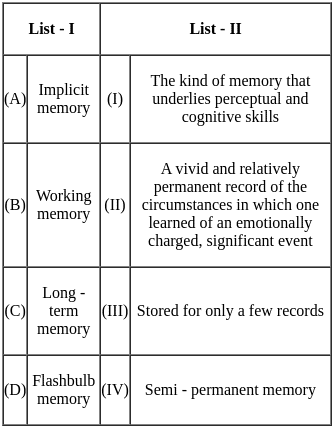
Choose the correct answer from the options given below:
(a) (A) - (I), (B) - (III), (C) - (IV), (D) - (II)
(b) (A) - (I), (B) - (II), (C) - (IV), (D) - (III)
(c) (A) - (II), (B) - (III), (C) - (IV), (D) - (I)
(d) (A) - (III), (B) - (IV), (C) - (II), (D) - (I)
Ans: a
Sol: The correct answer is '(A) - (I), (B) - (III), (C) - (IV), (D) - (II)'
Implicit memory:
- Implicit memory (A) - (I): The kind of memory that underlies perceptual and cognitive skills.
- Implicit memory refers to unconscious memory processes that influence thoughts and behaviors without conscious awareness.
Working memory:
- Working memory (B) - (III): Stored for only a few seconds.
- Working memory is a short-term memory system that temporarily holds and manipulates information needed for cognitive tasks.
Long-term memory:
- Long-term memory (C) - (IV): Semi-permanent memory.
- Long-term memory stores information over an extended period, ranging from days to a lifetime.
Flashbulb memory:
- Flashbulb memory (D) - (II): A vivid and relatively permanent record of the circumstances in which one learned of an emotionally charged, significant event.
- Flashbulb memories are detailed and vivid memories of significant and emotional events.
Other Related Points
Other Options:
- Option 2: Incorrect because it mismatches the definitions of implicit memory and flashbulb memory.
- Option 3: Incorrect because it mismatches the definitions of implicit memory and working memory.
- Option 4: Incorrect because it mismatches the definitions of implicit memory and long-term memory.
Q43: Match List - I with List - II.
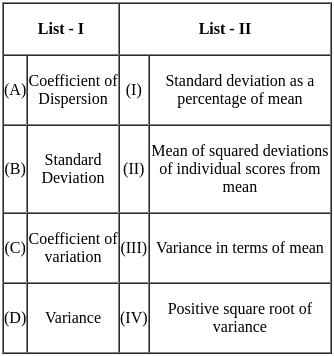
Choose the correct answer from the options given below:
(a) (A) - (IV), (B) - (III), (C) - (I), (D) - (II)
(b) (A) - (III), (B) - (IV), (C) - (II), (D) - (I)
(c) (A) - (III), (B )- (IV), (C) - (I), (D) - (II)
(d) (A) - (IV), (B) - (II), (C) - (III), (D) - (I)
Ans: c
Sol: The correct answer is '(A) - (III), (B )- (IV), (C) - (I), (D) - (II)'
Coefficient of Dispersion (A):
- Matched with (III): Variance in terms of mean.
- The Coefficient of Dispersion is usually expressed as a ratio of the variance to the mean.
Standard Deviation (B):
- Matched with (IV): Positive square root of variance.
- Standard Deviation is calculated as the square root of the variance, providing a measure of dispersion around the mean.
Coefficient of Variation (C):
- Matched with (I): Standard deviation as a percentage of mean.
- The Coefficient of Variation is a normalized measure of dispersion, calculated as the ratio of the standard deviation to the mean, often expressed as a percentage.
Variance (D):
- Matched with (II): Mean of squared deviations of individual scores from mean.
- Variance is defined as the average of the squared differences from the mean.
Other Related Points
Explanation of Incorrect Options:
Option 1:
- (A) - (IV) is incorrect because Coefficient of Dispersion is not the positive square root of variance.
- (B) - (III) is incorrect because Standard Deviation is not the variance in terms of mean.
- (C) - (I) is correct.
- (D) - (II) is correct.
Option 2:
- (A) - (III) is correct.
- (B) - (IV) is correct.
- (C) - (II) is incorrect because Coefficient of Variation is not the mean of squared deviations of individual scores from mean.
- (D) - (I) is incorrect because Variance is not the standard deviation as a percentage of mean.
Option 4:
- (A) - (IV) is incorrect because Coefficient of Dispersion is not the positive square root of variance.
- (B) - (II) is incorrect because Standard Deviation is not the mean of squared deviations of individual scores from mean.
- (C) - (III) is incorrect because Coefficient of Variation is not the variance in terms of mean.
- (D) - (I) is incorrect because Variance is not the standard deviation as a percentage of mean.
Q44: Match List - I with List - II.
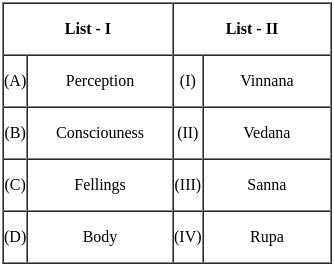
Choose the correct answer from the options given below:
(a) (A) - (II), (B) - (I), (C) - (IV), (D) - (III)
(b) (A) - (III), (B) - (I), (C) - (II), (D) - (IV)
(c) (A) - (IV), (B) - (II), (C) - (III), (D) - (I)
(d) (A) - (III), (B) - (IV), (C) - (II), (D) - (I)
Ans: b
Sol: The correct answer is (A) - (III), (B) - (I), (C) - (II), (D) - (IV)
Buddhism offers a rich understanding of the mind and its components, providing insights into perception, consciousness, feelings, and the body. These concepts are fundamental to Buddhist philosophy and meditation practices aimed at cultivating mindfulness and insight into the nature of reality.
Perception (A) - (III) Sanna:
- Perception refers to the cognitive process of recognizing and interpreting sensory information.
- In Buddhist psychology, perception is represented by the term "Sanna," which encompasses the mental function of recognizing and categorizing sensory stimuli.
- Sanna plays a crucial role in the formation of mental constructs and the interpretation of experiences.
Consciousness (B) - (I) Vinnana:
- Consciousness, in the context of Buddhist psychology, refers to awareness or the faculty of cognizance.
- The term "Vinnana" represents consciousness and is considered one of the five aggregates (khandhas) that constitute the psychophysical being.
- Vinnana encompasses both sensory consciousness (related to the five senses) and mental consciousness (related to thoughts, emotions, and mental states).
Feelings (C) - (II) Vedana:
- Feelings refer to the affective aspect of subjective experience, including sensations of pleasure, pain, or neutrality.
- In Buddhist psychology, feelings are represented by the term "Vedana," which denotes the hedonic tone or quality of an experience.
- Vedana is considered one of the fundamental mental factors and is central to understanding the nature of suffering and its cessation in Buddhist teachings.
Body (D) - (IV) Rupa:
- The body, in Buddhist psychology, refers to the physical aspect of the individual, including the material body and its sensations.
- The term "Rupa" denotes physical form or materiality and is one of the five aggregates (khandhas) that constitute the psychophysical being.
- Rupa encompasses the physical elements and sensations experienced through the body and is subject to impermanence and change.
Other Related Points
- These concepts from Buddhist psychology provide a holistic framework for understanding the nature of human experience and the workings of the mind.
- Buddhist teachings emphasize the impermanent, unsatisfactory, and selfless nature of phenomena, including mental processes and bodily sensations.
- Practitioners of mindfulness meditation often use these concepts to cultivate awareness and insight into the transient and conditioned nature of perception, consciousness, feelings, and the body.
Q45: Match List - I with List - II.
With reference to psychosocial theory of Development (Erikson):
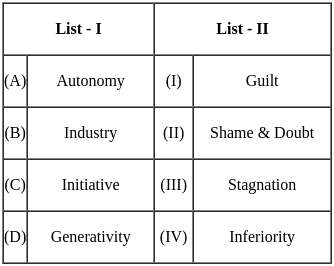
Choose the correct answer from the options given below:
(a) (A) - (II), (B) - (IV), (C) - (I), (D) - (III)
(b) (A) - (II), (B) - (III), (C) - (IV), (D) - (I)
(c) (A) - (I), (B) - (II), (C) - (III), (D) - (IV)
(d) (A) - (III), (B) - (II), (C) - (IV), (D) - (I)
Ans: a
Sol: The correct answer is(A) - (II), (B) - (IV), (C) - (I), (D) - (III)
Autonomy - Shame & Doubt:
- Erikson's stage of Autonomy vs. Shame & Doubt occurs in early childhood (approximately 1-3 years).
- Children who are encouraged and supported in their increased independence become more confident and secure in their own ability to survive in the world.
Industry - Inferiority:
- Erikson's stage of Industry vs. Inferiority occurs during the school-age years (approximately 5-12 years).
- Children who are encouraged and commended by parents and teachers develop a feeling of competence and belief in their skills.
Initiative - Guilt:
- Erikson's stage of Initiative vs. Guilt occurs during the preschool years (approximately 3-5 years).
- Children begin to assert their power and control over the world through directing play and other social interactions.
Generativity - Stagnation:
- Erikson's stage of Generativity vs. Stagnation occurs during middle adulthood (approximately 40-65 years).
- Adults who feel they are contributing to the world by being active in their home and community develop a sense of generativity.
Other Related Points
Option 2:
- This option incorrectly matches Industry with Stagnation and Generativity with Guilt, which do not align with Erikson's stages of development.
Option 3:
- This option incorrectly matches Autonomy with Guilt, Industry with Shame & Doubt, and Initiative with Stagnation, which do not align with Erikson's stages of development.
Option 4:
- This option incorrectly matches Autonomy with Stagnation and Industry with Shame & Doubt, which do not align with Erikson's stages of development.
Q46: Match List - I with List - II.
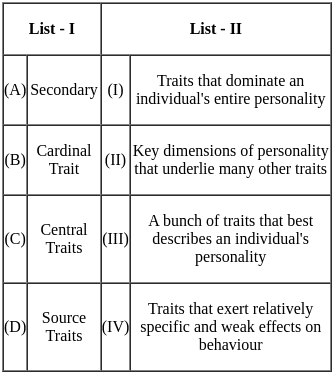
Choose the correct answer from the options given below:
(a) (A) - (I), (B) - (II), (C) - (III), (D) - (IV)
(b) (A) - (II), (B) - (III), (C) - (IV), (D) - (I)
(c) (A) - (III), (B) - (IV), (C) - (I), (D) - (II)
(d) (A) - (IV), (B) - (I), (C) - (III), (D) - (II)
Ans: d
Sol: The correct answer is '(A) - (IV), (B) - (I), (C) - (III), (D) - (II)'
Secondary Traits:
- Traits that exert relatively specific and weak effects on behaviour.
- These traits are not as influential on overall personality but can still affect an individual's reactions in certain situations.
Cardinal Trait:
- Traits that dominate an individual's entire personality.
- These are rare and are so pervasive that the person becomes known specifically for these traits.
Central Traits:
- A bunch of traits that best describes an individual's personality.
- These are the basic building blocks of an individual's personality and are more influential than secondary traits.
Source Traits:
- Key dimensions of personality that underlie many other traits.
- These traits are more fundamental and give rise to surface traits.
Other Related Points
Incorrect Pairings:
- (A) - (I): Secondary traits are not traits that dominate an individual's entire personality.
- (B) - (II): Cardinal traits are not the key dimensions of personality that underlie many other traits.
- (C) - (I): Central traits are not traits that dominate an individual's entire personality.
- (D) - (I): Source traits are not traits that dominate an individual's entire personality.
Q47: Match List - I with List - II.
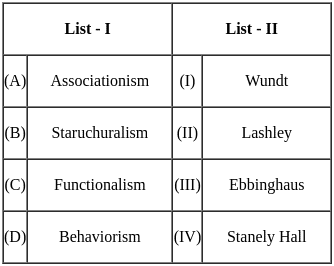
Choose the correct answer from the options given below:
(a) (A) - (II), (B) - (III), (C) - (IV), (D) - (I)
(b) (A) - (IV), (B) - (II), (C) - (I), (D) - (III)
(c) (A) - (III), (B) - (I), (C) - (IV), (D) - (II)
(d) (A) - (II), (B) - (IV), (C) - (III), (D) - (I)
Ans: c
Sol: The correct answer is '(A) - (III), (B) - (I), (C) - (IV), (D) - (II)'
Associationism (A) - Ebbinghaus (III):
- Hermann Ebbinghaus is known for his work in associationism, particularly his research on memory and the forgetting curve.
Structuralism (B) - Wundt (I):
- Wilhelm Wundt is considered the father of structuralism, which focuses on breaking down mental processes into the most basic components.
Functionalism (C) - Stanely Hall (IV):
- G. Stanley Hall was a key figure in the development of functionalism, which emphasizes the purpose of consciousness and behavior.
Behaviorism (D) - Lashley (II):
- Karl Lashley was known for his work in behaviorism, particularly his research on brain mechanisms and behavior.
Other Related Points
Option 1:
- This option incorrectly matches Associationism with Lashley, Structuralism with Ebbinghaus, Functionalism with Hall, and Behaviorism with Wundt.
Option 2:
- This option incorrectly matches Associationism with Hall, Structuralism with Lashley, Functionalism with Wundt, and Behaviorism with Ebbinghaus.
Option 4:
- This option incorrectly matches Associationism with Lashley, Structuralism with Hall, Functionalism with Ebbinghaus, and Behaviorism with Wundt.
Q48: Match List - I with List - II.
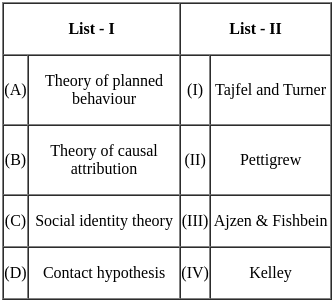
Choose the correct answer from the options given below:
(a) (A) - (II), (B) - (I), (C) - (IV), (D) - (III)
(b) (A) - (I), (B) - (II), (C) - (III), (D) - (IV)
(c) (A) - (III), (B) - (IV), (C) - (I), (D) - (II)
(d) (A) - (III), (B) - (IV), (C) - (II), (D) - (I)
Ans: c
Sol: The correct answer is '(A) - (III), (B) - (IV), (C) - (I), (D) - (II)'
Theory of planned behaviour (A) - Ajzen & Fishbein (III):
- The Theory of Planned Behaviour was developed by Icek Ajzen and Martin Fishbein.
- It is an extension of the Theory of Reasoned Action and includes perceived behavioral control as a determinant of intention.
Theory of causal attribution (B) - Kelley (IV):
- Harold Kelley is known for his work on the attribution theory, which explains how individuals pinpoint the causes of their own and others' behavior.
- Kelley proposed the covariation model, which considers consistency, distinctiveness, and consensus information.
Social identity theory (C) - Tajfel and Turner (I):
- Henri Tajfel and John Turner developed the Social Identity Theory.
- This theory explains that a person's sense of who they are is based on their group membership(s).
Contact hypothesis (D) - Pettigrew (II):
- The Contact Hypothesis was proposed by Gordon Allport and further developed by Thomas Pettigrew.
- It suggests that under appropriate conditions interpersonal contact is one of the most effective ways to reduce prejudice between majority and minority group members.
Other Related Points
Explanation of incorrect options:
- Option 1: This incorrectly matches (A) - (II), (B) - (I), (C) - (IV), (D) - (III). None of these matches are correct.
- Option 2: This incorrectly matches (A) - (I), (B) - (II), (C) - (III), (D) - (IV). None of these matches are correct.
- Option 4: This incorrectly matches (A) - (III), (B) - (IV), (C) - (II), (D) - (I). Only (A) - (III) and (B) - (IV) are correct in this option, while (C) and (D) are incorrectly matched.
Q49: Match List - I with List - II.
Match the substages of Kolhberg's Moral Development Theory:
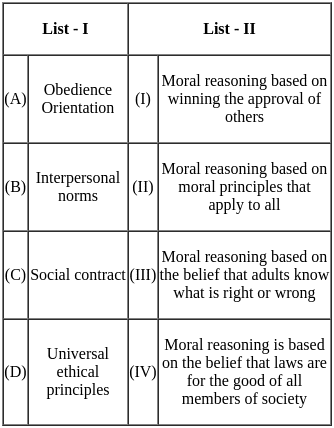
Choose the correct answer from the options given below:
(a) (A) - (III), (B) - (IV), (C) - (I), (D) - (II)
(b) (A) - (III), (B) - (I), (C) - (IV), (D) - (II)
(c) (A) - (I), (B) - (IV), (C) - (II), (D) - (III)
(d) (A) - (I), (B) - (II), (C) - (IV), (D) - (III)
Ans: b
Sol: The correct answer is '2'
Kolhberg's Moral Development Theory:
- Kohlberg's theory outlines different stages of moral development, focusing on the reasoning behind moral decisions rather than the decisions themselves.
- The stages are divided into three levels: Pre-conventional, Conventional, and Post-conventional, each containing two substages.
Explanation of correct matches:
(A) Obedience Orientation - (III):
- Moral reasoning based on the belief that adults know what is right or wrong. This belongs to the Pre-conventional level, where children obey rules to avoid punishment or gain rewards.
(B) Interpersonal norms - (I):
- Moral reasoning based on winning the approval of others. This is part of the Conventional level, where individuals behave in ways that will gain social approval.
(C) Social contract - (IV):
- Moral reasoning is based on the belief that laws are for the good of all members of society. This fits within the Post-conventional level, where individuals recognize the importance of social contracts and laws.
(D) Universal ethical principles - (II):
- Moral reasoning based on moral principles that apply to all. This is also part of the Post-conventional level, where individuals follow self-chosen ethical principles.
Other Related Points
Incorrect options overview:
- Option 1: Incorrect because (B) Interpersonal norms should match with (I) and not (IV).
- Option 3: Incorrect because (A) Obedience Orientation should match with (III) and not (I).
- Option 4: Incorrect because (C) Social contract should match with (IV) and not (II).
Q50: Match List - I with List - II.
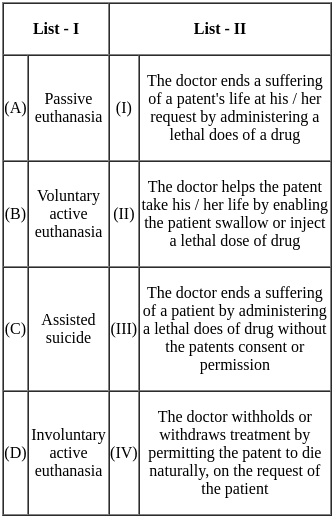
Choose the correct answer from the options given below:
(a) (A) - (IV), (B) - (I), (C) - (II), (D) - (III)
(b) (A) - (IV), (B) - (II), (C) - (III), (D) - (I)
(c) (A) - (I), (B) - (II), (C) - (III), (D) - (IV)
(d) (A) - (I), (B) - (II), (C) - (IV), (D) - (III)
Ans: a
Sol: The correct answer is '(A) - (IV), (B) - (I), (C) - (II), (D) - (III)'
Passive euthanasia:
- Passive euthanasia involves the doctor withholding or withdrawing treatment, allowing the patient to die naturally, usually at the request of the patient.
- In this case, it corresponds to (A) - (IV).
Voluntary active euthanasia:
- Voluntary active euthanasia is where the doctor ends a suffering patient's life at the patient's request by administering a lethal dose of a drug.
- This matches (B) - (I).
- Assisted suicide:
- Assisted suicide involves the doctor helping the patient take their own life by enabling them to swallow or inject a lethal dose of a drug.
- This corresponds to (C) - (II).
Involuntary active euthanasia:
- Involuntary active euthanasia occurs when the doctor ends a suffering patient's life by administering a lethal dose of a drug without the patient's consent or permission.
- This matches (D) - (III).
Other Related Points
Incorrect options:
- Option 2: (A) - (IV), (B) - (II), (C) - (III), (D) - (I) - This is incorrect because it misclassifies voluntary active euthanasia and assisted suicide.
- Option 3: (A) - (I), (B) - (II), (C) - (III), (D) - (IV) - This is incorrect because passive euthanasia and involuntary active euthanasia are misclassified.
- Option 4: (A) - (I), (B) - (II), (C) - (IV), (D) - (III) - This is incorrect because passive euthanasia and assisted suicide are misclassified.
Q51: Match List - I with List - II.
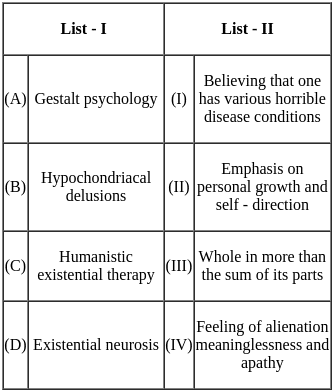
Choose the correct answer from the options given below:
(a) (A) - (III), (B) - (IV), (C) - (I), (D) - (II)
(b) (A) - (III), (B) - (I), (C) - (II), (D) - (IV)
(c) (A) - (II), (B) - (I), (C) - (IV), (D) - (III)
(d) (A) - (II), (B) - (I), (C) - (III), (D) - (IV)
Ans: b
Sol: The correct answer is '(A) - (III), (B) - (I), (C) - (II), (D) - (IV)'
Gestalt psychology (A) - (III):
- Gestalt psychology emphasizes that "the whole is more than the sum of its parts." This means that our perception is not just a simple combination of sensory elements, but rather a holistic experience.
Hypochondriacal delusions (B) - (I):
- This condition involves believing that one has various horrible disease conditions without medical evidence, leading to excessive worry and anxiety about health.
Humanistic existential therapy (C) - (II):
- This therapy places emphasis on personal growth and self-direction. It focuses on the individual's potential and stresses the importance of growth and self-actualization.
Existential neurosis (D) - (IV):
- Existential neurosis is characterized by feelings of alienation, meaninglessness, and apathy. It is a form of psychological distress related to existential issues.
Other Related Points
Option 1:
- Incorrect because it mismatches Humanistic existential therapy (C) with (I) and Existential neurosis (D) with (II). Humanistic existential therapy is about personal growth, not hypochondriacal delusions, and existential neurosis involves feelings of meaninglessness, not self-direction.
Option 3:
- Incorrect because it mismatches Gestalt psychology (A) with (II) and Humanistic existential therapy (C) with (IV). Gestalt psychology is about holistic perception, not personal growth, and Humanistic existential therapy is about personal growth, not feelings of alienation.
Option 4:
- Incorrect because it mismatches Gestalt psychology (A) with (II). Gestalt psychology is about holistic perception, not personal growth.
Q52: Csikszentmihalyi (1996) observed that the creative process normally takes five steps. Arrange those steps in order:
(A) Preparation
(B) Evaluation
(C) Incubation
(D) Elaboration
(E) Insight
Choose the correct answer from the options given below:
(a) (A), (B), (D), (E), (C)
(b) (A), (C), (B), (D), (E)
(c) (A), (C), (E), (B), (D)
(d) (A), (B), (E), (C), (D)
Ans: c
Sol: The correct answer is '(A) Preparation, (C) Incubation, (E) Insight, (B) Evaluation, (D) Elaboration'
(A) Preparation:
- This is the initial stage where the individual gathers information and resources, and develops a deep understanding of the problem or task at hand.
(C) Incubation:
- During this stage, the individual takes a break from the problem, allowing the subconscious mind to work on it.
(E) Insight:
- This stage involves the "aha" moment where a sudden understanding or solution to the problem emerges.
(B) Evaluation:
- Here, the individual assesses the validity and feasibility of the insight or solution.
(D) Elaboration:
- In this final stage, the idea or solution is developed, refined, and implemented in detail.
Other Related Points
Option 1:
- Sequence: (A) Preparation, (B) Evaluation, (D) Elaboration, (E) Insight, (C) Incubation
- Incorrect because it places Evaluation and Elaboration before Insight and Incubation.
Option 2:
- Sequence: (A) Preparation, (C) Incubation, (B) Evaluation, (D) Elaboration, (E) Insight
- Incorrect because it places Evaluation and Elaboration before Insight.
Option 4:
- Sequence: (A) Preparation, (B) Evaluation, (E) Insight, (C) Incubation, (D) Elaboration
- Incorrect because it places Evaluation before Insight and Incubation after Insight.
Q53: Arrange the following sentences in sequential order according to classical conditioning:
(A) A stimulus such as food is presented to an organism which is called unconditioned stimulus (US)
(B) The neutral stimulus light alone is provided which makes the organism to salivate
(C) A neutral stimulus such as light is presented to the organism just prior to the presentation of US
(D) Another neutral stimulus (tone) is provided prior to light
(E) The neutral stimulus (tone) above is provided which makes the organism to salivate
Choose the correct answer from the options given below:
(a) (A), (C), (D), (B), (E)
(b) (A), (B), (D), (C), (E)
(c) (A), (C), (B), (D), (E)
(d) (A), (C), (B), (E), (D)
Ans: c
Sol: The correct answer is '(A), (C), (B), (D), (E)'
Explanation of the Correct Order:
- (A) A stimulus such as food is presented to an organism which is called unconditioned stimulus (US): This is the starting point where the organism is presented with an unconditioned stimulus (food) that naturally elicits a response.
- (C) A neutral stimulus such as light is presented to the organism just prior to the presentation of US: A neutral stimulus (light) is introduced before the unconditioned stimulus (food) to start forming an association.
- (B) The neutral stimulus light alone is provided which makes the organism to salivate: After repeated pairings, the neutral stimulus (light) alone starts to elicit the response (salivation), indicating that conditioning has occurred.
- (D) Another neutral stimulus (tone) is provided prior to light: A new neutral stimulus (tone) is introduced before the already conditioned stimulus (light) to create a second level of conditioning.
- (E) The neutral stimulus (tone) above is provided which makes the organism to salivate: Finally, the new neutral stimulus (tone) alone elicits the response (salivation), showing that the second level of conditioning is successful.
Other Related Points
Explanation of Incorrect Options:
- (A), (B), (D), (C), (E): This sequence incorrectly places (B) before (C), suggesting that the neutral stimulus (light) alone elicits a response before it has been paired with the unconditioned stimulus (food).
- (A), (C), (D), (B), (E): This sequence incorrectly places (D) before (B), suggesting that another neutral stimulus (tone) is introduced before the first neutral stimulus (light) has been conditioned.
- (A), (C), (B), (E), (D): This sequence incorrectly places (E) before (D), suggesting that the new neutral stimulus (tone) elicits a response before it has been paired with the conditioned stimulus (light).
Q54: Arrange the following in correct sequence of HPA axis response to stress, and consequences:
(A) Adrenal glands get stimulated
(B) Release of corticotropin releasing factor
(C) Release of cortisol, epinephrine and nor epinephrine
(D) Release of glucose from liver and muscle
(E) Release of adrenocorticotropic hormone
Choose the correct answer from the options given below:
(a) (A), (B), (C), (E), (D)
(b) (A), (C), (B), (E), (D)
(c) (B), (E), (A), (C), (D)
(d) (E), (B), (A), (C), (D)
Ans: c
Sol: The correct answer is '(B), (E), (A), (C), (D)'
Sequence of HPA Axis Response to Stress:
- (B) Release of corticotropin releasing factor (CRF): The hypothalamus releases CRF in response to stress.
- (E) Release of adrenocorticotropic hormone (ACTH): CRF stimulates the pituitary gland to release ACTH.
- (A) Adrenal glands get stimulated: ACTH travels through the bloodstream to the adrenal glands.
- (C) Release of cortisol, epinephrine, and norepinephrine: The adrenal glands release these hormones to help the body manage stress.
- (D) Release of glucose from liver and muscle: Cortisol and other hormones stimulate the release of glucose to provide immediate energy.
Other Related Points
Incorrect Options:
- Option 1: (A), (B), (C), (E), (D) - Incorrect because it starts with adrenal gland stimulation, which is not the first step.
- Option 2: (A), (C), (B), (E), (D) - Incorrect because it incorrectly sequences the release of hormones before CRF.
- Option 4: (E), (B), (A), (C), (D) - Incorrect because ACTH release cannot precede CRF release.
Q55: Put the following milestones of psychology in ascending chronological order:
(A) Intelligence test developed by Binet and Simon in France
(B) The first psychology laboratory in Leipzig by Wundt
(C) First psychology course in United States by James
(D) American Psychological Association (APA) was founded by Stanley Hall
(E) Pavlov wins the Nobel prize for his work on digestive system
Choose the correct answer from the options given below:
(a) (A), (B), (D), (C), (E)
(b) (B), (C), (D), (E), (A)
(c) (C), (B), (D), (E), (A)
(d) (D), (B), (C), (A), (E)
Ans: c
Sol: The correct answer is (C), (B), (D), (E), (A)
Psychology, as a scientific discipline, has a rich history marked by significant milestones. These milestones have contributed to the development and evolution of psychology as we know it today. Understanding the chronological order of these milestones helps in appreciating the progression and achievements in the field.
First Psychology Course in the United States:
- William James is credited with offering the first psychology course in the United States at Harvard University in the late 19th century. This course laid the foundation for the academic study of psychology in the country.
First Psychology Laboratory:
- Wilhelm Wundt established the first psychology laboratory at the University of Leipzig in Germany in 1879. This event is often considered the formal beginning of psychology as an experimental and scientific discipline.
American Psychological Association (APA):
- The APA was founded in 1892 by G. Stanley Hall. This organization aimed to advance psychology as a science and profession, providing a platform for researchers and practitioners to collaborate and share their work.
Nobel Prize for Pavlov:
- Ivan Pavlov won the Nobel Prize in Physiology or Medicine in 1904 for his research on the digestive system, particularly his work on classical conditioning, which later had a profound impact on psychology.
Intelligence Test by Binet and Simon:
- In 1905, Alfred Binet and Théodore Simon developed the first intelligence test in France. This test aimed to identify children with learning difficulties and is considered a significant advancement in the field of educational psychology.
Other Related Points
- First psychology course in the United States by James:
- William James offered the first psychology course in the United States in the late 19th century. This event precedes the establishment of psychology laboratories and associations.
- The first psychology laboratory in Leipzig by Wundt:
- Wilhelm Wundt established the first experimental psychology laboratory in 1879, marking the formal beginning of psychology as a scientific discipline.
- American Psychological Association (APA) was founded by Stanley Hall:
- The APA was founded in 1892, providing a professional organization for psychologists in the United States.
- Pavlov wins the Nobel Prize for his work on the digestive system:
- Ivan Pavlov was awarded the Nobel Prize in 1904 for his research on the digestive system, which included his groundbreaking work on classical conditioning.
- Intelligence test developed by Binet and Simon in France:
- Alfred Binet and Théodore Simon developed the first intelligence test in 1905. This test was a significant contribution to educational psychology and the study of human intelligence.
Q56: Arrange to Astanga yoga arrange the stages in the correct sequence:
(A) Dhyana
(B) Asana
(C) Samadhi
(D) Pranayama
Choose the correct answer from the options given below:
(a) (B), (D), (A), (C)
(b) (A), (C), (D), (B)
(c) (D), (B), (C), (A)
(d) (C), (A), (B), (D)
Ans: a
Sol: The correct answer is '(B), (D), (A), (C)'
Stages of Ashtanga Yoga:
- Asana (B): This is the third stage in the Ashtanga Yoga sequence. It involves physical postures to prepare the body for meditation.
- Pranayama (D): This is the fourth stage. It involves breathing exercises to control the prana (life force) in the body.
- Dhyana (A): This is the seventh stage. It involves meditation and focus on a single point or concept.
- Samadhi (C): This is the eighth and final stage. It represents the state of meditative consciousness and ultimate union with the divine.
Other Related Points
Incorrect Options Overview:
- Option 2 (A, C, D, B): This sequence is incorrect because it starts with Dhyana, which is the seventh stage, followed by Samadhi, the final stage, and then Pranayama and Asana, which should come earlier.
- Option 3 (D, B, C, A): This sequence starts with Pranayama, which should come after Asana. It also places Samadhi before Dhyana, which is incorrect.
- Option 4 (C, A, B, D): This sequence starts with Samadhi, the final stage, and places Dhyana, Asana, and Pranayama in the wrong order.
Q57: Arrange the stages of group development as suggested by Tuckman:
(A) Storming
(B) Performing
(C) Forming
(D) Adjourning
(E) Norming
Choose the correct answer from the options given below:
(a) (C), (A), (B), (E), (D)
(b) (C), (A), (E), (B), (D)
(c) (A), (C), (E), (B), (D)
(d) (A), (C), (B), (E), (D)
Ans: b
Sol: The correct answer is '(C), (A), (E), (B), (D)'
Stages of Group Development by Tuckman:
- Forming: This is the initial stage where group members come together and start to understand the group's purpose, structure, and leadership.
- Storming: In this stage, group members start to express their individual opinions and may experience conflicts as they try to establish their positions within the group.
- Norming: Here, the group starts to establish norms and cohesive relationships, leading to more cooperative and organized behavior.
- Performing: At this stage, the group is fully functional and works towards achieving its goals effectively and efficiently.
- Adjourning: This final stage involves disbanding the group after its objectives have been achieved, and members move on to other tasks.
Other Related Points
Incorrect Options:
- Option 1: (C), (A), (B), (E), (D) - This sequence incorrectly places Performing before Norming.
- Option 3: (A), (C), (E), (B), (D) - This sequence incorrectly starts with Storming instead of Forming.
- Option 4: (A), (C), (B), (E), (D) - This sequence incorrectly places Performing before Norming and starts with Storming instead of Forming.
Q58: Development of psychoanalysis is marked by four phases namely antecedent analysis who were associated with each phase sequentially:
(A) Breur
(B) G.T. Fechner
(C) Sullivan
(D) Adler
Choose the correct answer from the options given below:
(a) (B), (A), (D), (C)
(b) (A), (B), (C), (D)
(c) (C), (B), (A), (D)
(d) (D), (C), (B), (A)
Ans: a
Sol: The correct answer is (B), (A), (D), (C)
Development of psychoanalysis:
- The development of psychoanalysis can be traced through different phases and key figures associated with each phase.
- These figures contributed to the evolution of psychoanalytic theories and practices over time.
(B) G.T. Fechner:
- G.T. Fechner is associated with the initial phase of psychoanalysis, contributing to the foundational ideas of the discipline.
- His work laid the groundwork for further developments in psychoanalytic theory.
(A) Breur:
- Breur is linked to the second phase, where he, along with Freud, developed the method of cathartic treatment.
- This phase marked significant advancements in understanding and treating psychological conditions.
(D) Adler:
- Adler represents the third phase, introducing his own theories of individual psychology.
- His contributions expanded the scope of psychoanalysis to include social factors and individual motivations.
(C) Sullivan:
- Sullivan is associated with the fourth phase, focusing on interpersonal relationships and their impact on mental health.
- He emphasized the role of social interactions in the development and treatment of psychological issues.
Other Related Points
Option 2 (A), (B), (C), (D):
- This sequence is incorrect as it does not follow the historical progression of psychoanalytic development.
- It incorrectly places Breur before Fechner and Adler before Sullivan.
Option 3 (C), (B), (A), (D):
- This sequence is incorrect as it starts with Sullivan, who is associated with a later phase of psychoanalysis.
- It disrupts the chronological order of contributions by key figures.
Option 4 (D), (C), (B), (A):
- This sequence is incorrect as it places Adler and Sullivan before Fechner and Breur.
- It does not align with the historical timeline of psychoanalytic development.
Q59: Given below are two statements: one is labelled as Assertion (A) and the other is labelled as Reason (R).
Assertion (A) : One psychometrician used Cronbach's alpha to verify reliability of a general knowledge test with answers, in True/False format.
Reason (R) : Cronbach's alpha estimates the internal consistency of a Test.
In the light of the above statements, choose the most appropriate answer from the options given below:
(a) Both (A) and (R) are correct and (R) is the correct explanation of (A)
(b) Both (A) and (R) are correct but (R) is not the correct explanation of (A)
(c) (A) is correct but (R) is not correct
(d) (A) is not correct but (R) is correct
Ans: d
Sol: The correct answer is '(A) is not correct but (R) is correct'
Reason (R) is correct:
- Cronbach's alpha is a measure used to assess the internal consistency of a test, indicating how well the items in a test measure the same construct.
Assertion (A) is not correct:
- Cronbach's alpha is not suitable for tests with dichotomous (True/False) items. For such tests, a more appropriate measure is the Kuder-Richardson Formula 20 (KR-20).
Other Related Points
Both (A) and (R) are correct and (R) is the correct explanation of (A):
- This option is incorrect because Assertion (A) is not correct. Cronbach's alpha is not appropriate for True/False tests.
Both (A) and (R) are correct but (R) is not the correct explanation of (A):
- This option is incorrect because Assertion (A) is not correct, even though Reason (R) is correct.
(A) is correct but (R) is not correct:
- This option is incorrect because Reason (R) is correct; Cronbach's alpha does measure internal consistency.
Q60: Given below are two statements: one is labelled as Assertion (A) and the other is labelled as Reason (R).
Assertion (A) : Tabooed words are difficult to recognise.
Reason (R) : Perception of the tabooed words is dependent or knowledge about sociocultural factors.
In the light of the above statements, choose the most appropriate answer from the options given below:
(a) Both (A) and (R) are correct and (R) is the correct explanation of (A)
(b) Both (A) and (R) are correct but (R) is not the correct explanation of (A)
(c) (A) is correct but (R) is not correct
(d) (A) is not correct but (R) is correct
Ans: b
Sol: The correct answer is 'Both (A) and (R) are correct but (R) is not the correct explanation of (A)'
Assertion (A):
- States that tabooed words are difficult to recognize.
- This is generally correct as tabooed words often evoke strong emotional reactions, making them more difficult to process cognitively.
Reason (R):
- States that the perception of tabooed words is dependent on knowledge about sociocultural factors.
- This is also correct because understanding what makes a word taboo often requires cultural and societal context.
Explanation:
- While both (A) and (R) are correct, (R) does not directly explain why tabooed words are difficult to recognize.
- The difficulty in recognizing tabooed words is more related to their emotional and cognitive impact rather than just sociocultural knowledge.
Other Related Points
Option 1:
- This option is incorrect because (R) is not the correct explanation for (A).
Option 3:
- This option is incorrect because (R) is correct.
Option 4:
- This option is incorrect because (A) is correct.
Q61: Given below are two statements: one is labelled as Assertion (A) and the other is labelled as Reason (R).
Assertion (A) : Sexual drive is one of the physiological need.
Reason (R) : Human beings cannot live without gratifying sexual drive.
In the light of the above statements, choose the most appropriate answer from the options given below:
(a) Both (A) and (R) are correct and (R) is the correct explanation of (A)
(b) Both (A) and (R) are correct but (R) is not the correct explanation of (A)
(c) (A) is correct but (R) is not correct
(d) (A) is not correct but (R) is correct
Ans: c
Sol: The correct answer is (A) is correct but (R) is not correct
Assertion (A) is correct:
- Sexual drive is considered one of the physiological needs according to various psychological theories, such as Maslow's hierarchy of needs.
- It is categorized under basic physiological needs which also include food, water, and sleep.
Reason (R) is not correct:
- While sexual drive is a significant physiological need, human beings can live without gratifying it. Unlike food and water, which are essential for survival, the lack of sexual gratification does not result in death.
- There are many individuals who choose celibacy or abstain from sexual activities for various reasons, and they continue to live healthy lives.
Other Related Points
Both (A) and (R) are correct and (R) is the correct explanation of (A):
- This option is incorrect because (R) does not correctly explain (A). While both statements are about sexual drive, (R) makes an exaggerated claim about its necessity for human survival.
Both (A) and (R) are correct but (R) is not the correct explanation of (A):
- This option is incorrect because (R) is not correct. Although (A) is correct, (R) makes an incorrect claim about the necessity of gratifying sexual drive for survival.
(A) is not correct but (R) is correct:
- This option is incorrect because (A) is indeed correct. Sexual drive is a recognized physiological need.
- (R) is not correct as it incorrectly states the necessity of sexual gratification for survival.
Q62: Read the following passage and answer the questions asked at the end of it:
A twelve-year-old boy named Jeevan is taken to a psychologist because he hates school. When the teacher was contacted he informed that Jeevan's pretentious behaviour in the class, which also caused disruption in the class, was not liked by him. Apparently at home his parents found his behaviour amusing, they used to laugh at it and enjoy it. The psychologist designed a programme to bring about a change in Jeevan's behaviour. First he helped the parents to understand what is pretentious and what is not. The psychologist told Jeevan's parents not to pay attention to his pretentious behaviour. The teacher was told to praise him whenever someone in the class helps his classmates in any way. The psychologist also said that every time Jeevan behaves pretentiously the teacher should produce the sound of a bore well being dug. In fact the psychologist used therapeutic intervention.
Teaching the parents to understand which is show off behaviours and which is not, is helping them with:
(a) Discrimination
(b) Deactivation
(c) Generalization
(d) Discretion
Ans: a
Sol: The correct answer is 'Discrimination'
Discrimination:
- Discrimination, in the context of behavioral psychology, refers to the ability to distinguish between different stimuli.
- Teaching parents to understand which behaviors are show-off behaviors and which are not helps them discriminate between different types of behaviors.
- This skill is crucial for effectively managing and responding to their child's behavior.
Other Related Points
Deactivation:
- Deactivation is not a relevant term in the context of understanding and distinguishing between different behaviors.
- It generally refers to the process of making something inactive or turning off a function, which does not apply to behavioral analysis.
Generalization:
- Generalization refers to the tendency to respond in the same way to different but similar stimuli.
- In this context, generalization would mean treating all behaviors as the same, which is the opposite of what is needed to distinguish between show-off behaviors and other types of behaviors.
Discretion:
- Discretion refers to the ability to make decisions based on one's own judgment.
- While discretion is important in parenting, it is not specifically about distinguishing between different types of behaviors.
Q63: Read the following passage and answer the questions asked at the end of it:
A twelve-year-old boy named Jeevan is taken to a psychologist because he hates school. When the teacher was contacted he informed that Jeevan's pretentious behaviour in the class, which also caused disruption in the class, was not liked by him. Apparently at home his parents found his behaviour amusing, they used to laugh at it and enjoy it. The psychologist designed a programme to bring about a change in Jeevan's behaviour. First he helped the parents to understand what is pretentious and what is not. The psychologist told Jeevan's parents not to pay attention to his pretentious behaviour. The teacher was told to praise him whenever someone in the class helps his classmates in any way. The psychologist also said that every time Jeevan behaves pretentiously the teacher should produce the sound of a bore well being dug. In fact the psychologist used therapeutic intervention.
By instructing the parents not to pay attention to Jeevan's show off behaviour at home the psychologist aimed at:
(a) Punishment
(b) Stimulus discrimination
(c) Extinction
(d) Stimulus generalization
Ans: c
Sol: The aim of instructing the parents not to pay attention to Jeevan's show-off behaviour at home is 'extinction'
Extinction:
- Extinction in psychology refers to the gradual weakening and eventual disappearance of a conditioned response.
- This occurs when the conditioned response is no longer reinforced. In this case, Jeevan's show-off behaviour is expected to diminish because it is not receiving the usual attention or reinforcement from his parents.
Other Related Points
Punishment:
- Punishment involves adding or removing a stimulus to decrease the likelihood of a behavior. Here, no stimulus is added or removed; rather, the behavior is being ignored.
Stimulus Discrimination:
- Stimulus discrimination occurs when an individual learns to respond only to the original stimulus and not to other similar stimuli. This does not apply as the aim is to reduce the behavior altogether, not to differentiate between stimuli.
Stimulus Generalization:
- Stimulus generalization happens when a conditioned response starts occurring in response to similar stimuli, not just the conditioned stimulus. This is not relevant as the goal is to eliminate the behavior, not generalize it.
Q64: Read the following passage and answer the questions asked at the end of it:
A twelve-year-old boy named Jeevan is taken to a psychologist because he hates school. When the teacher was contacted he informed that Jeevan's pretentious behaviour in the class, which also caused disruption in the class, was not liked by him. Apparently at home his parents found his behaviour amusing, they used to laugh at it and enjoy it. The psychologist designed a programme to bring about a change in Jeevan's behaviour. First he helped the parents to understand what is pretentious and what is not. The psychologist told Jeevan's parents not to pay attention to his pretentious behaviour. The teacher was told to praise him whenever someone in the class helps his classmates in any way. The psychologist also said that every time Jeevan behaves pretentiously the teacher should produce the sound of a bore well being dug. In fact the psychologist used therapeutic intervention.
By instructing the teacher to praise those children whenever anyone helped their classmates the psychologist applied the factor of:
(a) Positive reinforcement for Jeevan
(b) Modelling for Jeevan
(c) Reinforcement substitution for Jeevan
(d) Classical conditionial for Jeevan
Ans: b
Sol: The correct answer is 'Modelling for Jeevan'
Modelling for Jeevan:
- Modelling involves learning by observing and imitating others. In this scenario, the children observe and imitate positive behavior, which in turn reinforces similar behavior in Jeevan.
- The teacher's praise acts as a reinforcement for the behavior being modelled, thereby encouraging Jeevan to adopt the same behavior.
Other Related Points
Positive reinforcement for Jeevan:
- Positive reinforcement involves giving a reward to increase the likelihood of a behavior being repeated. While praise is a form of positive reinforcement, the key factor here is modelling, not direct reinforcement for Jeevan.
Reinforcement substitution for Jeevan:
- Reinforcement substitution refers to replacing one form of reinforcement with another. This is not applicable in this scenario.
Classical conditioning for Jeevan:
- Classical conditioning involves associating an involuntary response with a stimulus. This is not relevant to the scenario where behavior is being modelled and reinforced through observation and praise.
Q65: Read the following passage and answer the questions asked at the end of it:
A twelve-year-old boy named Jeevan is taken to a psychologist because he hates school. When the teacher was contacted he informed that Jeevan's pretentious behaviour in the class, which also caused disruption in the class, was not liked by him. Apparently at home his parents found his behaviour amusing, they used to laugh at it and enjoy it. The psychologist designed a programme to bring about a change in Jeevan's behaviour. First he helped the parents to understand what is pretentious and what is not. The psychologist told Jeevan's parents not to pay attention to his pretentious behaviour. The teacher was told to praise him whenever someone in the class helps his classmates in any way. The psychologist also said that every time Jeevan behaves pretentiously the teacher should produce the sound of a bore well being dug. In fact the psychologist used therapeutic intervention.
By instructing the teacher to play the loud noise of bore - well digging the psychologist intraduced :
(a) Aversion Therapy
(b) Inplosive Therapy
(c) Response Shaping
(d) Rogerian Therapy
Ans: a
Sol: The correct answer is 'Aversion Therapy'
Aversion Therapy:
- Aversion therapy is a type of behavioral therapy that involves pairing an unwanted behavior with discomfort.
- In this case, the loud noise of bore-well digging is used to create an unpleasant experience, discouraging the behavior that needs to be changed.
- This method is often used to treat various addictions and habits by associating them with negative stimuli.
Other Related Points
Implosive Therapy:
- Implosive therapy, also known as flooding, involves exposing the patient to their fears in a controlled environment.
- It aims to help the patient face their fears directly and realize that their anxiety will decrease over time.
- This method is not used for creating aversions but for reducing phobias and anxieties.
Response Shaping:
- Response shaping involves reinforcing successive approximations of a desired behavior until the final behavior is achieved.
- This technique is commonly used in behavior modification and training.
- It is not related to creating aversions or discomfort.
Rogerian Therapy:
- Rogerian therapy, also known as person-centered therapy, was developed by Carl Rogers.
- It focuses on providing a supportive environment where clients can explore their feelings and thoughts without judgment.
- This approach is centered on empathy and unconditional positive regard, not on creating aversions.
Q66: Read the following passage and answer the questions asked at the end of it:
A twelve-year-old boy named Jeevan is taken to a psychologist because he hates school. When the teacher was contacted he informed that Jeevan's pretentious behaviour in the class, which also caused disruption in the class, was not liked by him. Apparently at home his parents found his behaviour amusing, they used to laugh at it and enjoy it. The psychologist designed a programme to bring about a change in Jeevan's behaviour. First he helped the parents to understand what is pretentious and what is not. The psychologist told Jeevan's parents not to pay attention to his pretentious behaviour. The teacher was told to praise him whenever someone in the class helps his classmates in any way. The psychologist also said that every time Jeevan behaves pretentiously the teacher should produce the sound of a bore well being dug. In fact the psychologist used therapeutic intervention.
The approach of the psychologist in handling the problem of Jeevan can be summarised as:
(a) Gestalt Therapy
(b) Reality Therapy
(c) Behaviour Therapy
(d) Client-centered Therapy
Ans: c
Sol: The approach of the psychologist in handling the problem of Jeevan can be summarised as Behaviour Therapy
Behaviour Therapy:
- Focuses on changing maladaptive behaviors through techniques like conditioning, reinforcement, and desensitization.
- Often used for treating phobias, anxiety disorders, and other behavioral issues by modifying negative behaviors and reinforcing positive ones.
Other Related Points
Gestalt Therapy:
- Emphasizes personal responsibility and focuses on the individual's experience in the present moment.
- It is less about behavior modification and more about self-awareness and self-acceptance.
Reality Therapy:
- Focuses on present issues and encourages individuals to take responsibility for their actions.
- It is about making better choices to achieve specific goals, rather than changing behavior through conditioning.
Client-centered Therapy:
- Developed by Carl Rogers, it emphasizes a non-directive, empathetic approach that empowers and motivates the client in the therapeutic process.
- Focuses on creating a supportive environment rather than directly altering behavior.
Q67: Read the following passage carefully and answer the questions related to it:
A researcher studies the variables that determine post-traumatic growth (PTG) in husbands of breast cancer survivors. In the available literature, various factors such as emotional support, quality of marital relationship, association with persons with PTG, etc. were identified as important determinants of PTG in women. No information was available on PTG of the husbands of the patients. The researcher also investigated the factors influencing the husband's PTG.
What is the design used by the researcher?
(a) Correctional design
(b) Quasi experimental design
(c) ABBA design
(d) Single group pre and post test design
Ans: b
Sol: The design used by the researcher is 'Quasi experimental design'
Quasi experimental design:
- This type of design is used when the researcher does not have full control over the experimental variables.
- Participants are not randomly assigned to conditions, but the researcher can still manipulate an independent variable and measure a dependent variable.
- Useful in real-world settings where random assignment is not feasible.
Other Related Points
Correctional design:
- Focuses on identifying relationships between variables without establishing a cause-and-effect relationship.
- Used to observe naturally occurring variables and the strength and direction of their relationships.
ABBA design:
- A type of counterbalanced design used to control for order effects in experiments.
- Participants are exposed to conditions in a specific sequence to balance out potential order-related biases.
Single group pre and post test design:
- Involves measuring a single group of participants before and after an intervention or treatment.
- Does not include a control group, which limits the ability to make causal inferences.
Q68: Read the following passage carefully and answer the questions related to it:
A researcher studies the variables that determine post-traumatic growth (PTG) in husbands of breast cancer survivors. In the available literature, various factors such as emotional support, quality of marital relationship, association with persons with PTG, etc. were identified as important determinants of PTG in women. No information was available on PTG of the husbands of the patients. The researcher also investigated the factors influencing the husband's PTG.
What type of statistical analysis should be used by the researcher address his objective?
(a) One way ANOVA
(b) 't' test
(c) Regression Analysis
(d) Chi - Square
Ans: c
Sol: The correct answer is Regression Analysis
Regression Analysis:
- Used to understand the relationship between a dependent variable and one or more independent variables.
- Helps in predicting the value of the dependent variable based on the values of independent variables.
- Commonly used in research to identify trends, make forecasts, and infer causal relationships.
Other Related Points
One way ANOVA:
- Used to compare means among three or more groups to see if at least one group is significantly different from the others.
- Not suitable for analyzing relationships between dependent and independent variables.
- 't' test:
- Used to compare the means of two groups to determine if they are significantly different from each other.
- Limited to comparing two groups and does not analyze relationships between variables.
- Chi-Square:
- Used to examine the association between categorical variables.
- Not suitable for analyzing continuous variables or predicting outcomes.
Q69: Read the following passage carefully and answer the questions related to it:
A researcher studies the variables that determine post-traumatic growth (PTG) in husbands of breast cancer survivors. In the available literature, various factors such as emotional support, quality of marital relationship, association with persons with PTG, etc. were identified as important determinants of PTG in women. No information was available on PTG of the husbands of the patients. The researcher also investigated the factors influencing the husband's PTG.
What is the criterion variable in this study?
(a) Gender
(b) Social context factor
(c) Post-traumatic growth
(d) Quality of marital relationship
Ans: c
Sol: The criterion variable in this study is 'Post-traumatic growth'
Post-traumatic growth:
- Post-traumatic growth (PTG) refers to the positive psychological change experienced as a result of the struggle with highly challenging life circumstances.
- In the context of this study, PTG is the main outcome or criterion variable being measured to understand the impact of different factors.
- It is the dependent variable that researchers are looking to explain or predict based on other variables such as gender, social context factors, and quality of marital relationship.
Other Related Points
Gender:
- Gender is generally considered an independent variable in psychological studies, often used to examine differences in outcomes between males and females.
- In this study, it is one of the variables that might influence the criterion variable, but it is not the criterion variable itself.
Social context factor:
- Social context factors include elements such as social support, community environment, and cultural influences.
- These are also independent variables that could impact the criterion variable, PTG, by providing a supportive or challenging environment.
Quality of marital relationship:
- This variable assesses the overall health and satisfaction within a marital relationship.
- Like gender and social context factors, it is an independent variable that might influence the level of post-traumatic growth experienced by individuals.
Q70: Read the following passage carefully and answer the questions related to it:
A researcher studies the variables that determine post-traumatic growth (PTG) in husbands of breast cancer survivors. In the available literature, various factors such as emotional support, quality of marital relationship, association with persons with PTG, etc. were identified as important determinants of PTG in women. No information was available on PTG of the husbands of the patients. The researcher also investigated the factors influencing the husband's PTG.
There are different domains of PGT. Which one of the following does not come under them?
(a) Personal strength
(b) Spiritual change
(c) Relationship with others
(d) Creativity
Ans: d
Sol: The correct answer is 'Creativity'
Personal strength:
- This domain focuses on an individual's ability to cope with stress and adversity, enhancing their resilience and overall mental well-being.
Spiritual change:
- This domain deals with changes in one's spiritual or existential views, often leading to a more meaningful and purposeful life.
Relationship with others:
- This domain emphasizes the improvement of relationships with family, friends, and the community, fostering better social connections and support systems.
Creativity:
- This domain is not typically associated with Post-traumatic Growth (PTG). PTG primarily focuses on psychological and social aspects rather than creative abilities.
Other Related Points
Creativity:
- While creativity can be a beneficial trait and may improve as a result of overcoming adversity, it is not one of the core domains identified in PTG research.
Q71: Read the following passage carefully and answer the questions related to it:
A researcher studies the variables that determine post-traumatic growth (PTG) in husbands of breast cancer survivors. In the available literature, various factors such as emotional support, quality of marital relationship, association with persons with PTG, etc. were identified as important determinants of PTG in women. No information was available on PTG of the husbands of the patients. The researcher also investigated the factors influencing the husband's PTG.
Which of the following will be the correct hypothesis for the study?
(a) The emotional support, quality of marital relationship and exposure to individual modeling of PTG will all contribute husband's experience of PTG
(b) PTG of the husbands will be different from that of wives
(c) The social context factors of husbands and the social context factors of wives will correlate
(d) The emotional support, quality of marital relationship and exposure to individuals modelling PTG will correlate
Ans: a
Sol: The correct answer is 'The emotional support, quality of marital relationship and exposure to individual modeling of PTG will all contribute husband's experience of PTG'
The emotional support, quality of marital relationship and exposure to individual modeling of PTG will all contribute husband's experience of PTG:
- This hypothesis suggests that multiple factors-emotional support, quality of marital relationship, and exposure to individuals modeling Post-Traumatic Growth (PTG)-collectively influence the husband's experience of PTG.
- It is a comprehensive approach that considers various social and relational influences on PTG.
Other Related Points
PTG of the husbands will be different from that of wives:
- This hypothesis focuses on gender differences in PTG but does not address the specific factors contributing to PTG in husbands.
- It is more comparative rather than explanatory in nature.
The social context factors of husbands and the social context factors of wives will correlate:
- This hypothesis suggests a correlation between the social context factors of husbands and wives but does not specifically target the factors contributing to PTG in husbands.
- It is more about the relationship between social context factors rather than their impact on PTG.
The emotional support, quality of marital relationship and exposure to individuals modelling PTG will correlate:
- This hypothesis suggests a correlation among the factors themselves but does not directly link these factors to the husband's experience of PTG.
- It lacks the direct connection to the outcome (husband's PTG) that is present in the correct hypothesis.
Q72: One psychologist developed a questionnaire on employee 'Green behaviour', what would be the correct sequence in the context of this tool development:
(A) Identifying the discrimination index of the items
(B) Calculation of Cronbach's alpha
(C) Developing a standard score norm
(D) Confirmatory factor analysis
(E) Exploratory factor analysis
Choose the correct answer from the options given below:
(a) (C), (A), (B), (D), (E)
(b) (C), (B), (A), (D), (E)
(c) (A), (E), (B), (C), (D)
(d) (A), (B), (E), (D), (C)
Ans: d
Sol: The correct answer is '(A), (B), (E), (D), (C)'
Identifying the discrimination index of the items (A):
- This step involves determining how well each item on the questionnaire differentiates between respondents who have high and low levels of the characteristic being measured.
- This is typically the first step to ensure that each item on the questionnaire is effective before moving on to further analysis.
Calculation of Cronbach's alpha (B):
- After identifying the discrimination index, the reliability of the questionnaire is assessed using Cronbach's alpha, which measures internal consistency.
- This step ensures that the items on the questionnaire are consistently measuring the same construct.
Exploratory Factor Analysis (EFA) (E):
- Once reliability is confirmed, EFA is conducted to identify the underlying structure of the questionnaire.
- This step helps in understanding the dimensions or factors that the items group into.
Confirmatory Factor Analysis (CFA) (D):
- After identifying the structure through EFA, CFA is performed to confirm the factor structure.
- This step validates the hypothesized structure and ensures that the model fits the data well.
Developing a standard score norm (C):
- The final step is to develop norms or standard scores based on the questionnaire results.
- This allows for the interpretation of individual scores in the context of a larger population.
Other Related Points
Option (C), (A), (B), (D), (E):
- This sequence incorrectly places the development of standard score norms at the beginning, which should be the final step after confirming the questionnaire's structure and reliability.
Option (C), (B), (A), (D), (E):
- Similarly, this sequence starts with norm development and fails to follow the logical order of psychometric analysis.
Option (A), (E), (B), (C), (D):
- This sequence places EFA before reliability analysis, which is not ideal as reliability should be confirmed before exploring factor structures.
Q73: In one Exploratory sequential design what would be the correct sequence?
(A) Quantitative Data Collection
(B) Qualitative Data Collection
(C) Quantitative Data analysis
(D) Qualitative Data Analysis
(E) Interpretation
Choose the correct answer from the options given below:
(a) (A), (B), (C), (D), (E)
(b) (B), (A), (D), (C), (E)
(c) (A), (C), (B), (D), (E)
(d) (B), (D), (A), (C), (E)
Ans: d
Sol: The correct answer is '(B), (D), (A), (C), (E)'
Exploratory Sequential Design Sequence:
In an exploratory sequential design, the correct sequence is:
- (B) Qualitative Data Collection
- (D) Qualitative Data Analysis
- (A) Quantitative Data Collection
- (C) Quantitative Data Analysis
- (E) Interpretation
This sequence allows researchers to explore a phenomenon qualitatively first, then test and generalize findings quantitatively.
Other Related Points
Option 1:
- This sequence starts with quantitative data collection and analysis before qualitative, which is not exploratory.
Option 2:
- This sequence has the correct starting point with qualitative data collection but incorrectly places qualitative analysis after quantitative steps.
Option 3:
- This sequence starts with quantitative steps, which is not in line with exploratory design principles.
Q74: The program evaluation model of a community health program has 4 steps arranged the following in sequences:
(A) Outcome evaluation
(B) Identifying goals and desired outcomes
(C) Process evaluation
(D) Impact evaluation
Choose the correct answer from the options given below:
(a) (B), (C), (A), (D)
(b) (B), (C), (D), (A)
(c) (C), (B), (D), (A)
(d) (C), (D), (B), (A)
Ans: a
Sol: The correct answer is '(B), (C), (A), (D)'
(B) Identifying goals and desired outcomes:
- This is the first step in the program evaluation model. It involves setting clear objectives and outcomes that the program aims to achieve.
- Establishing goals provides a framework for the entire evaluation process, ensuring that every subsequent step aligns with these targets.
(C) Process evaluation:
- This step assesses the implementation of the program, ensuring that activities are being conducted as planned.
- It helps in identifying any issues in the delivery of the program and provides insights for making necessary adjustments.
(A) Outcome evaluation:
- This step measures the immediate effects of the program, determining whether the short-term goals are being met.
- Outcome evaluation focuses on the direct results of the program activities and their alignment with the initial objectives.
(D) Impact evaluation:
- This is the final step and it examines the long-term effects and overall impact of the program on the community.
- Impact evaluation assesses the broader changes and benefits resulting from the program, indicating its effectiveness and sustainability.
Other Related Points
Option 2 (B), (C), (D), (A):
- This sequence incorrectly places impact evaluation before outcome evaluation, which disrupts the logical flow of assessing immediate outcomes before long-term impacts.
Option 3 (C), (B), (D), (A):
- This option incorrectly starts with process evaluation, which should follow the identification of goals and desired outcomes.
- It also places impact evaluation before outcome evaluation, which is not the correct order.
Option 4 (C), (D), (B), (A):
- This sequence starts with process evaluation, which is incorrect as it should follow the identification of goals.
- Additionally, it places impact evaluation before both the identification of goals and outcome evaluation, which is not logical.
Q75: Given below are two statements: one is labelled as Assertion (A) and the other is labelled as Reason (R).
Assertion (A) : Allostasis is a process of adaptation to acute stress by releasing stress hormones in the event of challenge with a goal to restore the homeostasis.
Reason (R) : HPA axis gets activated in the event of stress.
In the light of the above statements, choose the most appropriate answer from the options given below:
(a) Both (A) and (R) are correct and (R) is the correct explanation of (A)
(b) Both (A) and (R) are correct but (R) is not the correct explanation of (A)
(c) (A) is correct but (R) is not correct
(d) (A) is not correct but (R) is correct
Ans: a
Sol: The correct answer is 'Both (A) and (R) are correct and (R) is the correct explanation of (A)'
Allostasis and HPA Axis:
- Allostasis is the process of achieving stability through physiological or behavioral change, particularly in response to stress.
- The Hypothalamic-Pituitary-Adrenal (HPA) axis is a central stress response system that releases stress hormones like cortisol when activated.
- Both (A) and (R) are correct because allostasis involves the activation of the HPA axis to release stress hormones, which helps in restoring homeostasis.
Other Related Points
Explanation of Incorrect Options:
- Option 2: Although both (A) and (R) are correct, this option is incorrect because (R) does indeed explain (A).
- Option 3: This option is incorrect because (R) is correct; the HPA axis does get activated in response to stress.
- Option 4: This option is incorrect because (A) is correct; allostasis is a process of adaptation to acute stress.
Q76: Given below are two statements: one is labelled as Assertion (A) and the other is labelled as Reason (R).
Assertion (A) : The researcher manipulating one or more variables is called an experiment.
Reason (R) : A research design is one in which a variable is manipulated with a goal of identifying the causes of events is called experimental design
In the light of the above statements, choose the most appropriate answer from the options given below:
(a) Both (A) and (R) are correct and (R) is the correct explanation of (A)
(b) Both (A) and (R) are correct but (R) is not the correct explanation of (A)
(c) (A) is correct but (R) is not correct
(d) (A) is not correct but (R) is correct
Ans: a
Sol: The correct answer is Both (A) and (R) are correct but (R) is the correct explanation of (A)
Assertion (A):
- The statement that "The researcher manipulating one or more variables is called an experiment" is correct.
- In an experiment, researchers actively manipulate variables to observe the effect on other variables.
Reason (R):
- The statement "A research design is one in which a variable is manipulated with a goal of identifying the causes of events is called experimental design" is also correct.
- An experimental design involves manipulating variables to establish cause-and-effect relationships.
Other Related Points
Explanation of Option 1:
- This option is incorrect because although both (A) and (R) are correct, (R) does not directly explain (A).
- (R) defines experimental design but does not specifically explain the concept of an experiment as stated in (A).
Explanation of Option 3:
- This option is incorrect because (R) is a correct statement about experimental design.
Explanation of Option 4:
- This option is incorrect because (A) is correct in defining what an experiment is.
Q77: To calculate the correlation between a genuinely dichotomus variable and a continuous variable we have to use _________.
(a) Bi - serial 'r'
(b) Point Biserial 'r'
(c) Tetrachoric 'r'
(d) Phi coefficient
Ans: b
Sol: The correct answer is 'Point Biserial 'r''
Point Biserial 'r':
- This is a statistical measure used to calculate the correlation between a genuinely dichotomous variable (e.g., gender: male/female) and a continuous variable (e.g., test scores).
- It is specifically designed for scenarios where one variable is binary, and the other is continuous.
Other Related Points
Bi-serial 'r':
- This is used to measure the correlation between an artificially dichotomized variable and a continuous variable.
- An artificially dichotomized variable is one that was originally continuous but has been split into two categories.
Tetrachoric 'r':
- This is used for estimating the correlation between two dichotomous variables that are both assumed to have an underlying continuous distribution.
- It is not suitable when one variable is genuinely dichotomous and the other is continuous.
Phi coefficient:
- This measures the association between two binary variables.
- It is not appropriate for scenarios involving one binary and one continuous variable.
Q78: Attitude which is conscious and easy to report is called ________.
(a) Implicit attitude
(b) Explicit attitude
(c) Unconscious attitude
(d) Intrinsic attitude
Ans: b
Sol: The correct answer is 'Explicit attitude'
Explicit attitude:
- An explicit attitude is a conscious and deliberate evaluation of something or someone.
- It is easy to report because individuals are aware of these attitudes and can express them openly.
- These attitudes are usually formed through direct experiences and can be influenced by social norms and expectations.
Other Related Points
Implicit attitude:
- Implicit attitudes are unconscious evaluations that individuals are not directly aware of.
- These attitudes influence feelings and behavior without conscious awareness.
- Implicit attitudes are often measured through indirect methods, like the Implicit Association Test (IAT).
Unconscious attitude:
- Unconscious attitudes are similar to implicit attitudes in that they operate below the level of conscious awareness.
- These attitudes can affect perceptions and behaviors without the individual realizing it.
Intrinsic attitude:
- Intrinsic attitudes are internally motivated and are not necessarily conscious.
- They are based on personal values and beliefs, and are often self-sustained without external rewards.
Q79: A theory which advocates prejudice stems, at least in part, from economic competition between social groups is _________.
(a) Contact hypothesis
(b) Social identify theory
(c) Realistic conflict theory
(d) Repulsion hypothesis
Ans: c
Sol: The correct answer is 'Realistic conflict theory'
Realistic conflict theory:
- This theory suggests that prejudice arises from competition over scarce resources, such as jobs or housing.
- It posits that conflict between groups is a result of competing interests, leading to hostility and discrimination.
- Developed by Muzafer Sherif, it is supported by various studies, including the famous Robbers Cave experiment.
Other Related Points
Contact hypothesis:
- This theory suggests that under certain conditions, direct contact between hostile groups will reduce prejudice.
- It emphasizes the importance of cooperative activities and equal status in reducing intergroup hostility.
- While it addresses prejudice, it does not focus on economic competition as a cause.
Social identity theory:
- Developed by Henri Tajfel and John Turner, this theory posits that individuals derive part of their identity from the groups to which they belong.
- It explains prejudice as a result of the need for positive self-esteem and group distinctiveness.
- It does not specifically address economic competition as a source of prejudice.
Repulsion hypothesis:
- This hypothesis suggests that people are repelled by, and thus avoid, those who are different from themselves.
- It focuses on the psychological distance and discomfort felt towards out-group members.
- It does not consider economic competition as a factor in prejudice.
Q80: If members in a group are performing additive tasks, then ________.
(a) Social loafing will be less
(b) Social loafing will be more
(c) Social loafing will not exist
(d) Level of social loafing cannot be decided
Ans: b
Sol: The correct answer is Social Loafing will be more.
Social loafing in additive tasks:
- Social loafing refers to the phenomenon where individuals exert less effort when working in a group compared to when working alone.
- In additive tasks, the contributions of each member are summed to produce the final group output.
- Because individual efforts are less visible in additive tasks, members may feel less accountable and thus may reduce their effort, leading to more social loafing.
Other Related Points
Social loafing will be less:
- This option is incorrect because additive tasks often lead to less visibility of individual efforts, which generally increases social loafing, not decreases it.
Social loafing will not exist:
- This option is incorrect because social loafing is a well-documented phenomenon in group settings, particularly in additive tasks.
Level of social loafing cannot be decided:
- This option is incorrect because research has shown that social loafing is more likely to occur in additive tasks, making it possible to predict an increase in social loafing.
Q81: The psychological state characterized by reduced self awareness brought on by external conditions is known as _________.
(a) Exhaustion
(b) Entitativity
(c) Deindividuation
(d) Discrimination
Ans: c
Sol: The correct answer is 'Deindividuation'
Deindividuation:
- Deindividuation refers to a psychological state where an individual loses self-awareness and personal responsibility due to being in a group or under specific external conditions.
- It often leads to a decrease in inhibitions and an increase in impulsive behavior, as the individual feels less accountable for their actions.
- This phenomenon is commonly observed in situations like riots, crowds, and online anonymity.
Other Related Points
Exhaustion:
- Exhaustion refers to extreme physical or mental fatigue.
- While it can affect psychological states, it is not specifically characterized by reduced self-awareness.
Entitativity:
- Entitativity is the perception of a group as a single entity.
- It does not relate to an individual's psychological state or self-awareness.
Discrimination:
- Discrimination involves unjust treatment of different categories of people.
- It is a social behavior rather than a psychological state characterized by reduced self-awareness.
Q82: Although she likes to wear gold ear-ring very much, Tanmaya removed the same when she joined a school where gold ornaments are not allowed.
This social influence is example of _______.
(a) Compliance
(b) Conformity
(c) Symbol influence
(d) Pluralistic ignorance
Ans: b
Sol: The correct answer is 'Conformity'
Conformity:
- Conformity refers to the act of matching attitudes, beliefs, and behaviors to group norms or expectations.
- In this context, Tanmaya removed her gold earrings to adhere to the school's rule against wearing gold ornaments, demonstrating conformity to the school's norms.
Other Related Points
Compliance:
- Compliance involves changing one's behavior due to the request or direction of another person, often an authority figure.
- While similar to conformity, compliance does not necessarily involve changing personal beliefs or attitudes.
Symbol Influence:
- Symbol influence refers to the impact that symbols (e.g., logos, flags) have on individuals' attitudes and behaviors.
- This concept does not directly apply to the scenario of Tanmaya adhering to school rules.
Pluralistic Ignorance:
- Pluralistic ignorance occurs when members of a group mistakenly believe that their own thoughts, feelings, or behaviors are different from those of the group.
- This concept does not fit the scenario as it involves a misunderstanding of group norms rather than adherence to them.
Q83: The two specific objectives of Watson's Behaviourism are 'NOT':
(a) to predict the response by knowing the stimulus and to predict the stimulus by knowing the response
(b) to predict the behaviour of the leamer and to modify the behaviour
(c) to control the behaviour of the learner and vary the experimental condition to bring about the change
(d) to study the learner in a controlled laboratory environment and to examine the effect of reinforcement
Ans: d
Sol: The correct answer is 'to study the learner in a controlled laboratory environment and to examine the effect of reinforcement'
Watson's Behaviourism Objectives:
- Watson's Behaviourism primarily aims to predict the response by knowing the stimulus and to predict the stimulus by knowing the response.
- It also focuses on predicting the behaviour of the learner and modifying the behaviour accordingly.
- Another key objective is to control the behaviour of the learner and vary the experimental conditions to bring about the change.
Other Related Points
Option Analysis:
- Predicting the response by knowing the stimulus and predicting the stimulus by knowing the response: This is a core principle of Behaviourism, focusing on the relationship between stimuli and responses.
- Predicting and modifying the behaviour of the learner: Behaviourism is deeply involved in the prediction and modification of behaviour through conditioning techniques.
- Controlling the behaviour of the learner and varying experimental conditions: This aligns with Behaviourism's objective of understanding and controlling behaviour through experimental manipulation.
- Studying the learner in a controlled laboratory environment and examining the effect of reinforcement: While studying behaviour in a controlled environment is a method used, it is not a specific objective of Watson's Behaviourism. The focus is more on prediction, control, and modification of behaviour rather than the study environment itself.
Q84: The ability of brain to adopt to the environment and to replace function following damage is known as:
(a) Neuroplasticity
(b) Accommodation
(c) Assimilation
(d) Hemespherical coordination
Ans: a
Sol: The correct answer is 'Neuroplasticity'
Neuroplasticity:
- Neuroplasticity refers to the brain's ability to reorganize itself by forming new neural connections throughout life.
- This ability allows the neurons (nerve cells) in the brain to compensate for injury and disease and to adjust their activities in response to new situations or changes in their environment.
- Neuroplasticity is crucial for learning and memory, recovery from brain injuries, and adapting to new situations.
Other Related Points
Accommodation:
- Accommodation refers to the process of altering one's existing schemas or ideas as a result of new information or new experiences.
- It is a concept in Piaget's theory of cognitive development and is not specifically related to the brain's ability to adapt after injury.
Assimilation:
- Assimilation is the process of taking in new information and incorporating it into existing cognitive schemas.
- Like accommodation, it is part of Piaget's theory of cognitive development and does not involve the brain's ability to reorganize after damage.
Hemispherical coordination:
- Hemispherical coordination refers to the interaction and communication between the left and right hemispheres of the brain.
- While important for overall brain function, it does not specifically refer to the brain's ability to adapt and reorganize itself following damage.
Q85: Temporal Lobe epilepsy results in:
(a) Docile behaviour
(b) Aggressive behaviour
(c) Antisocial behaviour
(d) Prosocial behaviour
Ans: b
Sol: The correct answer is Aggressive behaviour
Aggressive behavior is one of the potential consequences of temporal lobe epilepsy. However, it's essential to recognize that not all individuals with TLE will exhibit aggressive behavior, and the manifestation and severity of behavioral changes can vary greatly among affected individuals.
- Neurological Basis: The temporal lobes are involved in various functions, including emotion regulation, memory processing, and social behavior. Seizures originating from these areas can disrupt the normal functioning of these processes, leading to alterations in behavior.
- Aggressive Behavior: Aggressive behavior in individuals with TLE can manifest as verbal outbursts, physical aggression towards others, or self-directed aggression. The aggression may occur during seizures (ictal aggression) or in the interictal period (between seizures).
- Psychosocial Factors: Aggressive behavior in TLE can also be influenced by psychosocial factors such as stress, frustration, and emotional dysregulation. Individuals with TLE may experience increased irritability and impulsivity, contributing to aggressive tendencies.
- Comorbid Conditions: Aggressive behavior in TLE can be exacerbated by comorbid psychiatric conditions such as mood disorders (e.g., depression, bipolar disorder) or personality disorders. These conditions may co-occur with TLE and interact with the neurological effects of the disorder to influence behavior.
- Treatment Considerations: Management of aggressive behavior in individuals with TLE requires a comprehensive approach that addresses both the neurological aspects of the condition and any underlying psychiatric or psychosocial factors. Treatment may involve antiepileptic medications to control seizures, psychotherapy to address behavioral issues, and psychotropic medications to manage comorbid psychiatric conditions.
Other Related Points
- Aggressive behavior in TLE can have significant implications for the individual's quality of life and interpersonal relationships. It may lead to social isolation, difficulties in maintaining employment or education, and legal consequences if the aggression results in harm to others.
- Early identification and intervention for aggressive behavior in individuals with TLE are crucial for improving outcomes and reducing the risk of adverse consequences. This may involve regular monitoring of behavior, psychosocial support, and collaboration between healthcare providers specializing in epilepsy management and mental health care.
Q86: Socrates questioning is a :
(a) Philosophical questioning
(b) Technique for self understanding
(c) Psychoanalytical technique
(d) Technique in which counsellor asks the questions to the client
Ans: b
Sol: Socrates questioning is a 'Technique for self understanding'
Technique for self understanding:
- Socrates' method, known as the Socratic method, involves asking a series of questions to help a person or group discover their beliefs about some topic.
- The technique aims to stimulate critical thinking and illuminate ideas, leading to self-understanding and self-examination.
- It is a form of cooperative argumentative dialogue between individuals.
Other Related Points
Philosophical questioning:
- While the Socratic method is rooted in philosophy, philosophical questioning is a broader term that encompasses various methods of inquiry used in philosophy.
- Philosophical questioning can include the Socratic method but is not limited to it.
Psychoanalytical technique:
- Psychoanalytical techniques are used in psychology and psychiatry to explore the unconscious mind.
- These techniques are different from the Socratic method, which focuses on logical reasoning and dialogue rather than exploring the unconscious.
Technique in which counsellor asks the questions to the client:
- This option refers to techniques used in counseling and therapy, where the counselor guides the client through questions.
- While similar in that both involve asking questions, the Socratic method is more focused on philosophical inquiry and self-discovery rather than therapeutic goals.
Q87: Studies on weight loss programs in a follow up study revealed that:
(a) Weight gain was more for those practicing drug therapy
(b) Weight gain was more for those practicing behaviour modification therapy
(c) Weight loss was less for those practicing drug therapy
(d) Those practicing behaviour modification therapy were able to maintain their body weight
Ans: d
Sol: The correct answer is 'Those practicing behaviour modification therapy were able to maintain their body weight'
Those practicing behaviour modification therapy were able to maintain their body weight:
- Behaviour modification therapy focuses on changing eating and exercise habits, which can lead to sustainable weight management.
- Studies have shown that individuals who adopt behaviour modification techniques are more likely to maintain their weight loss over the long term.
Other Related Points
Weight gain was more for those practicing drug therapy:
- This option is incorrect because drug therapy can often lead to temporary weight loss, but it is not as effective in maintaining long-term weight management.
- Individuals on drug therapy may regain weight once they stop the medication.
Weight gain was more for those practicing behaviour modification therapy:
- This option is incorrect because behaviour modification therapy is designed to help individuals maintain their weight loss by adopting healthier lifestyle choices.
- It is unlikely that individuals practicing behaviour modification therapy would experience significant weight gain.
Weight loss was less for those practicing drug therapy:
- This option is incorrect because drug therapy can be effective in achieving weight loss, although it may not be sustainable in the long term.
- The issue with drug therapy is not the initial weight loss but the maintenance of that weight loss.
Q88: Homeostatic temperature in the body is regulated by :
(a) changes in the external environment
(b) drive reduction
(c) preoptic region of the hypothalamus
(d) electrical activities in the brain
Ans: c
Sol: The correct answer is preoptic region of the hypothalamus
Preoptic region of the hypothalamus:
- The preoptic region of the hypothalamus plays a crucial role in thermoregulation by acting as the body's thermostat.
- This region monitors the body's temperature and initiates responses to either produce or dissipate heat to maintain homeostasis.
- It integrates various inputs from the body and external environment to regulate temperature effectively.
Other Related Points
Changes in the external environment:
- While changes in the external environment can influence body temperature, they do not directly regulate it.
- The body's internal mechanisms, particularly the hypothalamus, are responsible for adjusting to these external changes.
Drive reduction:
- Drive reduction theory primarily deals with motivation and behavior, not directly with temperature regulation.
- It explains how physiological needs create drives that motivate behavior to reduce those needs.
Electrical activities in the brain:
- Electrical activities in the brain are involved in various functions but are not specifically responsible for regulating body temperature.
- The hypothalamus uses neural and hormonal signals to control thermoregulation, not just electrical activities.
Q89: Which of the following is not true of structuralism?
(a) it provided strong scientific impetus
(b) it provided a thorough test of classical introspective method
(c) it emphasised on basic conscious elements
(d) it provided a strong and clear orthodoxy against which other schools resisted
Ans: d
Sol: The correct answer is 'it provided a strong and clear orthodoxy against which other schools resisted'
It provided strong scientific impetus:
- Structuralism aimed to analyze the structure of the mind through introspective methods, thus providing a scientific approach to understanding mental processes.
- This approach laid the groundwork for future psychological research by emphasizing a systematic and scientific methodology.
It provided a thorough test of classical introspective method:
- Structuralism utilized introspection as its primary method for exploring the conscious experience.
- This thorough testing helped identify the limitations and strengths of introspection, contributing to the evolution of psychological methods.
It emphasized on basic conscious elements:
- Structuralism focused on breaking down mental processes into the most basic components, or elements of consciousness.
- This emphasis aimed to understand how these elements combined to form complex mental experiences.
Other Related Points
It provided a strong and clear orthodoxy against which other schools resisted:
- Structuralism did not establish a rigid orthodoxy; instead, it was one of the first schools of thought in psychology, which later gave rise to other schools.
- Other schools of thought, such as functionalism and behaviorism, emerged in response to the limitations of structuralism, but not necessarily against a strict orthodoxy.
Q90: Which of the following is a disease not related to Cardiovascular system?
(a) Atherosclerosis
(b) Angina Pectoris
(c) Crohn's Disease
(d) Aneurysm
Ans: c
Sol: The correct answer is 'Crohn's Disease'
Crohn's Disease:
- Crohn's Disease is a type of inflammatory bowel disease (IBD) that primarily affects the gastrointestinal (GI) tract.
- It causes inflammation of the digestive tract, which can lead to abdominal pain, severe diarrhea, fatigue, weight loss, and malnutrition.
- This disease is not related to the cardiovascular system.
Atherosclerosis:
- Atherosclerosis is a cardiovascular disease characterized by the buildup of fats, cholesterol, and other substances in and on the artery walls (plaques), which can restrict blood flow.
- This condition can lead to serious problems, including heart attack, stroke, and other cardiovascular diseases.
Angina Pectoris:
- Angina Pectoris is a symptom of coronary artery disease, a cardiovascular condition.
- It is characterized by chest pain or discomfort due to reduced blood flow to the heart muscle.
- It is often triggered by physical activity or stress and is a sign of an underlying heart problem.
Aneurysm:
- An Aneurysm is an abnormal bulge or ballooning in the wall of a blood vessel, typically an artery, and is related to the cardiovascular system.
- If an aneurysm ruptures, it can cause life-threatening internal bleeding.
- Aneurysms can occur in any artery, but the most common locations are the aorta and the arteries of the brain.
Other Related Points
Cardiovascular System:
- The cardiovascular system, also known as the circulatory system, comprises the heart and blood vessels (arteries, veins, and capillaries).
- Its primary function is to circulate blood throughout the body, delivering oxygen and nutrients to tissues and removing waste products.
- Common cardiovascular diseases include coronary artery disease, heart attack, stroke, and hypertension.
Q91: Zeigarnik effect explains:
(a) The translation of learning into behaviour.
(b) Behaviour directed toward some goal.
(c) The tendency to remember uncompleted tasks longer than completed ones.
(d) A number of interrelated individual memory traces.
Ans: c
Sol: The correct answer is 'The tendency to remember uncompleted tasks longer than completed ones'
The tendency to remember uncompleted tasks longer than completed ones:
- The Zeigarnik effect is a psychological phenomenon that describes how people remember uncompleted or interrupted tasks better than completed ones.
- This effect was named after Bluma Zeigarnik, who first observed it in the 1920s.
- It is believed that the tension created by an uncompleted task keeps it active in our memory until it is completed.
Other Related Points
The translation of learning into behaviour:
- This concept relates to how acquired knowledge or skills are applied in real-world situations, often referred to as "learning transfer."
- It does not specifically address memory retention of completed versus uncompleted tasks.
Behaviour directed toward some goal:
- This option describes goal-oriented behavior, which is driven by the desire to achieve a specific outcome.
- While goal orientation can influence memory, it is not the core idea behind the Zeigarnik effect.
A number of interrelated individual memory traces:
- This concept pertains to the idea that memories are stored as interconnected traces in the brain.
- It does not specifically focus on the retention of uncompleted tasks over completed ones.
Q92: Parameter : population :: ________ : sample.
(a) Dispersion
(b) Inference
(c) Statistic
(d) Operation
Ans: c
Sol: The correct answer is 'Statistic'
Statistic:
- In statistics, a "population" refers to the entire group that you want to draw conclusions about, whereas a "sample" is a subset of the population used for analysis.
- The term "statistic" specifically refers to a measure that describes a characteristic of a sample, making it the appropriate term to compare with "parameter," which describes a characteristic of a population.
Other Related Points
Dispersion:
- Dispersion refers to the extent to which values in a dataset vary, such as variance or standard deviation.
- It does not specifically relate to the comparison between population and sample.
Inference:
- Inference involves drawing conclusions about a population based on sample data.
- While related to the concepts of population and sample, it is not a direct counterpart to either.
Operation:
- Operation generally refers to mathematical or logical procedures.
- It is not specifically related to the statistical concepts of population and sample.
Q93: Which of the following software is used extensively for analysis of qualitative data by researchers in psychology ?
(a) SPSS
(b) AMOS
(c) N-VIVO
(d) LISEREL
Ans: c
Sol: The correct answer is 'N-VIVO'
N-VIVO:
- N-VIVO is a software tool specifically designed for qualitative data analysis.
- It allows researchers to organize, analyze, and find insights in unstructured or qualitative data such as interviews, open-ended survey responses, articles, social media, and web content.
- It is extensively used in fields like psychology, sociology, and other social sciences for its robust capabilities in handling qualitative data.
Other Related Points
SPSS:
- SPSS (Statistical Package for the Social Sciences) is used primarily for statistical analysis of quantitative data.
- It is widely used for data management and statistical analysis in social science, health, and marketing research.
- While powerful for quantitative data, it is not designed for qualitative data analysis.
AMOS:
- AMOS (Analysis of Moment Structures) is an add-on module for SPSS used for structural equation modeling (SEM).
- It is used to estimate, assess, and present models to show hypothesized relationships among variables.
- Like SPSS, it is not suitable for qualitative data analysis.
LISREL:
- LISREL (Linear Structural Relations) is a software package used for structural equation modeling.
- It is used for path analysis, confirmatory factor analysis, and other multivariate analyses.
- Similar to AMOS, LISREL is intended for quantitative data analysis, not qualitative data.
Q94: Statutory rape refers to:
(a) The husband forcing the unwilling wife for sexual intercourse
(b) Forcibly having sexual intercourse with a resisting minor
(c) Forcibly having sexual intercourse with a resisting person from the same gender
(d) Violence in sexual intercourse by a husband or wife legally married
Ans: b
Sol: The correct answer is 'Forcibly having sexual intercourse with a resisting minor'
Forcibly having sexual intercourse with a resisting minor:
- Statutory rape is a legal term that refers to sexual activity with a minor who is below the age of consent as defined by law.
- The key aspect is that the minor is legally incapable of giving consent due to their age, regardless of whether the act was consensual in fact.
- This law is designed to protect minors from exploitation and abuse.
Other Related Points
The husband forcing the unwilling wife for sexual intercourse:
- This refers to marital rape, which is a different legal concept. Marital rape involves non-consensual sex between spouses.
- While serious, this is not what statutory rape refers to.
Forcibly having sexual intercourse with a resisting person from the same gender:
- This describes an act of sexual assault or rape, but it does not fall under the specific category of statutory rape.
- Statutory rape specifically involves a minor.
Violence in sexual intercourse by a husband or wife legally married:
- This also refers to marital rape or domestic violence, which is distinct from statutory rape.
- Statutory rape is specifically about the age of the victim, not the relationship status of the perpetrator and victim.
Q95: The increased accessibility or retrievability of information stored in memory produced by the prior presentation of relevant cues is called:
(a) Priming
(b) Primacy
(c) Cue
(d) Acquisition
Ans: a
Sol: The correct answer is 'Priming'
Priming:
- Priming refers to the phenomenon where exposure to one stimulus influences the response to another stimulus, without conscious guidance or intention.
- It enhances the accessibility of information stored in memory through the prior presentation of relevant cues.
- This process helps in quicker retrieval of information when a related concept or cue is presented later.
Other Related Points
Primacy:
- Primacy refers to the tendency to remember the first items in a series better than the middle items.
- This is not related to the retrieval of information based on prior cues.
Cue:
- A cue is a stimulus that aids in the retrieval of information from memory.
- While cues are related to priming, the term cue itself does not describe the process of increased accessibility due to prior presentation.
Acquisition:
- Acquisition refers to the process of learning or obtaining new information or skills.
- This term is more about the initial learning phase rather than the retrieval of stored information.
Q96: One psychologist while collecting data from gamblers, first identified one gambler and from him traced out three more; and through these three further more. He continued like this. This is an example of ________.
(a) Quota sampling
(b) Stratified sampling
(c) Snowball sampling
(d) Accidental sampling
Ans: c
Sol: The correct answer is 'Snowball sampling'
Snowball sampling:
- In snowball sampling, existing study subjects recruit future subjects from among their acquaintances.
- This technique is often used in hidden populations which are difficult for researchers to access.
- The process continues until a sufficient sample size is reached.
Other Related Points
Quota sampling:
- Quota sampling involves dividing the population into exclusive subgroups and then choosing subjects from each group.
- The researcher ensures that each subgroup is represented in the sample proportionally.
- This method is not used in the given scenario as the sample is not recruited based on specific quotas.
Stratified sampling:
- Stratified sampling involves dividing the population into different strata and randomly selecting samples from each stratum.
- This method ensures that every subgroup of the population is represented.
- It is not used in the given scenario as the sample is not divided into strata for random sampling.
Accidental sampling:
- Accidental sampling, or convenience sampling, involves selecting subjects who are conveniently available.
- This method is not used in the given scenario as the sample is not chosen based on convenience.
```
Q97: Autoclitic behaviour refers to :
(a) A grammatical framework for verbal behaviour
(b) A person who works alone
(c) Behaviour for the benefit of oneself
(d) Behaviour exhibited when one meets a specified objective
Ans: a
Sol: The correct answer is 'A grammatical framework for verbal behaviour'
A grammatical framework for verbal behaviour:
- Autoclitic behaviour is a term from B.F. Skinner's analysis of verbal behaviour, describing a secondary layer of verbal behaviour that modifies the primary verbal behaviour.
- It involves the use of grammatical and syntactical elements to provide additional context or meaning to a statement.
- This concept is crucial for understanding how language functions in a more nuanced manner, beyond basic word association.
Other Related Points
A person who works alone:
- This option is incorrect as it refers to an individual working in isolation, which has no relation to the concept of autoclitic behaviour in verbal communication.
Behaviour for the benefit of oneself:
- This option is incorrect as it describes self-serving behaviour, which is unrelated to the grammatical and syntactical aspects of verbal behaviour.
Behaviour exhibited when one meets a specified objective:
- This option is incorrect as it pertains to goal-oriented behaviour, which does not encompass the linguistic and communicative aspects defined by autoclitic behaviour.
Q98: Which of the following is considered to be error component in ANOVA ?
(a) Between mean square
(b) Within mean square
(c) Interaction mean square
(d) Total mean square
Ans: b
Sol: The correct answer is 'Within mean square'
Within mean square:
- Within mean square, also known as the mean square error (MSE), represents the variation within individual groups or samples.
- This component captures the random error or noise in the data, which is not explained by the factors being studied in the ANOVA model.
- It is used as a denominator in the F-ratio calculation to test the significance of the factors.
Other Related Points
Between mean square:
- Between mean square measures the variation between the group means.
- It reflects the effect of the independent variable or factor being studied.
- This is not considered an error component as it is used to determine the effect of the treatment or factor.
Interaction mean square:
- Interaction mean square measures the interaction effects between factors in a factorial ANOVA.
- It helps to understand if the effect of one factor depends on the level of another factor.
- This is also not an error component as it is part of the model's explanatory power.
Total mean square:
- Total mean square is the overall variance in the data.
- It is the sum of the between-group and within-group variances.
- This measure includes both the explained and unexplained variance, hence not purely an error component.
Q99: Name the psychologist who has proposed and suggested that the declarative memory can either be Episodic or Semantic.
(a) Tulving
(b) Lockhart
(c) Craik
(d) Warrington
Ans: a
Sol: The correct answer is 'Tulving'
Tulving:
- Endel Tulving is a renowned psychologist known for his pioneering work in the field of memory.
- He proposed that declarative memory can be divided into two types: Episodic memory (personal experiences and specific events) and Semantic memory (general world knowledge).
- This distinction has been fundamental in understanding how memory works and has influenced various research studies in cognitive psychology.
Other Related Points
Lockhart:
- Fergus I. M. Craik and Robert S. Lockhart are known for their Levels of Processing theory, which suggests that memory retention depends on the depth of processing (shallow vs. deep).
- Lockhart did not specifically propose the distinction between episodic and semantic memory.
Craik:
- Craik, along with Lockhart, introduced the Levels of Processing framework in memory research.
- He focused on how the depth of processing affects memory retention, rather than categorizing types of declarative memory.
Warrington:
- Elizabeth Warrington is known for her work on neuropsychology and memory disorders, particularly in the context of brain injuries and diseases.
- While her research has contributed to understanding memory, she did not propose the specific distinction between episodic and semantic memory.
Q100: According to Piaget's theory a cognitive process in which a schema is modified as a response to feedback from environment.
(a) Operation
(b) Assimilation
(c) Conservation
(d) Accommodation
Ans: d
Sol: The answer is 'Accommodation'
Accommodation:
- In Piaget's theory, accommodation refers to the process of modifying an existing schema, or creating a new one, in response to new information or experiences that do not fit into existing schemas.
- This process is essential for cognitive development as it allows individuals to adapt their understanding and knowledge based on new experiences.
- For example, a child who has a schema for birds may modify it to include bats when they learn that bats are mammals, not birds.
Other Related Points
Operation:
- Operations are mental processes that allow logical thinking. According to Piaget, this ability develops during the concrete operational stage (7-11 years) and formal operational stage (12 years and up).
- It is not directly related to the modification of schemas in response to environmental feedback.
Assimilation:
- Assimilation involves integrating new information into existing schemas without changing the schema itself.
- For example, a child who knows how to grasp a toy may use the same schema to grasp a new object.
- It differs from accommodation, which involves changing schemas to fit new information.
Conservation:
- Conservation is the understanding that certain properties of objects, such as volume, mass, and number, remain the same despite changes in their form or appearance.
- This concept is typically developed during the concrete operational stage and is not directly related to modifying schemas.
FAQs on UGC NET Paper 2: Psychology 14 Dec 2023
| 1. What is the structure and syllabus of the UGC NET Paper 2 for Psychology? |  |
| 2. How can candidates effectively prepare for UGC NET Paper 2 Psychology? | |
| 3. What types of questions are typically asked in UGC NET Paper 2 Psychology? | |
| 4. Are there any recommended books or resources for studying Psychology for UGC NET Paper 2? | |
| 5. What is the significance of UGC NET Paper 2 Psychology for aspiring educators and researchers? | |