NEET PG Exam > NEET PG Notes > Biochemistry > Mind Map: Proteins -1
Mind Map: Proteins -1

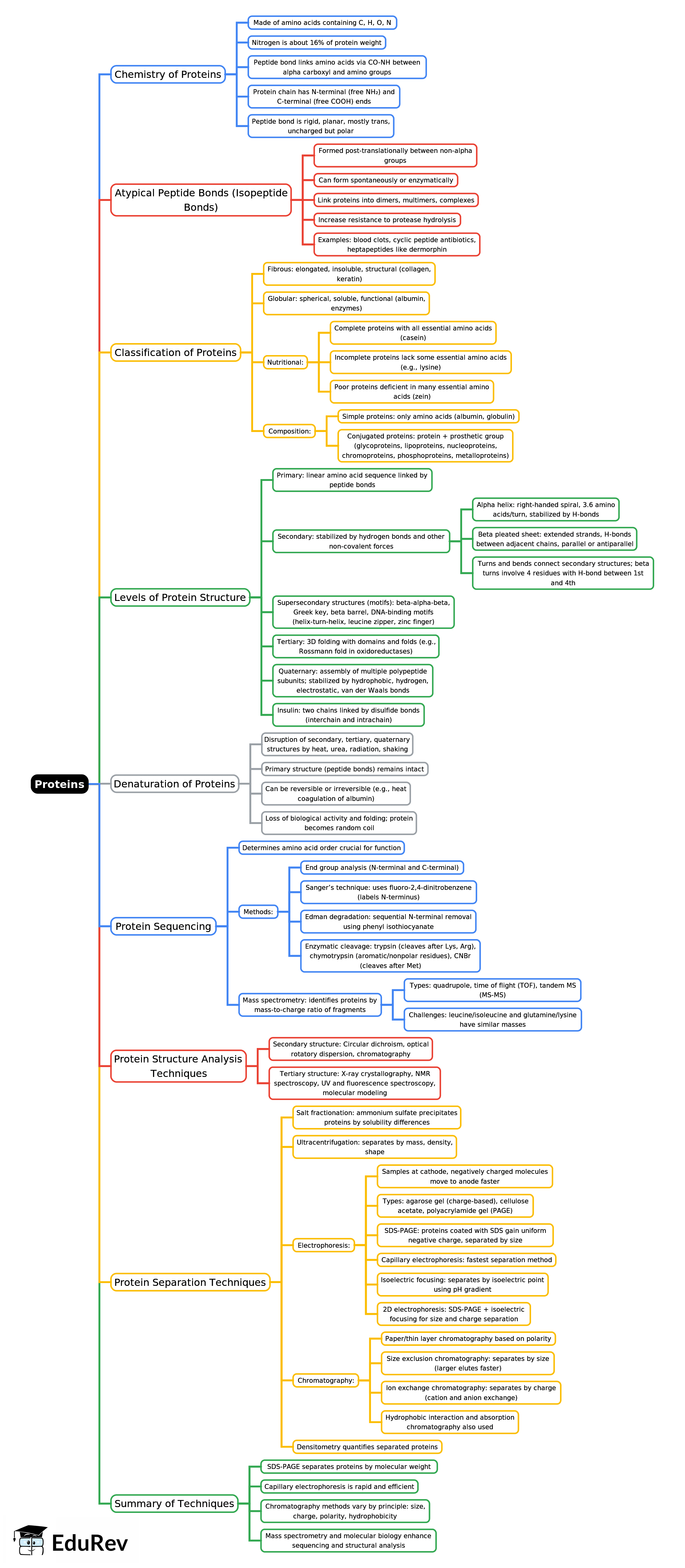
The document Mind Map: Proteins -1 is a part of the NEET PG Course Biochemistry.
All you need of NEET PG at this link: NEET PG
FAQs on Mind Map: Proteins -1
| 1. What are the primary functions of proteins in the human body? |  |
Ans. Proteins play several critical roles in the human body, including serving as enzymes that catalyze biochemical reactions, providing structural support in cells and tissues, facilitating cell communication and signaling, transporting molecules such as oxygen (e.g., hemoglobin), and aiding in immune responses by forming antibodies. Additionally, proteins are involved in muscle contraction and movement, making them essential for overall health and functionality.
| 2. How are proteins synthesized in cells? | |
Ans. Protein synthesis occurs through two main processes: transcription and translation. During transcription, the DNA sequence of a gene is copied into messenger RNA (mRNA) in the nucleus. The mRNA then travels to the ribosome, where translation occurs. In translation, ribosomes read the mRNA sequence and assemble amino acids in the correct order to form a protein, guided by transfer RNA (tRNA) molecules that bring the appropriate amino acids.
| 3. What are the different types of proteins based on structure? | |
Ans. Proteins can be classified into four levels of structure: primary, secondary, tertiary, and quaternary. The primary structure is the linear sequence of amino acids. The secondary structure refers to local folding patterns, such as alpha helices and beta sheets. The tertiary structure is the overall three-dimensional shape of a single protein molecule, determined by interactions among various amino acids. Quaternary structure occurs when multiple protein subunits assemble to form a functional complex.
| 4. What is the significance of protein folding and what can happen if it goes wrong? | |
Ans. Protein folding is crucial for a protein's functionality, as the specific shape determines its activity and interactions. Misfolded proteins can lead to loss of function and are associated with various diseases, such as Alzheimer's, Parkinson's, and cystic fibrosis. In some cases, misfolded proteins may aggregate and form toxic clumps, disrupting cellular function and leading to disease progression.
| 5. How do dietary proteins impact health, and what are some sources of high-quality proteins? | |
Ans. Dietary proteins are essential for growth, repair, and maintenance of body tissues. They provide amino acids that the body cannot synthesize on its own, known as essential amino acids. High-quality protein sources include animal products such as meat, fish, eggs, and dairy, which contain all essential amino acids. Plant-based sources, such as legumes, nuts, seeds, and whole grains, can also provide protein but may need to be combined to ensure a complete amino acid profile. Adequate protein intake supports muscle health, immune function, and overall well-being.
About this Document

4.64/5 Rating

Apr 20, 2026 Last updated
Document Description: Mind Map: Proteins -1 for NEET PG 2026 is part of Biochemistry preparation. The notes and questions for Mind Map: Proteins -1 have been prepared according to the NEET PG exam syllabus. Information about Mind Map: Proteins -1 covers topics like and Mind Map: Proteins -1 Example, for NEET PG 2026 Exam. Find important definitions, questions, notes, meanings, examples, exercises and tests below for Mind Map: Proteins -1.
Introduction of Mind Map: Proteins -1 in English is available as part of our Biochemistry for NEET PG & Mind Map: Proteins -1 in Hindi for Biochemistry course. Download more important topics related with notes, lectures and mock test series for NEET PG Exam by signing up for free. NEET PG: Mind Map: Proteins -1
Description
Mind Map: Proteins of Biochemistry provides you one-page visual summary of the chapter covering all the important topics. Download the PDF from EduRev.
Information about Mind Map: Proteins -1
In this doc you can find the meaning of Mind Map: Proteins -1 defined & explained in the simplest way possible. Besides explaining types of Mind Map: Proteins -1 theory, EduRev gives you an ample number of questions to practice Mind Map: Proteins -1 tests, examples and also practice NEET PG tests


Related Searches
Summary, Sample Paper, mock tests for examination, Free, Objective type Questions, past year papers, study material, Mind Map: Proteins -1, shortcuts and tricks, practice quizzes, video lectures, ppt, Viva Questions, Previous Year Questions with Solutions, Semester Notes, Important questions, Extra Questions, pdf , Exam, Mind Map: Proteins -1, MCQs, Mind Map: Proteins -1;