NEET PG Exam > NEET PG Notes > Biochemistry > Mind Map: Proteins -2
Mind Map: Proteins -2

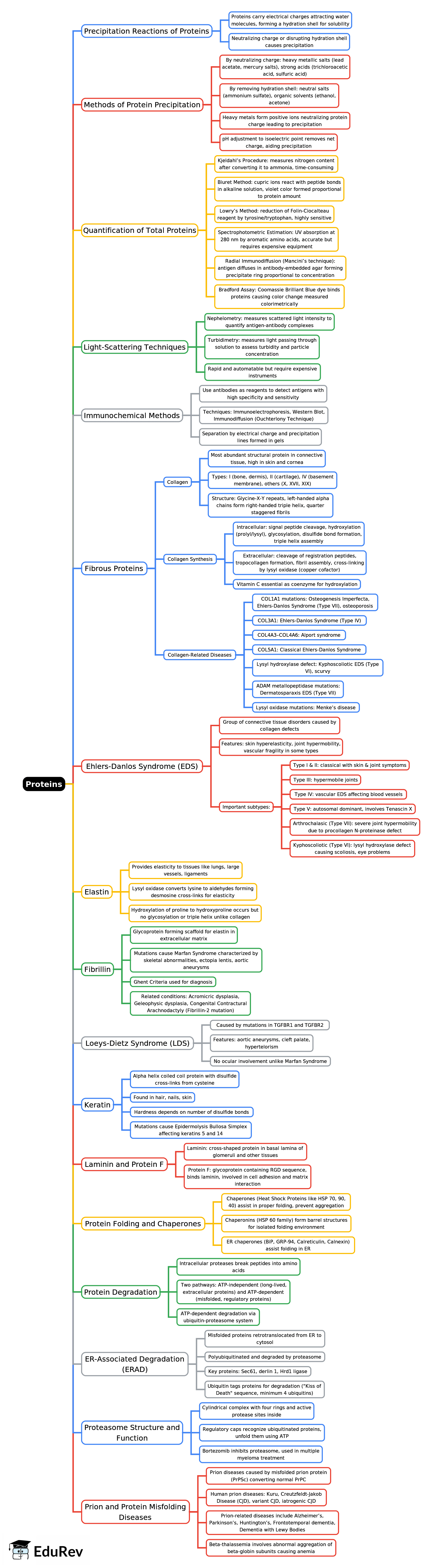
The document Mind Map: Proteins -2 is a part of the NEET PG Course Biochemistry.
All you need of NEET PG at this link: NEET PG
FAQs on Mind Map: Proteins -2
| 1. What are the primary functions of proteins in the human body? |  |
Ans. Proteins serve several vital functions in the human body, including acting as enzymes that catalyze biochemical reactions, serving as structural components in cells and tissues, facilitating transport of molecules, regulating biological processes through hormones, and playing a critical role in immune response. They are essential for growth, repair, and maintenance of body tissues.
| 2. How are proteins synthesized in cells? | |
Ans. Protein synthesis occurs in two main stages: transcription and translation. During transcription, DNA is transcribed into messenger RNA (mRNA) in the nucleus. The mRNA then travels to the ribosome, where translation occurs. In translation, transfer RNA (tRNA) brings amino acids to the ribosome, which assembles them into a polypeptide chain according to the sequence of codons in the mRNA, ultimately forming a functional protein.
| 3. What is the structure of proteins and how does it relate to their function? | |
Ans. Proteins have four levels of structure: primary, secondary, tertiary, and quaternary. The primary structure is the sequence of amino acids. The secondary structure involves local folding into alpha-helices and beta-sheets. The tertiary structure is the overall 3D shape of a single polypeptide chain, while the quaternary structure is formed when multiple polypeptide chains come together. The specific structure of a protein determines its function, as the shape of the protein affects its interaction with other molecules.
| 4. What are the differences between essential and non-essential amino acids? | |
Ans. Essential amino acids cannot be synthesized by the body and must be obtained from the diet. There are nine essential amino acids, including lysine and leucine. Non-essential amino acids, on the other hand, can be synthesized by the body and are not required to be consumed in the diet. Examples of non-essential amino acids include alanine and glutamic acid. Both types are critical for protein synthesis and overall health.
| 5. How do proteins contribute to the immune system? | |
Ans. Proteins play a crucial role in the immune system primarily through antibodies, which are specialized proteins that identify and neutralize pathogens such as bacteria and viruses. Other proteins, such as cytokines, are involved in cell signaling and regulating immune responses. Additionally, proteins help in the formation of immune cells and enzymes that are essential for immune function, helping to protect the body against infections and diseases.
About this Document

4.74/5 Rating

Apr 20, 2026 Last updated
Document Description: Mind Map: Proteins -2 for NEET PG 2026 is part of Biochemistry preparation. The notes and questions for Mind Map: Proteins -2 have been prepared according to the NEET PG exam syllabus. Information about Mind Map: Proteins -2 covers topics like and Mind Map: Proteins -2 Example, for NEET PG 2026 Exam. Find important definitions, questions, notes, meanings, examples, exercises and tests below for Mind Map: Proteins -2.
Introduction of Mind Map: Proteins -2 in English is available as part of our Biochemistry for NEET PG & Mind Map: Proteins -2 in Hindi for Biochemistry course. Download more important topics related with notes, lectures and mock test series for NEET PG Exam by signing up for free. NEET PG: Mind Map: Proteins -2
Description
Mind Map: Proteins of Biochemistry provides you one-page visual summary of the chapter covering all the important topics. Download the PDF from EduRev.
Information about Mind Map: Proteins -2
In this doc you can find the meaning of Mind Map: Proteins -2 defined & explained in the simplest way possible. Besides explaining types of Mind Map: Proteins -2 theory, EduRev gives you an ample number of questions to practice Mind Map: Proteins -2 tests, examples and also practice NEET PG tests


Related Searches
Semester Notes, mock tests for examination, Summary, Mind Map: Proteins -2, pdf , Mind Map: Proteins -2, past year papers, Previous Year Questions with Solutions, Sample Paper, video lectures, shortcuts and tricks, MCQs, study material, Mind Map: Proteins -2, Important questions, ppt, Extra Questions, Exam, practice quizzes, Viva Questions, Free, Objective type Questions;