NEET PG Exam > NEET PG Notes > Pathology > Mind Map: White Blood Cells and Platelets -1
Mind Map: White Blood Cells and Platelets -1

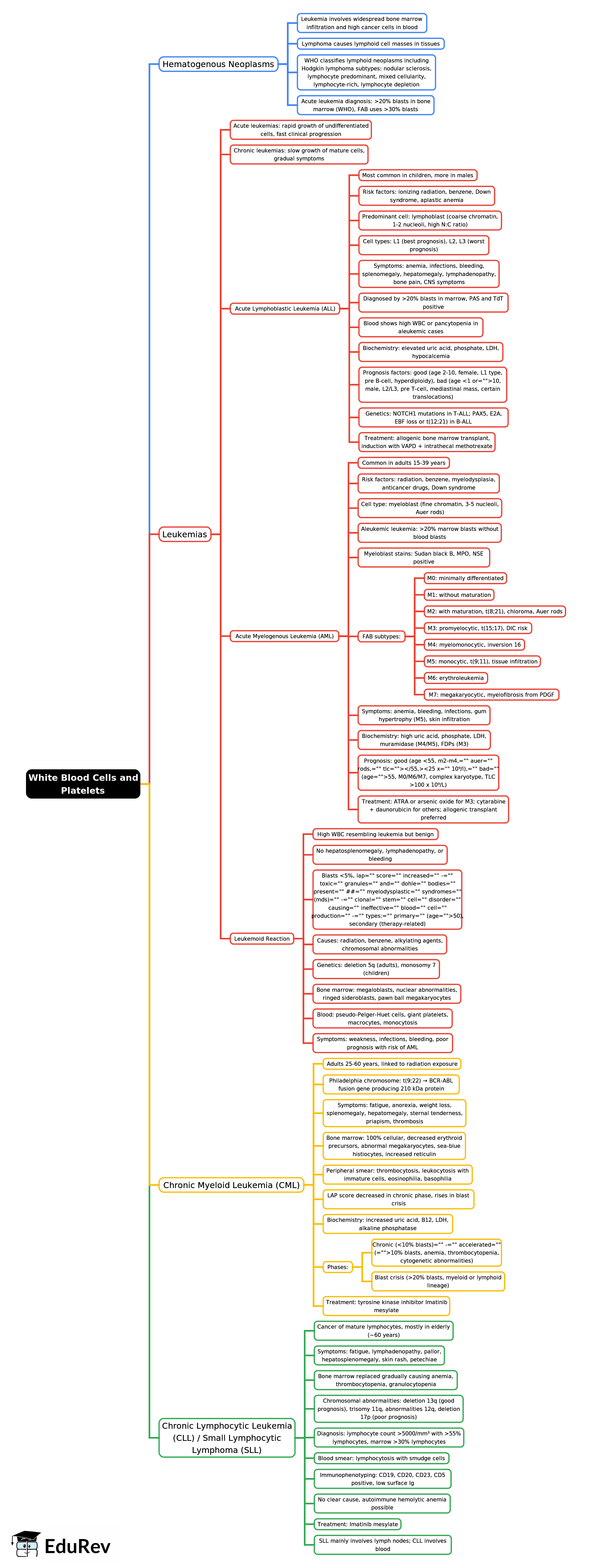
FAQs on Mind Map: White Blood Cells and Platelets -1
| 1. What are the main types of white blood cells and their functions? |  |
Ans. The main types of white blood cells (leukocytes) include neutrophils, lymphocytes, monocytes, eosinophils, and basophils. Neutrophils are the first responders to infections and play a key role in phagocytosis. Lymphocytes are crucial for the adaptive immune response; B cells produce antibodies, while T cells destroy infected cells. Monocytes differentiate into macrophages and dendritic cells, aiding in phagocytosis and presenting antigens. Eosinophils combat parasitic infections and are involved in allergic reactions, while basophils release histamine during inflammatory responses.
| 2. How do platelets function in the clotting process? | |
Ans. Platelets, or thrombocytes, are essential for hemostasis. When a blood vessel is injured, platelets adhere to the exposed collagen and activate. They release chemicals that attract more platelets to the site, forming a temporary plug. This aggregation is further enhanced by the activation of the coagulation cascade, leading to the conversion of fibrinogen to fibrin, which stabilizes the platelet plug and forms a clot to prevent further bleeding.
| 3. What is the significance of a complete blood count (CBC) in assessing white blood cells and platelets? | |
Ans. A complete blood count (CBC) is critical for evaluating overall health and diagnosing various conditions. It measures the levels of white blood cells, red blood cells, hemoglobin, hematocrit, and platelets. Abnormal levels of white blood cells can indicate infections, inflammation, or hematological disorders, while platelet counts can help diagnose bleeding disorders or assess the risk of thrombosis. The CBC provides essential information for monitoring treatment effects and disease progression.
| 4. What conditions can result from abnormalities in white blood cells and platelets? | |
Ans. Abnormalities in white blood cells can lead to conditions such as leukopenia (low white blood cell count), which increases the risk of infections, or leukocytosis (high white blood cell count), which may indicate infections or leukemia. For platelets, thrombocytopenia (low platelet count) can cause excessive bleeding, while thrombocytosis (high platelet count) can increase the risk of clot formation, potentially leading to thromboembolic events or strokes.
| 5. How do white blood cells differentiate between self and non-self components? | |
Ans. White blood cells differentiate between self and non-self components through the recognition of specific markers on cell surfaces, known as antigens. The immune system uses a complex set of receptors, such as T cell receptors (TCRs) on T cells, to identify foreign antigens. Self-tolerance mechanisms, including the deletion of self-reactive T cells during development, help prevent autoimmune responses, ensuring the immune system targets only pathogens while sparing the body's own tissues.
About this Document

4.76/5 Rating

Apr 26, 2026 Last updated
Related Exams
Document Description: Mind Map: White Blood Cells and Platelets -1 for NEET PG 2026 is part of Pathology preparation. The notes and questions for Mind Map: White Blood Cells and Platelets -1 have been prepared according to the NEET PG exam syllabus. Information about Mind Map: White Blood Cells and Platelets -1 covers topics like and Mind Map: White Blood Cells and Platelets -1 Example, for NEET PG 2026 Exam. Find important definitions, questions, notes, meanings, examples, exercises and tests below for Mind Map: White Blood Cells and Platelets -1.
Introduction of Mind Map: White Blood Cells and Platelets -1 in English is available as part of our Pathology for NEET PG & Mind Map: White Blood Cells and Platelets -1 in Hindi for Pathology course. Download more important topics related with notes, lectures and mock test series for NEET PG Exam by signing up for free. NEET PG: Mind Map: White Blood Cells and Platelets -1
Description
Mind Map: White Blood Cells & Platelets of Pathology provides you one-page visual summary of the chapter covering all the important topics. Download the PDF from EduRev.
Information about Mind Map: White Blood Cells and Platelets -1
In this doc you can find the meaning of Mind Map: White Blood Cells and Platelets -1 defined & explained in the simplest way possible. Besides explaining types of Mind Map: White Blood Cells and Platelets -1 theory, EduRev gives you an ample number of questions to practice Mind Map: White Blood Cells and Platelets -1 tests, examples and also practice NEET PG tests



Related Searches
Important questions, study material, Extra Questions, Semester Notes, Mind Map: White Blood Cells and Platelets -1, pdf , mock tests for examination, Mind Map: White Blood Cells and Platelets -1, Previous Year Questions with Solutions, Mind Map: White Blood Cells and Platelets -1, shortcuts and tricks, video lectures, past year papers, Sample Paper, MCQs, Free, Objective type Questions, Viva Questions, Summary, Exam, practice quizzes, ppt;