NEET PG Exam > NEET PG Notes > Pathology > Mind Map: Kidney and Urinary Bladder -1
Mind Map: Kidney and Urinary Bladder -1

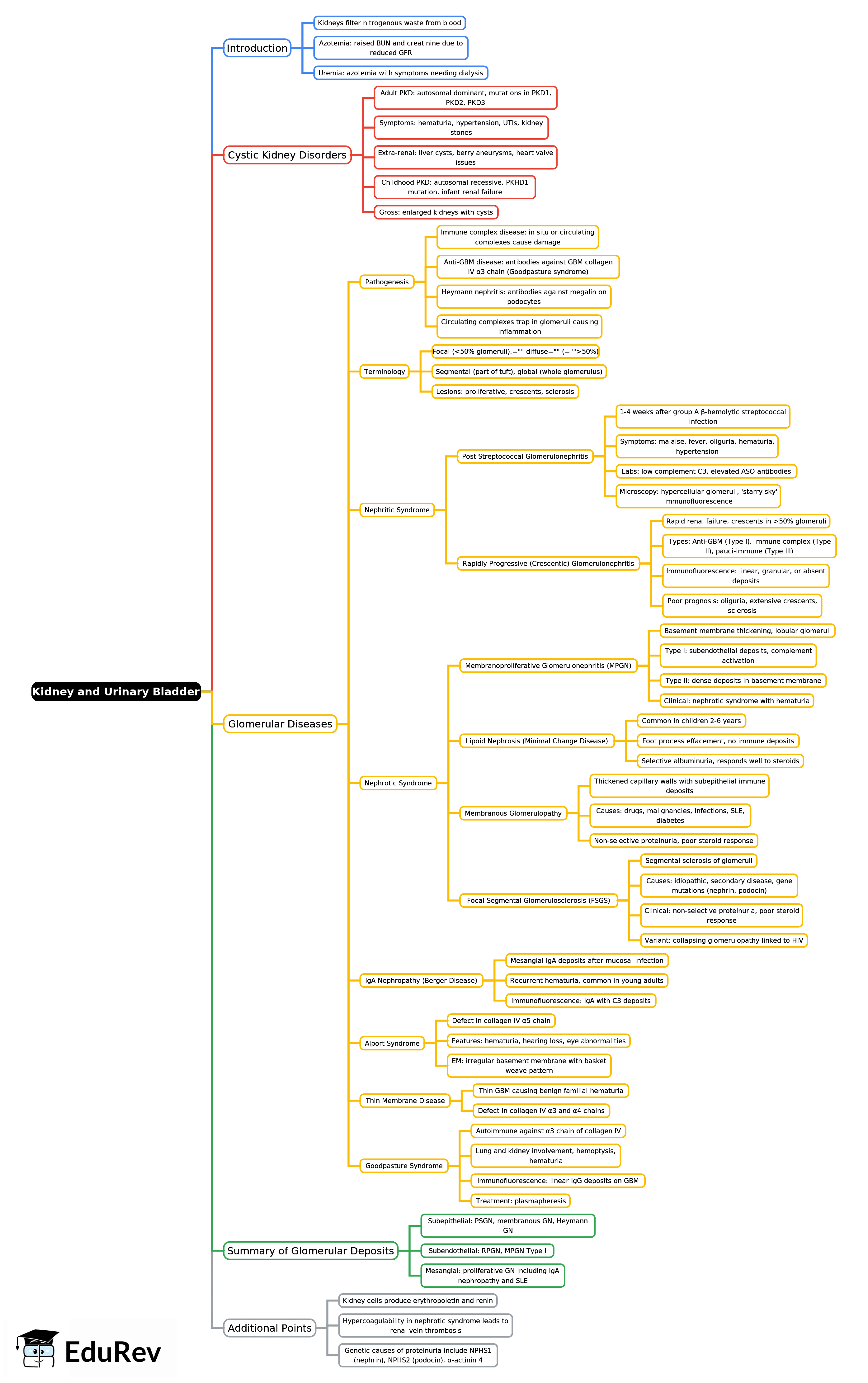
FAQs on Mind Map: Kidney and Urinary Bladder -1
| 1. What are the primary functions of the kidneys in the human body? |  |
Ans. The kidneys perform several essential functions, including the filtration of blood to remove waste products and excess substances, regulation of electrolyte balance, maintenance of acid-base homeostasis, regulation of blood pressure through the renin-angiotensin-aldosterone system, and production of hormones such as erythropoietin, which stimulates red blood cell production.
| 2. How does the urinary bladder function in the storage and expulsion of urine? | |
Ans. The urinary bladder is a muscular sac that stores urine until it is ready to be expelled. It has a capacity of about 300-500 mL. When the bladder fills, stretch receptors send signals to the brain, prompting the urge to urinate. Upon voluntary contraction of the bladder's detrusor muscle and relaxation of the external urethral sphincter, urine is expelled through the urethra.
| 3. What are common diseases affecting the kidneys and urinary bladder? | |
Ans. Common kidney diseases include chronic kidney disease, glomerulonephritis, kidney stones, and urinary tract infections (UTIs). For the urinary bladder, common conditions include cystitis (bladder inflammation), bladder stones, and bladder cancer. Each condition varies in symptoms and requires specific diagnostic and treatment approaches.
| 4. How do the kidneys regulate blood pressure? | |
Ans. The kidneys help regulate blood pressure through the renin-angiotensin-aldosterone system (RAAS). When blood pressure drops, the kidneys release renin, an enzyme that converts angiotensinogen to angiotensin I. Angiotensin I is then converted to angiotensin II, which causes blood vessels to constrict and stimulates the release of aldosterone from the adrenal glands, leading to sodium and water retention, thus increasing blood volume and pressure.
| 5. What role do electrolytes play in kidney function and urine formation? | |
Ans. Electrolytes, including sodium, potassium, chloride, and bicarbonate, are crucial for maintaining fluid balance, nerve function, and muscle contractions. The kidneys regulate the levels of these electrolytes in the blood by filtering them during urine formation. They reabsorb necessary electrolytes and excrete excess ones to maintain homeostasis, significantly influencing urine composition and volume.
About this Document

4.63/5 Rating

Apr 26, 2026 Last updated
Related Exams
Document Description: Mind Map: Kidney and Urinary Bladder -1 for NEET PG 2026 is part of Pathology preparation. The notes and questions for Mind Map: Kidney and Urinary Bladder -1 have been prepared according to the NEET PG exam syllabus. Information about Mind Map: Kidney and Urinary Bladder -1 covers topics like and Mind Map: Kidney and Urinary Bladder -1 Example, for NEET PG 2026 Exam. Find important definitions, questions, notes, meanings, examples, exercises and tests below for Mind Map: Kidney and Urinary Bladder -1.
Introduction of Mind Map: Kidney and Urinary Bladder -1 in English is available as part of our Pathology for NEET PG & Mind Map: Kidney and Urinary Bladder -1 in Hindi for Pathology course. Download more important topics related with notes, lectures and mock test series for NEET PG Exam by signing up for free. NEET PG: Mind Map: Kidney and Urinary Bladder -1
Description
Mind Map: Kidney & Urinary Bladder of Pathology provides you one-page visual summary of the chapter covering all the important topics. Download the PDF from EduRev.
Information about Mind Map: Kidney and Urinary Bladder -1
In this doc you can find the meaning of Mind Map: Kidney and Urinary Bladder -1 defined & explained in the simplest way possible. Besides explaining types of Mind Map: Kidney and Urinary Bladder -1 theory, EduRev gives you an ample number of questions to practice Mind Map: Kidney and Urinary Bladder -1 tests, examples and also practice NEET PG tests



Related Searches
Sample Paper, Mind Map: Kidney and Urinary Bladder -1, Mind Map: Kidney and Urinary Bladder -1, shortcuts and tricks, ppt, MCQs, Mind Map: Kidney and Urinary Bladder -1, pdf , mock tests for examination, Free, study material, past year papers, Semester Notes, Important questions, Previous Year Questions with Solutions, Extra Questions, Viva Questions, Objective type Questions, Exam, Summary, practice quizzes, video lectures;