NEET PG Exam > NEET PG Notes > Pathology > Mind Map: Kidney and Urinary Bladder -2
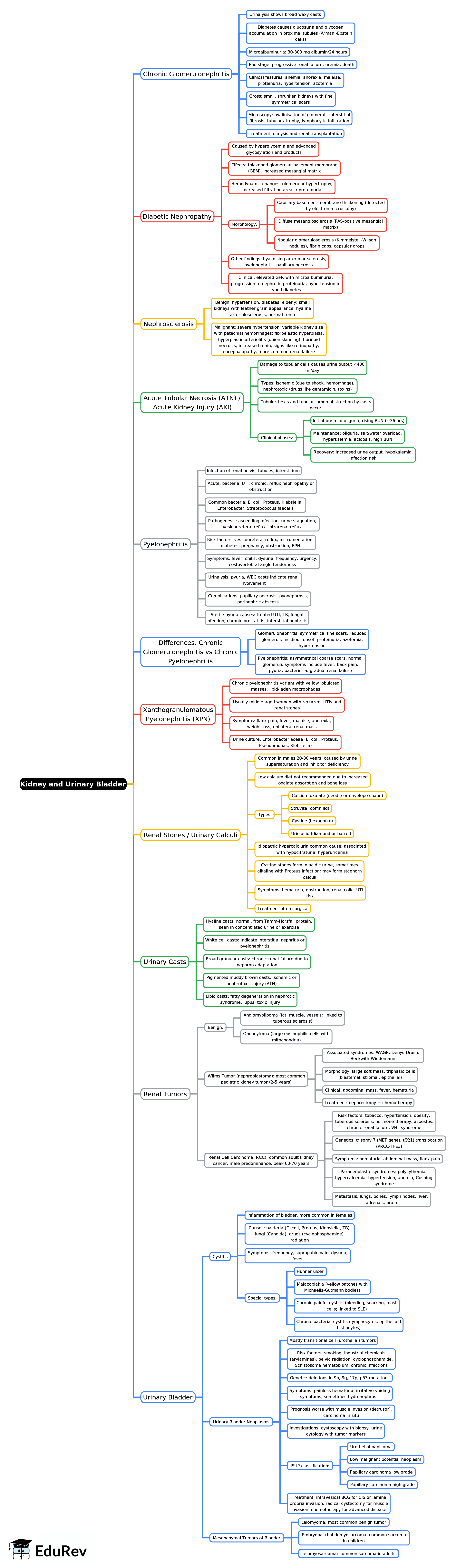
Mind Map: Kidney and Urinary Bladder -2

FAQs on Mind Map: Kidney and Urinary Bladder -2
| 1. What are the primary functions of the kidneys in the urinary system? |  |
Ans. The kidneys play a crucial role in the urinary system by performing several vital functions. They filter blood to remove waste products and excess substances, regulate electrolyte balance, maintain acid-base homeostasis, and control blood pressure through the renin-angiotensin-aldosterone system. Additionally, kidneys produce hormones such as erythropoietin, which stimulates red blood cell production, and calcitriol, the active form of vitamin D, which is essential for calcium absorption.
| 2. How does the urinary bladder facilitate the process of urination? | |
Ans. The urinary bladder serves as a storage reservoir for urine until it is excreted from the body. As the bladder fills, stretch receptors in its wall send signals to the brain, indicating the need to urinate. When the appropriate time arises, signals from the brain trigger the contraction of the detrusor muscle and relaxation of the internal and external urethral sphincters, allowing urine to flow from the bladder through the urethra and out of the body.
| 3. What are common diseases associated with the kidneys and urinary bladder? | |
Ans. Common diseases affecting the kidneys include chronic kidney disease, acute kidney injury, and kidney stones. Urinary bladder issues often involve urinary tract infections (UTIs), bladder cancer, and interstitial cystitis. These conditions can lead to various symptoms, such as pain, changes in urination patterns, and in more severe cases, kidney failure or bladder dysfunction.
| 4. How is kidney function assessed in clinical practice? | |
Ans. Kidney function is commonly assessed using several tests, including serum creatinine levels, which help estimate the glomerular filtration rate (GFR). A GFR below 60 mL/min/1.73 m² may indicate kidney dysfunction. Other assessments include urinalysis to detect abnormalities in urine composition, imaging studies like ultrasound to visualize kidney structure, and kidney biopsy in specific cases to understand underlying pathologies.
| 5. What preventive measures can be taken to maintain kidney and urinary bladder health? | |
Ans. To maintain kidney and urinary bladder health, individuals should stay well-hydrated, manage blood pressure and blood sugar levels, maintain a balanced diet low in sodium and high in fruits and vegetables, and avoid excessive use of nonsteroidal anti-inflammatory drugs (NSAIDs). Regular exercise and avoiding smoking can also help reduce the risk of kidney and bladder diseases. Additionally, practicing good hygiene and avoiding risky sexual practices can prevent urinary tract infections.
About this Document

4.72/5 Rating

Apr 26, 2026 Last updated
Related Exams
Document Description: Mind Map: Kidney and Urinary Bladder -2 for NEET PG 2026 is part of Pathology preparation. The notes and questions for Mind Map: Kidney and Urinary Bladder -2 have been prepared according to the NEET PG exam syllabus. Information about Mind Map: Kidney and Urinary Bladder -2 covers topics like and Mind Map: Kidney and Urinary Bladder -2 Example, for NEET PG 2026 Exam. Find important definitions, questions, notes, meanings, examples, exercises and tests below for Mind Map: Kidney and Urinary Bladder -2.
Introduction of Mind Map: Kidney and Urinary Bladder -2 in English is available as part of our Pathology for NEET PG & Mind Map: Kidney and Urinary Bladder -2 in Hindi for Pathology course. Download more important topics related with notes, lectures and mock test series for NEET PG Exam by signing up for free. NEET PG: Mind Map: Kidney and Urinary Bladder -2
Description
Mind Map: Kidney & Urinary Bladder of Pathology provides you one-page visual summary of the chapter covering all the important topics. Download the PDF from EduRev.
Information about Mind Map: Kidney and Urinary Bladder -2
In this doc you can find the meaning of Mind Map: Kidney and Urinary Bladder -2 defined & explained in the simplest way possible. Besides explaining types of Mind Map: Kidney and Urinary Bladder -2 theory, EduRev gives you an ample number of questions to practice Mind Map: Kidney and Urinary Bladder -2 tests, examples and also practice NEET PG tests



Related Searches
practice quizzes, Objective type Questions, Extra Questions, study material, Mind Map: Kidney and Urinary Bladder -2, Sample Paper, Mind Map: Kidney and Urinary Bladder -2, past year papers, MCQs, Summary, pdf , mock tests for examination, shortcuts and tricks, video lectures, Mind Map: Kidney and Urinary Bladder -2, Previous Year Questions with Solutions, Free, ppt, Viva Questions, Important questions, Exam, Semester Notes;