NEET PG Exam > NEET PG Notes > Pathology > Mind Map: Miscellaneous Topics of Pathology
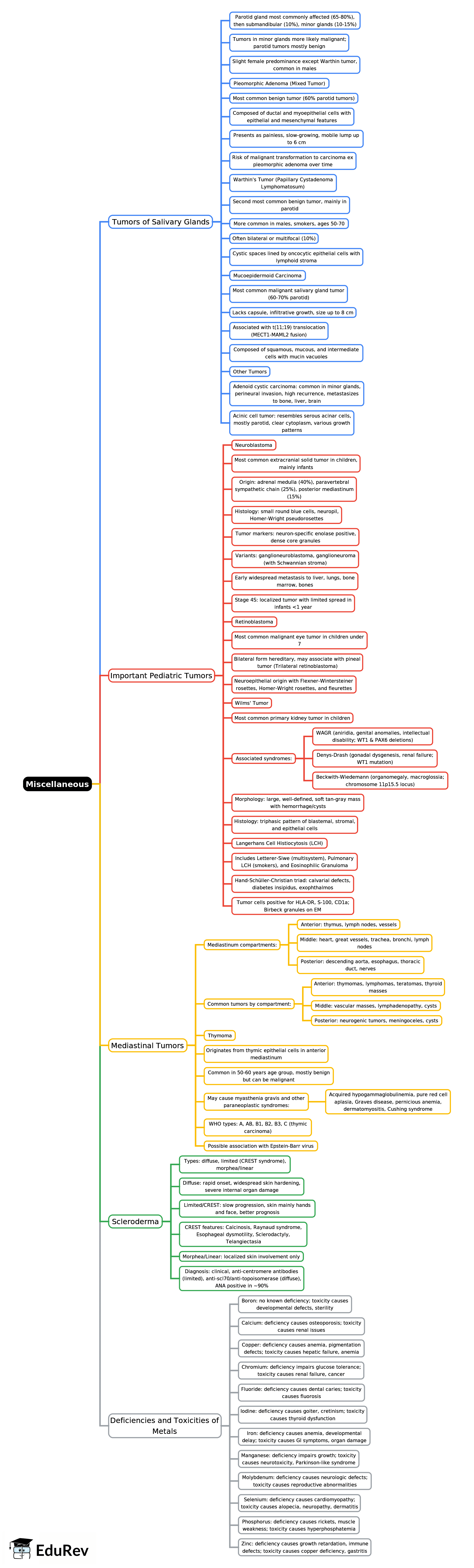
Mind Map: Miscellaneous Topics of Pathology

FAQs on Mind Map: Miscellaneous Topics of Pathology
| 1. What are the common types of necrosis observed in pathology? |  |
Ans. The common types of necrosis include coagulative necrosis, liquefactive necrosis, caseous necrosis, fatty necrosis, and fibrinoid necrosis. Coagulative necrosis typically occurs in cases of ischemia or infarction and is characterized by the preservation of cell outlines despite cellular death. Liquefactive necrosis is often seen in bacterial infections, leading to pus formation. Caseous necrosis is associated with tuberculosis and presents as a cheese-like appearance. Fatty necrosis generally occurs in pancreatic injury due to the release of lipases, while fibrinoid necrosis is related to immune-mediated vascular damage.
| 2. How does apoptosis differ from necrosis in pathological processes? | |
Ans. Apoptosis and necrosis are two distinct forms of cell death. Apoptosis is a programmed and controlled process that occurs as a part of normal development and homeostasis, resulting in cell shrinkage, chromatin condensation, and formation of apoptotic bodies which are phagocytosed without causing inflammation. In contrast, necrosis is an uncontrolled process resulting from cell injury, characterized by cell swelling, membrane rupture, and inflammation due to the release of cellular contents into the extracellular space. This inflammation can lead to tissue damage and a secondary immune response.
| 3. What role do tumor markers play in the diagnosis and management of cancer? | |
Ans. Tumor markers are substances produced by cancer cells or by the body in response to cancer, which can be detected in blood, urine, or tissues. They play a crucial role in the diagnosis, monitoring treatment response, and detecting recurrence of cancer. Examples include prostate-specific antigen (PSA) for prostate cancer, alpha-fetoprotein (AFP) for liver cancer, and carcinoembryonic antigen (CEA) for colorectal cancer. While they are helpful tools, it is important to note that tumor markers are not definitive for cancer diagnosis and should be used in conjunction with other diagnostic modalities.
| 4. What are the key features of inflammation in pathological conditions? | |
Ans. Inflammation is a complex biological response to tissue injury or infection and is characterized by several key features: redness (rubor), heat (calor), swelling (tumor), pain (dolor), and loss of function (functio laesa). The process involves the activation of immune cells, release of inflammatory mediators, and changes in blood flow. Acute inflammation occurs rapidly and is typically short-lived, while chronic inflammation can persist for months or years, often leading to tissue damage and contributing to diseases such as autoimmune disorders, chronic infections, and cancer.
| 5. What are the primary mechanisms of cell injury in pathological states? | |
Ans. The primary mechanisms of cell injury include hypoxia, chemical injury, infectious agents, immunological reactions, and genetic factors. Hypoxia, often due to ischemia, results in a lack of oxygen and subsequent cellular damage. Chemical injury can arise from toxins, drugs, or heavy metals, leading to direct cellular damage or metabolic disruptions. Infectious agents such as bacteria and viruses can invade and destroy cells. Immunological reactions may result in autoimmunity or hypersensitivity, causing tissue injury. Lastly, genetic factors can lead to inherited metabolic disorders and predispose cells to injury.
About this Document

4.63/5 Rating

Apr 26, 2026 Last updated
Related Exams
Document Description: Mind Map: Miscellaneous Topics of Pathology for NEET PG 2026 is part of Pathology preparation. The notes and questions for Mind Map: Miscellaneous Topics of Pathology have been prepared according to the NEET PG exam syllabus. Information about Mind Map: Miscellaneous Topics of Pathology covers topics like and Mind Map: Miscellaneous Topics of Pathology Example, for NEET PG 2026 Exam. Find important definitions, questions, notes, meanings, examples, exercises and tests below for Mind Map: Miscellaneous Topics of Pathology.
Introduction of Mind Map: Miscellaneous Topics of Pathology in English is available as part of our Pathology for NEET PG & Mind Map: Miscellaneous Topics of Pathology in Hindi for Pathology course. Download more important topics related with notes, lectures and mock test series for NEET PG Exam by signing up for free. NEET PG: Mind Map: Miscellaneous Topics of Pathology
Description
Mind Map: Miscellaneous Topics of Pathology of Pathology provides you one-page visual summary of the chapter covering all the important topics. Download the PDF from EduRev.
Information about Mind Map: Miscellaneous Topics of Pathology
In this doc you can find the meaning of Mind Map: Miscellaneous Topics of Pathology defined & explained in the simplest way possible. Besides explaining types of Mind Map: Miscellaneous Topics of Pathology theory, EduRev gives you an ample number of questions to practice Mind Map: Miscellaneous Topics of Pathology tests, examples and also practice NEET PG tests



Related Searches
Mind Map: Miscellaneous Topics of Pathology, Viva Questions, Sample Paper, pdf , Objective type Questions, practice quizzes, past year papers, mock tests for examination, study material, Mind Map: Miscellaneous Topics of Pathology, ppt, Mind Map: Miscellaneous Topics of Pathology, Important questions, Summary, Exam, MCQs, video lectures, Free, Previous Year Questions with Solutions, shortcuts and tricks, Extra Questions, Semester Notes;