IGCSE Year 11 > Year 11 Notes > Physical Education for GCSE/ > Types of Movement in Sport
Types of Movement in Sport

Basic Movements in Sport
Movements in sports can be categorized into several types:- Flexion and extension
- Abduction and adduction
- Rotation
- Circumduction
- Plantar flexion and dorsiflexion
These movement types are explored in greater detail in the topic The Structure & Functions of the Musculoskeletal System.
Examples of types of movement in sport
Push-ups
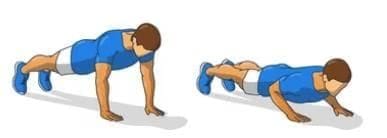
- A push-up consists of two phases:
- Push-up Phase: The elbow joint extends to raise the body in an extension movement.
- Lowering Phase: The elbow joint flexes to return the body to the starting position.
Push-up Movement Diagram
Football Throw-in
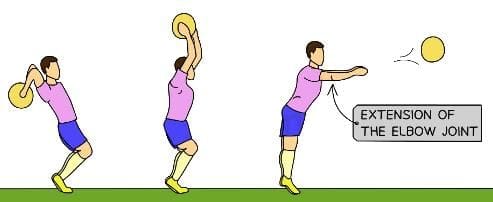
- When performing a throw-in, the player grips the ball with both hands, positioning it behind their head.
- The ball is then released from behind and over the head using both hands, involving elbow joint extension.
Football Throw-in Movement Diagram
Running
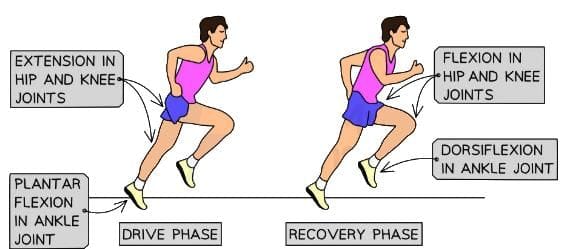
Running involves movements at the hip, knee, and ankle joints.
- During the drive phase, when the foot strikes the ground, the performer propels forward:
- The knee joint extends.
- The hip undergoes extension.
- The ankle joint performs plantar flexion.
- The recovery phase follows, where the leg swings forward for the next stride:
- The knee joint flexes.
- The hip flexes.
- The ankle joint moves into dorsiflexion.
One leg is in the drive phase while the other is in the recovery phase.
Running Movement Diagram
Kicking
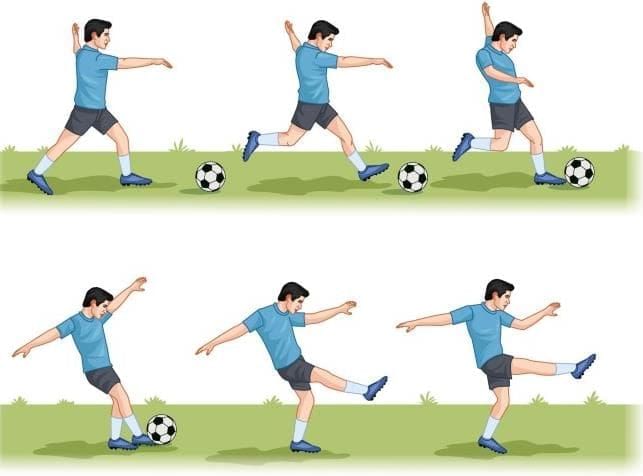
- Kicking mirrors the drive phase of running.
- The leg swings backward to prepare, then swings forward, straightening as the foot strikes the ball:
- The knee joint transitions from flexion to extension.
- The hip is in flexion.
- The ankle joint remains in plantar flexion throughout.
Kicking Movement Diagram
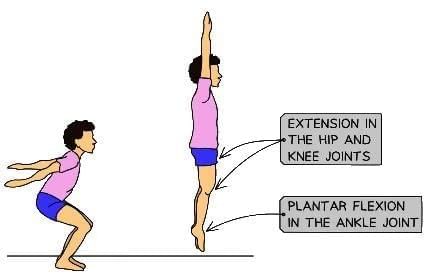
Standing Vertical Jumps
- In a standing vertical jump, the performer starts with feet shoulder-width apart and knees bent.
- They then launch upward through the hips, knees, and ankles:
- The hip extends.
- The knee joints extend.
- The ankle joints perform plantar flexion.
Standing Vertical Jump Movement Diagram
Star Jumps
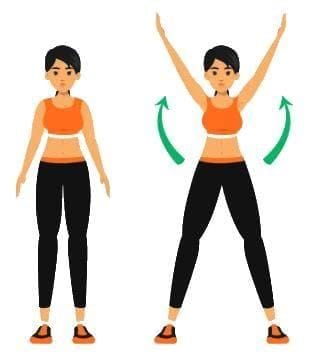
For a star jump, the performer begins with feet together and arms at their sides.
- They jump vertically, spreading their legs and arms outward to form a star shape:
- Abduction occurs at the shoulder as the arms and legs move away from the body.
- Upon landing, the arms return to the sides, and the legs come together:
- Adduction occurs at the shoulder as the arms and legs move toward the body.
Star Jump Movement Diagram
Squats
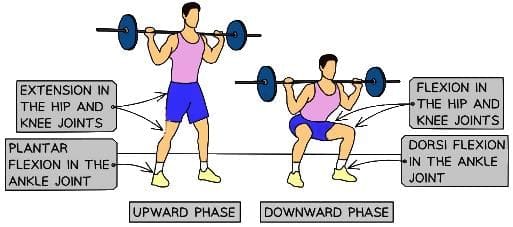
- In a squat, the performer stands with feet shoulder-width apart, involving a downward and upward phase.
- There is a downward and an upward phase
- The downward phase begins by bending at the hips and knees simultaneously to lower the body until the thighs are at least parallel to the ground:
- The hips flex.
- The knee joints flex.
- The ankle joints exhibit slight dorsiflexion.
- In the upward phase, the performer pushes back up through the heels and midfoot to the starting position:
- The hips extend.
- The knee joints extend.
- The ankle joints show slight plantar flexion.
- The downward phase begins by bending at the hips and knees simultaneously to lower the body until the thighs are at least parallel to the ground:
Squat Movement Diagram
Cricket Bowling
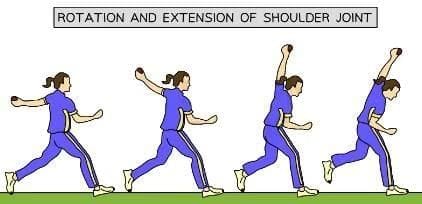
In cricket, the bowler approaches the crease, swinging their dominant arm backward and then forward in a circular motion:
- The shoulder joint undergoes rotation.
- Extension occurs at the shoulder joint.
- Circumduction takes place at the shoulder as the arm traces a circular path.
Cricket Bowling Movement Diagram
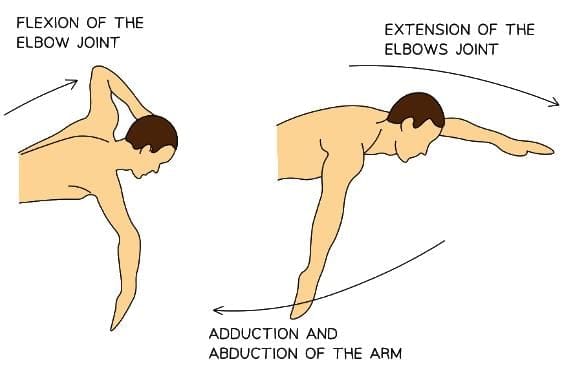
Swimming Front Crawl
- In the front crawl, the swimmer lies face down in a streamlined position in the water.
- The stroke begins as one arm extends forward into the water, then pulls back in a sweeping motion for propulsion:
- The elbow flexes as the arm bends upward.
- The elbow extends as the arm reaches forward.
- Abduction occurs at the shoulder as the arm sweeps away from the body.
- Adduction occurs at the shoulder as the arm pulls back toward the body.
- Circumduction at the shoulder allows the arm to move in a circular pattern.
Front Crawl Swimming Movement Diagram
The document Types of Movement in Sport is a part of the Year 11 Course Physical Education for GCSE/IGCSE.
All you need of Year 11 at this link: Year 11
FAQs on Types of Movement in Sport
| 1. What are the basic types of movements in sport? |  |
Ans. The basic types of movements in sport include running, jumping, throwing, and catching. Each of these movements involves specific biomechanics and techniques that athletes must master to excel in their respective sports.
| 2. How do different sports emphasize various types of movements? | |
Ans. Different sports emphasize various types of movements based on their unique requirements. For instance, track and field events focus heavily on running and jumping, while sports like basketball prioritize jumping and agility. Team sports like soccer require a combination of running, kicking, and strategic movements.
| 3. Why is understanding movement types important for athletes? | |
Ans. Understanding movement types is crucial for athletes as it helps them improve their performance, reduce the risk of injury, and enhance their training efficiency. By focusing on specific movements, athletes can develop targeted skills and conditioning that align with their sport's demands.
| 4. What role does biomechanics play in sports movements? | |
Ans. Biomechanics plays a vital role in sports movements as it involves analyzing the physical principles that govern motion. By studying biomechanics, athletes and coaches can optimize techniques, improve efficiency, and enhance overall performance while minimizing the risk of injury.
| 5. How can athletes improve their movement skills? | |
Ans. Athletes can improve their movement skills through targeted training, practice, and conditioning. This may include drills that focus on specific movements, strength training to enhance muscular power, flexibility exercises to improve range of motion, and agility training to enhance quickness and coordination.
About this Document

4.77/5 Rating

Apr 19, 2026 Last updated
Related Exams
Document Description: Types of Movement in Sport for Year 11 2026 is part of Physical Education for GCSE/IGCSE preparation. The notes and questions for Types of Movement in Sport have been prepared according to the Year 11 exam syllabus. Information about Types of Movement in Sport covers topics like and Types of Movement in Sport Example, for Year 11 2026 Exam. Find important definitions, questions, notes, meanings, examples, exercises and tests below for Types of Movement in Sport.
Introduction of Types of Movement in Sport in English is available as part of our Physical Education for GCSE/IGCSE for Year 11 & Types of Movement in Sport in Hindi for Physical Education for GCSE/IGCSE course. Download more important topics related with notes, lectures and mock test series for Year 11 Exam by signing up for free. Year 11: Types of Movement in Sport
Description
Types of Movement in Sport of Physical Education covers all the important topics, helping you prepare for the Year 11 exam on EduRev. Start for free!
Information about Types of Movement in Sport
In this doc you can find the meaning of Types of Movement in Sport defined & explained in the simplest way possible. Besides explaining types of Types of Movement in Sport theory, EduRev gives you an ample number of questions to practice Types of Movement in Sport tests, examples and also practice Year 11 tests



Related Searches
Extra Questions, Exam, Types of Movement in Sport, Viva Questions, Types of Movement in Sport, Previous Year Questions with Solutions, Summary, Semester Notes, MCQs, Sample Paper, Types of Movement in Sport, shortcuts and tricks, video lectures, mock tests for examination, practice quizzes, Free, past year papers, ppt, Important questions, pdf , Objective type Questions, study material;