UPSC Exam > UPSC Notes > Geography CSE > Cheat Sheet: Activities & Sectors of Economy
Cheat Sheet: Activities & Sectors of Economy


Classification of Economic Activities
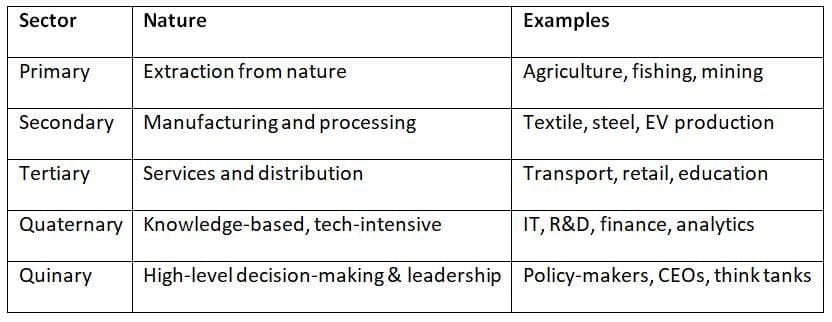
Based on Employment Nature
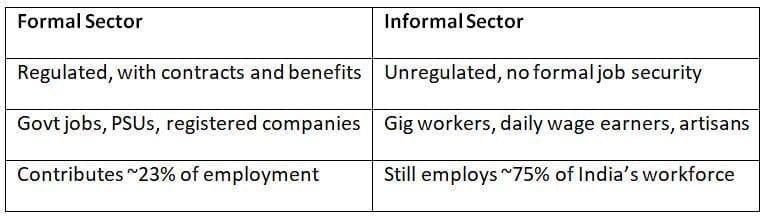
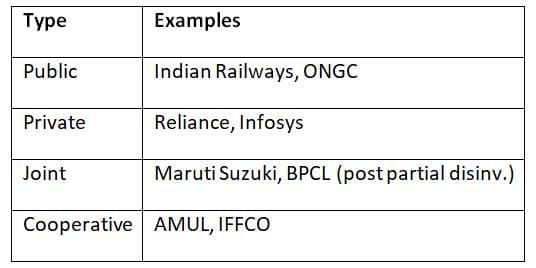
Based on Ownership
Sectoral Contribution to GDP & Employment
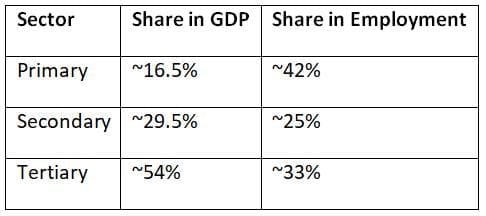
- Mismatch in primary sector share vs employment → disguised unemployment.
Key Trends & Government Initiatives
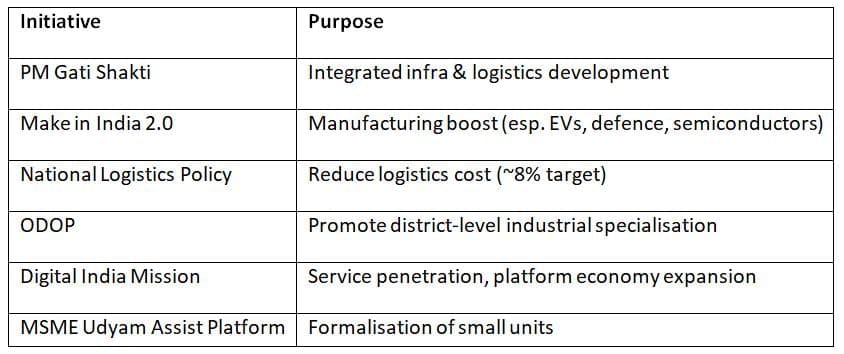
Notable Sectoral Examples
- EV manufacturing - Tamil Nadu, Gujarat
- Fintech hubs - Mumbai, Bengaluru
- Green hydrogen projects - Gujarat, Rajasthan
- Defence corridor - Uttar Pradesh, Tamil Nadu
- Digital services - Remote work in Tier-II towns rising
Emerging Issues
- Rising informality in services
- Low female LFPR despite service sector growth
- Jobless growth in industrial sector
- Climate shocks affecting agriculture output
- Need for upskilling for Industry 4.0
Way Forward
- Balance sectoral growth & shift surplus labour to industry/services
- Encourage labour-intensive manufacturing
- Support formalisation of gig economy
- Foster rural enterprise via cooperatives and SHGs
- Skilling in digital, green, and AI-driven sectors
The document Cheat Sheet: Activities & Sectors of Economy is a part of the UPSC Course Geography for UPSC CSE.
All you need of UPSC at this link: UPSC
FAQs on Cheat Sheet: Activities & Sectors of Economy
| 1. What are the main classifications of economic activities based on employment nature? |  |
Ans.Economic activities can primarily be classified into three categories based on employment nature: primary, secondary, and tertiary sectors. The primary sector involves the extraction of natural resources, such as agriculture, fishing, and mining. The secondary sector includes manufacturing and construction activities that transform raw materials into finished goods. The tertiary sector encompasses services such as retail, healthcare, education, and finance, focusing on providing support and services rather than goods.
| 2. How are economic activities classified based on ownership? | |
Ans.Economic activities are classified based on ownership into three main categories: public, private, and cooperative sectors. The public sector is owned and operated by government entities and includes services like public health and education. The private sector is owned by individuals or corporations aiming for profit, covering businesses like retail shops and factories. The cooperative sector is owned and managed by a group of individuals for their mutual benefit, such as agricultural cooperatives or credit unions.
| 3. What is the significance of sectoral contribution to GDP and employment? | |
Ans.Sectoral contribution to GDP and employment reflects the economic structure and health of a nation. The primary sector typically contributes a smaller percentage to GDP in developed countries, while the secondary and tertiary sectors become more significant as economies advance. Employment distribution across sectors indicates labor market dynamics, with the tertiary sector usually employing the largest share of the workforce in developed economies, showcasing a shift towards service-oriented jobs.
| 4. What are some recent trends and government initiatives in economic activities? | |
Ans.Recent trends in economic activities include a growing emphasis on digitalization, sustainability, and the gig economy. Governments are initiating policies to encourage innovation, support small and medium enterprises (SMEs), and promote green technologies. Initiatives like Startup India and Make in India aim to boost entrepreneurship, manufacturing, and job creation, while investments in infrastructure and education aim to enhance overall economic productivity and employment opportunities.
| 5. What are some emerging issues in economic activities, and what is the way forward? | |
Ans.Emerging issues in economic activities include the impact of automation and artificial intelligence on jobs, income inequality, and environmental sustainability. The way forward involves adapting workforce skills to meet the demands of evolving industries, addressing climate change through sustainable practices, and ensuring inclusive growth that reduces disparities. Policymakers must focus on creating a resilient economy that can adapt to future challenges while promoting equitable opportunities for all.
About this Document

4.91/5 Rating

Apr 19, 2026 Last updated
Related Exams
Document Description: Cheat Sheet: Activities & Sectors of Economy for UPSC 2026 is part of Geography for UPSC CSE preparation. The notes and questions for Cheat Sheet: Activities & Sectors of Economy have been prepared according to the UPSC exam syllabus. Information about Cheat Sheet: Activities & Sectors of Economy covers topics like and Cheat Sheet: Activities & Sectors of Economy Example, for UPSC 2026 Exam. Find important definitions, questions, notes, meanings, examples, exercises and tests below for Cheat Sheet: Activities & Sectors of Economy.
Introduction of Cheat Sheet: Activities & Sectors of Economy in English is available as part of our Geography for UPSC CSE for UPSC & Cheat Sheet: Activities & Sectors of Economy in Hindi for Geography for UPSC CSE course. Download more important topics related with notes, lectures and mock test series for UPSC Exam by signing up for free. UPSC: Cheat Sheet: Activities & Sectors of Economy
Description
Cheat Sheet: Activities & Sectors of Economy of Geography to help you remember important concepts with short tricks. Start learning for UPSC exam & improve retention with EduRev.
Information about Cheat Sheet: Activities & Sectors of Economy
In this doc you can find the meaning of Cheat Sheet: Activities & Sectors of Economy defined & explained in the simplest way possible. Besides explaining types of Cheat Sheet: Activities & Sectors of Economy theory, EduRev gives you an ample number of questions to practice Cheat Sheet: Activities & Sectors of Economy tests, examples and also practice UPSC tests



Related Searches
practice quizzes, study material, ppt, Cheat Sheet: Activities & Sectors of Economy, Extra Questions, Viva Questions, Free, mock tests for examination, Objective type Questions, Cheat Sheet: Activities & Sectors of Economy, Cheat Sheet: Activities & Sectors of Economy, pdf , Important questions, video lectures, Summary, Semester Notes, MCQs, Exam, Sample Paper, shortcuts and tricks, Previous Year Questions with Solutions, past year papers;