UPSC Exam > UPSC Notes > Indian Economy CSE > Cheat Sheet: Money and Banking
Cheat Sheet: Money and Banking


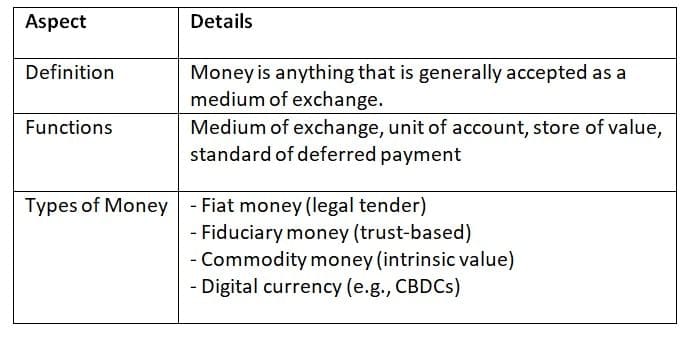
Money: Definition & Functions
Supply of Money
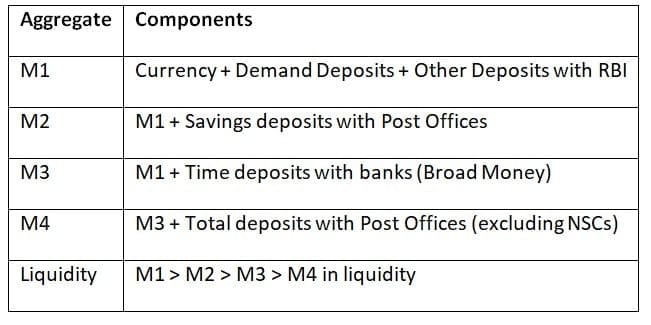
Measures of Money Supply (as per RBI)
- Reserve Money (M0) = Currency in circulation + Bankers' deposits with RBI + Other deposits
- Money Multiplier = M3 / M0
- Influenced by CRR, SLR, and public's currency-deposit preference.
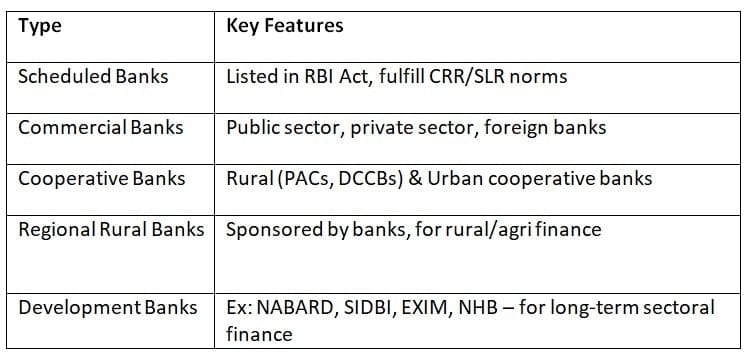
Banking System in India
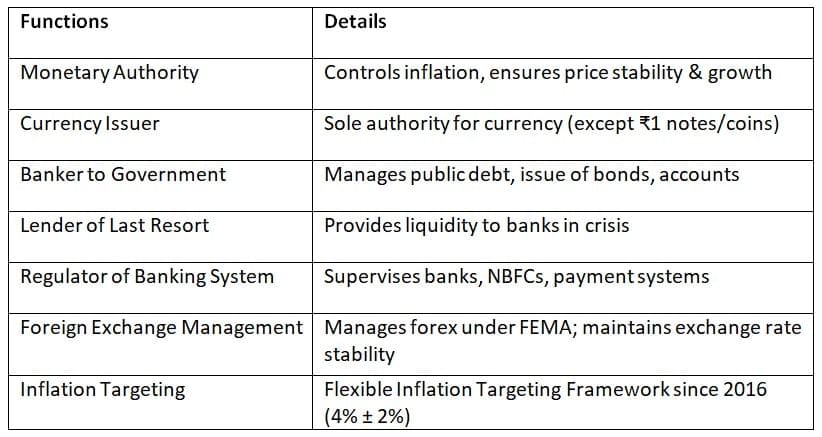
Central Bank - RBI
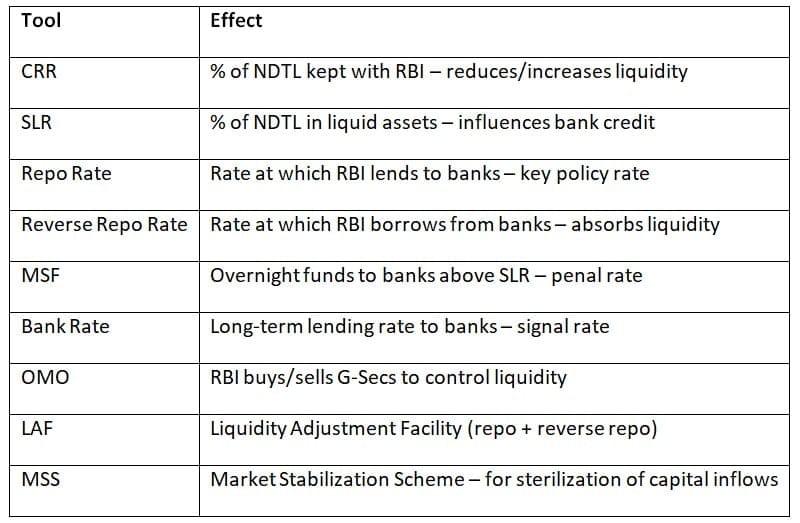
Monetary Policy Instruments
Types of Banking Systems
- Universal Banking - One-stop financial services under one roof.
- Narrow Banking - Invest only in safe instruments (e.g., G-Secs).
- Shadow Banking - Non-bank financial intermediaries (e.g., NBFCs).
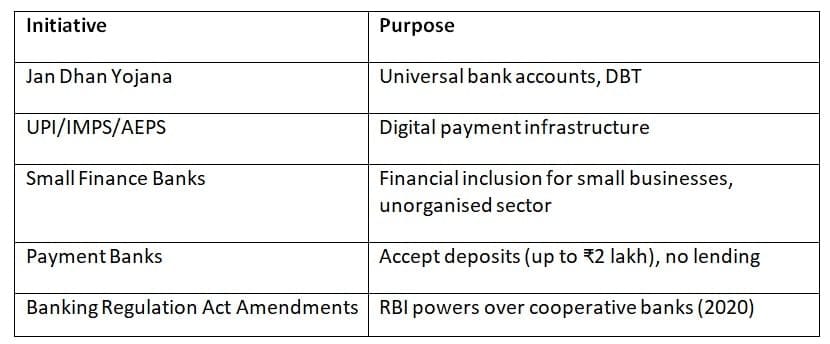
- Digital Banking - Neobanks, UPI, CBDC (e₹), payment banks.
Financial Inclusion & Reforms
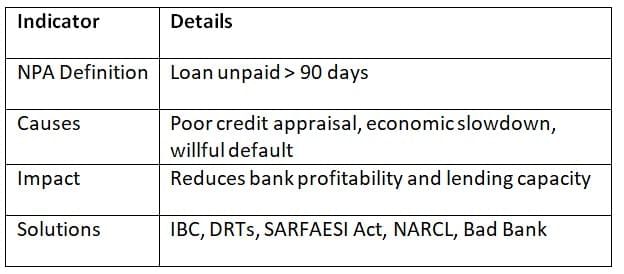
Non-Performing Assets (NPAs)
Recent Developments (2024-2025)
- RBI launched Digital Rupee (CBDC) - retail and wholesale pilots ongoing.
- Monetary Policy Committee (MPC) continues inflation targeting (April 2025 policy: Repo Rate 6.5%).
- UPI cross-border integration expanding with UAE, Singapore, France.
- Focus on strengthening bank governance and digitisation of cooperative banks.
The document Cheat Sheet: Money and Banking is a part of the UPSC Course Indian Economy for UPSC CSE.
All you need of UPSC at this link: UPSC
FAQs on Cheat Sheet: Money and Banking
| 1. What is the definition of money and its primary functions? |  |
Ans. Money is a medium of exchange that facilitates transactions for goods and services. Its primary functions include serving as a unit of account, a store of value, and a medium of exchange. It provides a standard measure of value, allows individuals to save and defer consumption, and simplifies trade by eliminating the need for barter.
| 2. What are the measures of money supply as defined by the Reserve Bank of India (RBI)? | |
Ans. The measures of money supply as per the Reserve Bank of India typically include M1, M2, M3, and M4. M1 includes currency in circulation plus demand deposits with banks. M2 adds savings deposits to M1. M3 is the broad money supply, including M2 plus time deposits with banks. M4 includes M3 plus total deposits with post offices.
| 3. What role does the Reserve Bank of India (RBI) play as the central bank? | |
Ans. The Reserve Bank of India serves as the central bank of the country, responsible for regulating the monetary policy, issuing currency, managing foreign exchange, and overseeing the financial system. It aims to maintain price stability and ensure the smooth functioning of financial markets.
| 4. What are some common instruments of monetary policy used by the RBI? | |
Ans. The common instruments of monetary policy used by the RBI include the repo rate, reverse repo rate, cash reserve ratio (CRR), and statutory liquidity ratio (SLR). The repo rate is the rate at which the RBI lends to commercial banks, while the reverse repo rate is the rate at which it borrows from them. CRR is the percentage of deposits that banks must hold in reserve, and SLR is the percentage of their net demand and time liabilities that banks must maintain in safe and liquid assets.
| 5. What is financial inclusion, and why is it important in the context of banking reforms in India? | |
Ans. Financial inclusion refers to the process of ensuring access to financial services, such as banking, credit, insurance, and investment, for all individuals, especially those from disadvantaged groups. It is important as it promotes economic growth, reduces poverty, and enhances the overall financial health of the population, leading to more robust and inclusive economic development. Banking reforms aimed at increasing financial inclusion have focused on expanding branch networks, promoting digital banking, and enhancing financial literacy.
About this Document

4.93/5 Rating

Apr 30, 2026 Last updated
Related Exams
Document Description: Cheat Sheet: Money and Banking for UPSC 2026 is part of Indian Economy for UPSC CSE preparation. The notes and questions for Cheat Sheet: Money and Banking have been prepared according to the UPSC exam syllabus. Information about Cheat Sheet: Money and Banking covers topics like and Cheat Sheet: Money and Banking Example, for UPSC 2026 Exam. Find important definitions, questions, notes, meanings, examples, exercises and tests below for Cheat Sheet: Money and Banking.
Introduction of Cheat Sheet: Money and Banking in English is available as part of our Indian Economy for UPSC CSE for UPSC & Cheat Sheet: Money and Banking in Hindi for Indian Economy for UPSC CSE course. Download more important topics related with notes, lectures and mock test series for UPSC Exam by signing up for free. UPSC: Cheat Sheet: Money and Banking
Description
Cheat Sheet: Money & Banking of Indian Economy to help you remember important concepts with short tricks. Start learning for UPSC exam & improve retention with EduRev.
Information about Cheat Sheet: Money and Banking
In this doc you can find the meaning of Cheat Sheet: Money and Banking defined & explained in the simplest way possible. Besides explaining types of Cheat Sheet: Money and Banking theory, EduRev gives you an ample number of questions to practice Cheat Sheet: Money and Banking tests, examples and also practice UPSC tests



Related Searches
Cheat Sheet: Money and Banking, Cheat Sheet: Money and Banking, pdf , Free, video lectures, Previous Year Questions with Solutions, practice quizzes, Exam, Important questions, MCQs, ppt, study material, Extra Questions, Objective type Questions, shortcuts and tricks, mock tests for examination, Viva Questions, Semester Notes, Cheat Sheet: Money and Banking, past year papers, Summary, Sample Paper;