NCERT Solutions: The Frog

Let us Think (Page 56)
A. Answer the following questions
Q1: Where does the frog like to sit or spend time?
Ans: The frog likes to sit in ponds, in the rain, or in a muddy drain.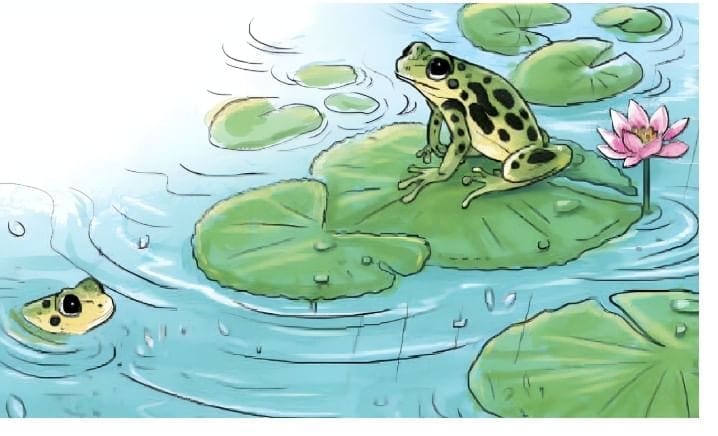
Q2: How does the frog catch its food?
Ans: The frog catches its food by quickly flicking out its tongue.
Q3: How does the frog move in water and on land?
Ans: In water, the frog swims with its webbed feet. On land, it hops and jumps high.
Q4: What helps the frog hide in its surroundings?
Ans: The frog's colours, which match plants and trees, help it hide in grass and leaves.
B. Think and discuss
Q1: What would it feel like to live like a frog, both in water and on land?
Ans: Living like a frog would feel exciting because I could swim in water and hop on land. It would be fun to live in damp places, but also a little scary to stay safe from snakes.
Q2: If you could hop as high as a frog, what fun things would you do?
Ans: If I could hop as high as a frog, I would jump across puddles, play hopping games with my friends, and even try to touch low tree branches.
Q3: How is a frog's life different from a fish's life?
Ans: A frog can live both on land and in water, while a fish can live only in water. Frogs hop and swim, but fish only swim. Frogs catch insects with their tongue, while fish eat food in the water.
Q4: How are frogs' webbed feet similar to the flippers used by scuba divers?
Ans: Frogs' webbed feet and scuba divers' flippers are similar because both help them swim easily by pushing water back.
Let us Learn (Page 57)
A. Choose the correct words from the brackets and fill in the blanks.
1. My colours match the plants ............... trees.(or/and)
2. Would you like to learn about frogs ...............tadpoles? (because/and)
3. I hop around happily, ............... I must watch out for snakes! (but/so)
4. Frogs swim easily ............... they have webbed feet. (because/or)
Ans:
1. My colours match the plants and trees.
2. Would you like to learn about frogs and tadpoles?
3. I hop around happily but I must watch out for snakes!
4. Frogs swim easily because they have webbed feet.
B. The following words have been rearranged into sentences. Choose the correct option.
1. hunts/night/the/silently/tiger/at
Options:
a. The tiger hunts silently at night.
b. Tiger hunts the silently at night.
c. Hunts the tiger at night silently.
2. elephants/in/forests/live/large/groups/in
Options:
a. Elephants live large in groups forests.
b. In groups large, elephants live in forests.
c. Elephants live in large groups in forests.
3. web/a/spider/carefully/its/weaves
Options:
a. A spider carefully weaves its web.
b. Spider carefully weaves its web a.
c. Carefully a spider weaves web its.
4. crocodile/waits/the/silently/riverbank/the/near
Options:
a. Crocodile waits the silently the near riverbank.
b. The silently crocodile waits near the riverbank.
c. The crocodile waits silently near the riverbank.
5. a/swims/turtle/slowly/in/ocean/the
Options:
a. A turtle swims slowly in the ocean.
b. Swims turtle slowly an ocean in.
c. The ocean swims a slowly turtle in.
Ans:
1. a. The tiger hunts silently at night.
2. c. Elephants live in large groups in forests.
3. a. A spider carefully weaves its web.
4. c. The crocodile waits silently near the riverbank.
5. a. A turtle swims slowly in the ocean.
Let us Speak (Page 58)
A. Three tongue twisters are given below. Try speaking each tongue twister slowly at first. Gradually increase your speed with each repetition. Count how many times you can say it correctly without making a mistake.
This is a classroom activity. Practice saying the tongue twisters:
1. Four fierce frogs fight for flies.
2. Fast frogs flip-flop across fluffy fields.
3. Funny frogs flap floppy feet.
Start slowly, then say them faster, and count how many times you say them correctly.
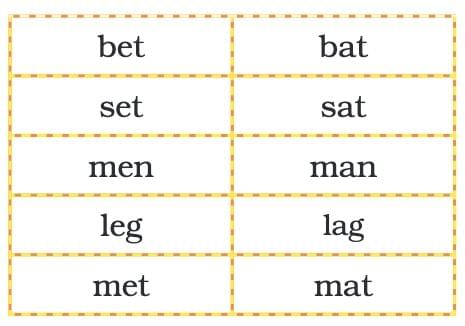
B. Listen and repeat.
Your teacher will say aloud the following pairs of words. Listen carefully and repeat each pair.
Let us Listen (Page 59)
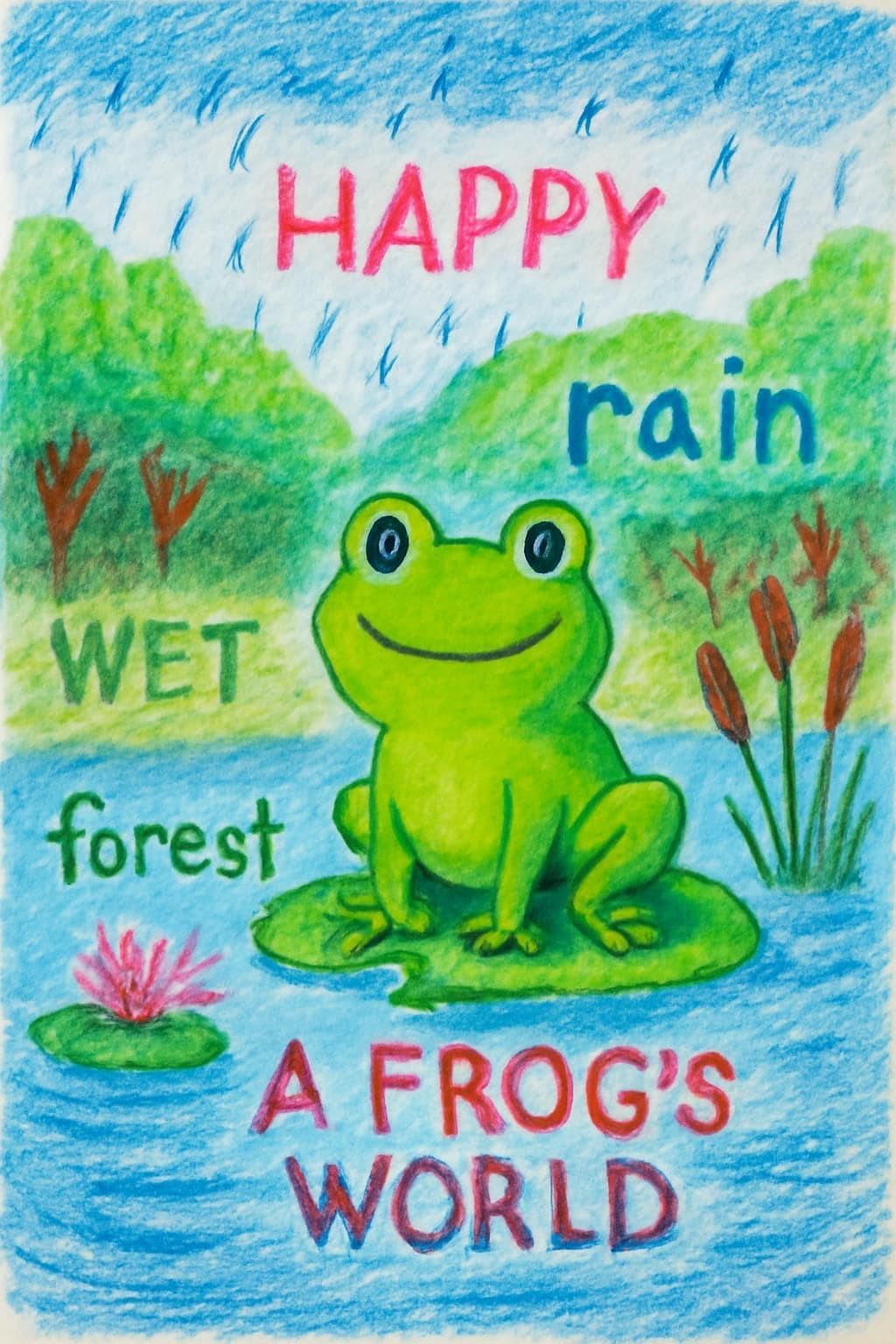
A. Your teacher will read out instructions for you to follow and create your own 'Frog's World'.
1. Draw the place: Imagine a place where your frog might be happy, like a pond, a forest or a rainy area.
2. Draw your frog: Draw a frog in the above setting.
3. Decorate with words: Around your drawing, write some words from the poem that describe the frog's life. You can even write your own short sentence about the frog's world.
4. Colour it: Use colours to bring your frog's world to life! Be creative and make it as colourful as you would like.
1. Draw a pond, forest, or rainy area.
2. Draw a frog in that place.
3. Write words from the poem like "hop," "croak," or "webbed" around the drawing.
4. Colour the drawing to make it bright and lively.
Let us Write (Page 61)
Here is a message for you from Hopper, the frog.
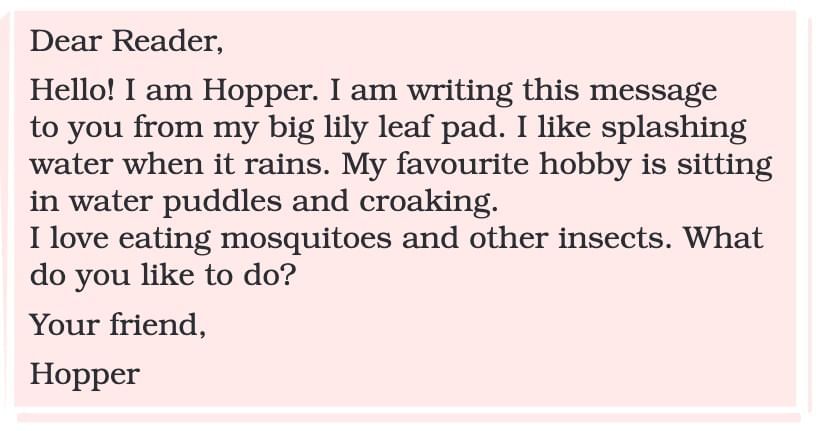
Dear Hopper,
Hello! I was very happy to get your message from your big lily leaf pad. Splashing in the rain and croaking in puddles sounds like great fun! I like playing games with my friends, reading storybooks, and running in the park. My favourite snack is fruits. What else do you enjoy in your pond?
Your friend,
[Your Name]
FAQs on NCERT Solutions: The Frog
| 1. What does the frog do when it gets frightened in the poem "The Frog"? |  |
| 2. Why does the frog live in a wet place like a pond or marsh? | |
| 3. How does "The Frog" poem help you understand animal behaviour and characteristics? | |
| 4. What are the main differences between how frogs move and how other animals move? | |
| 5. How should students approach answering comprehension questions about "The Frog" for their CBSE exams? | |