NCERT Solutions: Reshaping India’s Political Map


Page No. 21
The Big Questions
Q1: How did foreign invasions and the rise of new dynasties reshape India's political boundaries during this period?
Ans: Between the 11th and 17th centuries, foreign invasions and the emergence of new dynasties repeatedly reshaped India's political boundaries. Turkic and Afghan invasions led to the establishment of the Delhi Sultanate, which brought large parts of northern India under a single authority. Later, Babur's victory in 1526 laid the foundation of the Mughal Empire, which expanded over much of the subcontinent under rulers like Akbar and Aurangzeb. At the same time, powerful regional kingdoms such as the Vijayanagara and Bahmani states in the Deccan, the Ahoms in the northeast, and Rajput kingdoms in Rajasthan controlled their own territories. Repeated invasions, regional resistance, and the rise and fall of dynasties caused India's political map to change continuously over several centuries.
Q2: How did Indian society respond to invasions? How did India's economy adapt during times of political instability?
Ans: Indian society showed courage and unity during invasions. The Vijayanagara kings, the Ahoms, and the Rajputs bravely resisted foreign rulers, while the Sikh Khalsa stood for justice and freedom.
Despite wars, the economy remained strong. Farmers grew crops using good irrigation, and trade continued through ports like Calicut and Surat. Merchants used the hundi system to send money safely. Temples and artisans supported local business. So, though rulers changed often, the people kept the economy running.
Q3: What impact did this period have on the lives of the people?
Ans: This period had mixed effects on the lives of the people. Frequent wars, heavy taxation, and political instability often caused hardship for peasants and common people. At the same time, the growth of towns, trade, and crafts provided opportunities for merchants and artisans. The period also witnessed significant cultural developments, including temple architecture in the south and monumental Mughal buildings. Many individuals and communities displayed courage and resilience, and village-level institutions continued to provide support and stability. Overall, while life was often difficult, social and cultural life continued to develop despite political changes.
Page No. 26
Let's Explore
Q1: Looking at Fig. 2.6, why do you think Ala-ud-din Khilji called himself 'the second Alexander'?
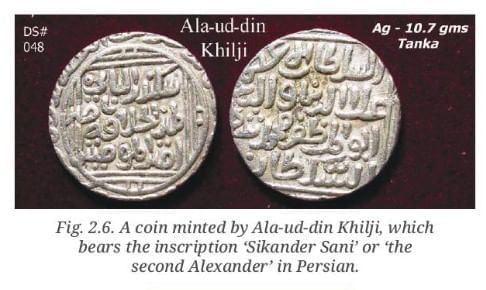
Ans: Ala-ud-din Khilji adopted the title "the second Alexander" to convey his ambition and military prowess. By comparing himself to Alexander the Great, he emphasised his desire to be remembered as a great conqueror and to project power and authority over a large empire.
Q2: What kind of resources do you think were needed to maintain an army and wage war in those days? Discuss in groups the various types of expenditure involved, from weapons or food for soldiers to animals used in warfare, road construction, etc.
Ans: Maintaining an army in medieval times required several kinds of resources, including:
- Weapons: Swords, bows and arrows, and later, artillery using gunpowder, were essential for combat.
- Food Supplies: Regular supplies of grain and other provisions were necessary for soldiers and animals.
- Animals: Horses, elephants and camels were important for transport, cavalry and heavy work in war.
- Infrastructure: Roads, bridges and fortified routes were needed to move troops and supplies quickly.
- Financing: Funds came from taxes, land revenues and sometimes plunder; these paid soldiers' wages, bought equipment and maintained forts.
- Artisans and Labour: Skilled craftsmen produced weapons and armour, while labourers built fortifications and maintained supply lines.
Page No. 28
Think About It
Q1: Why do we use the term 'image' rather than common terms like 'idol' or 'icon'? The latter two terms are considered pejorative in the context of Judaism, Christianity and Islam, whose orthodox sects condemn 'idolatry' or the worship of 'idols' or 'icons'.
India's classical texts used words like murti, vigraha, pratima, rupa, etc., to designate images, often statues, used for worship in temples or homes. In English, 'image' is a neutral term.
Ans: We use the word image because the words idol and icon can carry negative meanings in some religions, such as certain forms of Christianity and Islam, which oppose idol worship. Classical Indian terms like murti and pratima are neutral and descriptive. Thus, using the neutral English term image is respectful and avoids the negative connotations that other words sometimes have.
Page No. 29
Think About It
Q2: During the time of the Tughlaqs, the Musunuri Nayakas, Telugu chieftains, rallied over 75 more chieftains of the region, formed a confederacy that defeated smaller provinces, formed a confederacy that defeated the Delhi Sultanate forces, and expelled Muhammad bin Tughlaq's army from Warangal (present-day Telangana) around 1330-1336. Do you think it would have been an easy task to bring together 75 leaders in those days?
Ans: No, it would not have been easy. Communication was slow and travel difficult, and local chiefs often had rival interests. Bringing together over 75 leaders would have required skilful leadership, careful negotiation and a clear common goal. The success of the Musunuri Nayakas shows they could persuade many chiefs to cooperate for the shared aim of driving out the Delhi Sultanate's forces.
Page No. 31
Let's Explore
Q3: Why do you think such locations were chosen for many of the medieval forts? Discuss pros and cons. (Hint: think of issues of strategy, security, vulnerability, etc.)
Ans: Medieval forts, such as Kumbhalgarh, were often built in places like the Aravalli hills for clear strategic reasons:
- The high ground gave defenders a strong advantage against attackers.
- Elevation and visibility made it easier to spot approaching enemies early.
- Nearby forests provided timber and other resources for the fort.
- Steep slopes and rough terrain made direct assaults difficult.
There were drawbacks as well:
- Remote hill forts could be hard to reinforce quickly in times of danger.
- Supplying food, water and building materials was more difficult and costly.
Overall, the defence advantages often outweighed the difficulties, which is why many rulers chose such sites.
Page No. 32
Think About It
Q3: Have you noticed the term pati in titles like 'Gajapati'? Pati means 'lord' or 'master' and was commonly used by many ruling dynasties of this period to signify power and stature. The Vijayanagara kings were called 'Narapati\", the Bahmani Sultanate rulers 'Ashwapati', and the Maratha rulers 'Chhatrapati' - each title reflecting different aspects of kingship and power. Can you guess what these three terms might mean?
Ans: The term pati in royal titles indicates lordship or mastery. The three titles mean:
- Narapati: Literally "lord of men", used by the Vijayanagara rulers to stress authority over people and society.
- Ashwapati: Literally "lord of horses", used to emphasise the importance of cavalry and mounted power.
- Chhatrapati: Often rendered as "supreme sovereign", used by the Maratha rulers to indicate supreme political authority.
Page No. 35
Let's Explore
Q4: In Fig. 2.14, what elements do you observe? What do they tell you about life then? (Hint: observe the weapons, the animals, the activities.)
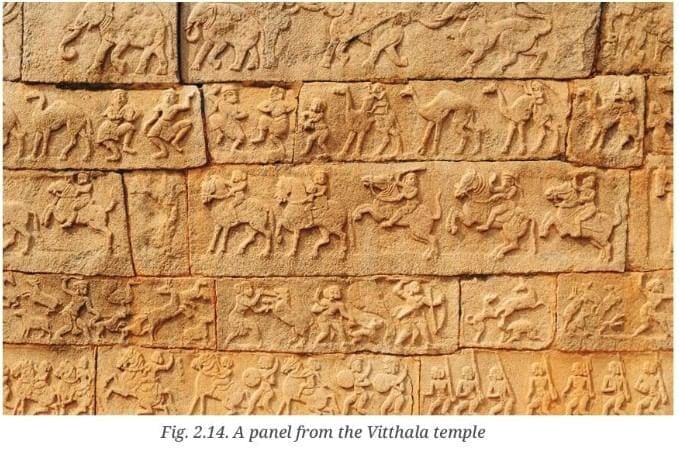
Ans: The figure from the Vitthala temple shows several important features:
- Weapons: Depictions of swords, spears and shields indicate the prominence of armed conflict and the skills of warriors.
- Animals: Horses appear often, showing their importance for transport and warfare.
- Activities: Scenes of battle and military manoeuvres suggest that warfare and military training were significant parts of life.
Taken together, these elements suggest a society in which military skill and animals such as horses played a major role in politics, defence and the economy.
Page No. 37
Think About It
Q4: What strikes you in Babur's impressions of India? Discuss in groups.
Ans: Babur's impressions show a mixture of unfamiliarity and appreciation. He missed the cooler climate and familiar life of Central Asia and was sometimes critical of local customs and food. At the same time he noted India's wealth - abundant gold and silver, busy markets, skilled craftsmen and rich agricultural lands. His account reflects both his homesickness and his recognition of India's material prosperity and variety of cultures.
Page No. 40
Q5: Why do you think Akbar employed different strategies to expand his empire, while the earlier rulers of Delhi relied mostly on military might?
Ans: Akbar combined different strategies to extend and consolidate his empire rather than relying on force alone. His methods included:
- Diplomacy: Negotiations and alliances helped secure territories with less destruction and more stability.
- Marriage Alliances: Marriages into Rajput families and other alliances created political bonds and loyalty.
- Sulh-i-kul: The policy of religious tolerance encouraged cooperation from diverse religious and social groups.
Earlier Delhi sultans depended more heavily on military conquest, which often led to instability and rebellions when control rested mainly on force. Akbar's mixed approach-combining military strength with diplomacy and tolerance-helped create a larger, more stable empire.
Page No. 41
Let's Explore
Q5: Compare the maps in Figs. 2.3, 2.12 and 2.16. What differences do you notice? What is the 'reshaping' that has occurred?
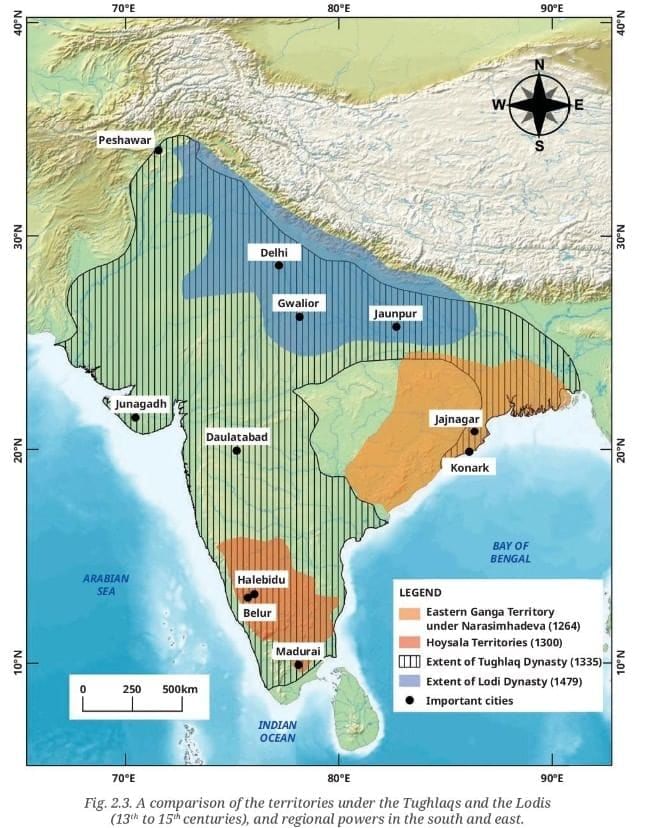
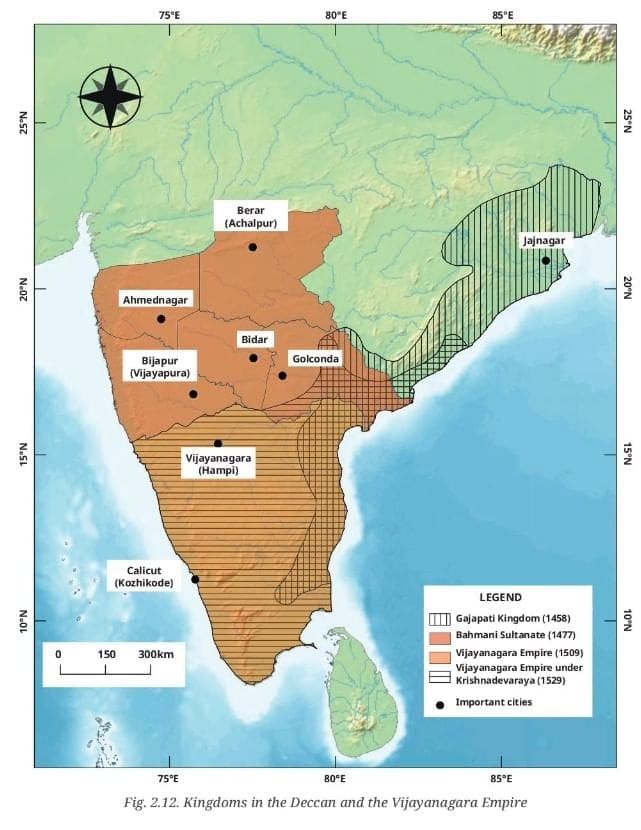
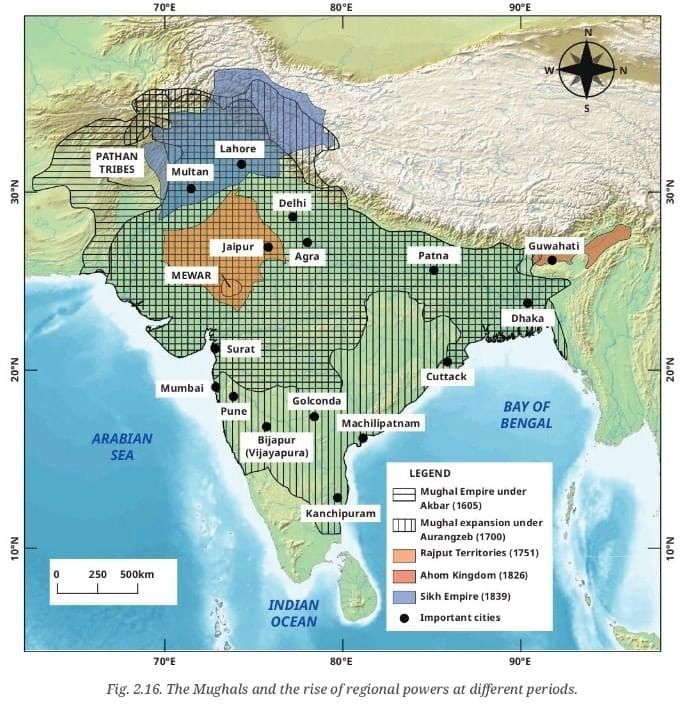
Ans: The three maps show how political control shifted over time. Fig. 2.3 shows the Delhi Sultanate's control mainly over northern India during the 13th to 15th centuries, while large parts of the south and east remained under independent regional kingdoms such as the Hoysalas and Eastern Gangas. Fig. 2.12 illustrates the rise of southern powers like the Vijayanagara Empire, the Bahmani Sultanate in the Deccan, and the Gajapati kingdom in the east, indicating regional fragmentation and strong local rule. Fig. 2.16 depicts the later Mughal Empire, which expanded under emperors such as Akbar and Aurangzeb to cover most of India, though some regions such as Rajputana and parts of the northwest continued to resist. The overall 'reshaping' involves a move from a northern-centred Sultanate to a period of powerful regional kingdoms, followed by the near-unification of much of India under the Mughals.
Page No. 43
Think About It
Q6: We saw above that Delhi sultans' average reign lasted about nine years. This figure becomes 27 years in the case of Mughal emperors up to Aurangzeb; and 16 years if we consider all Mughal rulers, up to the end of the empire in the 19th century. What do you make of these numbers of years of reign?
Ans: An average reign of about nine years for the Delhi sultans suggests political instability, frequent contests for the throne and shorter, often violent successions. The longer average of about 27 years for the Mughal emperors up to Aurangzeb points to greater administrative strength, stronger succession arrangements and more stable rule during that period. When the average drops to 16 years for all Mughal rulers up to the nineteenth century, it reflects the later decline of the empire, with increasing factionalism, weaker central control and shorter reigns among later rulers.
Page No. 45
Let's Explore
Q6: In his last letters to two of his sons, Aurangzeb wrote, "I came alone and am going away alone. I know not who I am and what I have been doing. ... I have not done well for the country and the people, and of the future there is no hope. I was helpless [in life] and I am departing helpless." What do these words tell us about Aurangzeb? How do you feel about them?
Ans: Aurangzeb's words show a sense of loneliness, regret and reflection near the end of his life. They suggest that he looked back on his actions - including the harsh measures he used to gain and hold power, such as imprisoning rivals and suppressing opposition - and felt that these had not benefited the country or its people. His words also show despair about the future and a feeling of helplessness in old age. Readers may feel sympathy for his human loneliness, but also be critical of the suffering caused by some of his policies and military campaigns.
Page No. 48
Let's Explore
Q7: Discuss in class how the paik system affected the daily lives of the people in the Ahom kingdom, both in terms of challenges and benefits, and helped the king manage both the army and the economy.
Ans: The paik system shaped life in the Ahom kingdom in several ways:
- The system gave able-bodied men land rights in return for periods of labour or military service.
- It provided economic security to households because land was allotted and could be used for cultivation when not on duty.
- The kingdom benefited by having a large, organised labour force and a ready reserve of soldiers without maintaining a large standing army permanently.
- Mandatory service could be a burden on families, disrupting regular farming and household routines.
- The system made it possible to build roads, embankments and other public works, improving agriculture and transport.
- It enabled efficient mobilisation for battles such as the Battle of Saraighat in 1671, demonstrating both military and administrative strengths.
Overall, the paik system helped the king manage the economy and defence, though it also placed obligations on ordinary people.
Page No. 49
Let's Explore
Q8: How did the Ahoms use the rivers, hills, and forests of Assam to their advantage? Can you think of ways in which the geography helped them build defences and fight wars?
Ans: The Ahoms used Assam's geography skilfully for defence and warfare:
- Dense forests and hills provided cover for troops and made large-scale enemy movements difficult.
- They used guerrilla tactics and ambushes suited to the landscape, as in the Battle of Saraighat (1671).
- The Brahmaputra River and its channels were used for transport, supply and defensive manoeuvres, complicating enemy navigation.
By exploiting local terrain and waterways, the Ahoms could defend their territory effectively against larger invading forces.
Page No. 52
Think About It
Q7: Why do you think Guru Tegh Bahadur endured torture rather than convert? Why did he think his sacrifice would make a difference?
Ans: Guru Tegh Bahadur chose to endure torture rather than convert because he wanted to defend the right of others to practise their religion freely, especially the Kashmiri Pandits. His willingness to suffer and die was an act of moral courage intended to inspire resistance to oppression and to uphold religious freedom. He believed that his sacrifice would set a strong example and encourage others to stand for justice and liberty.
Q8: What values did the Sikh Gurus and the Khalsa embody?
Ans: The Sikh Gurus and the Khalsa stood for several important values:
- Courage: They showed bravery in standing against injustice.
- Justice: They fought for fairness and the protection of the weak.
- Equality: They taught that all people are equal, rejecting caste and social discrimination.
- Selfless service: They promoted helping others without expecting reward (seva).
They also defended religious freedom and sought to create a strong, united community based on moral principles.
Q9: How are they relevant in today's world?
Ans: These values remain relevant because they encourage us to treat others fairly, stand against injustice, offer service to those in need and respect different beliefs. Practising courage, equality and selfless service helps build peaceful and inclusive communities today.
Page No. 59
Questions and activities
Q1: Compare the political strategies of the Delhi Sultanate and the Mughals. What similarities and differences existed between them?
Ans: There were both similarities and differences in the political strategies used by the Delhi Sultanate and the Mughal Empire. Similarities included reliance on military force to conquer territory, collection of taxes to fund the state, and governance through local officials or nobles. Differences were important: the Mughals developed a more organised administrative system, used marriage and alliance-building (especially with Rajputs), and practised policies of religious tolerance such as sulh-i-kul, which helped them secure loyalty from diverse groups. The Delhi sultans often depended more heavily on force and less on integration strategies, which contributed to more frequent instability.
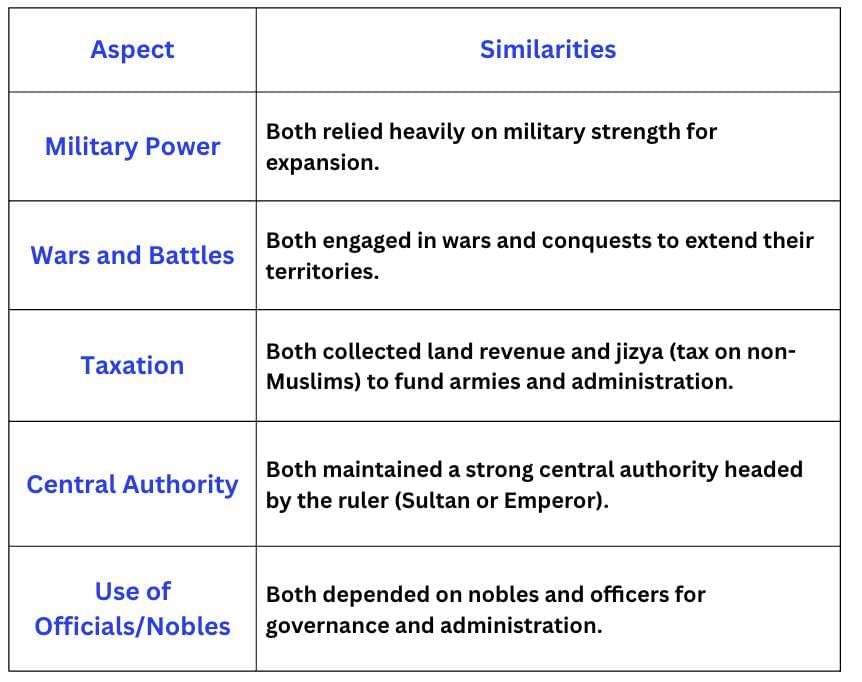
Differences between the Delhi Sultanate and the Mughal Empire political strategies are:
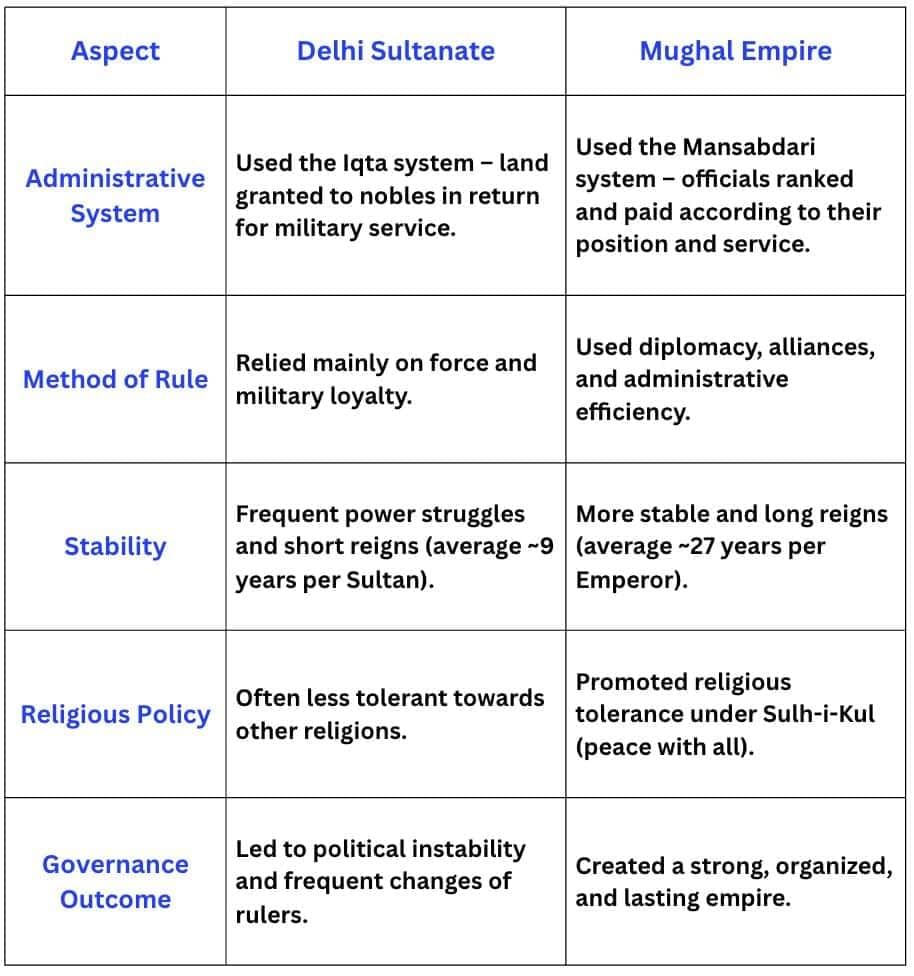
In summary, while both empires depended on war and taxes, the Mughals established a more organised and longer-lasting system of governance that combined force with policies to win co-operation from different social and regional groups.
Q2: Why did kingdoms like the Vijayanagara Empire and the Ahom Kingdom manage to resist conquest for a longer time compared to others? What geographical, military, and social factors contributed to their success?
Ans: Kingdoms such as the Vijayanagara Empire and the Ahom Kingdom resisted conquest for longer because of a combination of factors:
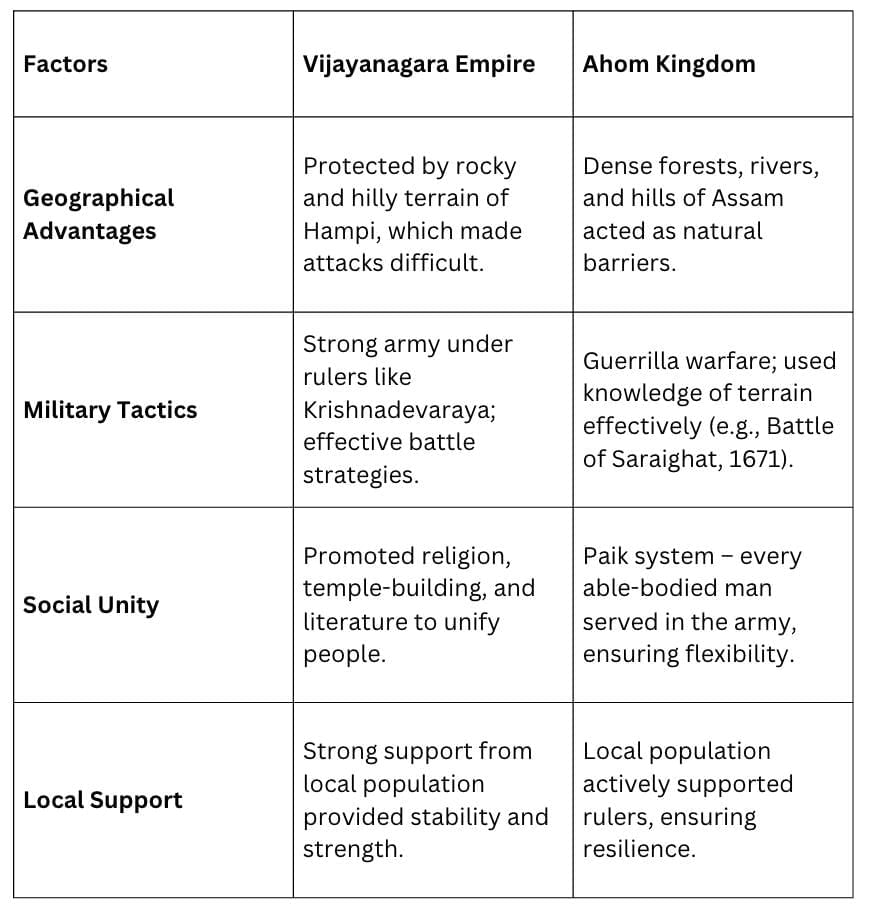
- Geography: Natural barriers such as hills, forests and rivers made invasion and occupation difficult.
- Military organisation: Strong local armies, effective use of cavalry or river fleets and tactics suited to local terrain gave them an edge.
- Local support: Strong ties with local elites, peasants and artisans helped sustain resistance and supply armies.
- Effective leadership: Capable kings and commanders maintained morale and organised defence.
These combined strengths helped them survive longer than many other kingdoms that lacked such advantages.
Q3: Imagine you are a scholar in the court of Akbar or Krishnadevaraya. Write a letter to a friend describing the politics, trade, culture, and society you are witnessing.
Ans:
Dear Friend,
I hope you are well. I write to tell you about life here in Vijayanagara under our great king, Krishnadevaraya. The empire is powerful and prosperous, ruling much of the Deccan. The king is a patron of arts and learning and encourages poets and scholars; he himself is credited with literary work. Our city is full of grand temples, palaces, gardens and busy markets; many say it rivals the great cities of the world. Traders from distant lands come to buy and sell goods, and the markets are always lively.
Life in the city is energetic and wealthy, though it is not without danger. After Krishnadevaraya's death in 1529 the empire faced difficulties, and in 1565 the Battle of Talikota brought great destruction when enemy forces defeated our army. Many buildings and temples were damaged and the political order changed, with local leaders, the Nayakas, gaining greater power. Still, the memory of Krishnadevaraya's rule and the cultural achievements of Vijayanagara remain strong in people's minds.
Yours sincerely,
(Scholar's name)
Q4: How come Akbar, a ruthless conqueror in his young days, grew tolerant and benevolent after some years? What could have led to such a change?
Ans: When Akbar became emperor at the young age of 13, his early rule was marked by military campaigns and harsh measures, such as the long siege of Chittor. Over time several factors contributed to his change of approach:
- Regular interaction with people of different faiths and cultures broadened his outlook.
- Marriage alliances with Rajput families helped build stable political ties.
- The influence of scholars and advisors in his court encouraged more inclusive policies.
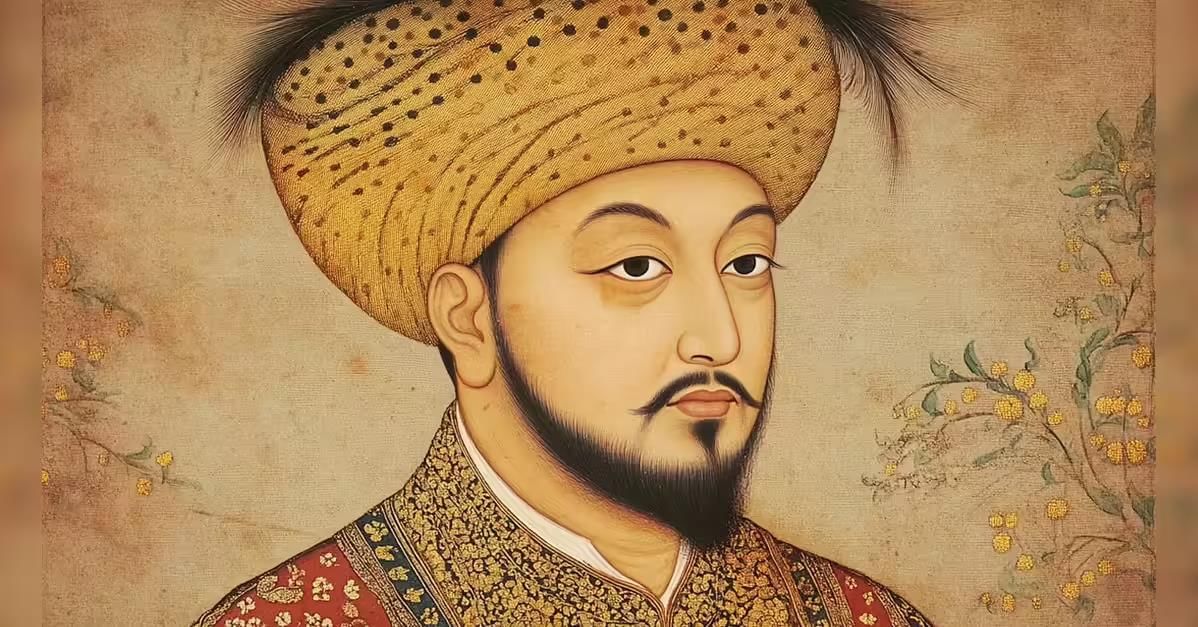
As a result, Akbar abolished the jizya tax on non-Muslims and promoted sulh-i-kul (peace with all), fostering religious tolerance and harmony. He came to prefer respect and cooperation over coercion because these brought more stability and unity. His historian Abul Fazl records that Akbar later rejected forced conversions as wrong and ineffective. Thus, political prudence, alliances and intellectual influence combined to change him from a harsh conqueror into a more tolerant ruler.
Q5: What might have happened if the Vijayanagara Empire had won the Battle of Talikota? Imagine and describe how it could have changed the political and cultural history of south India.
Ans: If the Vijayanagara Empire had won the Battle of Talikota in 1565, the history of south India might have followed a different path. Possible outcomes include:
- The Vijayanagara empire could have remained strong and united, preventing the rapid fragmentation into smaller principalities.
- It might have resisted further invasions from the Deccan Sultanates and posed a sustained challenge to the Mughals, altering the balance of power in peninsular India.
- Art, literature and temple architecture could have flourished further, drawing more poets, scholars and craftsmen to the kingdom.
- Cities such as Vijayanagara might have grown into larger centres of trade and culture, attracting merchants and artisans from farther afield.
- South India could have remained a strong and influential political region for a longer period, shaping its identity and heritage more continuously.
Q6: Many values promoted by early Sikhism, including equality, seva, and justice, remain relevant today. Select one of these values and discuss how it remains relevant in contemporary society.
Ans: The value of equality, taught by Guru Nanak, is very important even today. He taught that all people are equal before God (Ik Onkar) and rejected caste and religious discrimination. Later Gurus, such as Guru Tegh Bahadur, defended the right of others to practise their faith. In modern societies, equality helps us to respect everyone, ensure fair treatment and work towards inclusive schools, workplaces and communities.
Q7: Imagine you are a trader in a port city (Surat, Calicut, or Hooghly). Describe the scenes you see as regards goods, people you trade with, movement of ships, etc.
Ans: As a trader in Surat, I would see a busy, prosperous port where ships from Arabia, Persia and Africa arrive with silk, horses and other goods, while we export cotton textiles, spices and jewellery. Labourers unload cargo, merchants haggle in crowded markets and brokers arrange deals. The hundi system helps transfer money safely over long distances. People of many backgrounds live and trade together, making Surat a thriving centre of commercial activity.
FAQs on NCERT Solutions: Reshaping India’s Political Map
| 1. What were the main reasons India's political map was redrawn after independence? |  |
| 2. How did the integration of princely states change India's political structure? | |
| 3. What is the difference between linguistic states and the old administrative divisions in India? | |
| 4. Why did India need a States Reorganisation Commission to reshape its political map? | |
| 5. How does understanding India's political map reshaping help in CBSE Class 8 Social Studies exams? | |