NCERT Solution: The Decision of the Panchayat


Let us Think (Page 95)
A. Answer the following questions
Q1: Why did the farmer buy the well?
Ans: The farmer bought the well so that he would have a steady source of water to irrigate his fields and grow crops.
Q2: Why did the farmer become upset?
Ans: The farmer became upset because his neighbour would not let him take water from the well and claimed that the water still belonged to him.
Q3: How did the Panchayat solve the problem?
Ans: The Panchayat listened to both men and reasoned that if the neighbour insisted the water was his, he must remove it from the farmer's well; if he did not, then the water would belong to the farmer.
Q4: What was the final judgment given by the Panchayat?
Ans: The Panchayat decided that the neighbour must either remove the water he claimed or stop claiming it; if he did not remove it, the water would belong to the farmer.
B. Think and discuss
a. "I sold only the well, not the water,"
b. "Remove the water or use it all up immediately,"
c. "He is not letting me take the water."
Ans:
- The neighbour said (a) to the farmer and to the Panchayat.
- The village chief said (b) to the neighbour.
- The farmer said (c) to the village chief.
Let us Learn (Page 96)
A. Match the words with their meanings

1-f
2-a
3-e
4-c
5-b
6-d
B. Fill in the blanks with the correct prepositions (in, at, by, after, before, under, with, to, for). A preposition can be used more than once.
1. The farmer went ................... the village chief to explain his problem.
2. The neighbour was standing ................... the well, blocking the way.
3. The villagers tried to reason ................... the cunning man.
4. The decision was made ................... careful consideration of both sides.
5. There lived a farmer ................... the small village.
6. The Panchayat members listen to both sides ................... coming to a decision.
7. The villagers gathered the Panchayat................... the banyan tree.
8. The neighbour was punished ................... his dishonesty.
9. The chief listened carefully ................... both the farmer and the neighbour.
10. The villagers agreed to meet ................... a later time to discuss the issue.
11. The farmer decided to buy a well ...................buying his third field.
Ans: 1. The farmer went to the village chief to explain his problem.
2. The neighbour was standing by the well, blocking the way.
3. The villagers tried to reason with the cunning man.
4. The decision was made after careful consideration of both sides.
5. The farmer lived in the small village.
6. The Panchayat members listened to both sides before coming to a decision.
7. The villagers gathered the Panchayat under the banyan tree.
8. The neighbour was punished for his dishonesty.
9. The chief listened carefully to both the farmer and the neighbour.
10. The villagers agreed to meet at a later time to discuss the issue.
11. The farmer decided to buy a well after buying his third field.
C. Rearrange the events in the correct order

Ans:

Let us Speak (Page 98)
Look at the Pictures below
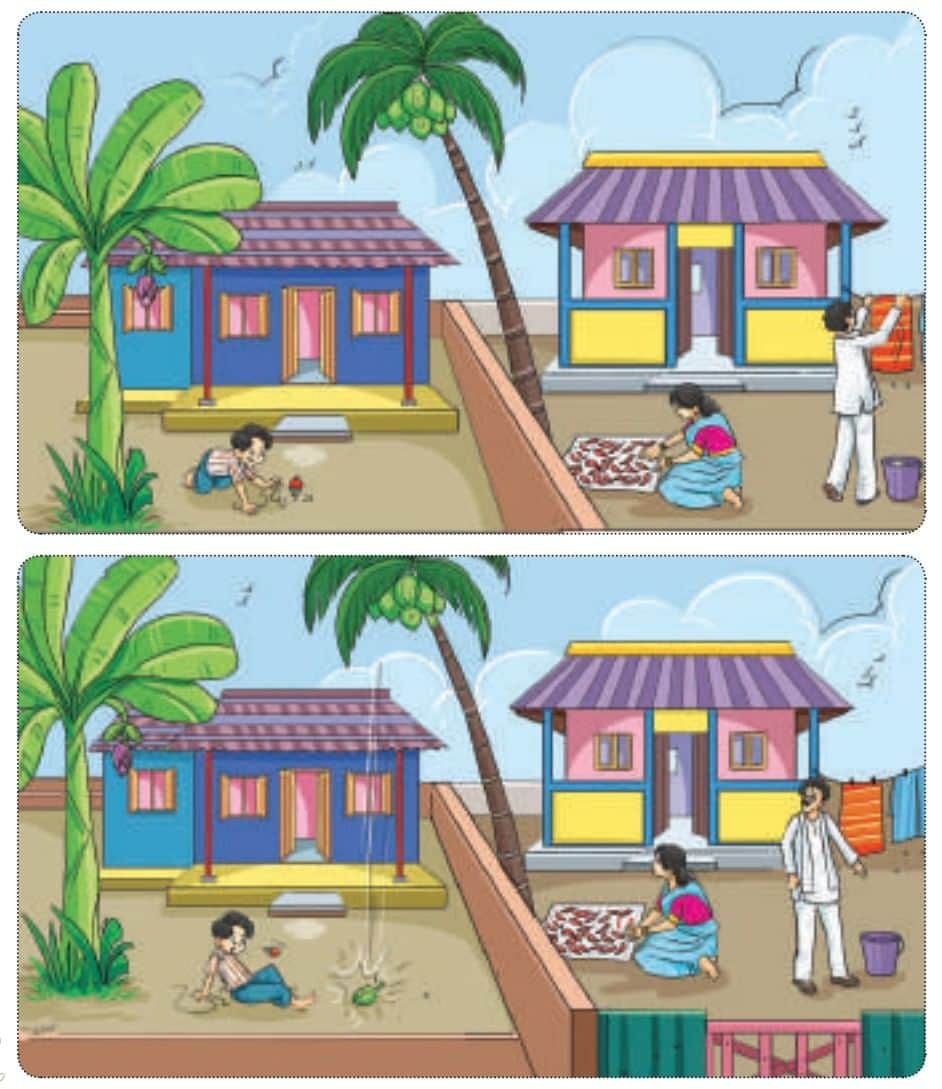
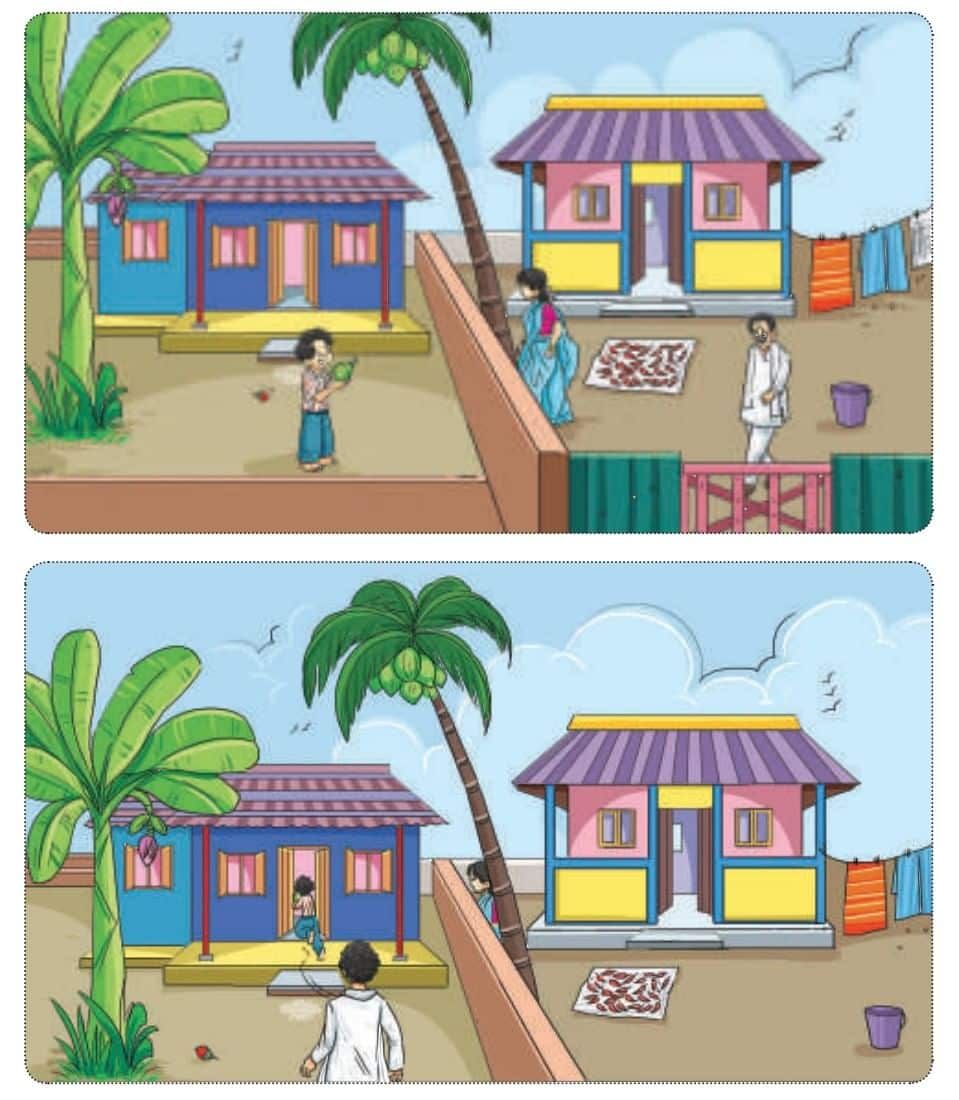
- The man may see the child crying and ask what happened. He may help the family.
- The man may come closer and help clean the place or fix the problem.
- Neighbours might start to share coconuts in future.
- The neighbours may help each other and live peacefully.
Let us Write (Page 100)
A. Imagine you are the farmer. Write a letter to your friend about the incident and the decision of the Panchayat. You may begin as follows:
My dear friend,
Something happened last week which I want to tell you. I wanted to buy a well ...
My dear friend,
Something happened last week which I want to tell you. I bought a well for my fields so that I could water my crops. The next day my neighbour stopped me from taking water. He said he had sold only the well, not the water. I was very upset and went to the village chief. The Panchayat met under the banyan tree and listened to both of us. They decided that if the neighbour still claimed the water he must take it away, but if he did not, the water would belong to me. The neighbour agreed, apologised and paid a fine. I am relieved because now I can use the water for my fields.
Yours sincerely,
The Farmer
B. Read the Following


Make sentences using the new words in your notebook.
1. Use + less = useless.
Sentence: The broken tool was useless for farming.
2. Hope + less = hopeless.
Sentence: The farmer felt hopeless when he could not get water.
3. Care + less = careless.
Sentence: Being careless with water wastes it.
4. Fear + less = fearless.
Sentence: The fearless farmer spoke to the Panchayat confidently.
5. Colour + less = colourless.
Sentence: The glass of water looked colourless and clear.
Let us Listen (Page 101)
Listen to your teacher read out this passage and answer the questions by choosing the correct option.

1. Where was Sri Ramakrishna Paramahamsa born?
Ans: (b)
Explanation: He was born in a small village in West Bengal, which is why option (b) is correct.
2. Who was the curious boy that became Sri Ramakrishna's student?
Ans: (b)
Explanation: The curious boy who became his student was Swami Vivekananda (Naren), so option (b) is correct.
3. What kind of life did Sri Ramakrishna live?
Ans: (b)
Explanation: He lived a simple and loving life, so option (b) fits best.
4. What did Sri Ramakrishna compare religions to?
Ans: (c)
Explanation: He compared religions to rivers flowing to the ocean, which matches option (c).
5. What did Sri Ramakrishna teach Naren?
Ans: (d)
Explanation: He taught Naren how to find inner peace, so option (d) is correct.
Let us do (Page 103)
A. Read the passage carefully and answer the following questions.
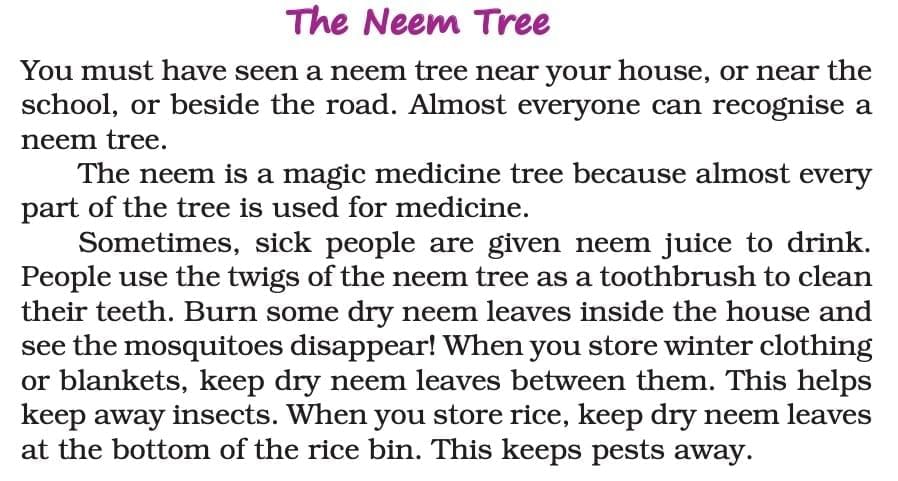
1. Where can you find neem trees?
Ans: Neem trees can be found near houses, schools or beside the roads in villages and towns.
2. Why do you think 'neem' is called a magic tree?
Ans: Neem is called a magic tree because many parts of the tree are useful for medicine and for keeping insects away.
3. What happens when dry neem leaves are burnt?
Ans: When dry neem leaves are burnt, mosquitoes and some other insects disappear from the area.
4. Why do people put neem leaves in clothes and rice containers?
Ans: People put neem leaves in clothes and rice containers to keep insects and pests away and protect the food and clothes.
5. How are neem twigs used?
Ans: Neem twigs are used as a toothbrush to clean teeth because they help keep the mouth clean.
6. Find the meaning of the word 'disappear' from the following options:
Ans: (b) Vanish
7. Find the word in the passage which means 'a short stick':
Ans: (c) Twig

Ans:
- Sun: In the top image, the sun has rays, while in the bottom image it does not.
- Tulsi Pot Design: The tulsi pot has a white border near the base in the top image; it is missing in the bottom image.
- Tulsi Plant: The tulsi plant has more leaves in the top image and fewer leaves in the bottom.
- Chappals: Blue slippers are outside in the top image; yellow slippers are in the bottom image.
- Border of Saree (Bottom): The woman's saree border has pink and green designs in the top image, while it is plain blue in the bottom.
- Pallu Border: The border of the saree pallu in the top image has a pink design; in the bottom image it is plain blue with pink at the edge.
- Bindi: The woman wears a red bindi in the top image; it is missing in the bottom image.
- Background Wall Design: The wall behind the tulsi pot has a green strip in the top image, which is missing in the bottom.
- Mud Pot Design (Top of Tulsi): The yellow part has a different wave design in the two images.
- Fan Handle: The design in the circular hand-fan is different in colour and style between the two images.
- Window Design: The window above the woman is open with bars in the top image; it has a blue glass pane in the bottom image.
FAQs on NCERT Solution: The Decision of the Panchayat
| 1. Who are the main characters in The Decision of the Panchayat and what roles do they play? |  |
| 2. What is the main conflict or problem that the panchayat has to solve in this story? | |
| 3. Why was the panchayat system important in villages and how did it work? | |
| 4. What lesson or moral does The Decision of the Panchayat teach us for Class 5 students? | |
| 5. How do the panchayat members reach their final decision in the story? | |