Q1: Consider the following statements in respect of the Non-Cooperation Movement: I. The Congress declared the attainment of 'Swaraj' by all legitimate and peaceful means to be its objective. II. It was to be implemented in stages with civil disobedience and non-payment of taxes for the next stage only if 'Swaraj' did not come within a year and the Government resorted to repression. Which of the statements given above is/are correct? (2025) (a) I only (b) II only (c) Both I and II (d) Neither I nor II
Solution:
Ans: (a) Statement I: Correct At the Nagpur session in 1920, the Indian National Congress declared that its goal was to achieve 'Swaraj' (self-rule) through legitimate and peaceful means. Statement II: Incorrect The Non-Cooperation Movement was planned in phases, but the given conditions are not fully accurate. Gandhi promised Swaraj within a year if the movement was followed earnestly. While civil disobedience and non-payment of taxes were potential strategies, they were not strictly contingent on Swaraj not being achieved within a year or on government repression. Gandhi retained the authority to decide when to initiate civil disobedience.
Q2: Consider the following subjects with regard to Non-Cooperation Programme: I. Boycott of law-courts and foreign cloth II. Observance of strict non-violence III. Retention of titles and honours without using them in public IV. Establishment of Panchayats for settling disputes How many of the above were parts of Non-Cooperation Programme? (2025) (a) Only one (b) Only two (c) Only three (d) All the four'
Solution:
Ans: (c) The Non-Cooperation Movement sought to oppose British rule through boycott and self-reliance while adhering to non-violence and promoting alternative institutions. Statement I: Correct
The movement prominently featured boycotts of British law courts and foreign cloth as key strategies.
Statement II: Correct
Gandhi emphasized strict adherence to non-violence throughout the movement.
Statement III: Incorrect
The programme called for the surrender of British titles and honours, not their retention.
Statement IV: Correct
Establishing Panchayats to resolve disputes locally was actively promoted.
Thus, the correct answer is: C (Only three statements are correct).
Q3: Subsequent to which one of the following events, Gandhiji, who consistently opposed untouchability and appealed for its eradication from all spheres, decided to include the upliftment of 'Harijans' in his political and social programme? (2025) (a) The Poona Pact (b) The Gandhi-Irwin Agreement (Delhi Pact) (c) Arrest of Congress leadership at the time of the Quit India Movement (d) Promulgation of the Government of India Act, 1935
Solution:
Ans: (a) Mahatma Gandhi prioritized the upliftment of Harijans (the term he used for the Depressed Classes) after rejecting the British Communal Award's proposal for separate electorates for them. Following the Poona Pact of 1932, an agreement with Dr. B.R. Ambedkar, Gandhi escalated his campaign against untouchability by establishing the Harijan Sevak Sangh and launching the 'Harijan' journal to advocate for their rights and social integration.
Q4: Consider the following statements about Raja Ram Mohan Roy: I. He possessed great love and respect for the traditional philosophical systems of the East. II. He desired his countrymen to accept the rational and scientific approach and the principle of human dignity and social equality of all men and women. Which of the statements given above is/are correct? (2025) (a) I only (b) II only (c) Both I and II (d) Neither I nor II
Solution:
Ans: (c) Raja Ram Mohan Roy was a reformer who valued Indian traditions while championing rational thought and social equality. Statement I: Correct He held traditional Eastern philosophies, such as Vedanta, in high regard but worked to reform them. Statement II: Correct He promoted rationalism, scientific thinking, and the equality of all individuals, regardless of gender. Thus, the correct answer is: C (both statements are correct).
Q5: Who among the following was the founder of the 'Self-Respect Movement'? (2025) (a) 'Periyar' E. V. Ramaswamy Naicker (b) Dr. B. R. Ambedkar (c) Bhaskarrao Jadhav (d) Dinkarrao Javalkar
Solution:
Ans: (a) The Self-Respect Movement, started in 1925, aimed to dismantle caste hierarchies and promote social equality, especially for non-Brahmin communities in Tamil Nadu. He founded the Self-Respect Movement to fight caste oppression and promote rationalism and equality.
Q6: Who provided legal defence to the people arrested in the aftermath of Chauri Chaura incident? (2025) (a) C. R. Das (b) Madan Mohan Malaviya and Krishna Kant (c) Dr. Saifuddin Kitchlew and Khwaja Hasan Nizami (d) M. A. Jinnah
Solution:
Ans: (b) Following the Chauri Chaura incident in 1922, numerous individuals were arrested and faced harsh punishments, including death sentences. Legal intervention played a crucial role in mitigating these penalties. Option B: Madan Mohan Malaviya and Krishna Kant - Correct Madan Mohan Malaviya, along with his son Krishna Kant, provided legal defense for the accused, successfully securing significant sentence reductions and saving many from execution.
Q7: 'Sedition has become my religion' was the famous statement given by Gandhiji at the time of (2025) (a) the Champaran Satyagraha (b) publicly violating Salt Law at Dandi (c) attending the Second Round Table Conference in London (d) the launch of the Quit India Movement
Solution:
Ans: (b) During the Salt Satyagraha, Mahatma Gandhi declared, "Sedition has become my religion," reflecting his bold, non-violent defiance of British authority. Option B: Publicly violating Salt Law at Dandi - Correct Gandhi made this striking statement during the Salt March of 1930, after deliberately breaking the Salt Law at Dandi.
Q8: Consider the following fruits: I. Papaya II. Pineapple III. Guava How many of the above were introduced in India by the Portuguese in the sixteenth and seventeenth centuries? (2025) (a) Only one (b) Only two (c) All the three (d) None
Solution:
Ans: (c) Papaya, pineapple, and guava are fruits not native to India, originating in the Americas and introduced during European colonial expansion, primarily by the Portuguese. Statement I: Papaya - Correct Originating in Central America, papaya was brought to India by the Portuguese in the 16th century. Statement II: Pineapple - Correct Native to South America, pineapple was introduced to India by Portuguese explorers. Statement III: Guava - Correct Guava, originating from Central America, was introduced to India by the Portuguese in the 17th century.
Q9: With reference to the Government of India Act, 1935, consider the following statements: 1. It provided for the establishment of an All India Federation based on the union of the British Indian Provinces and Princely States. 2. Defence and Foreign Affairs were kept under the control of the federal legislature. Which of the statements given above is/are correct? (2024) (a) 1 only (b) 2 only (c) Both 1 and 2 (d) Neither 1 nor 2
Solution:
Ans: (a) Statement 1: Correct The Government of India Act, 1935, envisioned an All India Federation uniting British Indian Provinces and Princely States, but it never fully took shape due to the unwillingness of many Princely States to participate. Statement 2: Incorrect The Act assigned critical areas like Defence and Foreign Affairs to the Governor General, acting for the British Crown, rather than the federal legislature, thereby preserving British authority over these vital domains.
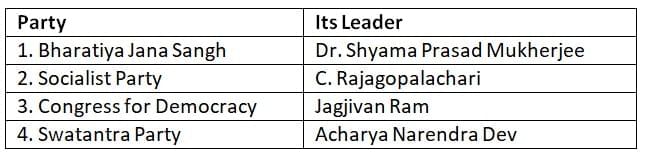
Q10: Consider the following pairs: How many of the above are correctly matched? (2024) (a) Only one (b) Only two (c) Only three (d) All four
Solution:
Ans: (b) Bharatiya Jana Sangh | Dr. Shyama Prasad Mukherjee: Correct Dr. Shyama Prasad Mukherjee founded the Bharatiya Jana Sangh (BJS), the precursor to the Bharatiya Janata Party (BJP), and served as its first president. Socialist Party | C. Rajagopalachari: Incorrect C. Rajagopalachari established the Swatantra Party, which promoted free-market principles. The Socialist Party, founded in 1934, was led by figures like Acharya Narendra Dev, Jayaprakash Narayan, Yusuf Mehrali, Mino Masani, Acchut Patwardhan, and Ashok Mehta. Congress for Democracy | Jagjivan Ram: Correct Jagjivan Ram founded the Congress for Democracy (CFD) in 1977 after splitting from the Indian National Congress during the Emergency to oppose Indira Gandhi's regime. The CFD was short-lived and later merged with the Janata Party. Swatantra Party | Acharya Narendra Dev: Incorrect The Swatantra Party was founded by C. Rajagopalachari in 1959 to advocate for free-market policies, opposing the Congress's socialist agenda. Acharya Narendra Dev was a prominent leader of the Socialist Party, not the Swatantra Party. Thus, only two pairs are correctly matched, making the answer B.
Q11: With reference to revenue collection by Cornwallis, consider the following statements: 1. Under the Ryotwari Settlement of revenue collection, the peasants were exempted from revenue payment in case of bad harvests or natural calamities. 2. Under the Permanent Settlement in Bengal, if the Zamindar failed to pay his revenues to the state, on or before the fixed date, he would be removed from his Zamindari. Which of the statements given above is/are correct? (2024) (a) 1 only (b) 2 only (c) Both 1 and 2 (d) Neither 1 nor 2
Solution:
Ans: (b) Statement 1: Incorrect The Ryotwari System, introduced primarily in the Madras (now Tamil Nadu) and Bombay (now Mumbai) presidencies by Alexander Reed and Thomas Munro, aimed to establish direct relations with cultivators (ryots). However, it did not provide a blanket exemption from revenue payments during poor harvests or calamities. Although some provisions for remission existed, they were neither automatic nor guaranteed. Statement 2: Correct The Permanent Settlement, introduced by Lord Cornwallis in 1793 in Bengal, Bihar, and parts of Odisha, required zamindars to pay a fixed revenue amount to the British by a strict deadline. Failure to meet this obligation could lead to the auctioning of their zamindari to recover the dues.
FAQs on Modern History- Solved Questions (2024-2025)
1. What are the key features of the modern history syllabus for UPSC exams?
Ans. The modern history syllabus for UPSC exams typically includes the following key features: the impact of the British colonial rule in India, the socio-economic and cultural changes during this period, the freedom struggle and major movements, important personalities involved in the independence movement, and the partition of India. It also covers significant events post-independence, including nation-building and the challenges faced by the newly independent India.
2. How does the freedom struggle in India reflect the socio-political changes of the time?
Ans. The freedom struggle in India is indicative of the socio-political changes of the time as it showcased the emergence of nationalist sentiments among various sections of society. Factors like the rise of the middle class, the influence of Western education, and the response to colonial policies, such as economic exploitation and social discrimination, contributed to a unified demand for independence. Movements like the Non-Cooperation Movement and the Civil Disobedience Movement highlighted mass mobilization and the role of grassroots organizations in challenging colonial rule.
3. Who were some of the pivotal figures in the Indian independence movement, and what were their contributions?
Ans. Key figures in the Indian independence movement include Mahatma Gandhi, who advocated for non-violent resistance and mass mobilization; Jawaharlal Nehru, who emphasized modernization and socialism; and Subhas Chandra Bose, who sought to achieve independence through armed struggle. Other notable leaders include Sardar Vallabhbhai Patel, who played a crucial role in integrating princely states, and B.R. Ambedkar, who fought for social justice and the rights of marginalized communities.
4. What role did World War II play in accelerating India’s independence?
Ans. World War II significantly accelerated India's independence by exacerbating economic difficulties and political tensions within the country. The British decision to involve India in the war without consulting Indian leaders led to widespread discontent and the Quit India Movement of 1942. Additionally, the weakening of British power post-war, coupled with international pressure for decolonization, created an environment conducive to negotiations for independence, ultimately leading to the partition and independence of India.
5. How did the partition of India impact communal relations and the political landscape in the subcontinent?
Ans. The partition of India had profound effects on communal relations and the political landscape. It led to widespread violence and mass migrations, creating deep-seated animosities between Hindus and Muslims. Politically, it resulted in the establishment of Pakistan as a separate nation, altering the demographic and political dynamics of the region. The partition also set the stage for ongoing conflicts and tensions, notably regarding Kashmir, which continue to influence India-Pakistan relations to this day.
Previous Year Questions with Solutions, ppt, mock tests for examination, Sample Paper, Objective type Questions, Semester Notes, study material, past year papers, Viva Questions, shortcuts and tricks, Modern History- Solved Questions (2024-2025), Important questions, Modern History- Solved Questions (2024-2025), Free, MCQs, video lectures, Summary, Extra Questions, practice quizzes, Modern History- Solved Questions (2024-2025), pdf , Exam;