Q1: Consider the following statements: I. Without the atmosphere, temperature would be well below freezing point everywhere on the Earth's surface. II. Heat absorbed and trapped by the atmosphere maintains our planet's average temperature. III. Atmosphere's gases, like carbon dioxide, are particularly good at absorbing and trapping radiation. Which of the statements given above are correct? (a) I and III only (b) I and II only (c) I, II and III (d) II and III only
Solution:
Ans: (c) All three statements are valid. Statement I accurately states that without an atmosphere, Earth's surface would lose heat quickly, resulting in extremely cold temperatures similar to those on the Moon. Statement II is also correct, as the atmosphere retains heat through the greenhouse effect, which helps sustain temperatures conducive to life. Statement III is true, explaining that gases such as carbon dioxide, methane, and water vapor absorb infrared radiation, driving the greenhouse effect. Thus, Statements I, II, and III are all correct, with Statements II and III providing the mechanisms by which the atmosphere, as described in Statement I, maintains Earth's temperature through the greenhouse effect.
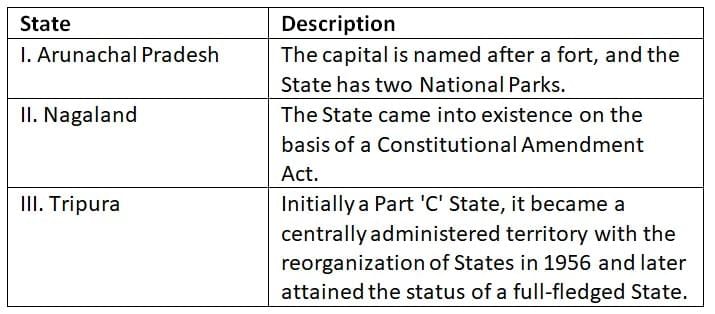
Q2: Consider the following pairs:
How many of the above pairs are correctly matched? (a) Only one (b) Only two (c) All the three (d) None
Solution:
Ans: (c) All three pairs are accurate. Statement I: Arunachal Pradesh is correct, as Itanagar, its capital, is named after Ita Fort, and the state is home to two National Parks, Namdapha and Mouling. Statement II: Nagaland is also correct, as it achieved statehood on December 1, 1963, through the State of Nagaland Act, 1962, enacted via a constitutional amendment. Statement III: Tripura is accurate, having been classified as a Part 'C' state, later becoming a Union Territory in 1956, and gaining full statehood in 1972. Thus, all three pairs correctly describe historical and administrative facts about these northeastern Indian states.
Q3: Which of the following are the evidences of the phenomenon of continental drift? I. The belt of ancient rocks from Brazil coast matches with those from Western Africa. II. The gold deposits of Ghana are derived from the Brazil plateau when the two continents lay side by side. III. The Gondwana system of sediments from India is known to have its counterparts in six different landmasses of the Southern Hemisphere. Select the correct answer using the code given below. (a) I and III only (b) I and II only (c) I, II and III (d) II and III only
Solution:
Ans: (c) All three statements are accurate.
Statement I: Ancient rock formations along Brazil's coastline align closely with those found in Western Africa, suggesting they were once part of a single geological structure.
Statement II: Gold deposits in Ghana share characteristics with those on the Brazilian plateau, pointing to a common geological origin.
Statement III: Sediments from the ancient supercontinent Gondwana, found in India, are similar to those in Antarctica, Australia, South Africa, South America, and Madagascar, containing comparable fossils and environmental markers.
Q4: Consider the following water bodies: I. Lake Tanganyika II. Lake Tonlé Sap III. Patos Lagoon Through how many of them does the equator pass? (a) Only one (b) Only two (c) All the three (d) None
Solution:
Ans: (d) None of the three statements are correct, as the Equator does not pass through any of the mentioned water bodies.
Statement I: Lake Tanganyika is located south of the Equator, spanning Tanzania, the Democratic Republic of the Congo, Burundi, and Zambia.
Statement II: Lake Tonlé Sap is situated in Cambodia, significantly north of the Equator.
Statement III: Patos Lagoon is found in southern Brazil, well south of the Equator.
Q5: Consider the following statements: Statement I: Scientific studies suggest that a shift is taking place in the Earth's rotation and axis. Statement II: Solar flares and associated coronal mass ejections bombarded the Earth's outermost atmosphere with tremendous amount of energy. Statement III: As the Earth's polar ice melts, the water tends to move towards the equator. Which one of the following is correct in respect of the above statements? (a) Both Statement II and Statement III are correct and both of them explain Statement I (b) Both Statement II and Statement III are correct but only one of them explains Statement I (c) Only one of the Statements II and III is correct and that explains Statement I (d) Neither Statement II nor Statement III is correct
Solution:
Ans: (b) All three statements are accurate.
Statement I: Research confirms that Earth's rotation and axis experience slight shifts due to the redistribution of mass within the planet.
Statement II: Solar flares impact only the upper atmosphere and do not contribute to changes in Earth's rotation.
Statement III: The melting of polar ice causes water to flow toward the equator, redistributing Earth's mass and affecting its spin and axis.
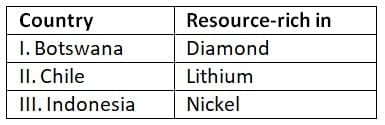
Q6: Consider the following pairs:
In how many of the above rows is the given information correctly matched? (a) Only one (b) Only two (c) All the three (d) None
Solution:
Ans: (c) All three statements are correct.
Statement I: Botswana is a leading global producer of diamonds, which are a cornerstone of its economy.
Statement II: Chile possesses significant lithium reserves in the Atacama Desert, making it a major supplier in the global market.
Statement III: Indonesia is the world's top producer of nickel, essential for battery production and steel manufacturing.
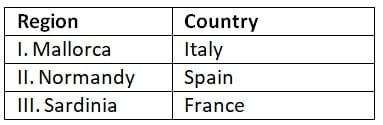
Q7: Consider the following pairs:
In how many of the above rows is the given information correctly matched? (a) Only one (b) Only two (c) All the three (d) None
Solution:
Ans: (d) None of the three statements are correct, as the regions are incorrectly associated with the listed countries.
Statement I: Mallorca is a region of Spain, not Italy.
Statement II: Normandy is located in France, not Spain.
Statement III: Sardinia is part of Italy, not France.
Q8: Consider the following statements: I. Anadyr in Siberia and Nome in Alaska are a few kilometers from each other, but when people are waking up and getting set for breakfast in these cities, it would be different days. II. When it is Monday in Anadyr, it is Tuesday in Nome. Which of the statements given above is/are correct? (a) I only (b) II only (c) Both I and II (d) Neither I nor II
Solution:
Ans: (a)
Statement I: Correct. The International Date Line separates Anadyr (Russia) and Nome (Alaska, USA), causing them to have nearly the same time of day but different calendar dates.
Statement II: Incorrect. When it is Monday in Anadyr, it is still Sunday in Nome, not Tuesday, as Anadyr is ahead of Nome by approximately 21 hours due to the Date Line.
Q9: Consider the following statements: Statement I: In the context of effect of water on rocks, chalk is known as a very permeable rock whereas clay is known as quite an impermeable or least permeable rock. Statement II: Chalk is porous and hence can absorb water. Statement III: Clay is not at all porous. Which one of the following is correct in respect of the above statements? (a) Both Statement II and Statement III are correct and both of them explain Statement I (b) Both Statement II and Statement III are correct but only one of them explains Statement I (c) Only one of the Statements II and III is correct and that explains Statement I (d) Neither Statement II nor Statement III is correct
Solution:
Ans: (c)
Statement I: Correct. Chalk is permeable, allowing water to flow through easily, while clay is impermeable, restricting water passage.
Statement II: Correct. Chalk's porous structure, with many small holes, enables it to hold water and contributes to its permeability.
Statement III: Incorrect. Clay is porous but has extremely small pores that limit water flow, making it impermeable, though not non-porous.
Only Statements I and II are correct, with Statement II providing an explanation for Statement I.
Q10: Consider the following countries: I. United Kingdom II. Denmark III. New Zealand IV. Australia V. Brazil How many of the above countries have more than four time zones? (a) All the five (b) Only four (c) Only three (d) Only two
Solution:
Ans: (b) Four of the five countries listed have more than four official time zones, including their overseas territories:
United Kingdom: Correct. It spans nine time zones due to its overseas territories.
Denmark: Correct. It has at least five time zones, including Greenland and other territories.
New Zealand: Correct. It covers five time zones, including its outlying islands.
Australia: Correct. It has eight to nine time zones, accounting for its mainland and external territories.
Brazil: Incorrect. Brazil has exactly four time zones, not more.
Thus, only four of the five countries have more than four time zones.
Q11: Consider the following statements: Statement I: In January, in the Northern Hemisphere, the isotherms bend equatorward while crossing the landmasses, and poleward while crossing the oceans. Statement II: In January, the air over the oceans is warmer than that over the landmasses in the Northern Hemisphere. Which one of the following is correct in respect of the above statements? (a) Both Statement I and Statement II are correct and Statement II explains Statement I (b) Both Statement I and Statement II are correct but Statement II does not explain Statement I (c) Statement I is correct but Statement II is not correct (d) Statement I is not correct but Statement II is correct
Solution:
Ans: (a) Both statements are accurate, with Statement II providing the explanation for Statement I.
Statement I: Correct. In January, isotherms shift equatorward over land, which cools more rapidly, and poleward over oceans, which retain heat longer.
Statement II: Correct. Oceans remain warmer than land in January due to water's higher specific heat, which allows it to store and release heat more slowly.
Relationship: Statement II explains the isotherm behavior in Statement I by highlighting the role of water's specific heat in maintaining warmer ocean temperatures compared to land.
Q12: Consider the following statements: Statement I: The amount of dust particles in the atmosphere is more in subtropical and temperate areas than in equatorial and polar regions. Statement II: Subtropical and temperate areas have less dry winds. Which one of the following is correct in respect of the above statements? (a) Both Statement I and Statement II are correct and Statement II explains Statement I (b) Both Statement I and Statement II are correct but Statement II does not explain Statement I (c) Statement I is correct but Statement II is not correct (d) Statement I is not correct but Statement II is correct
Solution:
Ans: (c) Statement I is correct because subtropical and temperate regions often experience dry conditions, limited vegetation, and strong winds, which contribute to increased dust levels. Statement II is incorrect because these regions typically have more frequent dry winds, not fewer, which facilitate dust being lifted into the air. Therefore, only Statement I is accurate.
Q13: Consider the following countries: I. Bolivia II. Brazil III. Colombia IV. Ecuador V. Paraguay VI. Venezuela Andes mountains pass through how many of the above countries? (a) Only two (b) Only three (c) Only four (d) Only five
Solution:
Ans: (c) Statement I is correct because the Andes mountain range runs through Bolivia, forming the Altiplano plateau. Statement II is incorrect as the Andes do not extend into Brazil, which is situated on the Brazilian Plateau. Statement III is accurate since the Andes pass through Colombia, dividing into three distinct mountain chains. Statement IV is correct because the Andes run north-south through Ecuador, significantly shaping its geography. Statement V is incorrect because Paraguay is located in interior lowlands and the Andes do not pass through it. Statement VI is correct as the Venezuelan Andes, specifically the Cordillera de Mérida, extend into western Venezuela. Therefore, only Statements I, III, IV, and VI are correct, confirming that the Andes pass through Bolivia, Colombia, Ecuador, and Venezuela, but not Brazil or Paraguay.
FAQs on UPSC Prelims Previous Year Questions 2025: Geography
1. What are the key factors influencing the climate of India?
Ans. The climate of India is influenced by several key factors, including latitude, altitude, and the monsoon winds. The country's vast geographical expanse leads to diverse climatic conditions, ranging from the tropical climate in the south to the temperate climate in the north. The Himalayas play a crucial role in blocking cold winds from Central Asia, while the Indian Ocean affects the monsoon patterns, leading to distinct wet and dry seasons across the country.
2. How does the concept of plate tectonics explain the formation of mountains?
Ans. The concept of plate tectonics explains that the Earth's lithosphere is divided into several tectonic plates that float on the semi-fluid asthenosphere beneath them. Mountains are formed primarily through the processes of continental collision and subduction. When two continental plates collide, they push against each other, leading to uplift and the formation of mountain ranges, such as the Himalayas, which were formed by the collision of the Indian and Eurasian plates.
3. What are the major types of biomes found in the world?
Ans. Major types of biomes include terrestrial biomes such as forests (tropical, temperate, and boreal), grasslands, deserts, and tundras, as well as aquatic biomes like freshwater (lakes, rivers) and marine (oceans, coral reefs). Each biome is characterized by specific climate conditions, plant and animal life, and ecological interactions. For instance, tropical rainforests are known for their high biodiversity, while deserts are characterized by low precipitation and extreme temperatures.
4. What is the significance of the Water Cycle in the Earth's ecosystem?
Ans. The Water Cycle, or hydrological cycle, is significant as it regulates the distribution and movement of water in the environment. This cycle involves processes such as evaporation, condensation, precipitation, and infiltration. It is essential for maintaining ecosystems, supporting plant growth, and replenishing freshwater sources. The cycle also plays a key role in weather patterns and climate regulation, influencing agricultural practices and water supply for human consumption.
5. How do human activities impact biodiversity?
Ans. Human activities, such as deforestation, pollution, urbanization, and climate change, significantly impact biodiversity. Habitat destruction leads to loss of species and ecosystems, while pollution can alter habitats and harm wildlife. Overexploitation of resources, such as overfishing and poaching, further threatens species survival. Conservation efforts are crucial to mitigate these impacts and preserve biodiversity, which is vital for ecosystem health and resilience.
Exam, Objective type Questions, Semester Notes, Summary, Free, video lectures, Important questions, Extra Questions, Sample Paper, Previous Year Questions with Solutions, shortcuts and tricks, pdf , ppt, study material, UPSC Prelims Previous Year Questions 2025: Geography, mock tests for examination, practice quizzes, past year papers, Viva Questions, UPSC Prelims Previous Year Questions 2025: Geography, MCQs, UPSC Prelims Previous Year Questions 2025: Geography;