Q1: Consider the following statements: I. No virus can survive in ocean waters. II. No virus can infect bacteria. III. No virus can change the cellular transcriptional activity in host cells. Which of the statements given above are correct? (a) Only one (b) Only two (c) All the three (d) None
Solution:
Ans: (d)
Explanation: None of the three statements is correct. Brief reasons are:
Statement I - False: Viruses that infect marine organisms are abundant and can survive and remain active in ocean waters; they influence nutrient cycles and ecosystem dynamics.
Statement II - False: Viruses that specifically infect bacteria, called bacteriophages, are well known and widespread.
Statement III - False: Many viruses alter host-cell transcriptional and regulatory pathways to favour their replication or evade immune responses.
Therefore, all three statements are incorrect and option (d) is the correct choice.
Q2: In the context of electric vehicle batteries, consider the following elements: I. Cobalt II. Graphite III. Lithium IV. Nickel How many of the above usually make up battery cathodes? (a) Only one (b) Only two (c) Only three (d) All the four
Solution:
Ans: (c)
Explanation: Three of the four materials listed are commonly associated with lithium-ion battery cathodes:
Cobalt: Present in cathode chemistries such as LCO (Lithium Cobalt Oxide) and NMC (Nickel Manganese Cobalt).
Graphite: Not a cathode material; graphite is typically used as the anode in lithium-ion batteries.
Lithium: A fundamental element in cathode formulations (for example, LCO and LFP contain lithium in their composition).
Nickel: Used in cathode chemistries like NMC and NCA (Nickel Cobalt Aluminium), to increase energy density.
Thus, Cobalt, Lithium and Nickel are associated with cathodes while Graphite is used at the anode. A simple mnemonic to recall cathode elements is CoLiNi (Cobalt, Lithium, Nickel).
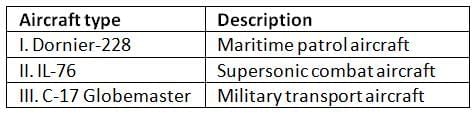
Q3: With reference to India's defence, consider the following pairs:
How many of the pairs given above are correctly matched? (a) Only one (b) Only two (c) All the three (d) None
Solution:
Ans: (b)
Explanation: Two of the three pairs are correctly matched:
Pair I - Dornier-228 : Maritime patrol aircraft - Correct. The Dornier-228 is used by the Indian Navy and Coast Guard for maritime surveillance and patrol duties.
Pair II - IL-76 : Supersonic combat aircraft - Incorrect. The Ilyushin IL-76 is a heavy transport aircraft for strategic airlift and logistics, not a supersonic combat aircraft.
Pair III - C-17 Globemaster III : Military transport aircraft - Correct. The C-17 is a strategic military transport aircraft operated by the Indian Air Force for heavy-lift missions.
Hence, Pairs I and III are correctly matched and option (b) is the right choice.
Q4: What is the common characteristic of the chemical substances generally known as CL-20, HMX and LLM-105, which are sometimes talked about in media? (a) These are alternatives to hydro-fluorocarbon refrigerants (b) These are explosives in military weapons (c) These are high-energy fuels for cruise missiles (d) These are fuels for rocket propulsion
Solution:
Ans: (b)
Explanation: All three substances are high-energy explosive compounds used in military applications:
CL-20: A very high-performance explosive with greater energy density than many conventional military explosives.
HMX: A well-known military-grade explosive used in various munitions and propellants.
LLM-105: A modern energetic material designed to offer high performance and improved stability in military uses.
Therefore, CL-20, HMX and LLM-105 are best categorised as explosives rather than refrigerants or fuels, so option (b) is correct.
Q5: Consider the following substances: I. Ethanol II. Nitroglycerine III. Urea Coal gasification technology can be used in the production of how many of them? (a) Only one (b) Only two (c) All the three (d) None
Solution:
Ans: (c)
Explanation: Coal gasification produces synthesis gas (syngas: mainly carbon monoxide and hydrogen), which can serve as a feedstock for various chemical syntheses, enabling production pathways for all three listed substances:
Ethanol: Syngas can be converted, via catalytic routes, into ethanol or intermediate chemicals that lead to ethanol synthesis.
Nitroglycerine: While nitroglycerine synthesis uses nitric and sulphuric acid with glycerol, syngas-derived chemicals (such as hydrogen or methanol intermediates) can supply feedstocks or precursors used in broader chemical manufacturing chains.
Urea: Ammonia, produced from hydrogen (available from syngas), is a primary input for urea manufacture; thus coal gasification can support urea production.
Accordingly, coal gasification can enable production routes for ethanol, nitroglycerine (via intermediates), and urea - so all three can be produced, making option (c) correct.
Q6: Consider the following statements: I. Indian Railways have prepared a National Rail Plan (NRP) to create a future ready railway system by 2028. II. 'Kavach' is an Automatic Train Protection system developed in collaboration with Germany. III. 'Kavach' system consists of RFID tags fitted on track in station section. Which of the statements given above are not correct? (a) I and II only (b) II and III only (c) I and III only (d) I, II and III
Solution:
Ans: (a)
Explanation: Statements I and II are incorrect; Statement III is correct. Clarification:
Statement I - Not correct: The National Rail Plan targets a future-ready railway network by 2030, not by 2028.
Statement II - Not correct:Kavach is an indigenous Automatic Train Protection system developed in India under the Make in India initiative, not developed in collaboration with Germany.
Statement III - Correct: The Kavach system uses RFID tags placed on tracks in station sections among other onboard and trackside technologies to monitor and control train movements for enhanced safety.
Thus, I and II are false while III is true, so option (a) is correct.
Q7: Consider the following statements: I. It is expected that Majorana 1 chip will enable quantum computing. II. Majorana 1 chip has been introduced by Amazon Web Services (AWS). III. Deep learning is a subset of machine learning. Which of the statements given above are correct? (a) I and II only (b) II and III only (c) I and III only (d) I, II and III
Solution:
Ans: (c)
Explanation: Two of the three statements are correct:
Statement I - Correct: The Majorana 1 chip is a development in quantum hardware expected to contribute to quantum computing capabilities.
Statement II - Not correct: The Majorana project has been associated with Microsoft rather than AWS; AWS pursues its own quantum initiatives but is not the introducer of this chip.
Statement III - Correct: Deep learning is a specialised subset of machine learning that uses multi-layer neural networks to learn hierarchical features from data.
Therefore, Statements I and III are true while II is false; option (c) is the correct selection.
Q8: With reference to monoclonal antibodies, often mentioned in news, consider the following statements: I. They are man-made proteins. II. They stimulate immunological function due to their ability to bind to specific antigens. III. They are used in treating viral infections like that of Nipah virus. Which of the statements given above are correct? (a) I and II only (b) II and III only (c) I and III only (d) I, II and III
Solution:
Ans: (d)
Explanation: All three statements about monoclonal antibodies are correct:
Statement I - Correct: Monoclonal antibodies are laboratory-produced proteins engineered to target specific molecules; they are therefore man-made.
Statement II - Correct: By binding to specific antigens, monoclonal antibodies can neutralise pathogens directly or recruit immune mechanisms, thereby modulating immunological function.
Statement III - Correct: Monoclonal antibodies have been developed for several viral infections, and research or therapeutic use extends to emerging infections such as Nipah where appropriate monoclonals can be applied.
Hence, I, II and III are all true and option (d) is correct.
Q9: GPS-Aided Geo Augmented Navigation (GAGAN) uses a system of ground stations to provide necessary augmentation. Which of the following statements is/are correct in respect of GAGAN? I. It is designed to provide additional accuracy and integrity. II. It will allow more uniform and high quality air traffic management. III. It will provide benefits only in aviation but not in other modes of transportation. Select the correct answer using the code given below. (a) I, II and III (b) II and III only (c) I only (d) I and II only
Solution:
Ans: (d)
Explanation: Statements I and II are correct while Statement III is incorrect:
Statement I - Correct: GAGAN, India's Satellite-Based Augmentation System developed by ISRO and AAI, improves GPS accuracy and provides integrity information crucial for aviation safety.
Statement II - Correct: By improving reliability and positional accuracy, GAGAN supports more uniform and higher-quality air traffic management and safer flight operations.
Statement III - Incorrect: GAGAN's benefits are not limited to aviation; improved positioning and timing services can also support rail, road, maritime, agriculture and disaster management applications.
Therefore, only I and II are correct and option (d) is the right choice.
Q10: Consider the following types of vehicles: I. Full battery electric vehicles II. Hydrogen fuel cell vehicles III. Fuel cell electric hybrid vehicles How many of the above are considered as alternative (powertrain) vehicles? (a) Only one (b) Only two (c) All the three (d) None
Solution:
Ans: (c)
Explanation: All three vehicle types are regarded as alternative powertrain vehicles since they differ from conventional internal-combustion powertrains:
Statement I - Full battery electric vehicles (BEVs): Run entirely on electric batteries and electric motors without a petrol or diesel engine.
Statement II - Hydrogen fuel cell vehicles (FCEVs): Generate electricity on-board from hydrogen using a fuel cell to power electric motors.
Statement III - Fuel cell electric hybrid vehicles (FCEHVs): Combine a hydrogen fuel cell with a battery and electric motor, offering a hybridised alternative powertrain.
Hence, BEVs, FCEVs and FCEHVs are all alternative powertrain choices, making option (c) correct.
Q11: Consider the following statements: Statement I: Some rare earth elements are used in the manufacture of flat television screens and computer monitors. Statement II: Some rare earth elements have phosphorescent properties. Which one of the following is correct in respect of the above statements? (a) Both Statement I and Statement II are correct and Statement II explains Statement I (b) Both Statement I and Statement II are correct but Statement II does not explain Statement I (c) Statement I is correct but Statement II is not correct (d) Statement I is not correct but Statement II is correct
Solution:
Ans: (a)
Explanation: Both statements are correct and Statement II explains Statement I:
Statement I - Correct: Rare earth elements such as europium, terbium and yttrium are used in display technologies for flat-panel televisions and monitors to produce vivid colours and efficient light emission.
Statement II - Correct: Many rare earth elements exhibit phosphorescent or luminescent properties, enabling them to absorb energy and emit light at specific wavelengths.
Relationship: The phosphorescent and luminescent characteristics (Statement II) are the reason these rare earth elements are used in displays (Statement I), so Statement II explains Statement I.
Q12: With reference to Unmanned Aerial Vehicles (UAVs), consider the following statements: I. All types of UAVs can do vertical landing. II. All types of UAVs can do automated hovering. III. All types of UAVs can use battery only as a source of power supply. How many of the statements given above are correct? (a) Only one (b) Only two (c) All the three (d) None
Solution:
Ans: (d)
Explanation: All three statements are incorrect because they make universal claims that do not apply to every UAV type:
Statement I - Incorrect: Not all UAVs can perform vertical landing. Multirotor and VTOL UAVs can land vertically, but conventional fixed-wing UAVs without VTOL capability require runway-like or belly/wing-assisted landings.
Statement II - Incorrect: Automated hovering is possible for multirotor and some hybrid VTOL designs, but many fixed-wing UAVs cannot hover at all.
Statement III - Incorrect: UAVs use a variety of power sources depending on size and role - batteries, liquid fuels, fuel cells, solar power or hybrid systems - so they are not all battery-only.
Hence, none of the statements is universally correct; option (d) is the right answer.
Q13: Consider the following space missions: I. Axiom-4 II. SpaDeX III. Gaganyaan How many of the space missions given above encourage and support micro-gravity research? (a) Only one (b) Only two (c) All the three (d) None
Solution:
Ans: (c)
Explanation: All three missions support or facilitate micro-gravity research in different ways:
Statement I - Axiom-4: Correct. Axiom crewed missions to the International Space Station are intended to conduct scientific experiments in the micro-gravity environment of the ISS.
Statement II - SpaDeX: Correct. ISRO's Space Docking Experiment (SpaDeX) is a technology demonstration for autonomous docking; such missions typically enable micro-gravity experiments or technology validation in orbit.
Statement III - Gaganyaan: Correct. India's human spaceflight programme Gaganyaan will enable on-board scientific experiments in micro-gravity conditions when crewed missions occur.
Therefore, all three missions encourage and support micro-gravity research and option (c) is correct.
FAQs on UPSC Prelims Previous Year Questions 2025: Science & Technology
1. What are the major advancements in space technology that have shaped modern exploration?
Ans. Major advancements in space technology include the development of reusable launch vehicles, advances in satellite technology, and improved propulsion systems. The introduction of the Space Shuttle program enabled multiple missions and satellite deployments, while the emergence of private companies like SpaceX has revolutionized access to space with cost-effective solutions. Additionally, advancements in robotics and AI have enhanced capabilities for exploration and data collection on other planets.
2. How has biotechnology impacted agriculture and food production?
Ans. Biotechnology has significantly improved agriculture and food production through genetic engineering, which allows for the development of crop varieties that are resistant to pests, diseases, and environmental stresses. Techniques such as CRISPR have enabled precise modifications to plant genomes, enhancing yield and nutritional content. Moreover, biotechnology facilitates the production of biofuels and biodegradable plastics, contributing to sustainable practices in agriculture.
3. What role does renewable energy play in sustainable development?
Ans. Renewable energy plays a crucial role in sustainable development by providing clean, inexhaustible sources of power that reduce greenhouse gas emissions and dependency on fossil fuels. Technologies such as solar, wind, and hydroelectric power contribute to energy security, job creation, and economic growth while minimizing environmental impact. Transitioning to renewable energy is essential for achieving global climate goals and promoting a sustainable future.
4. What are the ethical considerations surrounding artificial intelligence?
Ans. The ethical considerations surrounding artificial intelligence (AI) include issues of privacy, bias, accountability, and job displacement. Ensuring that AI systems are transparent and equitable is critical to prevent discrimination based on race, gender, or socioeconomic status. Additionally, there are concerns about the potential misuse of AI technologies in surveillance and decision-making processes. Establishing regulations and ethical guidelines is essential to address these challenges and promote responsible AI development.
5. How does nanotechnology influence medicine and healthcare?
Ans. Nanotechnology influences medicine and healthcare by enabling targeted drug delivery systems, enhancing imaging techniques, and developing advanced materials for medical devices. Nanoparticles can be engineered to deliver drugs directly to cancer cells, minimizing side effects and improving treatment efficacy. Moreover, nanotechnology aids in the development of diagnostic tools that provide rapid and accurate health assessments, thereby revolutionizing patient care and treatment outcomes.
Free, UPSC Prelims Previous Year Questions 2025: Science & Technology, Sample Paper, Viva Questions, practice quizzes, Objective type Questions, Semester Notes, ppt, mock tests for examination, Exam, UPSC Prelims Previous Year Questions 2025: Science & Technology, shortcuts and tricks, Extra Questions, study material, Important questions, past year papers, Summary, MCQs, pdf , Previous Year Questions with Solutions, UPSC Prelims Previous Year Questions 2025: Science & Technology, video lectures;