Q1: With reference to the planet Earth, consider the following statements: I. Rain forests produce more oxygen than that produced by oceans. II. Marine phytoplankton and photosynthetic bacteria produce about 50% of world's oxygen. III. Well-oxygenated surface water contains several folds higher oxygen than that in atmospheric air. Which of the statements given above is/are correct? (a) I and II (b) II only (c) I and III (d) None of the above statements is correct
Solution:
Ans: (b) Oxygen on Earth primarily comes from photosynthesis, with marine phytoplankton playing a significant role. The statements provided are evaluated as follows:
Statement I is false: Marine phytoplankton in oceans contribute more oxygen to the atmosphere than rainforests do.
Statement II is true: Approximately half of the world's oxygen is produced by marine phytoplankton and photosynthetic bacteria.
Statement III is false: Atmospheric air contains significantly more oxygen than surface water, not the other way around.
Thus, the correct answer is B.
Q2: Consider the following statements: Statement I: Article 6 of the Paris Agreement on climate change is frequently discussed in global discussions on sustainable development and climate change. Statement II: Article 6 of the Paris Agreement on climate change sets out the principles of carbon markets. Statement III: Article 6 of the Paris Agreement on climate change intends to promote inter-country non-market strategies to reach their climate targets. Which one of the following is correct in respect of the above statements? (a) Both Statement II and Statement III are correct and both of them explain Statement I (b) Both Statement II and Statement III are correct but only one of them explains Statement I (c) Only one of the Statements II and III is correct and that explains Statement I (d) Neither Statement II nor Statement III is correct
Solution:
Ans: (a) Article 6 of the Paris Agreement is vital for fostering international collaboration to achieve climate goals through both carbon markets and non-market mechanisms.
Statement I is true: Article 6 is frequently highlighted as it facilitates cooperation via market-based and non-market approaches to address climate change.
Statement II is true: It establishes guidelines for carbon markets, including mechanisms for carbon trading and credits.
Statement III is true: It supports non-market approaches, such as technology transfer and capacity building, to help meet climate objectives.
Therefore, the correct answer is A.
Q3: Consider the following statements: Statement I: At the 28th United Nations Climate Change Conference (COP28), India refrained from signing the "Declaration on Climate and Health". Statement II: The COP28 Declaration on Climate and Health is a binding declaration; and if signed, it becomes mandatory to decarbonize health sector. Statement III: If India's health sector is decarbonized, the resilience of its health-care system may be compromised. Which one of the following is correct in respect of the above statements? (a) Both Statement II and Statement III are correct and both of them explain Statement I (b) Both Statement II and Statement III are correct but only one of them explains Statement I (c) Only one of the Statements II and III is correct and that explains Statement I (d) Neither Statement II nor Statement III is correct
Solution:
Ans: (c) At COP28, India opted not to join the "Declaration on Climate and Health," a decision driven by specific concerns about the declaration's implications.
Statement I is true: India was among the countries that did not sign the COP28 Declaration on Climate and Health, which was endorsed by over 120 nations.
Statement II is false: The declaration is a voluntary political commitment, not a legally binding obligation, so signing it does not require immediate decarbonization of the health sector.
Statement III is true: India's reluctance stems from concerns that rapidly decarbonizing its health sector could undermine healthcare accessibility and resilience, given its developmental and resource constraints.
Thus, only Statement III accurately explains India's decision not to sign, while Statement II misrepresents the declaration's non-binding nature.
Q4: Regarding Peacock tarantula (Gooty tarantula), consider the following statements: I. It is an omnivorous crustacean. II. Its natural habitat in India is only limited to some forest areas. III. In its natural habitat, it is an arboreal species. Which of the statements given above is/are correct? (a) I only (b) I and III (c) II only (d) II and III
Solution:
Ans: (d)
The Peacock tarantula, also known as the Gooty tarantula, is a rare, tree-dwelling spider native to specific forest regions in India.
Statement I is false: The Peacock tarantula is an arachnid (spider), not an omnivorous crustacean.
Statement II is true: Its habitat is limited to certain forest areas in the Eastern Ghats of India.
Statement III is true: It is an arboreal species, residing in trees and tree crevices.
Therefore, the correct answer is D.
Q5: Which one of the following launched the 'Nature Solutions Finance Hub for Asia and the Pacific'? (a) The Asian Development Bank (ADB) (b) The Asian Infrastructure Investment Bank (AIIB) (c) The New Development Bank (NDB) (d) The International Bank for Reconstruction and Development (IBRD)
Solution:
Ans: (a) Nature-based solutions leverage natural processes to address climate change and biodiversity loss, requiring targeted financial backing. The Asian Development Bank (ADB) introduced the Nature Solutions Finance Hub for Asia and the Pacific to provide funding for nature-based initiatives tackling climate and environmental issues in the region.
Q6: Artificial way of causing rainfall to reduce air pollution makes use of (a) silver iodide and potassium iodide (b) silver nitrate and potassium iodide (c) silver iodide and potassium nitrate (d) silver nitrate and potassium chloride
Solution:
Ans: (a) Cloud seeding, a technique to induce rainfall, relies on chemicals with specific crystalline structures to form ice nuclei.
Option A is true: Silver iodide and potassium iodide are both used in cloud seeding due to their ability to promote ice nuclei formation, facilitating precipitation.
Option B is false: Silver nitrate is not utilized in artificial rainmaking processes.
Option C is false: Potassium nitrate is not employed in cloud seeding.
Option D is false: Neither silver nitrate nor potassium chloride is used for inducing rainfall.
Thus, the correct answer is A.
Q7: Consider the following statements: Statement I: Activated carbon is a good and an attractive tool to remove pollutants from effluent streams and to remediate contaminants from various industries. Statement II: Activated carbon exhibits a large surface area and a strong potential for adsorbing heavy metals. Statement III: Activated carbon can be easily synthesized from environmental wastes with high carbon content. Which one of the following is correct in respect of the above statements? (a) Both Statement II and Statement III are correct and both of them explain Statement I (b) Both Statement II and Statement III are correct but only one of them explains Statement I (c) Only one of the Statements II and III is correct and that explains Statement I (d) Neither Statement II nor Statement III is correct
Solution:
Ans: (a) Activated carbon is extensively utilized for pollutant removal due to its distinctive properties and environmentally friendly production methods.
Statement I is true: Activated carbon efficiently removes pollutants from industrial effluents, leveraging its high adsorption capacity, making it a staple in water treatment and pollution control.
Statement II is true: Its effectiveness stems from a vast surface area created by a porous structure, which enables it to capture heavy metals and other contaminants effectively.
Statement III is true: Activated carbon can be sustainably and cost-effectively produced from carbon-rich agricultural wastes, such as coconut shells and rice husks, enhancing its eco-friendliness.
Therefore, Statements II and III are correct and collectively explain the validity of Statement I.
Q8: Consider the following statements: I. Carbon dioxide (CO2) emissions in India are less than 0.5 t CO2/capita. II. In terms of CO2 emissions from fuel combustion, India ranks second in Asia-Pacific region. III. Electricity and heat producers are the largest sources of CO2 emissions in India. Which of the statements given above is/are correct? (a) I and III only (b) II only (c) II and III only (d) I, II and III
Solution:
Ans: (c) Statement I is incorrect: India's per capita CO2 emissions are approximately 1.9-2.0 tonnes, which is significantly higher than the 0.5 tonnes per capita mentioned. Statement II is correct: India is the second-largest emitter of CO2 from fuel combustion in the Asia-Pacific region, following China. Statement III is correct: The primary source of India's CO2 emissions is electricity and heat production, predominantly from coal-based power generation. Thus, the correct answer is C.
Q9: Which organization has enacted the Nature Restoration Law (NRL) to tackle climate change and biodiversity loss? (a) The European Union (b) The World Bank (c) The Organization for Economic Cooperation and Development (d) The Food and Agriculture Organization
Solution:
Ans: (a)
A. The European Union: The Nature Restoration Law (NRL), adopted in 2024, is an EU law that establishes mandatory targets for ecosystem restoration, climate change mitigation, and biodiversity protection across EU member states. Correct. B. The World Bank: This international financial institution provides loans and grants but does not have the authority to enact legislation like the NRL. Incorrect. C. OECD: The Organisation for Economic Co-operation and Development focuses on economic cooperation and policy coordination, not on enacting binding environmental laws like the NRL. Incorrect. D. FAO: The Food and Agriculture Organization, a UN agency, concentrates on addressing hunger and agricultural issues and does not enact regional legislation like the NRL. Incorrect. Thus, the correct answer is A.
Q10: The World Bank warned that India could become one of the first places where wet-bulb temperatures routinely exceed 35 °C. Which of the following statements best reflect(s) the implication of the above‐said report? I. Peninsular India will most likely suffer from flooding, tropical cyclones and droughts. II. The survival of animals including humans will be affected as shedding of their body heat through perspiration becomes difficult. Select the correct answer using the code given below. (a) I only (b) II only (c) Both I and II (d) Neither I nor II
Solution:
Ans: (b)
Statement I is incorrect: The World Bank's warning specifically addresses the dangers of wet-bulb temperatures, not flooding, cyclones, or droughts, which are separate climate-related threats. Statement II is correct: A wet-bulb temperature above 35°C prevents the human body from cooling itself through sweating, as it cannot release heat, leading to potentially fatal conditions for humans and animals. Thus, the correct answer highlights the critical impact of high wet-bulb temperatures on survival.
Q11: Consider the following: I. Cigarette butts II. Eyeglass lenses III. Car tyres How many of them contain plastic? (a) Only one (b) Only two (c) All the three (d) None
Solution:
Ans: (c)
Statement I is correct: Cigarette butts have filters made of cellulose acetate, a type of plastic.
Statement II is correct: Eyeglass lenses are typically made from polycarbonate or CR-39, both plastic materials, rather than glass.
Statement III is correct: Car tires include synthetic rubber, which contains plastic-based polymers.
Thus, all three items-cigarette butts, eyeglass lenses, and car tires-contain hidden plastics, confirming that the correct answer is that all statements are true.
Q12: Consider the following statements: Statement I: Circular economy reduces the emissions of greenhouse gases. Statement II: Circular economy reduces the use of raw materials as inputs. Statement III: Circular economy reduces wastage in the production process. Which one of the following is correct in respect of the above statements? (a) Both Statement II and Statement III are correct and both of them explain Statement I (b) Both Statement II and Statement III are correct but only one of them explains Statement I (c) Only one of the Statements II and III is correct and that explains Statement I (d) Neither Statement II nor Statement III is correct
Solution:
Ans: (a)
Statement I is correct: The circular economy reduces greenhouse gas emissions by minimizing waste and optimizing energy use.
Statement II is correct: It conserves raw materials by promoting reuse, recycling, and extending product lifecycles.
Statement III is correct: Sustainable design and efficient processes in the circular economy help reduce production waste.
Thus, all three statements are true, confirming that the circular economy effectively supports waste reduction, resource conservation, and emission cuts.
Q13: Consider the following statements: Statement I: Studies indicate that carbon dioxide emissions from cement industry account for more than 5% of global carbon emissions. Statement II: Silica-bearing clay is mixed with limestone while manufacturing cement. Statement III: Limestone is converted into lime during clinker production for cement manufacturing. Which one of the following is correct in respect of the above statements? (a) Both Statement II and Statement III are correct and both of them explain Statement I (b) Both Statement II and Statement III are correct but only one of them explains Statement I (c) Only one of the Statements II and III is correct and that explains Statement I (d) Neither Statement II nor Statement III is correct
Solution:
Ans: (b)
Statement I is correct: The cement industry accounts for approximately 5-8% of global CO₂ emissions, establishing it as a significant contributor to greenhouse gases.
Statement II is correct: In cement production, silica-bearing clay is combined with limestone to supply essential minerals such as silicon, aluminum, and iron, which are critical for the final cement product.
Statement III is correct: During clinker production, limestone (calcium carbonate) is heated, transforming into lime (calcium oxide) and releasing CO₂ through a process called calcination, which is the primary source of carbon emissions in cement manufacturing.
While both Statements II and III are accurate, Statement III directly addresses the primary source of carbon emissions in cement production as described in Statement I.
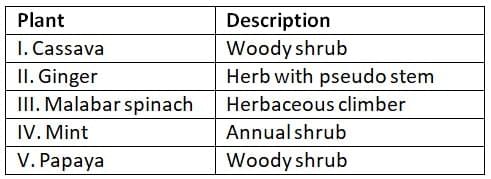
Q14: Consider the following pairs:
How many of the above pairs are correctly matched? (a) Only two (b) Only three (c) Only four (d) All the five
Solution:
Ans: (b)
Statement I is correct: Cassava is a perennial woody shrub, accurately classified based on its growth form.
Statement II is correct: Ginger is an herb with a pseudostem formed from tightly packed leaf bases, fitting its classification.
Statement III is correct: Malabar spinach is an herbaceous climber with soft, climbing stems, correctly identified.
Statement IV is incorrect: Mint is a perennial herb, not an annual shrub, as it lacks woody stems and persists across seasons.
Statement V is incorrect: Papaya is a large herbaceous plant, not a woody shrub, as its stem is soft and not fully woody.
Thus, only the first three statements are correct, making the correct answer B (Only three).
Q15: With reference to Direct Air Capture, an emerging technology, which of the following statements is/are correct? I. It can be used as a way of carbon sequestration. II. It can be a valuable approach for plastic production and in food processing. III. In aviation, it can be a source of carbon for combining with hydrogen to create synthetic low-carbon fuel. Select the correct answer using the code given below. (a) I and II only (b) III only (c) I, II and III (d) None of the above statements is correct
Solution:
Ans: (c)
Statement I is correct: Direct Air Capture (DAC) technology extracts CO2 from the atmosphere, enabling carbon sequestration to reduce greenhouse gas levels.
Statement II is correct: The CO2 captured through DAC can be utilized in industries, such as producing plastics and supporting food processing applications.
Statement III is correct: DAC provides CO2 that, when combined with hydrogen, can be used to create synthetic low-carbon aviation fuels, contributing to sustainable energy solutions.
Thus, all three statements are accurate, making the correct answer C.
The document UPSC Prelims Previous Year Questions 2025: Environment is a part of the UPSC Course Environment for UPSC CSE.
FAQs on UPSC Prelims Previous Year Questions 2025: Environment
1. What are the major environmental issues addressed in UPSC examinations?
Ans. The major environmental issues typically addressed in UPSC examinations include climate change, biodiversity loss, pollution (air, water, soil), deforestation, sustainable development, and conservation efforts. These topics are crucial for understanding the environmental challenges facing the world today and are often linked to policy and governance.
2. How does climate change impact biodiversity?
Ans. Climate change significantly impacts biodiversity by altering habitats, shifting species distributions, and increasing the frequency of extreme weather events. These changes can lead to the extinction of vulnerable species, disrupt ecosystems, and affect food webs, ultimately threatening the overall health of the planet's biodiversity.
3. What role do international agreements play in environmental conservation?
Ans. International agreements, such as the Paris Agreement and the Convention on Biological Diversity, play a critical role in environmental conservation by establishing frameworks for countries to collaborate on addressing global environmental issues. They promote commitments to reduce greenhouse gas emissions, protect endangered species, and preserve natural habitats, thereby fostering international cooperation and accountability.
4. What are the key components of sustainable development?
Ans. The key components of sustainable development include economic growth that does not harm the environment, social inclusion that ensures equity among communities, and environmental protection that maintains natural resources for future generations. Sustainable development aims to balance these components to promote a healthy planet and society.
5. How do pollutants affect human health and the environment?
Ans. Pollutants, such as heavy metals, chemicals, and particulate matter, can have severe impacts on human health, leading to respiratory diseases, cardiovascular issues, and neurological disorders. Environmentally, pollutants can disrupt ecosystems, harm wildlife, and contaminate water and soil, leading to long-term ecological damage and loss of biodiversity.
Free, mock tests for examination, Objective type Questions, pdf , Sample Paper, UPSC Prelims Previous Year Questions 2025: Environment, video lectures, MCQs, shortcuts and tricks, Previous Year Questions with Solutions, Extra Questions, Summary, Important questions, UPSC Prelims Previous Year Questions 2025: Environment, ppt, practice quizzes, Semester Notes, study material, Exam, Viva Questions, UPSC Prelims Previous Year Questions 2025: Environment, past year papers;