CBSE Class 7  >  Class 7 Notes  >  Mathematics (Ganita Prakash) - New NCERT Part 1 & 2  >  Unit Test: A Tale of Three Intersecting Lines

Unit Test: A Tale of Three Intersecting Lines

ime: 1 hour

M.M. 30

Attempt all questions.

Question numbers 1 to 5 carry 1 mark each.
Question numbers 6 to 8 carry 2 marks each.
Question numbers  9 to 11 carry 3 marks each.
Question number 12 & 13 carry 5 marks each.

Q1: If two angles of a triangle are 35° and 85°, what is the measure of the third angle? (1 Mark)
a) 50°
b) 60°
c) 70°
d) 80°

Q2: In triangle XYZ, the exterior angle at Y is 140°, and ∠X = 65°. What is the measure of ∠Z? (1 Mark)
a) 75°
b) 80°
c) 85°
d) 90°

Q3. In a triangle DEF, if ∠D = 50° and ∠E = 60°, can a triangle be formed with these angles and a side DE of 7 cm? (1 Mark)
a) Yes, because the sum of angles is less than 180°
b) No, because the sum of angles is equal to 180°
c) No, because the sum of angles is greater than 180°
d) Yes, but only if the side length is greater than 7 cm

Q4: Which of the following sets of side lengths cannot form a triangle? (1 Mark)
a) 7 cm, 8 cm, 10 cm
b) 4 cm, 4 cm, 8 cm
c) 6 cm, 9 cm, 14 cm
d) 5 cm, 12 cm, 13 cm

Q5. If two sides of a triangle are 6 cm and 8 cm, what is the minimum integer length of the third side?  (1 Mark)

a) 7 cm
b) 4 cm
c) 3 cm
d) 5 cm

Q6. In triangle XYZ, if ∠X = 90° and ∠Y = 45°, what is the measure of ∠Z? (2 Mark)

Q7. Find the exterior angle at vertex B in triangle ABC if angle A = 40 ° and angle C = 60°. (2 Mark)

Q8. In triangle XYZ, if angle X = angle Y and angle Z = 50°., what is angle X? (2 Mark)

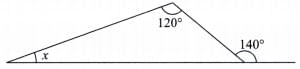
Q9. Find the value of the unknown angle: (3 Mark)
Unit Test: A Tale of Three Intersecting Lines


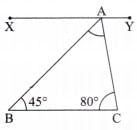
Q10. Find the third angle of a triangle when two of the angles are 45° and 80°. (3 Mark)
Unit Test: A Tale of Three Intersecting Lines

Q11. In triangle LMN, if angle L = 50 degrees and angle M = 70 degrees, find the exterior angle at vertex N and determine its relationship with angles L and M.  (3 Mark)

Q12. In triangle UVW, if angle U = 45 degrees and angle V = 60 degrees, find the third angle W and determine the ratio of angles U, V, and W. (5 Mark)

Q13. Construct a triangle having the side lengths 5, 5, and 8. (all units are in cm)  (5 Mark)

The document Unit Test: A Tale of Three Intersecting Lines is a part of the Class 7 Course Mathematics (Ganita Prakash) Class 7 - New NCERT Part 1 & 2.
All you need of Class 7 at this link: Class 7

FAQs on Unit Test: A Tale of Three Intersecting Lines

1. What are intersecting lines and how do they relate to angles?
Ans.Intersecting lines are lines that cross each other at a single point. This point of intersection creates angles. The angles formed can be classified as vertical angles (which are equal) and adjacent angles (which are supplementary, adding up to 180 degrees). Understanding these relationships is crucial in geometry.
2. How can we determine the angle measures formed by intersecting lines?
Ans.To determine the angle measures formed by intersecting lines, one can use a protractor to measure the angles directly. Alternatively, if one angle is known, the other angles can be calculated using the properties of vertical angles and the fact that adjacent angles are supplementary. For example, if one angle measures 50 degrees, the adjacent angle will measure 130 degrees (180° - 50°).
3. What is the significance of parallel lines in relation to intersecting lines?
Ans.Parallel lines are lines in a plane that never meet and are always the same distance apart. When a transversal (a line that crosses two or more lines) intersects parallel lines, it creates corresponding angles that are equal and alternate interior angles that are also equal. This relationship is important in understanding the properties of angles related to intersecting lines.
4. How do intersecting lines apply in real-life scenarios?
Ans.Intersecting lines can be observed in various real-life situations, such as road intersections, the design of buildings, and various engineering applications. Understanding the angles and relationships formed by these intersections can help in navigation and construction, making it an essential concept in practical fields.
5. What are some common mistakes students make when working with intersecting lines?
Ans.Common mistakes include miscalculating angle measures, confusing vertical angles with adjacent angles, and forgetting that vertical angles are equal. Students may also struggle with applying the properties of parallel lines when a transversal is involved. Practicing with diagrams and using tools like protractors can help avoid these errors.
Explore Courses for Class 7 exam
Get EduRev Notes directly in your Google search
Related Searches
Extra Questions, Free, MCQs, Previous Year Questions with Solutions, video lectures, Important questions, shortcuts and tricks, practice quizzes, Viva Questions, Exam, study material, Semester Notes, Unit Test: A Tale of Three Intersecting Lines, past year papers, mock tests for examination, Sample Paper, Objective type Questions, pdf , Summary, Unit Test: A Tale of Three Intersecting Lines, ppt, Unit Test: A Tale of Three Intersecting Lines;