CBSE Class 5  >  Class 5 Notes  >  Mathematics  >  Important Questions with Solutions: Fractions - 1

Important Questions with Solutions: Fractions - 1

Q1: Write next three equivalent fractions Important Questions with Solutions: Fractions - 1
Sol: We have:  

3 × 24 × 2 = 68

3 × 34 × 3 = 912

3 × 44 × 4 = 1216
So, 34 = 68 = 912 = 1216
Hence, the equivalent fractions to 34  are  689121216

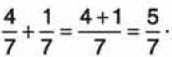
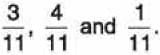
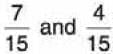
Q2: Find the sum of Important Questions with Solutions: Fractions - 1andImportant Questions with Solutions: Fractions - 1

Sol: We have Important Questions with Solutions: Fractions - 1

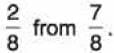
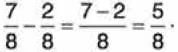
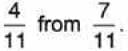
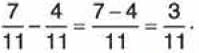
Q3: Subtract Important Questions with Solutions: Fractions - 1

Sol: We have : Important Questions with Solutions: Fractions - 1

Q4: Express each of the following fractions to its lowest terms :

(a)Important Questions with Solutions: Fractions - 1

(b)Important Questions with Solutions: Fractions - 1

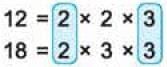
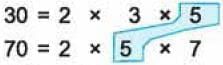
Sol: (a) We have,

Important Questions with Solutions: Fractions - 1

So, we can divide the numerator and the denominator by 2 x 3 = 6.

So, Important Questions with Solutions: Fractions - 1
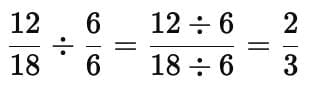
Thus, the simplest form of Important Questions with Solutions: Fractions - 1

(b) We have,

Important Questions with Solutions: Fractions - 1

So, we can divide the numerator and the denominator by 2 x 5 = 10 .

So,Important Questions with Solutions: Fractions - 1
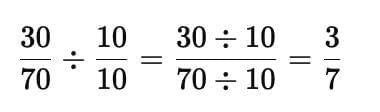
Thus, the Simplest form of Important Questions with Solutions: Fractions - 1

Q5: Subtract Important Questions with Solutions: Fractions - 1

Sol: We have: Important Questions with Solutions: Fractions - 1

Q6: Find the sum of Important Questions with Solutions: Fractions - 1

Sol: We have : Important Questions with Solutions: Fractions - 1

Q7: Compare :

(a) Important Questions with Solutions: Fractions - 1

(b) Important Questions with Solutions: Fractions - 1

Sol: We have:

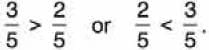
(a) Consider Important Questions with Solutions: Fractions - 1

Since, 3 > 2, hence Important Questions with Solutions: Fractions - 1

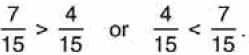
(b) Consider Important Questions with Solutions: Fractions - 1

Since, 7 > 4, hence Important Questions with Solutions: Fractions - 1

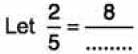
Q8: Find an equivalent fraction of Important Questions with Solutions: Fractions - 1 with numerator 8.

Sol: Important Questions with Solutions: Fractions - 1

To get 8 in the numerator, we multiply 2 by 4, and also 5 by 4.
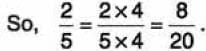
Important Questions with Solutions: Fractions - 1

Hence, Important Questions with Solutions: Fractions - 1 are equivalent fractions.

Q9: Reduce Important Questions with Solutions: Fractions - 1 to its lowest terms.

Sol: We can divide the numerator and the denominator step by step, by their common factors.

Important Questions with Solutions: Fractions - 1

Thus, Important Questions with Solutions: Fractions - 1 is in its lowest terms.

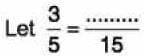
Q10: Find an equivalent fraction of Important Questions with Solutions: Fractions - 1 with denominator 15.

Sol: Important Questions with Solutions: Fractions - 1

To get 15 in the denominator, we multiply 5 by 3 and also 3 by 3.

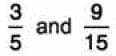
So, Important Questions with Solutions: Fractions - 1
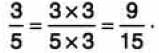
Hence,Important Questions with Solutions: Fractions - 1are equivalent fractions.

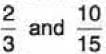
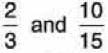
Q11AreImportant Questions with Solutions: Fractions - 1 equivalent fractions?

Sol: Important Questions with Solutions: Fractions - 12 X 15 = 30, 3 X 10 = 30

Both the products are equal.

Hence, Important Questions with Solutions: Fractions - 1 are equivalent fractions.
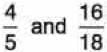
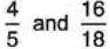
Q12: Are Important Questions with Solutions: Fractions - 1 equivalent fractions?

Sol: 

Important Questions with Solutions: Fractions - 1

Here, 4 x 18 = 72, 5 x 16 = 80

Products are not the same.

Hence, Important Questions with Solutions: Fractions - 1 are not equivalent fractions.
Q13: Compare
(a)Important Questions with Solutions: Fractions - 1

(b) Important Questions with Solutions: Fractions - 1

Sol: (a) Important Questions with Solutions: Fractions - 1

Since 9 < 11.

Hence Important Questions with Solutions: Fractions - 1

(b)Important Questions with Solutions: Fractions - 1

Since 14 > 13

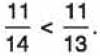
Hence Important Questions with Solutions: Fractions - 1

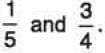
Q14: Compare Important Questions with Solutions: Fractions - 1

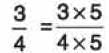
Sol: Important Questions with Solutions: Fractions - 1[Multiplying the numerator and the denominator by 4]

Important Questions with Solutions: Fractions - 1

Important Questions with Solutions: Fractions - 1[Multiplying the numerator and the denominator by 5]

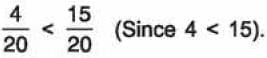
Important Questions with Solutions: Fractions - 1

Clearly, Important Questions with Solutions: Fractions - 1

Hence, Important Questions with Solutions: Fractions - 1

Another method: Two fractions can be compared by using the method of cross multiplication.

Q15: Compare
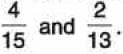
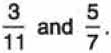
(a) Important Questions with Solutions: Fractions - 1
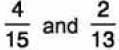
(b) Important Questions with Solutions: Fractions - 1

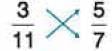
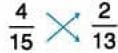
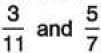
Sol: (a) Given fractions are Important Questions with Solutions: Fractions - 1

Important Questions with Solutions: Fractions - 1

 (Cross multiply)

Now 3 x 7 = 21 and 11 x 5 = 55.

Since 21 < 55, hence Important Questions with Solutions: Fractions - 1

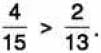
(b) Given fractions are Important Questions with Solutions: Fractions - 1

Important Questions with Solutions: Fractions - 1(Cross multiply)
Now 4 x 13 = 52 and 15 x 2 = 30.

Since, 52 > 30, hence, Important Questions with Solutions: Fractions - 1 
The document Important Questions with Solutions: Fractions - 1 is a part of the Class 5 Course Mathematics for Class 5.
All you need of Class 5 at this link: Class 5

FAQs on Important Questions with Solutions: Fractions - 1

1. What are fractions and how are they represented?
Ans. Fractions represent a part of a whole and are written in the form a/b, where 'a' is the numerator (the part) and 'b' is the denominator (the whole). For example, in the fraction ⅗, 3 is the part of the whole which is divided into 5 equal parts.
2. How do you add and subtract fractions?
Ans. To add or subtract fractions, they must have the same denominator. If they don't, find the least common denominator (LCD). For example, to add ⅓ and ¼, convert them to have a common denominator of 12: ⅓ = 4/12 and ¼ = 3/12. Then, add: 4/12 + 3/12 = 7/12.
3. What is the procedure for multiplying fractions?
Ans. To multiply fractions, simply multiply the numerators together and the denominators together. For example, to multiply ⅖ by ¾, multiply the numerators: 2 × 3 = 6, and the denominators: 5 × 4 = 20. Therefore, ⅖ × ¾ = 6/20, which simplifies to 3/10.
4. How do you simplify fractions?
Ans. To simplify a fraction, divide both the numerator and the denominator by their greatest common factor (GCF). For example, to simplify 8/12, the GCF of 8 and 12 is 4. Divide both by 4: 8 ÷ 4 = 2 and 12 ÷ 4 = 3. So, 8/12 simplifies to 2/3.
5. What are equivalent fractions?
Ans. Equivalent fractions are different fractions that represent the same value or part of a whole. For example, ½, 2/4, and 4/8 are all equivalent fractions because they all represent the same amount of the whole. You can find equivalent fractions by multiplying or dividing the numerator and denominator by the same number.
Explore Courses for Class 5 exam
Get EduRev Notes directly in your Google search
Related Searches
study material, Sample Paper, MCQs, Extra Questions, Free, practice quizzes, Important questions, ppt, Exam, Previous Year Questions with Solutions, Important Questions with Solutions: Fractions - 1, Semester Notes, shortcuts and tricks, Viva Questions, past year papers, Important Questions with Solutions: Fractions - 1, video lectures, Important Questions with Solutions: Fractions - 1, mock tests for examination, Summary, Objective type Questions, pdf ;