CBSE Class 5 > Class 5 Notes > Mathematics > Important Questions with Solutions: Fractions - 2
Important Questions with Solutions: Fractions - 2

Q1: Find the sum.
(4/14) + (4/14) = ____
Sol: 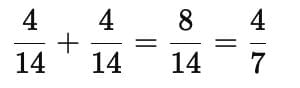 Q2: Find the sum.
(7/11) + (5/11) = ____
Sol: 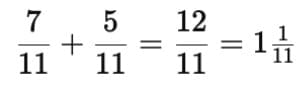 Q3: Find the sum.
(8/10) + (5/10) = ____
Sol: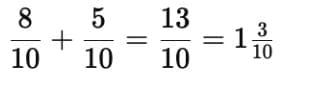 Q4: Find the sum.
(2/9) + (3/9) = ____
Sol: 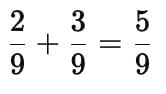 Q5: Find the sum.
(24/25) + (20/25) = ____
Sol: 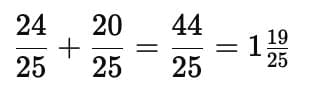 Q6: Find the sum.
(5/8) + (7/8) = ____
Sol: (5/8) + (7/8) = (1/(1/2))
Q7: Find the sum.
(1/2) + (1/2) = ____
Sol: 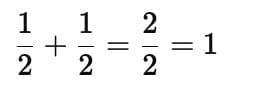 Q8: Find the sum.
(11/13) + (12/13) = ____
Sol: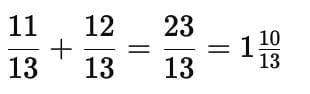 Q9: Find the sum.
(1/3) + (1/3) = ____
Sol: 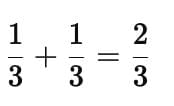 Q10: Find the sum.
(6/50) + (15/50) = ____
Sol: 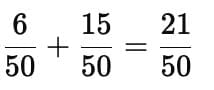
Q11: See the pie charts and write the equivalent fractions in the box.
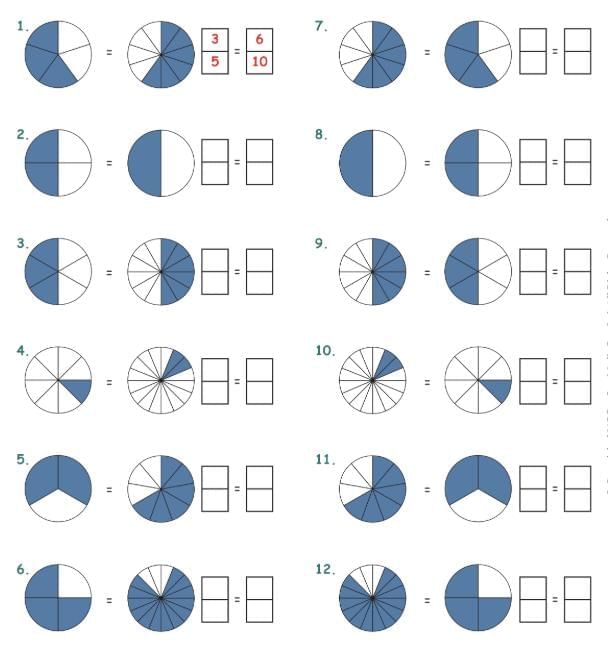
Sol:
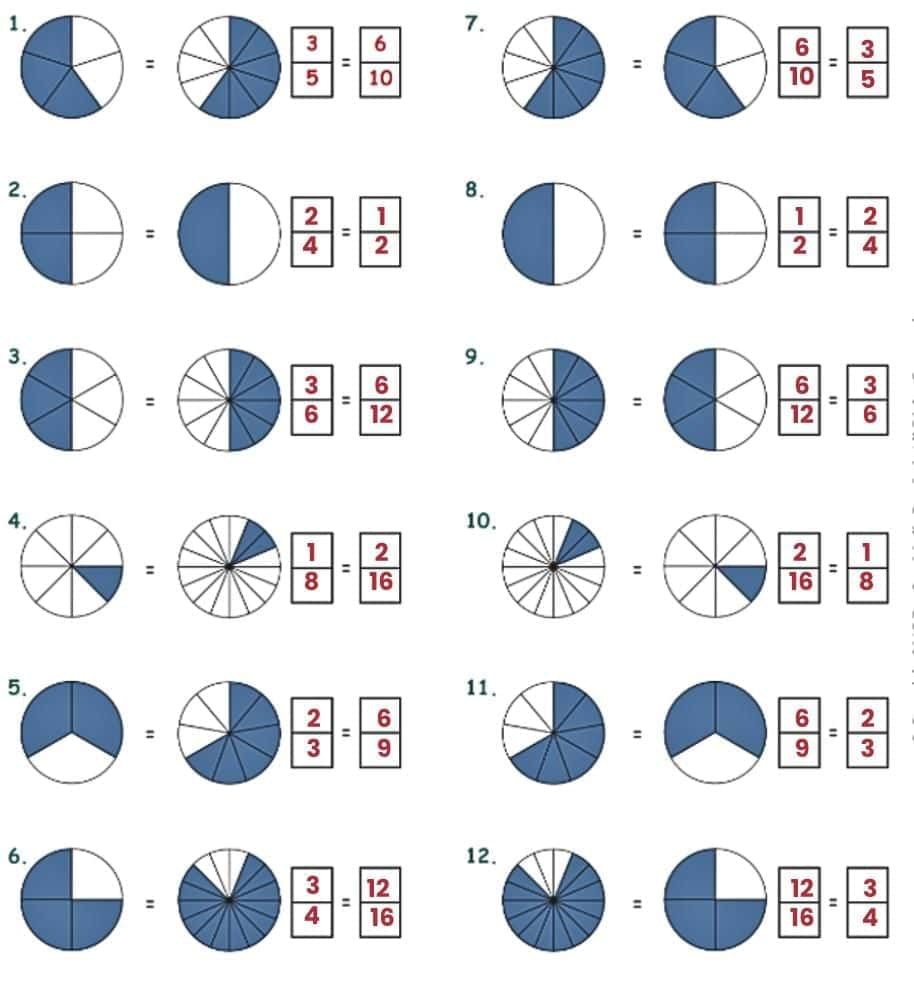
The document Important Questions with Solutions: Fractions - 2 is a part of the Class 5 Course Mathematics for Class 5.
All you need of Class 5 at this link: Class 5
FAQs on Important Questions with Solutions: Fractions - 2
| 1. What are fractions and why are they important in mathematics? |  |
Ans. Fractions are numerical expressions that represent a part of a whole. They consist of two parts: the numerator, which indicates how many parts we have, and the denominator, which shows how many equal parts the whole is divided into. Fractions are important in mathematics because they allow us to represent and work with quantities that are not whole numbers, enabling us to solve a variety of problems in real-life situations such as cooking, budgeting, and measurements.
| 2. How do you add and subtract fractions? | |
Ans. To add or subtract fractions, you need a common denominator. If the denominators are the same, you simply add or subtract the numerators while keeping the denominator the same. If the denominators are different, you first find the least common denominator (LCD), convert the fractions to equivalent fractions with the LCD, and then proceed with the addition or subtraction. Finally, simplify if necessary.
| 3. What is the difference between proper, improper, and mixed fractions? | |
Ans. Proper fractions are fractions where the numerator is less than the denominator (e.g., ⅗). Improper fractions have a numerator that is greater than or equal to the denominator (e.g., ⁵⁄₄). Mixed fractions consist of a whole number and a proper fraction combined (e.g., 1⅖). Understanding these types of fractions is crucial in performing mathematical operations and in real-life applications.
| 4. How do you convert a fraction to a decimal? | |
Ans. To convert a fraction to a decimal, you divide the numerator by the denominator. For example, to convert ¾ to a decimal, you would divide 3 by 4, which equals 0.75. This method allows you to express fractions in decimal form, making calculations easier in some cases.
| 5. Why is it important to simplify fractions, and how do you do it? | |
Ans. Simplifying fractions is important because it makes them easier to work with and understand. To simplify a fraction, you divide both the numerator and the denominator by their greatest common divisor (GCD). For example, to simplify ⁶⁄₈, you would divide both 6 and 8 by 2, resulting in ³⁄₄. Simplified fractions are typically preferred in mathematical expressions and calculations.
About this Document

4.86/5 Rating

Apr 20, 2026 Last updated
Document Description: Important Questions with Solutions: Fractions - 2 for Class 5 2026 is part of Mathematics for Class 5 preparation. The notes and questions for Important Questions with Solutions: Fractions - 2 have been prepared according to the Class 5 exam syllabus. Information about Important Questions with Solutions: Fractions - 2 covers topics like and Important Questions with Solutions: Fractions - 2 Example, for Class 5 2026 Exam. Find important definitions, questions, notes, meanings, examples, exercises and tests below for Important Questions with Solutions: Fractions - 2.
Introduction of Important Questions with Solutions: Fractions - 2 in English is available as part of our Mathematics for Class 5 for Class 5 & Important Questions with Solutions: Fractions - 2 in Hindi for Mathematics for Class 5 course. Download more important topics related with notes, lectures and mock test series for Class 5 Exam by signing up for free. Class 5: Important Questions with Solutions: Fractions - 2
Description
Important Questions with Solutions: Fractions of Mathematics - variety of important questions with solutions, helping you prepare for exam. Download free PDF from EduRev.
Information about Important Questions with Solutions: Fractions - 2
In this doc you can find the meaning of Important Questions with Solutions: Fractions - 2 defined & explained in the simplest way possible. Besides explaining types of Important Questions with Solutions: Fractions - 2 theory, EduRev gives you an ample number of questions to practice Important Questions with Solutions: Fractions - 2 tests, examples and also practice Class 5 tests



Related Searches
study material, MCQs, Previous Year Questions with Solutions, video lectures, ppt, Important Questions with Solutions: Fractions - 2, practice quizzes, pdf , Summary, Extra Questions, Viva Questions, shortcuts and tricks, Exam, Semester Notes, Free, Sample Paper, Important Questions with Solutions: Fractions - 2, Objective type Questions, mock tests for examination, Important questions, past year papers, Important Questions with Solutions: Fractions - 2;