CBSE Class 7 > Class 7 Notes > Science (Curiosity) - New NCERT > Infographics: Earth, Moon and the Sun
Infographics: Earth, Moon and the Sun

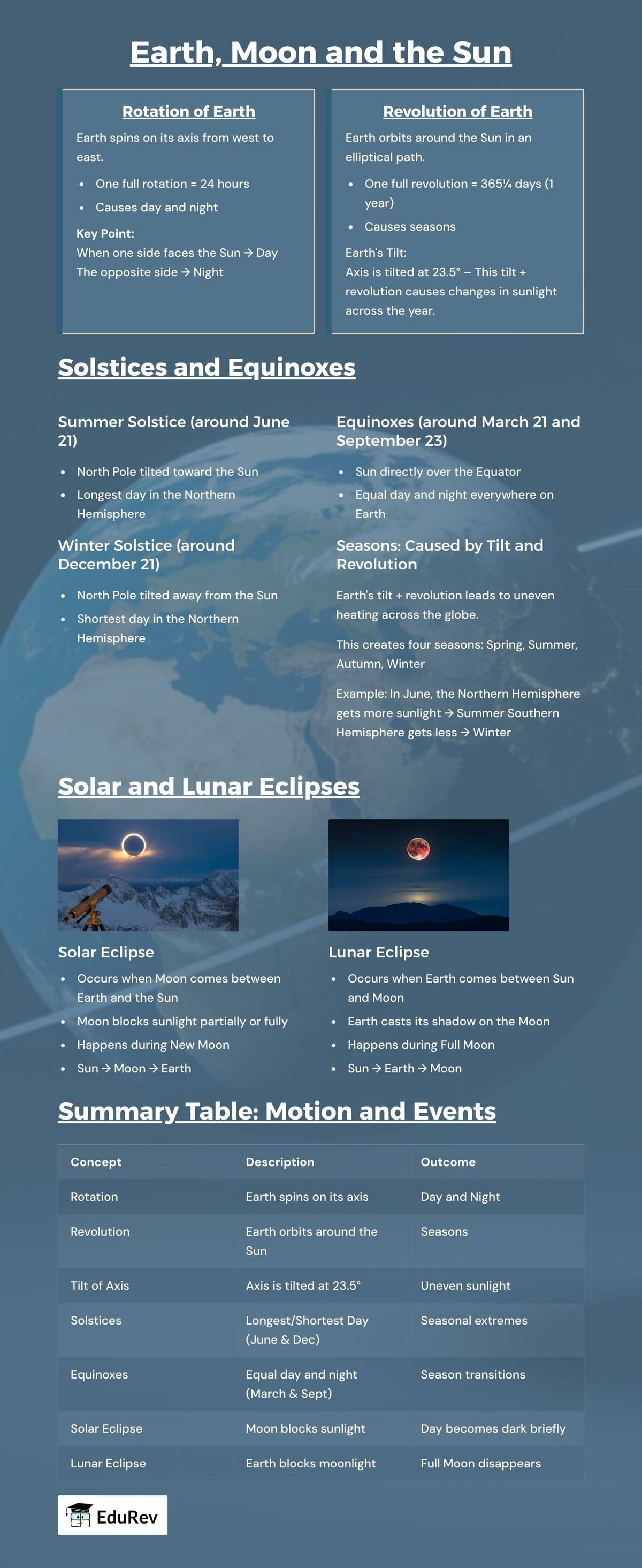
The document Infographics: Earth, Moon and the Sun is a part of the Class 7 Course Science (Curiosity) Class 7 - New NCERT.
All you need of Class 7 at this link: Class 7
FAQs on Infographics: Earth, Moon and the Sun
| 1. What are the main differences between the Earth, Moon, and Sun? |  |
Ans. The Earth is a terrestrial planet with a diverse atmosphere and ecosystems, supporting life. It has a diameter of about 12,742 km and orbits the Sun at an average distance of approximately 149.6 million km. The Moon is Earth's only natural satellite, measuring about 3,474 km in diameter. It orbits Earth at an average distance of about 384,400 km and has no atmosphere or water, resulting in extreme temperature variations. The Sun is a massive star at the center of our solar system, with a diameter of about 1.4 million km. It is primarily composed of hydrogen and helium and provides the necessary light and heat for life on Earth.
| 2. How do the Earth, Moon, and Sun interact during a solar and lunar eclipse? | |
Ans. A solar eclipse occurs when the Moon passes between the Earth and the Sun, blocking out the Sun's light either partially or completely. This can only happen during a new moon phase. In contrast, a lunar eclipse happens when the Earth comes between the Sun and the Moon, causing the Earth's shadow to fall on the Moon. This can only occur during a full moon phase. Both phenomena highlight the alignment of these three celestial bodies, showcasing their gravitational interactions.
| 3. Why does the Moon have phases, and how are they related to the Earth and Sun? | |
Ans. The Moon has phases due to its position relative to the Earth and the Sun. As the Moon orbits Earth, different portions of its surface are illuminated by the Sun, creating the visible phases: new moon, crescent, first quarter, gibbous, and full moon. This cycle takes about 29.5 days to complete. The relative positions of Earth, Moon, and Sun determine which phase is visible from Earth at any given time.
| 4. What is the significance of the Earth's rotation and revolution in relation to the Sun? | |
Ans. The Earth's rotation on its axis takes approximately 24 hours and is responsible for the day-night cycle. As Earth rotates, different parts of the planet face the Sun, resulting in daylight for those areas while others experience night. The revolution of Earth around the Sun takes about 365.25 days and is responsible for the seasons. As Earth orbits the Sun, the tilt of its axis causes varying angles of sunlight to reach different regions, leading to seasonal changes.
| 5. How does the distance between the Earth and the Sun affect the climate on Earth? | |
Ans. The average distance between the Earth and the Sun is about 149.6 million km, which plays a crucial role in determining Earth's climate. This distance influences the amount of solar energy that reaches Earth. A closer distance would increase temperatures, while a farther distance would decrease them, potentially leading to extreme climate conditions. The Earth's tilt and orbit shape also affect how sunlight is distributed across the planet, further influencing climate patterns and seasonal changes.
About this Document

1.2K Views

4.89/5 Rating

Apr 19, 2026 Last updated
Document Description: Infographics: Earth, Moon and the Sun for Class 7 2026 is part of Science (Curiosity) Class 7 - New NCERT preparation. The notes and questions for Infographics: Earth, Moon and the Sun have been prepared according to the Class 7 exam syllabus. Information about Infographics: Earth, Moon and the Sun covers topics like and Infographics: Earth, Moon and the Sun Example, for Class 7 2026 Exam. Find important definitions, questions, notes, meanings, examples, exercises and tests below for Infographics: Earth, Moon and the Sun.
Introduction of Infographics: Earth, Moon and the Sun in English is available as part of our Science (Curiosity) Class 7 - New NCERT for Class 7 & Infographics: Earth, Moon and the Sun in Hindi for Science (Curiosity) Class 7 - New NCERT course. Download more important topics related with notes, lectures and mock test series for Class 7 Exam by signing up for free. Class 7: Infographics: Earth, Moon and the Sun
Description
Infographics: Earth, Moon & the Sun of Science provides you one-page visual summary of the chapter covering all the important topics. Download the PDF from EduRev.
Information about Infographics: Earth, Moon and the Sun
In this doc you can find the meaning of Infographics: Earth, Moon and the Sun defined & explained in the simplest way possible. Besides explaining types of Infographics: Earth, Moon and the Sun theory, EduRev gives you an ample number of questions to practice Infographics: Earth, Moon and the Sun tests, examples and also practice Class 7 tests



Related Searches
pdf , Semester Notes, Objective type Questions, practice quizzes, Summary, past year papers, shortcuts and tricks, Viva Questions, Moon and the Sun, Infographics: Earth, Exam, MCQs, Previous Year Questions with Solutions, Moon and the Sun, Infographics: Earth, Moon and the Sun, Important questions, study material, Sample Paper, ppt, video lectures, Extra Questions, Free, mock tests for examination, Infographics: Earth;