Unit Test (Solutions): Introduction to Euclid's Geometry

Time: 1 hour
M.M. 30
Attempt all questions.
Question numbers 1 to 5 carry 1 mark each.
Question numbers 6 to 8 carry 2 marks each.
Question numbers 9 to 11 carry 3 marks each.
Question numbers 12 & 13 carry 5 marks each.
Q1. It is known that if x + y = 10, then x + y + z = 10 + z. Euclid's axiom that illustrates this statement is (1 Mark)
(a) First Axiom
(b) Second Axiom
(c) Third axiom
(d) Fourth Axiom
Ans: (b)
Euclid's second axiom states: "If equals are added to equals, the wholes are equal." Here, z is added on both sides, so the equation becomes x + y + z = 10 + z.
Q2. 'Lines are parallel if they do not intersect' is stated in the form of (1 Mark)
(a) Definition
(b) Proof
(c) Postulate
(d) Axiom
Ans: (a)
This statement gives the exact meaning of the term "parallel lines," hence it is a definition.
Q3. Who is known to have given the first known proof in geometry? (1 Mark)
Ans: Thales
Q4. How many dimensions does a surface have according to Euclid's definitions? (1 Mark)
Ans: A surface has two dimensions - length and breadth.
Q5. According to Euclid, what is a point? (1 Mark)
Ans: A point is that which has no part.
Q6. State Euclid's first and second postulates. (2 Marks)
Ans:
- A straight line may be drawn from any one point to any other point.
- A terminated line can be produced indefinitely.
Q7. What is a terminated line according to Euclid? (2 Marks)
Ans: A terminated line is a line segment that has two endpoints but can be extended indefinitely in both directions.
Q8. Define a plane surface according to Euclid and explain why it is considered an undefined term in modern geometry. (2 Marks)
Ans: According to Euclid, a plane surface is one which lies evenly with the straight lines on itself.
In modern geometry, it is considered undefined because explaining terms like "evenly" leads to further definitions, resulting in an endless chain.
Q9. In the figure, it is given that AD = BC. By which of Euclid's axioms can it be proved that AC = BD? (3 Marks) 
Ans: We are given: AD = BC
Subtracting equal lengths (CD) from both:
AD - CD = BC - CD
⇒ AC = BD
This follows from Euclid's third axiom: If equals are subtracted from equals, the remainders are equal.
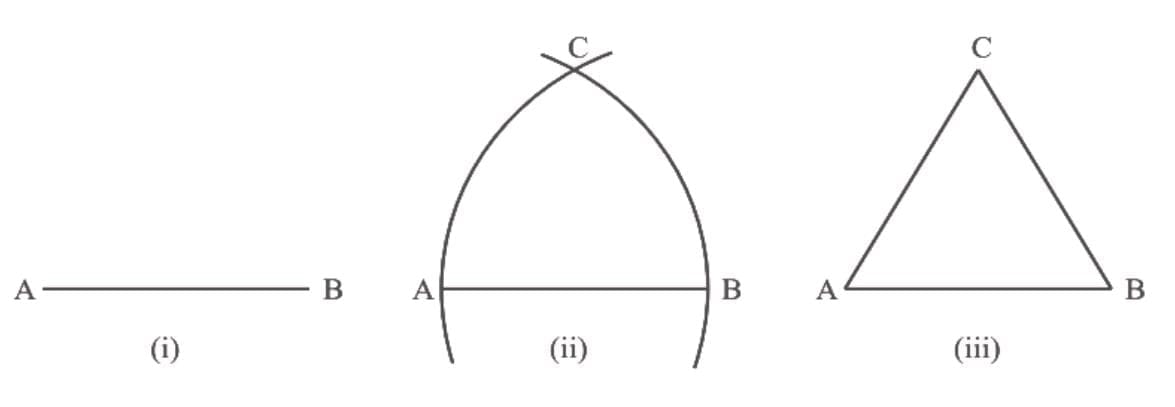
Q10. Construct an equilateral triangle on a given line segment AB using Euclid's postulates. (3 Marks)
Ans:
Take line segment AB.
By Postulate 3, draw a circle with center A and radius AB.
Draw another circle with center B and radius BA.
Let the circles intersect at point C.
Join AC and BC.
Now, AB = AC = BC (as radii of equal circles), so triangle ABC is equilateral.
Q11. What are the five postulates of Euclid's Geometry? (3 Marks)
Ans: Euclid's postulates were:
- A straight line may be drawn from one point to any other point.
- A terminated line can be produced indefinitely.
- A circle can be drawn with any centre and any radius.
- All right angles are equal to one another.
- If a straight line falling on two straight lines makes the interior angles on the same side of it taken together less than two right angles, then the two straight lines if produced indefinitely, meet on that side on which the sum of angles is less than two right angles.
Q12. If a point C lies between two points A and B such that AC = BC, then prove that AC =1/2 AB. Explain by drawing the figure. (5 Marks) 
Ans:
Given: AC = BC
To Prove: AC = ½ ABProof:
Step 1: Add AC to both sides:
AC + AC = BC + ACStep 2: From the figure, BC + AC = AB
⇒ 2AC = ABStep 3: Dividing both sides by 2:
⇒ AC = ½ ABHence proved.
(Axiom Used: If equals are added to equals, the wholes are equal.)
Q13. It is known that x + y = 10 and that x = z. Show that z + y = 10. (5 Marks)
Ans:
Given:
x + y = 10 ...(i)
x = z ...(ii)To Prove: z + y = 10
Proof:
From equation (ii), substitute x with z in (i):
⇒ z + y = 10(Axiom Used: If equals are substituted for equals, the result is the same - based on the principle of equality.)
Hence proved.
FAQs on Unit Test (Solutions): Introduction to Euclid's Geometry
| 1. What are the fundamental concepts introduced in Euclid's Geometry for Class 9? |  |
| 2. Why are Euclid's postulates significant in the study of geometry? | |
| 3. How do Euclidean and non-Euclidean geometries differ? | |
| 4. What is the importance of proofs in Euclid's Geometry? | |
| 5. How can students effectively prepare for exams on Euclid's Geometry? | |