Important Questions with Solutions: Grandmother’s Quilt

Q1: Length of a rectangular park is 3 times its breadth. If the length of the park is 90 metres, then find the area of the park.
Ans: Length of rectangular park = 90 m.
So, breadth = 90 m ÷ 3 = 30 m.
Area of the rectangle = length × breadth.
∴ Area = 90 m × 30 m = 2700 m2.
Q2: Find the area of a rectangular cardboard 1 m long and 25 cm broad.
Ans: Convert units to the same type. 1 m = 100 cm.
So, length = 100 cm and breadth = 25 cm.
Area = length × breadth = 100 cm × 25 cm = 2,500 cm2.
Q3: Find the area of a square with side 7 cm.
Ans: Area of a square = side × side.
∴ Area = 7 cm × 7 cm = 49 cm2.
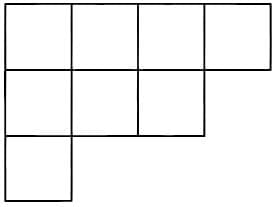
Q4: Find the Perimeter (P) and the Area (A) of the Given Figures. Assume Each Side of the Unit Square is 2 Cm
Ans:
Each small square has side = 2 cm.
Perimeter means the total length around the outside boundary of the figure.
From the figure, add the outer edge lengths as shown: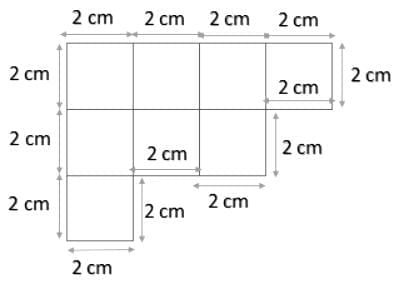
Perimeter = (2 + 2 + 2 + 2) + (2 + 2 + 2) + 2 + 2 + (2 + 2) + 2 + 2 + 2 = 28 cm.
∴ Perimeter = 28 cm.
Now there are 8 square in given figure as shown below;
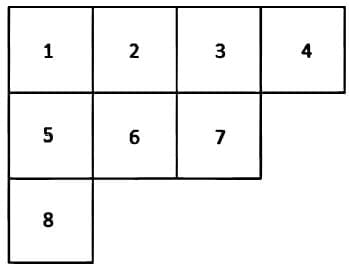
Area of one small square = 2 cm × 2 cm = 4 cm2.
Number of such squares in the figure = 8.
∴ Area of the figure = 4 cm2 × 8 = 32 cm2.
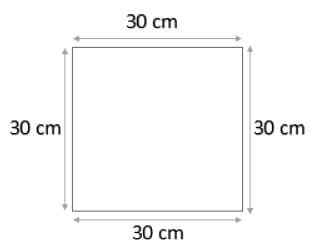
Q5: Find the Perimeter of and Area of below Square:
Side = 30
Ans: Square has all sides equal; side = 30 cm.
Perimeter = 4 × side = 4 × 30 cm = 120 cm.
Area = side × side = 30 cm × 30 cm = 900 cm2.
Q6: Find the Perimeter and Area of below Rectangle
Length = 4 m 20 cm and Breadth = 2 m 50 cm
Ans: Convert both measurements to the same unit (centimetres).
1 m = 100 cm.
Length = 4 m 20 cm = (4 × 100) cm + 20 cm = 400 cm + 20 cm = 420 cm.
Breadth = 2 m 50 cm = (2 × 100) cm + 50 cm = 200 cm + 50 cm = 250 cm.
Perimeter of rectangle = 2 × (length + breadth) = 2 × (420 cm + 250 cm) = 2 × 670 cm = 1,340 cm.
Convert perimeter to metres: 1,340 cm = 13.40 m.
Area = length × breadth = 420 cm × 250 cm = 105,000 cm2.
Convert area to square metres: 105,000 cm2 ÷ 10,000 = 10.5 m2.
∴ Perimeter = 1,340 cm (13.40 m) and Area = 105,000 cm2 (10.5 m2).
Q7: Neha and Rekha Draw a Circle of Same Size in Their Books
If Length and Breadth of Neha՚s Book is 60 Cm and 40 Cm and Length and Breadth of Rekha՚s Book is 70 Cm and 30 Cm, Find Whose Book Have More Circle?
Ans: Area of Neha's book = 60 cm × 40 cm = 2400 cm2.
Area of Rekha's book = 70 cm × 30 cm = 2100 cm2.
Since 2400 cm2 > 2100 cm2, Neha's book has the larger area.
If both draw circles of the same size, Neha's book can hold more such circles because it has more area.
Q8: An Open Cinema Ground is 240 Meter Long and 190 Meter in Breadth
Find the area of land acquired by Open Cinema.
Ans: The ground is rectangular with length = 240 m and breadth = 190 m.
Area = length × breadth = 240 m × 190 m = 45,600 m2.
∴ Area of the open cinema ground = 45,600 m2.
Q9: Answer the Following Questions. (Every Room is a Square or a Rectangle)
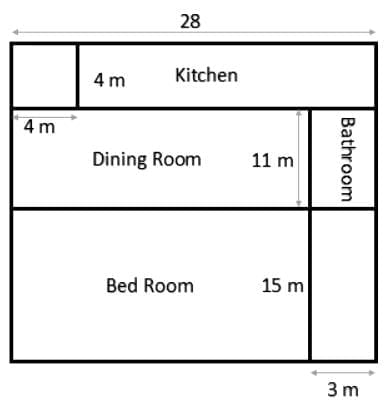
(i) Look at the house design and find the area of the Bathroom room.
Ans: Using the bathroom dimensions from the figure (rectangular shape):
Area = length × breadth = 11 × 3 = 33 m2.
(ii) Look at the house design and find the area of the Kitchen room.
Ans: Using the kitchen dimensions from the figure (rectangular shape):
Area = length × breadth = 24 × 4 = 96 m2.
Q10: Find the length of Rectangular School playground of 4800 square meter area and 60 m breadth.
Ans: Area of rectangle = length × breadth.
Given area = 4800 m2 and breadth = 60 m.
Length = Area ÷ Breadth = 4800 m2 ÷ 60 m = 80 m.
∴ Length of the playground = 80 m.
FAQs on Important Questions with Solutions: Grandmother’s Quilt
| 1. What is the significance of quilts in cultural traditions? |  |
| 2. How can children learn quilting skills from their grandparents? | |
| 3. What materials are commonly used in quilting? | |
| 4. What are some popular quilting techniques that beginners can start with? | |
| 5. How can quilting be a therapeutic activity for individuals? | |