NCERT Solutions: The Colonial Era in India


Page No. 83
The Big Questions
Q1: What is colonialism?
Ans: Colonialism is a system in which one country takes control of another country's land, people and resources to benefit the coloniser. It usually involves political domination, economic exploitation and cultural interference, and often causes hardship for the people being ruled.
Q2: What drew European powers to India?
Ans: Europeans were attracted to India mainly by trade and profit. India produced valuable goods such as spices, silk, cotton and indigo that were in high demand in Europe. European traders sought direct sea routes to avoid expensive middlemen. Religious motives, especially for the Portuguese, also played a part, as they wished to spread Christianity. Over time, states such as Portugal, the Netherlands, France and Britain competed to control Indian trade and political power.
Q3: What was India's economic and geopolitical standing before and during the colonial period?
Ans:
Before the Colonial Era: India consisted of many kingdoms and regional powers such as the Mughals, Marathas, Rajputs and several southern states, though some were declining or in conflict by the 18th century. These states were rich in trade, art and learning. Indian textiles, gems and spices were famous across the world and attracted merchants from Europe, Arabia and Southeast Asia. Rulers made diplomatic decisions, entered treaties and spread Indian culture, religion and knowledge to other Asian regions.
During the Colonial Period: British rule transformed India's economy to serve British needs. India became a supplier of raw materials like cotton and indigo for British industries and a market for British manufactured goods. Many local industries, especially textiles and handicrafts, declined. The British controlled defence, trade and foreign affairs and used Indian soldiers for imperial purposes. These changes weakened India's political autonomy and altered its economy and society to fit British interests.
Q4: How did the British colonial domination of India impact the country?
Ans:
- The British drained India's wealth and used natural resources for their own profit, transferring large sums of money and goods to Britain.
- Traditional Indian industries such as textiles and handicrafts were harmed because cheap machine-made British goods flooded domestic markets.
- Farmers suffered from heavy land taxes introduced under systems like the Permanent Settlement; this caused debt, poverty and contributed to the severity of several famines.
- India lost political freedom as the British took over administration, defence and foreign affairs, reducing the power of local rulers.
- English education created a small western-educated class, but Indian knowledge systems and many local languages were neglected.
- Transport and communication such as railways, roads and the telegraph were built mainly to serve British trade and military needs.
- Although these developments later helped India's unity and the freedom movement, they were originally designed to strengthen British control.
Page No. 87
Let's Explore
Q1: What do you think the cartoon (Fig. 4.3) is trying to express? (Keep in mind that the telegraph, which permitted instant communications for the first time, was then a recent invention.) Analyse different elements of the drawing.
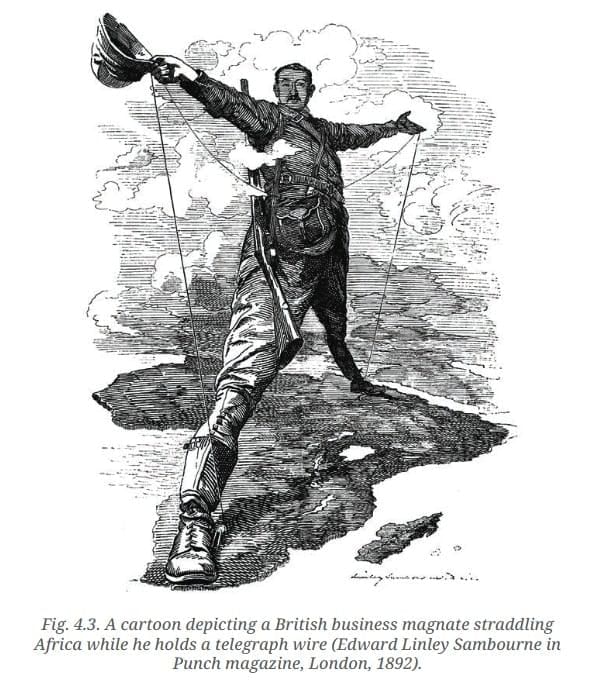
Ans:
- Before the telegraph, sending messages overseas could take weeks or months because letters travelled by ship.
- The telegraph allowed messages to be sent almost instantly. People were astonished that news could now travel "faster than the wind."
- The cartoon likely contrasts the slow old ways with the new speed: a person in London can send orders and information and receive replies from India very quickly.
- It emphasises how telegraphic links made distant parts of the empire feel much closer and easier to manage.
- For the British, the telegraph became a tool of control; it allowed London to issue instructions rapidly to officials and commanders in India.
Page No. 92
Let us Explore
Q1: Before you read further, have a good look at the painting on the first page of this chapter. It was specially ordered for the London headquarters of the East India Company and is over three metres long. Observe every aspect of it the people in it, the objects, the symbols and the attitudes. Form groups of four or five students and let each group present its conclusions as regards the messages the painting conveys. (You will find our answers a few pages down, when we return to the painting, but avoid looking at them right now!)
Ans:
- The painting presents Britain as powerful and supreme. A white woman, Britannia, sits like a goddess, symbolising British authority and rule.
- India is depicted as offering its wealth. Dark-skinned figures, shown in submissive postures, present pearls, jewels and cotton to British figures.
- A figure representing China also appears to be presenting gifts, suggesting that Britain drew riches from many lands.
- Exotic animals and trade symbols illustrate the variety of goods and resources under British control and the global reach of British trade.
- A man holding a trident symbolises the strength of the British navy and its command of the seas.
- The figure called Old Father Thames represents London's River Thames and suggests that wealth from the colonies flowed into Britain.
Conclusion: The painting conveys the message that Britain, through the East India Company, dominated its colonies and took their riches to increase its own power.
Page No. 98
Let's Explore
Q1: Why do you think Dadabhai Naoroji means by 'un-British rule in India'? (Hint: he was an MP in the House of Commons in 1892.)
Ans: Dadabhai Naoroji used the term "Un-British Rule in India" to show that British governance in India contradicted Britain's own professed values of justice, fairness and liberty. As an MP, he argued that although British rule claimed to be civilising, in practice it exploited Indians, denied them equal rights and drained their wealth. For Naoroji, this behaviour was not truly British in spirit.
Think About It
Q2: Let us return to this painting (Fig. 4.14), but now with some clues to its symbolism. Note how Britannia (a symbolic figure for Britain) sits higher than the colonies, pointing to her superior power; contrast with the lower position and bent posture of the colonies. Did they really 'offer' their wealth? Or did Britain seize it by force or ruse? Note also the Indians' dark complexion (in contrast with that of Britannia), reflecting the belief in the superiority of white people over the dark-skinned 'natives'.
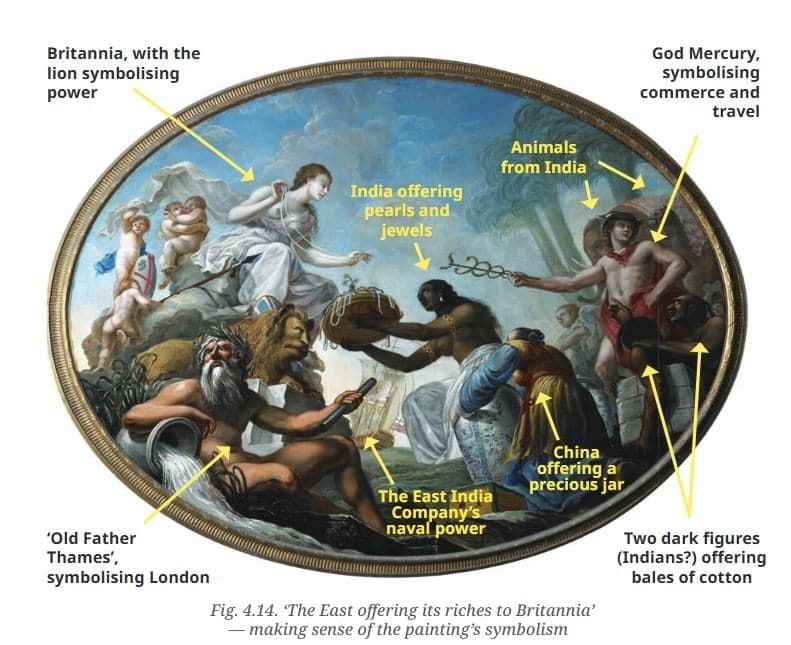
Ans: No. Indians did not freely offer their wealth. In most cases Britain took wealth through force, unequal treaties, unfair taxes and discriminatory trade policies. Indian farmers, artisans and rulers often had little choice because of military pressure, economic dependency and legal restrictions. The painting's portrayal as an offering hides the reality of exploitation and coercion.
Page No. 100
Let's Explore
Q1: Do you understand all the terms used above to list and describe Indian textiles? If not, form groups of four or five and try to find out more, then compare your findings with the help of your teacher.
Ans: Here are some common textile terms with simple explanations:
- Cotton: A soft, breathable fibre from the cotton plant used to make light clothing.
- Silk: A smooth, shiny and expensive fabric produced by silkworms; used for sarees and special garments.
- Wool: A warm fibre from the fleece of sheep and other animals, used for winter clothing like shawls and sweaters.
- Jute: A strong, coarse fibre used for sacks, ropes, mats and coarse cloth.
- Hemp: A durable natural fibre used for ropes, coarse cloth and bags.
- Coir: A rough fibre from coconut husks used for ropes, mats and brushes.
- Muslin: A very fine form of cotton once famous in Dhaka (now in Bangladesh); used for delicate garments.
Page No. 102
Think About It
Q1: What exactly did Macaulay mean when he wrote that "a single shelf of a good European library was worth the whole native literature of India and Arabia"? And why should he want to make Indians "English in taste, in opinions, in morals, and in intellect"? How does this relate to the 'civilising mission' mentioned at the start of the chapter? Ask your teacher to guide a class debate on these questions.
Ans: Macaulay implied that European knowledge was superior to Indian and Arabic learning. This reveals a colonial bias that undervalued local knowledge and culture. He wanted Indians to adopt British tastes, values and ways of thinking so they would be more manageable under colonial rule. This attitude is linked to the so-called "civilising mission", where Britain claimed to improve colonised peoples but actually sought cultural domination and political control.
Page No. 104
Think About It
Q1: What is meant by "the sun never sets on the British Empire"? Do you think this was a correct statement?
Ans: The phrase means the British Empire was so extensive, with territories across many parts of the world, that at any time the sun was shining on some part of the empire. This was largely true in the nineteenth and early twentieth centuries because Britain ruled colonies in Asia, Africa, the Americas and the Pacific.
Page No. 105
Let's Explore
Q1: Examine the map. What are the main differences with the map of today's India, in terms both of borders and of names?
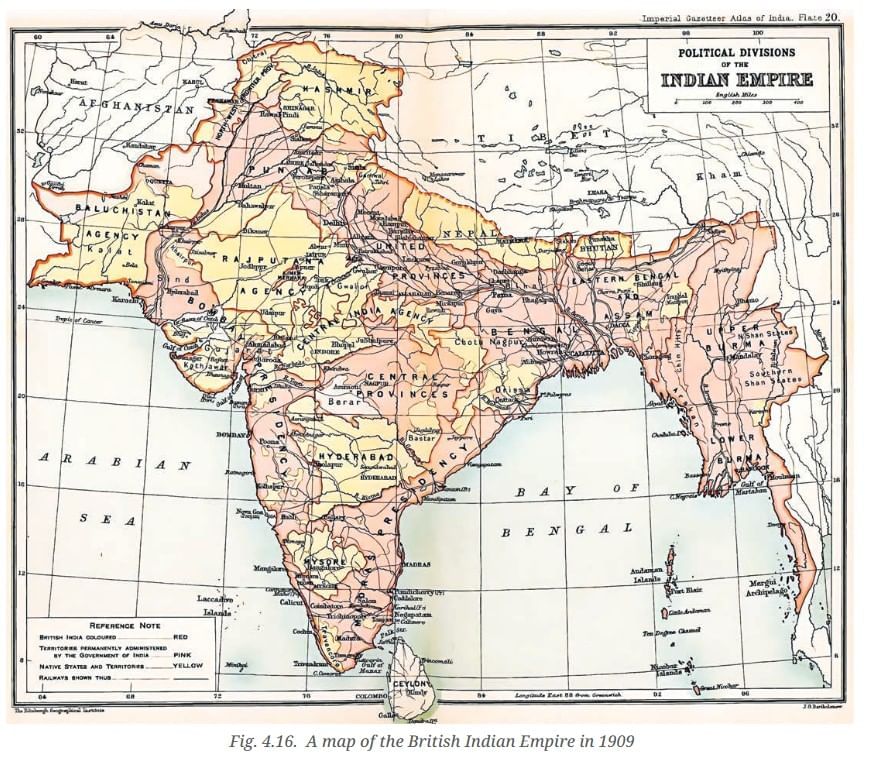
Ans:
- The 1909 map of the Indian Empire differs greatly from modern India.
- Under British rule, the territory shown as India included areas that are now Pakistan and Bangladesh, and until 1937 also included Myanmar (Burma).
- The north-west frontier included regions such as Baluchistan and the North-West Frontier Province, which are now part of Pakistan.
- Many city names have changed: Calcutta is now Kolkata, Bombay is Mumbai and Madras is Chennai.
- Territorial units were called Provinces, Agencies or Princely States under British rule; today India is divided into states and union territories.
- The 1909 map often used colour to show which areas were under direct British control (for example, pink) and which were princely states under indirect rule (for example, yellow).
- The map also marks railway lines built by the British, which connected important towns and ports for trade and administration.
Page No. 107
Let's Explore
Q1: Note how the Santhals are depicted in the 1856 sketch (Fig. 4.17) drawn from an artist's imagination: observe their complexion, dress, weapons and draw your conclusions as regards the image this depiction would create in the popular mind in Britain.
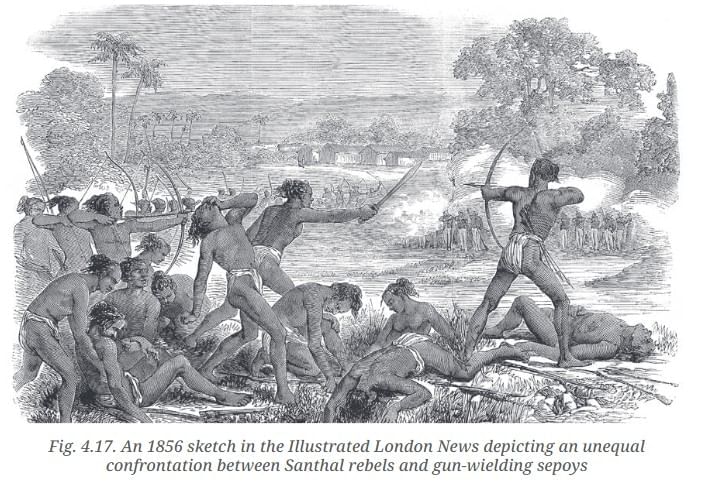
Ans: In the 1856 sketch the Santhals are shown with dark skin, scant clothing and traditional weapons like bows and arrows. The image presents them as primitive and violent, fighting British soldiers with handmade arms. Such portrayals would have created a fearful and negative image of tribal people in Britain, suggesting they were uncivilised and justifying British rule as a civilising necessity. In reality their resistance arose from exploitation, loss of land and injustice.
Page No. 108
Let's Explore
Q1: Indigo is a natural deep blue pigment used in dyeing. Can you think of other natural substances that have been traditionally used in India to dye cloth?
Ans: Traditional natural dyes used in India include turmeric (yellow), henna or mehndi (reddish-brown), madder root (red), pomegranate rind (brownish or yellow), neem leaves (greenish tints), tree barks (various browns), lac (red) and, of course, indigo (blue). These dyes were commonly used in techniques such as block printing, kalamkari and bandhani and were more environment-friendly than many modern chemical dyes.
Q2: Why do you think was the term 'Sepoy Mutiny' rejected after Indian Independence? Write one paragraph explaining your reasons.
Ans: After Independence historians and Indians rejected the term "Sepoy Mutiny" because it suggests the 1857 uprising was only a limited military revolt by a few Indian soldiers. In truth it was a large and widespread movement involving soldiers, peasants, landlords, regional rulers and ordinary townspeople across many regions. Calling it merely a mutiny understates its scale and political significance and ignores its role as an early expression of resistance to British rule.
Page No. 112
Let's Explore
Q1: In the sentence "It opened (or re-opened) India to the world and the world to India", why do you think we added 'reopened'?
Ans: The word "reopened" is used because India already had long-standing links with the rest of Asia and with Europe through trade, religion and learning before colonial rule. Traders, pilgrims and scholars travelled to and from India for centuries. The British re-integrated India into a different global network focused on European industrial needs rather than restoring ancient patterns of exchange.
Q2: Some argue that stolen cultural heritage has been better preserved abroad than it would have been in India. What is your view on its repatriation? Discuss in groups.
Ans: Many people argue that objects stolen during colonial rule should be returned because they are part of the country's history and identity. While some foreign museums may have preserved certain items, returning them recognises past injustice and allows people to reconnect with their heritage. Today India has the expertise and institutions to conserve and display these objects properly, and repatriation helps restore cultural dignity and access for future generations.
Page No. 114
Questions and Activities
Q1: What is colonialism? Give three different definitions based on the chapter or your knowledge.
Ans: Colonialism is when a powerful country takes control of another territory and uses its land, people and resources for its own benefit. It affects the ruled country's political power, economy and culture.
Three definitions of colonialism are:
- Historical Definition: Colonialism is the domination of one territory by another foreign power that extracts wealth and resources for its own benefit.
- Political Definition: Colonialism is the political control of one country by another, which removes or limits local sovereignty and self-rule.
- Economic and Social Definition: Colonialism is a system where a more powerful nation exploits the economy and people of a weaker territory and imposes its language, education and cultural norms.
Q2: Colonial rulers often claimed that their mission was to 'civilise' the people they ruled. Based on the evidence in this chapter, do you think this was true in the case of India? Why or why not?
Ans: No. The claim that the British came to "civilise" India does not stand up to the evidence. While colonial officials introduced some institutions such as railways and schools, these were primarily designed to serve British political and economic interests rather than to benefit Indians broadly.
Evidence from the chapter shows:
- Economic exploitation: Raw materials like cotton and indigo were exported to feed British industry while local crafts and textile production were ruined by competition from cheap British manufactures.
- High taxes and famines: Heavy land revenue demands impoverished farmers; during famines the colonial state often continued revenue collection rather than providing adequate relief.
- Loss of Indian rule: Many Indian rulers were defeated, coerced into unequal treaties or reduced to subsidiary status under British overlordship.
- Biased education: English education aimed to create a class of Indians who would think like the British, while indigenous knowledge systems were devalued.
Thus, the "civilising mission" served as a justification for domination and exploitation rather than a genuine effort to improve the lives of Indians.
Q3: How was the British approach to colonising India different from earlier European powers like the Portuguese or the French?
Ans: The British method of colonisation was more systematic, administrative and long-term compared with the Portuguese and French. While the Portuguese and French focused mainly on trade, coastal forts and a few settlements, the British extended control inland, intervened in local politics, created permanent administrative structures and reshaped the economy to suit imperial needs. Over time the British established direct rule over large territories and a complex bureaucracy to govern them.
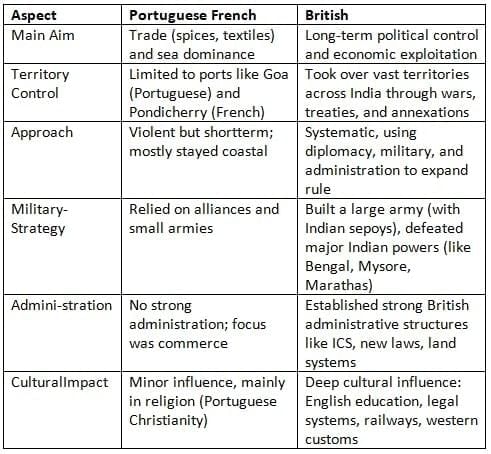
The British built a larger territorial empire, used Indian revenues to fund administration, and implemented legal and land revenue systems that had long-term effects on Indian society.
Q4: "Indians funded their subjugation." What does this mean in the context of British infrastructure projects in India like the railway and telegraph networks?
Ans: Although railways, telegraphs and postal services were built in India during British rule, they were financed largely from Indian revenues and loans. These projects were intended to serve British economic and military purposes rather than to provide equal benefit to Indians.
How Indians 'Funded their own subjugation':
- Colonial governments raised revenue from Indian taxpayers through land taxes and other levies, and spent this money on infrastructure that mainly facilitated the extraction of raw materials and troop movement.
- Large parts of the cost were covered by loans guaranteed by Indian revenues; interest payments and repayments therefore became an additional drain on India's economy.
- Railways and telegraphs mainly linked production centres to ports that sent goods to Britain, so the infrastructure supported imperial trade patterns rather than local economic development.
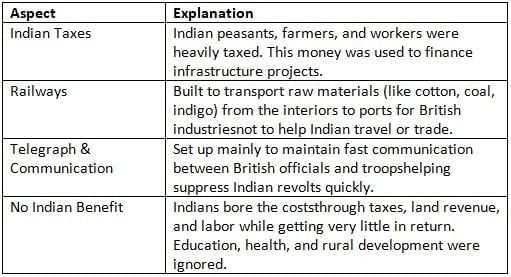
Conclusion: The infrastructure modernised parts of India physically, but it was paid for by Indian resources and taxes and used to strengthen British control. In that sense Indians helped pay for the very systems that consolidated their subjugation.
Q5: What does the phrase 'divide and rule' mean? Give examples of how this was used by the British in India?
Ans: "Divide and rule" refers to the deliberate creation or deepening of social, religious, regional and political divisions among Indians so that they would be less likely to unite against British rule. By encouraging rivalries and separate identities, the British could govern more easily with limited personnel.
Examples of "Divide and Rule" Policy in India:
- The British favoured different groups at different times (for example, giving some privileges to loyal princes or certain communities) to secure allies.
- They used separate electorates and reserved political representation for particular religious communities, which increased communal divisions.
- Administrative policies, censuses and legal classifications often emphasised caste, religion and ethnicity in ways that hardened identities.
- Interfering in succession and princely state affairs pitted rulers and factions against one another.
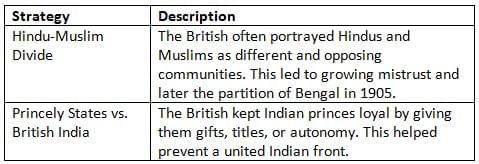
Conclusion: The British used these strategies to prevent a united opposition, making it easier for a relatively small colonial administration to control a large and diverse population.
Q6: Choose one area of Indian life, such as agriculture, education, trade, or village life. How was it affected by colonial rule? Can you find any signs of those changes still with us today? Express your ideas through a short essay, a poem, a drawing, or a painting.
Ans: Colonialism and Indian Agriculture: Under British rule Indian agriculture changed in ways that mostly harmed farmers. The colonial state encouraged the production of cash crops like indigo, cotton and opium for export to Britain instead of food crops for local needs. The Permanent Settlement of 1793 created a class of zamindars who were responsible for tax collection and often extracted high rents from peasants. This led to widespread poverty, indebtedness and vulnerability to famines. Railways were built primarily to move raw materials to ports rather than to serve farmers' needs. Some consequences, such as unequal land distribution, indebtedness and the emphasis on cash crops, continued to affect Indian agriculture after independence and can still be seen today.
Q7: Imagine you are a reporter in 1857. Write a brief news report on Rani Lakshmibai's resistance at Jhansi. Include a timeline or storyboard showing how the rebellion began, spread, and ended, highlighting key events and leaders.
Ans:
The Jhansi Flame: Rani Lakshmibai's Heroic Resistance!
Date: June 1858
Reporter: Vansh Mishra The Hindustan Herald
Rani Lakshmibai, the courageous queen of Jhansi, emerged as a leading figure during the Revolt of 1857. When the British attempted to annex Jhansi under the Doctrine of Lapse and denied her adopted son Damodar Rao the throne, she refused to surrender and declared, "I shall not surrender my Jhansi!" She led her forces, including women fighters, with great determination. After fierce battles Jhansi fell in April 1858, but Rani Lakshmibai escaped and later joined Tatya Tope at Gwalior. She died fighting on 17 June 1858, and her courage became a lasting symbol of resistance.
Timeline / Storyboard: Rani Lakshmibai and the 1857 Revolt
1853: After the death of Raja Gangadhar Rao, the British annexed Jhansi under the Doctrine of Lapse. Rani Lakshmibai protested but was ignored.
May 1857: The Revolt of 1857 began in Meerut and spread across North India. Inspired by this uprising, Rani Lakshmibai resolved to defend Jhansi.
June 1857: Soldiers and citizens of Jhansi joined the rebellion. Rani Lakshmibai organised defences and led her troops with determination.
March 1858: British forces under Sir Hugh Rose attacked Jhansi. Rani Lakshmibai fought bravely and inspired many to resist.
April 1858: After heavy fighting Jhansi was captured by the British. Rani Lakshmibai managed to escape and continued to resist.
June 1858: She joined Tatya Tope at Gwalior. On 17 June 1858 she was killed in battle, becoming a martyr and a lasting icon of Indian resistance.
Q8: Imagine an alternate history where India was never colonised by European powers. Write a short story of about 300 words exploring how India might have developed on its path.
Ans:
Title: The Lotus Never Wilted
In an alternate history, European powers never gained footholds in India. The great kingdoms-the Marathas, the Rajputs, Mysore and the Sikhs-gradually formed a confederation called the Bharatiya Sabha to foster trade, scientific exchange and cultural cooperation. Local artisans and merchants expanded maritime trade with China, Southeast Asia and Japan, and Indian shipyards became known for strong, fast vessels.
Universities modelled on Takshashila and Nalanda were revived, blending ancient learning with new discoveries. A network of regional colleges taught mathematics, astronomy, medicine and navigation, drawing students from across Asia. Indian languages and literature flourished, and arts such as weaving, metalwork and sculpture continued to develop under royal patronage.
By 1900 India was a centre of innovation, producing new agricultural techniques and medical treatments. Social reform movements gradually reduced inequalities and promoted wider education. Rather than being shaped by foreign markets, Indian industry grew to serve both local needs and export markets on its own terms. The tricolour in this world symbolises unity across diversity, and the lotus keeps blooming as a sign of self-reliance and cultural resilience.
Q9: Role-play: Enact a historical discussion between a British official and an Indian personality like Dadabhai Naoroji on the British colonial rule in India.
Ans: A Historical Role-Play Dialogue:
Setting: London, late 1890s - after a debate in the British Parliament.
British Official: Mr Naoroji, your "Drain of Wealth" theory seems exaggerated. The British have built railways, schools and laws in India. Aren't these benefits?
Dadabhai Naoroji: Sir, while railways and schools exist, they were paid for from Indian revenues and meant to serve British economic and strategic interests. India's wealth is being transferred to Britain through unfair trade and revenue policies.
British Official: But India is part of the Empire. Such developments would not have occurred without British rule.
Naoroji: Progress built on exploitation is not true progress. Our industries have been ruined, and people suffer from poverty and famine while resources are extracted.
British Official: That is the nature of empires, Mr Naoroji.
Naoroji: Then let justice begin with self-government. India can govern itself and deserve dignity, fairness and freedom, not merely charity.
Q10: Explore a local resistance movement (tribal, peasant, or princely) from your state or region during the colonial period. Prepare a report or poster describing:
- What was the specific trigger, if any?
- Who led the movement?
- What were their demands?
- How did the British respond?
- How is this event remembered today (e.g., local festivals, songs, monuments)?
Ans:
Report: The Santhal Rebellion (1855-56)
Region: Present-day Jharkhand (then part of Bengal Presidency)
Tribal Group: Santhals
Trigger:
The Santhals faced severe exploitation by zamindars, moneylenders and colonial officials. High taxes, loss of land and mounting debts pushed them into desperate poverty.
Beginning of the Revolt:
In June 1855, in the village of Bhognadih, leaders Sidhu and Kanhu Murmu with their brothers Chand and Bhairav raised the banner of revolt. Tens of thousands of Santhals joined them and declared they would stop paying taxes and defy colonial rules.
Demands and Actions:
They demanded an end to zamindari exploitation, restoration of tribal lands and fair treatment. Rebels attacked colonial outposts and moneylenders using traditional weapons.
British Response:
The British suppressed the uprising with strong military force. Many Santhals were killed, and leaders were captured or executed.
Legacy:
The Santhal Rebellion became one of the most significant tribal uprisings against British rule. June 30 is observed as Hul Diwas (Day of Revolt) in parts of Jharkhand. Statues of Sidhu and Kanhu Murmu stand in Dumka and Ranchi, and the Santhal Hul Museum preserves their memory.
FAQs on NCERT Solutions: The Colonial Era in India
| 1. What were the main reasons British East India Company took over India during the colonial era? |  |
| 2. How did the British colonial administration change Indian society and culture? | |
| 3. What was the Zamindari system and why did British introduce it in colonial India? | |
| 4. What were the major industries affected by British colonial policies in India? | |
| 5. How did Indians resist British colonial rule during the 18th and 19th centuries? | |