NCERT Solutions: The Parliamentary System: Legislature and Executive


Page No. 139
The Big Questions
Q1: What is India's parliamentary system, and how is it structured?
Ans: India's parliamentary system is a form of representative government in which the executive branch (the government) is drawn from the legislature and is accountable to it. Voters elect members to the Lok Sabha, and the political party or coalition with a majority there forms the government led by the Prime Minister. The system depends on the confidence of the legislature for the government to remain in office.
Structure of India's Parliamentary System:
- At the Union level, the Parliament consists of the President, Lok Sabha (House of the People), and Rajya Sabha (Council of States). This is a bicameral system.
- The Prime Minister leads the government and is supported by the Council of Ministers, who are accountable to the Lok Sabha.
- At the State level, each state has its own legislature and executive, called its State Assembly. Some states have two houses - the Vidhan Sabha and Vidhan Parishad.
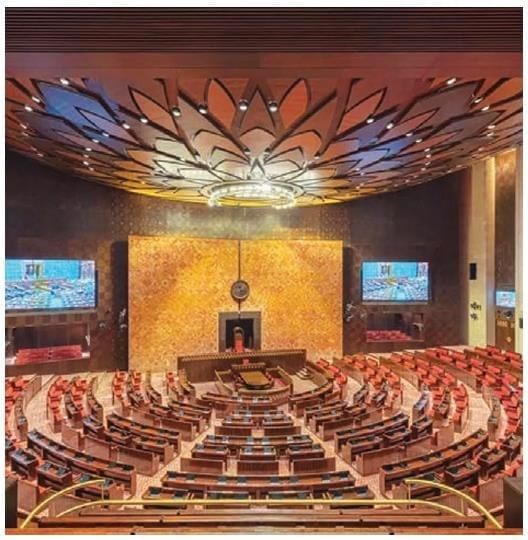 A view of the Chamber of the Rajya Sabha taken from the Press Gallery
 Q2: What are the key functions of the Parliament?
Ans: The Parliament performs several important functions:
1. Constitutional Function:
It protects the values of the Constitution, ensures democratic governance and federalism, and makes and amends laws that uphold Fundamental Rights and Directive Principles. The Parliament also performs duties such as electing certain constitutional office-holders and approving constitutional amendments.
2. Legislative Function:
It frames new laws, revises existing laws, and repeals laws that are no longer needed. Bills are debated and scrutinised before they become law to ensure they serve the public interest.
3. Financial Function:
It passes the Budget, authorises government spending and taxation, and examines how public money is raised and spent. Through financial scrutiny, Parliament controls and monitors the government's use of public funds.
4. Executive Control:
It oversees the work of the government using tools such as questions, debates, and discussions. This oversight keeps ministers accountable for their decisions and administration.
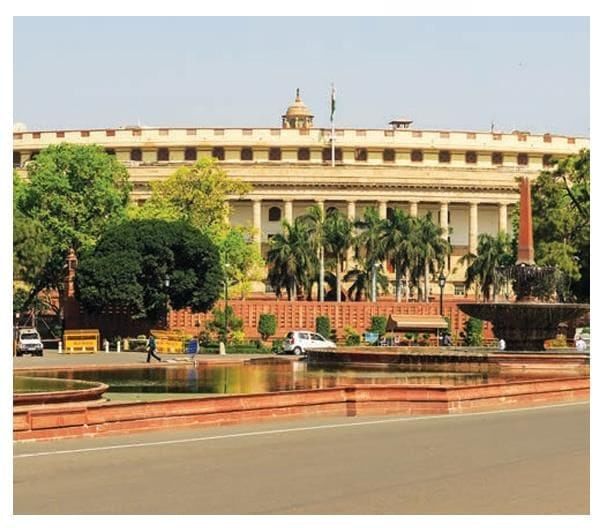 Our old Parliament (now called Samvidhan Sadan)
Q3: What are the roles of the legislature and the executive in India's Parliamentary democracy?
Ans: In India's Parliamentary democracy, the Legislature and the Executive have distinct but linked roles. The Legislature (Parliament) makes and amends laws, represents the people, debates public issues, and holds the Executive to account. The Executive (led by the Prime Minister and Council of Ministers) implements laws and runs the day-to-day administration of the country. Because ministers are members of Parliament, the Executive must explain and justify its actions in the House, remaining answerable to the Lok Sabha for its policies and decisions.
Q4: How are the legislature and the executive organised at the union and state levels?
Ans: India has a federal system in which both the Union and the States have their own legislature and executive. At the Union level, the legislature is bicameral, consisting of the Lok Sabha and the Rajya Sabha, together with the President. The Executive includes the President as Head of State, and the Prime Minister with the Council of Ministers who run the government. At the State level, the legislature may be unicameral or bicameral; the Executive includes the Governor, the Chief Minister and the Council of Ministers who are responsible to the State Assembly.
Page No. 145
Q1: (a) From your previous LET'S lessons on the theme of Democracy and Governance, name a few Constitutional functions of the Parliament. Did you list the election of President and Vice President?
Ans: The Parliament has several key constitutional functions. These include electing the President and the Vice-President, making and amending laws, approving the Budget, and supervising the Executive. Yes, the election of the President and Vice-President is an important parliamentary function and should be listed among these duties because Parliament takes part directly in choosing these office-holders.
(b) What about amendments to the Constitution?
Ans: The Parliament has the power to amend the Constitution. This allows it to change provisions of the Constitution to meet new needs or correct defects. Amendments follow the procedure prescribed in the Constitution and, in some cases, require approval by state legislatures as well. This power helps keep the Constitution relevant while preserving its basic framework.
Page No. 148
Let's Explore
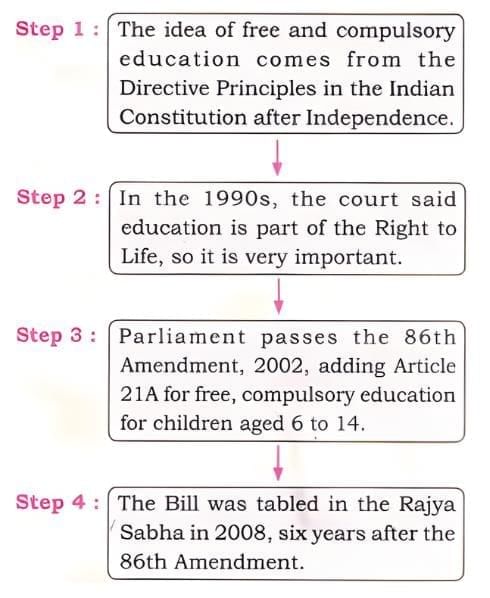
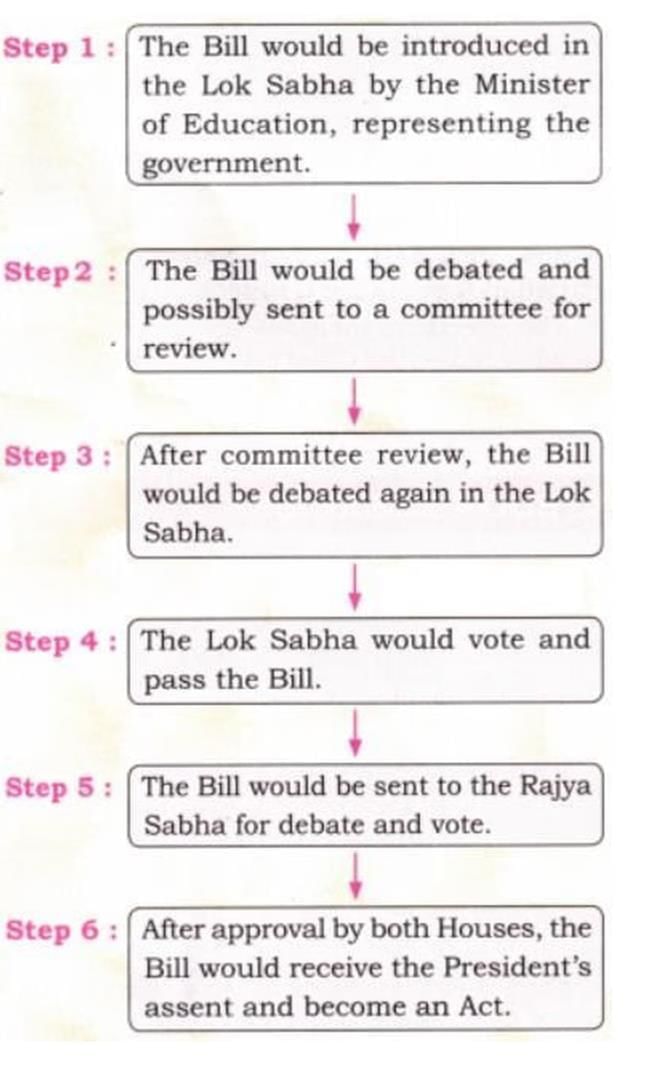
Q1: Draw a small chart to show the process of how RTE became an act. What do you think the process would be if RTE had been tabled in the Lok Sabha?
Ans: The Right to Education (RTE) Act became law through a step-by-step process in Parliament. Below is a chart showing how it became an Act.
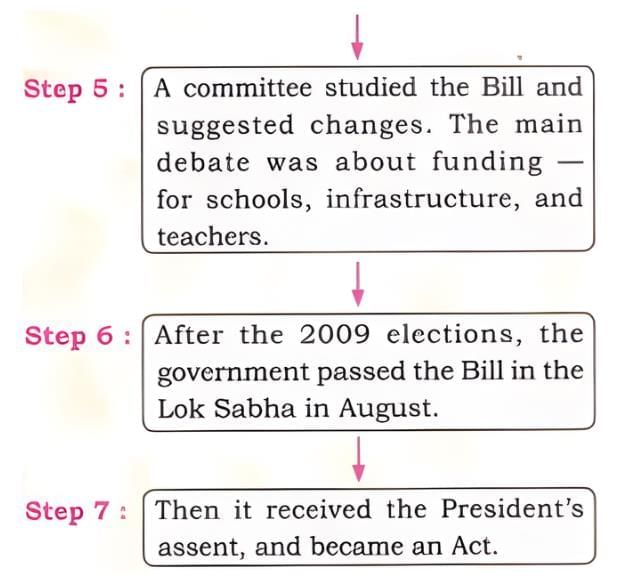
If it had been introduced in the Lok Sabha first:
Page No. 150
Let's Explore
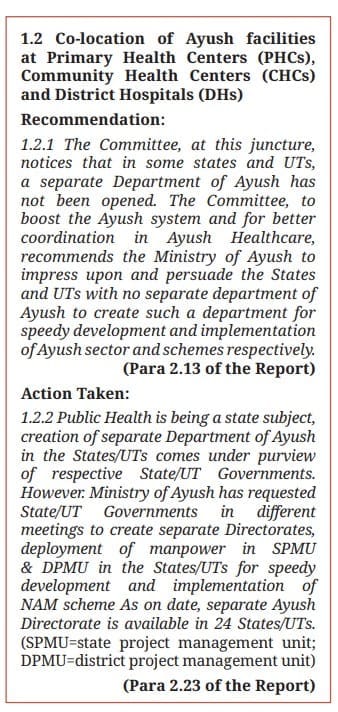
Q1: Given here is an extract from the report of meetings between the Standing Committee on Health and Family Welfare and the officers from the Ministry of Health and Family Welfare. Observe the screenshots above and discuss the following in small groups -
(a) Who is reporting to whom?
Ans: The officers of the Ministry of Health and Family Welfare are reporting to the Parliamentary Standing Committee on Health and Family Welfare. The Committee examines the Ministry's work, asks questions and makes recommendations to improve policy and implementation.
(b) What is the subject that has been reviewed?
Ans: The Committee reviewed the co-location of AYUSH facilities at Primary Health Centres (PHCs), Community Health Centres (CHCs) and District Hospitals, and the need for separate Departments of AYUSH in all States and Union Territories.
(c) Identify the Committee's recommendation.
Ans: The Committee recommended that States and Union Territories which do not have a separate Department or Directorate of AYUSH should create one. This would help better coordination, planning and faster implementation of AYUSH schemes at the state and district levels.
(d) What is the government's reply?
Ans: The Government replied that health is mainly a state subject, but noted that 24 States and Union Territories have already set up separate AYUSH Directorates. The reply indicates that the Centre expects states to take action while offering guidance and support where needed.
Page No. 151
Let's Explore
Q1: Why do you think that Parliament keeps an eye on government expenditure? (Hint: Whose money does the government spend?)
Ans: Parliament watches government spending because it uses public money collected through taxes. Parliament's oversight ensures that funds are spent for public services such as schools, hospitals and roads, and not wasted or misused. Through debates and questions and by examining the Budget, Parliament makes the government accountable, helps prevent corruption and ensures money is used for the benefit of citizens.
Don't Miss Out
Q1: Part V of the Indian Constitution begins with Chapter I - The Executive. It looks at the roles and responsibilities of the President, Vice President, and Council of Ministers, among others. It is in Chapter II that the role and functions of Parliament are listed. Why might this be so?
Ans: The Constitution begins with the executive because the Executive is central to running the government and carrying out laws. Placing the Executive first shows its role in administration. Chapter II then describes the role of the Parliament, which makes laws and supervises the Executive. This arrangement helps readers understand both how decisions are made and how they are to be implemented in practice.
Page No. 152
Let's Explore
Q1: If the Executive is part of the Legislature, how do we say that there is separation of power? (Hint: revisit the section on legislature above)
Ans: In India's parliamentary system, members of the Executive (the Prime Minister and ministers) are drawn from the Legislature, yet each organ has distinct functions. The Legislature makes laws and holds the government to account; the Executive implements laws; and the Judiciary interprets laws and checks constitutionality. Mechanisms such as Question Hour, debates, votes of no confidence and judicial review provide checks and balances that maintain separation of powers in practice.
Page No. 154
Q1: (a) What might happen if one of the organs Legislature, Executive, Judiciary had all the power?
Ans: If one organ held all power, democratic checks and balances would break down. This could lead to arbitrary rule, suppression of dissent, and erosion of citizens' rights and freedoms.
(b) How could it affect the rights of people?
Ans:
- If the Legislature had all the power, it could pass unfair laws without meaningful debate or protection for minorities.
- If the Executive ruled alone, decisions might favour a single party or leader and could ignore citizens' rights and fair procedures.
- If the Judiciary controlled everything, elected representatives would lose authority and democratic choice would be weakened.
In all cases, people's freedoms and equal treatment under the law would be at risk.
(c) Discuss with your classmates how each organ checks the others. For example, how does the Legislature question the actions of the Executive?
Ans: The Legislature checks the Executive through Question Hour, debates, no-confidence motions, parliamentary committees and by approving the Budget. Ministers must answer questions and explain policies in the House, so the Executive remains accountable for its actions.
(d) How does the Judiciary make sure that laws and government actions respect the Constitution?
Ans: The Judiciary reviews laws and government actions to ensure they conform to the Constitution. If a law violates constitutional provisions or fundamental rights, courts can strike it down or order changes. Judicial review protects citizens and maintains constitutional limits on power.
(e) Do you think there might be ways in which the actions of the Judiciary itself are reviewed?
Ans: Yes, the actions of the Judiciary can be reviewed. Though it is independent, if it goes beyond its powers, it can be checked by other branches. In cases of misconduct or corruption, judges can be impeached by Parliament. This ensures that the Judiciary remains fair, accountable, and within its limits.
Page No. 155
Q2: (a) Can you find examples where the Judiciary has asked lawmakers to review a law?
Ans: The Judiciary has often asked lawmakers to review or clarify laws. Some examples include:
- Motor Vehicles Act, 1988: In 2024, the Supreme Court clarified the type of driving licence required for certain transport vehicles under the LMV category and urged the Government to amend the law to remove confusion.
- Uniform Civil Code (UCC): The Supreme Court has emphasised the need for a Uniform Civil Code to promote equality and reduce legal differences across religions, asking lawmakers to consider reforms.
- National Judicial Appointments Commission (NJAC) (2015): The Supreme Court struck down the NJAC Act and recommended a review of the judicial appointment process to protect judicial independence.
- Right to Privacy (2017): The Supreme Court declared privacy a fundamental right and advised legislators to review laws such as the Aadhaar Act to address privacy concerns.
(b) Can you find any instances when the implementation of a law has been questioned by the Judiciary?
Ans: Yes. The Judiciary has frequently questioned government action where implementation of laws was weak or delayed.
- In 2013, the Supreme Court directed the government to ensure the Right to Information (RTI) Act was implemented effectively, noting delays and non-compliance by some departments.
- In 2016, the Court intervened to secure timely wage payments under MNREGA for rural workers where delays had been reported.
- In 2005, the Court ordered stronger steps to prevent pollution of the Ganga and Yamuna, enforcing environmental laws more strictly.
- In 1997, it stopped large-scale deforestation and directed proper implementation of the Forest Conservation Act.
Page No. 157
Let's Explore
Q1: What type of legislature does your state have?
Ans: (Suggestive Answer) I live in West Bengal, and it has a unicameral legislature. That means it has only one house, called the Vidhan Sabha or Legislative Assembly.
Page No. 158
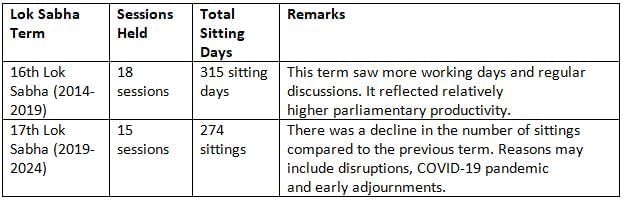
Q1: Study the data given in the following table. What conclusions can you draw about the functioning of Parliament over time? Compile data for more recent years.
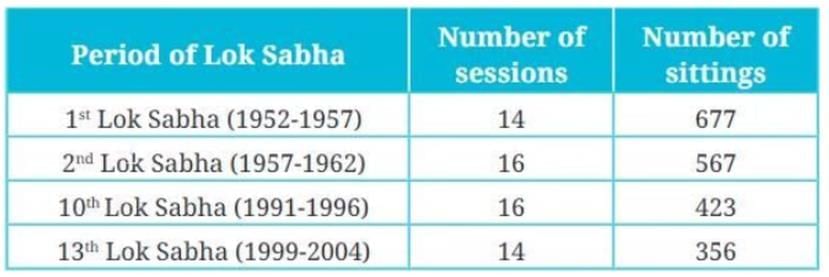
Ans: The data suggests a fall in the total number of sittings and the time Parliament spends in detailed discussion. For example, the 1st Lok Sabha held 677 sittings, which reduced in later years to 567 in the 2nd, 423 in the 10th and 356 in the 13th. This decline may mean less time is available for debate and scrutiny, which can affect the quality of law-making. To reach firmer conclusions, students should compile more recent figures and compare session lengths, the number of questions answered and bills examined.
Q2: Read the following statement of the former chairman of the Rajya Sabha, M. Venkaiah Naidu given in 2021: "...the productivity of Rajya Sabha during 200414 has been about 78% and it declined to about 65% since then. Of the 11 sessions [that he presided over], four of them clocked low productivity of 6.80%, 27.30%, 28.90% and 29.55%; during the year 2018, the Rajya Sabha recorded the lowest ever productivity of35.75% under the impact of disruptions."
(a) What conclusions can you draw from this statement?
Ans: The statement by M. Venkaiah Naidu shows that the productivity of the Rajya Sabha has declined over time. Between 2004-2014, it worked efficiently with about 78% productivity, but later it fell to around 65%, and some sessions were even below 30%. In 2018, productivity reached its lowest at 35.75% due to frequent disruptions. This shows that the Rajya Sabha is often unable to discuss and pass laws properly, which affects its effectiveness and reduces public trust in Parliament.
(b) What implications does this have for the role that the Rajya Sabha is expected to play?
Ans: The Rajya Sabha represents the states and helps maintain the federal balance in Parliament. When its productivity declines, important debates and discussions are reduced. This limits regional participation in national decision-making and may lead to laws being passed without enough review. Continuous disruptions also lower public confidence. A strong and active Rajya Sabha is important for a healthy democracy because it improves the quality of law-making and ensures accountability of the government.
Page No. 159
Q1: Take up a small group project. Compile data regarding the functioning of the legislature in your state or union territory.
Ans: I studied the West Bengal Legislative Assembly, which has a unicameral legislature with 294 elected members.
The main office bearers are the Speaker, Deputy Speaker, Chief Minister, Governor, and Leader of the Opposition.
Laws are made through steps such as bill introduction, discussion, voting, and Governor's approval.
Recent sessions discussed education, health, welfare schemes, and economic development.
The 2023 Budget Session focused on infrastructure and labour reforms.
Information was collected from the official Assembly website, news reports, and NCERT textbooks.
Q2: Seek an appointment with an MLA and gather information about challenges with respect to the state legislature.
Ans: After speaking with an MLA, I learnt the state legislature faces several challenges. Many members are absent during important debates, which reduces discussion quality. Frequent disruptions stop the House from working smoothly. Some bills get delayed because of lack of proper debate or consensus. Debates sometimes become too political and ignore public issues. The MLA said citizens, especially young people, should take more interest since their active participation can strengthen the legislature.
Page No. 160
Don't Miss Out
Q1: Atal Bihari Vajpayee, a former Prime Minister of India, said during a speech in the Lok Sabha, "Sarkaarein aayengi, jaayengi. Paartiyaan banengi, bigadengi. Lekin yeh desh rehna chaahiye, is desh ka loktantra amar rehna chaahiye."
(Governments will come and go , parties will rise and fall. But the nation must endure, and its democracy must live on.)
(a) What message do you think this gives about the role of Parliament and leaders in a democracy?
Ans: This remark stresses that leaders and parties should place the nation's interests and democratic values above short-term political gain. Parliament and its members must act responsibly, engage in constructive debate and protect democratic institutions so that the nation and its democracy endure through changes of government.
(b) Why is it important to protect democratic values even when political power changes?
Ans: Protecting democratic values ensures stability, rule of law and citizens' rights regardless of who holds power. Even when governments change, democratic norms such as free debate, accountability and respect for rights preserve public trust and prevent misuse of authority. This continuity allows the nation to progress and protects minorities and the vulnerable.
Page No. 161
Questions and Activities
Q1: Find out how many representatives from your state are in each House of the Parliament.
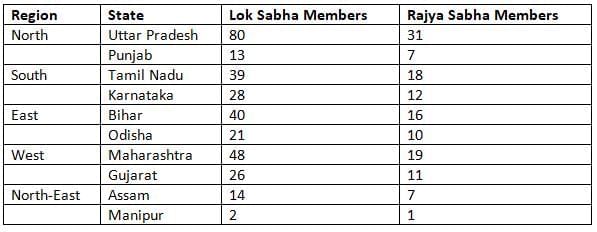
Ans: (Suggestive Answer) Every state in India has representatives in both Houses of Parliament. In my state, Uttar Pradesh, there are 80 members in the Lok Sabha. These members are directly elected by the people. There are also 31 members from Uttar Pradesh in the Rajya Sabha. These members are elected by the state legislators. So, Uttar Pradesh has 80 representatives in the Lok Sabha and 31 in the Rajya Sabha. This shows how important my state is in making laws and decisions for the country.
For reference, the number of representatives from other states are also given below:
Q2: What makes the Indian Parliament the "voice of the people"? How does it ensure that different opinions are heard?
Ans: The Indian Parliament is called the "voice of the people" because it represents citizens from all parts of the country. Members of the Lok Sabha are directly elected by the people, and members of the Rajya Sabha are chosen by state legislatures. This combination ensures that a wide range of regional and public views are included in national decision-making.
Parliament ensures that different opinions are heard through:
- Question Hour, where MPs ask the government about its work.
- Debates and discussions on bills and national issues.
- Parliamentary Committees, which study laws and policies in detail before they are passed.
Q3: Why do you think the Constitution made the Executive responsible to the Legislature?
Ans: The Constitution made the Executive (Prime Minister, ministers, and officials) responsible to the Legislature (Parliament) so that the government remains accountable to the people. This system prevents the misuse of power and ensures that leaders work within their limits. Ministers must explain their actions and decisions in Parliament, making the government transparent and answerable. This relationship between the Executive and the Legislature helps to protect democracy and ensures that the government always serves the people's interests.
Q4: Why do you think we have chosen the system of bicameral legislature at the Union level?
Ans: India adopted a bicameral legislature at the Union level to balance direct popular representation with state representation. The Lok Sabha reflects the will of the people through direct elections, while the Rajya Sabha represents states and safeguards regional interests. A two-house system allows more thorough discussion and review of laws, which is useful in a large and diverse country.
Q5: Try to track the journey of a recent bill passed by the Parliament. Identify in which House it was introduced. Were there any major debates or disagreements? How long did it take for the bill to become a law? Use newspaper archives, government websites, and Lok Sabha debates, or ask your teacher for help.
Ans: (Suggestive Answer) The Women's Reservation Bill, which reserves 33% of seats for women in the Lok Sabha and State Assemblies, had a long journey. It was first introduced in 1996 but faced many delays. The Bill was reintroduced in the Lok Sabha on 19th September 2023 and passed on 21st September 2023 with 454 votes in favour. The Rajya Sabha also passed it on the same day. Finally, it received the President's assent on 28th September 2023, becoming the Constitution (106th Amendment) Act, 2023. It took 27 years for this Bill to become a law, showing the long struggle for women's political representation.
Q6: Choose a recent law passed by the Parliament. Divide into teams to role-play different parts of the process - MPs debating in Lok Sabha and Rajya Sabha, ministers answering questions, and the President giving assent. Present a short skit showing how a bill becomes a law; enact a 'model Parliament'.
Ans: Model Parliament Skit: How the Women's Reservation Bill Becomes a Law.
- Characters:
- Speaker of the Lok Sabha
- Law Minister
- Supportive MP
- Opposition MP
- President
- Scene: Lok Sabha (Lower House)
- Speaker: Honourable Members, we will now discuss the Women's Reservation Bill, which proposes reserving 33% of seats for women for the Lok Sabha and State Assemblies.
- Law Minister: This bill will increase women's participation in politics. I request everyone's support.
- Supportive MP: I strongly support this bill! Women must have equal represent.
- Opposition MP: I agree, but we ensure proper implementation in all regions.
- Speaker: All in favour, say Aye!
- All MPs (except a few): Aye
- Speaker: The Bill passes in the Lok Sabha. Now, it goes to the Rajya Sabha.
- Scene: Rajya Sabha (Upper House)
- Rajya Sabha Speaker: The Women's Reservation Bill is now being discussed.
- Supportive MP: This bill is essential for a stronger democracy!
- Opposition MP: Honourable Speaker, we support the bill, but we believe it should include more details on how women from all backgrounds will benefit, especially in rural areas.
- Speaker: All in favour, say Aye!
- Most MPs: Aye!
- Rajya Sabha Speaker: The Bill passes. We now send it for Presidential assent.
- Scene: The President's Assent
- President: I have received the Women's Reservation Bill and after review, I give my assent.
- President: The Women's Reservation Bill is now a law.
Q7: The Women's Reservation Bill, 2023, was passed with wide support. Why might it have taken over 25 years for this bill to be passed, despite being discussed for so long?
Ans: The Women's Reservation Bill, 2023 took 25 years to pass for several reasons:
- Political parties differed about the reservation structure. Some asked for sub-reservation for women from OBCs within the 33% quota, while others opposed this change.
- Reserving seats for women meant some existing members would lose their seats, creating resistance within parties and among incumbents.
- Although no major party openly opposed the bill finally, there was a lack of consistent political will over the years to make it a priority; it was often treated as a long-term promise rather than an urgent legislative task.
Q8: Sometimes the Parliament is disrupted and does not function for the number of days it is supposed to. What impact do you think this has on the quality of laws and the trust people place in their representatives?
Ans: When Parliament is frequently disrupted, it reduces the time available for careful debate and detailed examination of bills. Important laws may be passed without full discussion, lowering their quality. Repeated disruptions also make citizens lose faith in their representatives and waste public resources. Over time, this weakens democratic institutions and discourages public engagement in politics.
In the long run, frequent disruptions slow down the country's progress and reduce respect for democratic institutions.
Q9: Can you create 'interest' groups among students and list questions related to any policy that you may want to ask your MP and/or your MLA? How would these questions be different if it were the MP instead of the MLA, and vice versa?
Ans: As students, we care about education, jobs and the environment. We divided the class into two groups: Group A and Group B.
Group A focused on national issues and prepared questions to ask our MP (Member of Parliament):
- Education: What is the central government doing to make higher education more accessible and affordable for students across the country?
- Jobs: What steps are being taken to create better job opportunities for young people in various sectors?
- Environment: What national-level actions are being taken to reduce pollution and protect natural resources?
Group B focused on local and state issues and prepared questions to ask our MLA (Member of Legislative Assembly):
- Education: What is being done to improve the quality of education in government schools and colleges in our area?
- Jobs: How is the state government helping to create more jobs for young people in our locality?
- Environment: What local steps are being taken to reduce pollution and make our surroundings more eco-friendly?
The questions differ because MPs address national policies while MLAs focus on state and local matters. Asking the right representative helps get clearer and more useful answers.
Q10: What is the role that the Judiciary plays in Indian democracy? What could happen if we didn't have an independent judiciary?
Ans: The Judiciary protects the Constitution and citizens' rights. It interprets laws, ensures government actions follow the Constitution and resolves disputes between individuals and the state or between different levels of government. Judicial review allows courts to strike down laws that violate constitutional principles. Without an independent judiciary, laws and decisions could become biased, citizens' rights would be at risk, and there would be little check on arbitrary or unlawful actions by the government, weakening democracy.
FAQs on NCERT Solutions: The Parliamentary System: Legislature and Executive
| 1. What's the difference between the legislature and executive in India's parliamentary system? |  |
| 2. How does the Prime Minister's role work in the parliamentary system for CBSE Class 8? | |
| 3. Why can't the executive function independently from the legislature in parliamentary democracy? | |
| 4. What happens if the executive loses majority support in Parliament according to NCERT parliamentary system notes? | |
| 5. How do ministers and departments fit into the structure of legislative and executive branches? | |