Unit Test (Solutions): Lines & Angles

Time: 1 hour
M.M. 30
Attempt all questions.
Question numbers 1 to 5 carry 1 mark each.
Question numbers 6 to 8 carry 2 marks each.
Question numbers 9 to 11 carry 3 marks each.
Question numbers 12 & 13 carry 5 marks each.
Q1: What is the measure of a straight angle? (1 Mark)
(a) 90°
(b) 180°
(c) 360°
(d) 0°
Ans: (b)
Q2: If two angles are complementary, their sum is: (1 Mark)
(a) 90°
(b) 180°
(c) 360°
(d) 45°
Ans: (a)
Q3: When two lines intersect, how many pairs of vertically opposite angles are formed? (1 Mark)
(a) One
(b) Two
(c) Three
(d) Four
Ans: (b)
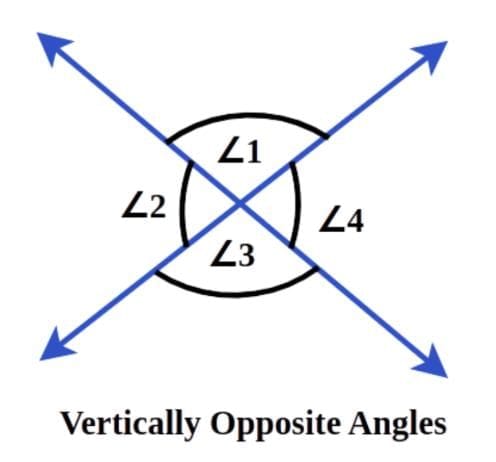
Q4: If a ray stands on a line, the sum of the two adjacent angles formed is: (1 Mark)
(a) 90°
(b) 180°
(c) 270°
(d) 360°
Ans: (b)
Q5: Lines parallel to the same line are: (1 Mark)
(a) Intersecting
(b) Parallel to each other
(c) Perpendicular
(d) Non-collinear
Ans: (b)
Q6. If two lines AB and CD intersect at O, and ∠AOC = 40°, find the measure of the vertically opposite angle ∠BOD. (2 Marks)
Ans: Vertically opposite angles are equal.
∠BOD = ∠AOC = 40°
Q7. The two complementary angles are in the ratio 1 : 5. Find the measures of the angles. (2 Marks)
Ans: Let the two complementary angles be x and 5x.
∴ x + 5x = 90°
⇒ 6x = 90°
⇒ x = 15°
Hence, the two complementary angles are 15° and 5 × 15° i.e., 15° and 75°.
Q8. If an angle is 14° more than its complement, then find its measure. (2 Marks)
Ans: Let the required angle be x
∴ Its complement = 90° - x
Now, according to given statement, we obtain
x = 90° - x + 14°
⇒ 2x = 104°
⇒ x = 52°
Hence, the required angle is 52°.
Q9. If an angle is half of its complementary angle, then find its degree measure. (3 Marks)
Ans: Let the required angle be x.
∴ Its complement = 90° - x
Now, according to given statement, we obtain
x = 1/2 (90° - x)
⇒ 2x = 90° - x
⇒ 3x = 90°
⇒ x = 30°
Hence, the required angle is 30°.
Q10. If AB || EF and EF || CD, then find the value of x. (3 Marks)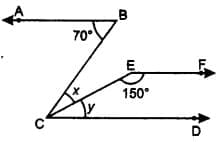
Ans: Since EF || CD ∴ y + 150° = 180°
⇒ y = 180° - 150° = 30°
Now, ∠BCD = ∠ABC ( Since AB || EF and EF || CD, So AB || CD)
x + y = 70°
x + y = 70°
x + 30 = 70
⇒ x = 70° - 30° = 40°
Hence, the value of x is 40°.
Q11. In the given figure, PQ || RS and EF || QS. If ∠PQS = 60°, then find the measure of ∠RFE. (3 Marks)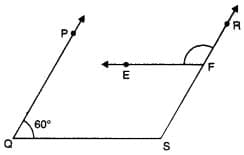
Ans: Since PQ || RS
∴ ∠PQS + ∠QSR = 180°
⇒ 60° + ∠QSR = 180°
⇒ ∠QSR = 120°
Now, EF || QS ⇒ ∠RFE = ∠QSR [corresponding ∠s]
⇒ ∠RFE = 120°
Q12. In the figure, lines AB and CD intersect at O. If ∠AOC + ∠BOE = 70° and ∠BOD = 40°, find ∠BOE and reflex ∠COE. (5 Marks)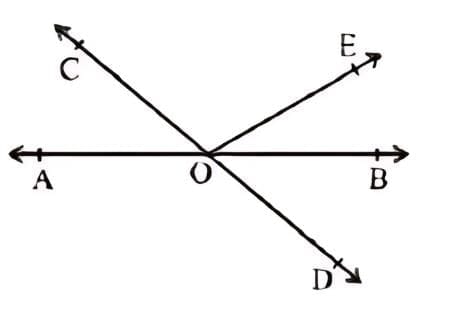
Ans: From the given figure, we can see;
∠AOC, ∠BOE, ∠COE and ∠COE, ∠BOD, ∠BOE form a straight line each.
So, ∠AOC + ∠BOE +∠COE = ∠COE +∠BOD + ∠BOE = 180°
Now, by substituting the values of ∠AOC + ∠BOE = 70° and ∠BOD = 40° we get:
70° +∠COE = 180°
∠COE = 110°
Similarly,
110° + 40° + ∠BOE = 180°
∠BOE = 30°
Q13. In the Figure, POQ is a line. Ray OR is perpendicular to line PQ. OS is another ray lying between rays OP and OR. Prove that ∠ROS = 1/2(∠QOS - ∠POS). (5 Marks)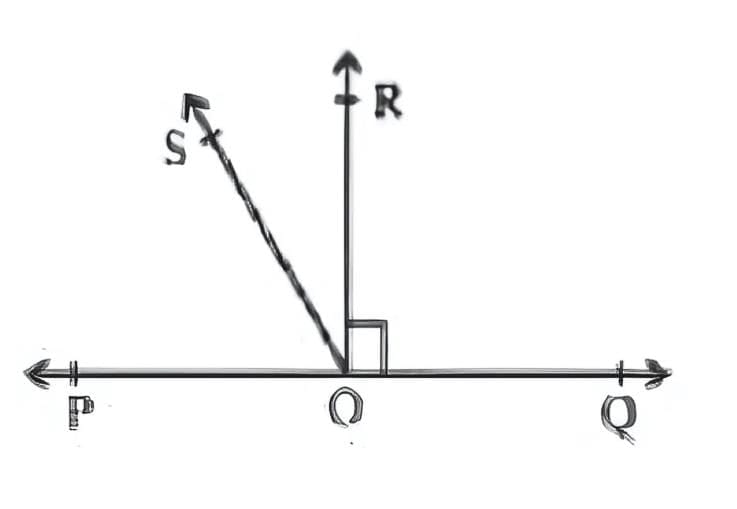
Ans: In the question, it is given that (OR ⊥ PQ) and ∠POQ = 180°
So, ∠POS + ∠ROS + ∠ROQ = 180° (Linear pair of angles)
Now, ∠POS + ∠ROS = 180° - 90° (Since ∠POR = ∠ROQ = 90°)
∴ ∠POS + ∠ROS = 90°
Now, ∠QOS = ∠ROQ + ∠ROS
It is given that ∠ROQ = 90°,
∴ ∠QOS = 90° + ∠ROS
Or, ∠QOS - ∠ROS = 90°
As ∠POS + ∠ROS = 90° and ∠QOS - ∠ROS = 90°, we get
∠POS + ∠ROS = ∠QOS - ∠ROS
⇒=>2 ∠ROS + ∠POS = ∠QOS
Or, ∠ROS = 1/2 (∠QOS - ∠POS) (Hence proved).
FAQs on Unit Test (Solutions): Lines & Angles
| 1. What are the basic types of angles studied in Class 9 geometry? |  |
| 2. How do complementary and supplementary angles differ? | |
| 3. What is the significance of the angles formed when two lines intersect? | |
| 4. Can you explain the concept of parallel lines and the angles formed when they are crossed by a transversal? | |
| 5. What is the importance of angle properties in real-life applications? | |